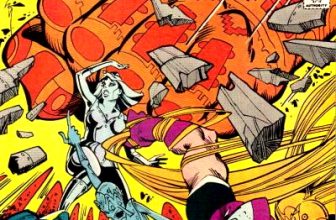
X-Men #97 (February, 1976) | Attack of the 50 Year Old Comic Books


Re-reading the early issues of the revived, “All-New, All-Different” X-Men title for the first time in decades, your humble blogger has found himself struck not only by how quickly writer Chris Claremont — still a relative neophyte in 1975 — made the book his own, but also by how enduring many of the concepts and characters he introduced in the first half-dozen or so of the stories he wrote on his lonesome (the first two issues under his byline, #94 and #95, had of course been plotted by his predecessor, Len Wein) have ultimately proven to be. Half a century on, it’s hard to imagine what the X-books — or maybe even the Marvel Universe, period — would look like, had neither Moira MacTaggart nor the Shi’ar (to name two of the most prominent examples), ever existed.

Cover to X-Men #96 (Dec., 1975). Art by… let’s go with “various”.
That said, not everything that Claremont threw at the wall in the way of mutant mythos-building early on stuck — nor was every individual story a straight-up winner. As a case in point, let’s take Claremont’s first more-or-less solo flight as writer, X-Men #96, which features the done-in-one “Night of the Demon” (I say “more-or-less” based on a credit given on the splash page to Bill Mantlo for a “welcome plotting assist”). Produced in collaboration with artist Dave Cockrum (with Sam Grainger on inks), the story pits the titular heroes against the N’Garai — demonic “Elder Gods” whom Claremont had created for one of his earliest pro comics writing assignments (in Giant-Size Dracula #2 [Sep., 1974]) — but who frankly seemed rather superfluous in a Marvel Universe that already seemed to have the Lovecraftian angle pretty well covered via the Undying Ones, Shuma-Gorath, and so on. While I won’t try to convince you that the N’Garai had no juice whatsoever (a look at their page at the Appendix to the Handbook of the Marvel Universe would put the lie to such an assertion pretty quickly), I think it’s safe to say that as X-villains, they’ve never been more than “C”-list at best. And even if their later track record had proved more impressive, this particular outing still wouldn’t be all that memorable — at least, not for this reader.
On the other hand, there are other significant developments in this issue which are worth noting before we move on to the ostensible main topic of this post (i.e., X-Men #97) — beginning with the introduction of an important new supporting character whose name we’ve already dropped above…

Along with being both a good bit younger and easier on the eyes than Sean “Banshee” Cassidy was expecting, Moira MacTaggart offers yet another surprise to her fellow Gael, further on in the story, when she throws herself into the middle of the X-Men’s fight against a big, bad N’Garai named Kierrok and sprays the demon with machine-gun fire. “A nice widder-woman,” indeed.
Well before that happens, however, we have the following scene, which sets up a near-future storyline that’ll kick off properly in X-Men #98, and culminate in the book’s milestone 100th issue…


Gee, that big purple leg in the last panel above looks kind of familiar, doesn’t it? If Dr. Steven Lang’s references to Bolivar Trask and his son earlier on the page hadn’t already given the game away, this visual clue clinches it: the Sentinels are back.
We now turn to the story’s “A”-plot, if only briefly, for another couple of developments that will prove to have long-term significance. To set the scene: after having inadvertently released Kierrok of the N’Garai from a stone structure in the woods near Professor Xavier’s School for Gifted Youngsters, the X-Men manage to hold the attacking demon-god at bay… but only just, and only for the moment. Along the way, we have this dramatic interaction between Kierrok and Wolverine:


Coming on the heels of a moment earlier in the issue where, while training in the Danger Room, Wolverine had almost disemboweled Nightcrawler, this scene establishes not only Wolvie’s tendency to occasionally lapse into berserker rages, but also his personal ambivalence as to whether that should be considered a bug or a feature.
Unfortunately, despite Wolverine’s very thorough shredding of Kierrok, the N’Garai gets better almost immediately, and the battle is rejoined. So Prof X sends Storm out to cut the demon’s power off at its source, by sealing up the very same stone structure (Claremont’s script calls it a “cairn”, but “obelisk” seems more appropriate to what Dave Cockrum has drawn) that Cyclops earlier shattered with his eyebeams while agonizing about the death of Thunderbird in the finale of X-Men #95 (that’s right, this whole mess is basically Cyke’s fault)…


Storm’s dramatic action takes care of the menace, sending Kierrok as well as the other demons back to their nether-dimension. But as to the meaning of her sudden, panicked feeling of entrapment, and its accompanying visions of her childhood, both the weather-worker and we readers would have to wait until issue #102 — which, thanks to X-Men‘s bimonthly publishing schedule, wouldn’t be out until September, 1976 (which of course means that this blog’s discussion of the Secret Origin of Storm That Was Never Intended by Her Co-Creators will have to wait until September of 2026, or thereabouts).
“Night of the Demon!” ends with another bit of foreshadowing…

Colonel Michael “Mickey” Rossi would seem to be the very model of a throwaway character — someone introduced briefly into a storyline to move the plot forward a tad, and then forgotten about by the writer as quickly as they are by the reader. For whatever reason, however, Chris Claremont didn’t forget Col. Rossi; a couple of years later, he’d use him in flashbacks in Ms. Marvel to build out the backstory of Carol Danvers, and then, sometime after that, bring him back into present-day X-continuity in the pages of New Mutants #2 (Apr., 1983), revealing along the way that he (obviously) hadn’t actually died in that crash in X-Men #96, after all. You never know, I guess.
We now come to X-Men #97, whose cover by Rich Buckler and Dave Cockrum (hey, thanks for signing your names, guys!) gives me strong Neal Adams vibes — and whose first-page credits box indicates that Chris Claremont is finally flying completely solo…

…though, having said that, I don’t want to understate the importance of Dave Cockrum’s contribution to these early Claremont X-Men stories, as the artist’s visual imagination made us want to see more of the new characters and other plot elements being introduced herein, whereas a less creative illustrator might not have piqued our curiosity quite as sharply. I mean, just look at these ships…!


And here we get our first glimpse of another new character who’ll ultimately loom at least as large in X-lore as Moira MacTaggart: the Shi’ar empress, Lilandra — albeit we only get to see her through a glass darkly, as it were. It’ll be another seven issues (or fourteen months) before we get a decent enough look through her spacesuit’s insectoid faceplate to guess that she’s (probably) female — and another two-month wait beyond that before Charles Xavier actually meets his future lady-love face-to-face. Chris Claremont was playing a long game… but if one was willing to wait, one’s patience would be rewarded. (Well, usually, anyway.)

“I had no right to ask you, not after…” Again, Claremont teases us with a mystery that won’t pay off for some time to come… years, in this case.


For the record, this is the first time that Lorna Dane (first introduced back in X-Men #49 [Oct., 1968]) has gone by the name “Polaris”. And — despite her obviously being mind-controlled at this particular moment — it’s one she’ll keep, long after the present storyline concludes.

Yep, even Charles Xavier was cracking Jaws jokes in late 1975.
Meanwhile, although Jean Grey had seemed to make a pretty big deal of kissing Scott “Cyclops” Summers goodbye when she moved out of the X-mansion back at the beginning of X-Men #94, it sure doesn’t seem like she’s gone very far, does it? It’s also interesting to note that the arrival of the former (?) Marvel Girl on the scene, coming on top of the return of Alex Summers and Lorna Dane to these pages, makes for the inclusion in this issue of every character who’s ever been a regular member of the X-Men team — with, of course, the notable exceptions of the three currently ensconced with other super-teams (i.e., the Beast with the Avengers, and Angel and Iceman with the Champions). It feels rather like Claremont and Cockrum didn’t want to let anyone go, if they could possibly help it.

This was the first appearance of “Tony Stark’s image inducer” — obviously a very handy gadget, although Kurt “Nightcrawler” Wagner ended up not using it all that much after a year or two. In the words of Dave Cockrum, “we just sort of went for a blue-is-beautiful-and-to-hell-with-you-guys attitude.” (See The X-Men Companion: I [1981], p. 55.)
Oh, and the “1930’s movie star” Kurt is intended to look like here is Errol Flynn.

For the record, poor Alex Summers’ long-established superhero moniker, “Havok”, gets misspelled as “Havoc” throughout this issue. Oh, well…

Knocked off his feet by Alec and Lorna’s combined powers, Scott tells his teammates to get after them before they can reach Professor X. The X-Men dutifully spring into action, but even as they do, Havok takes aim at the swiftly taxiing airplane carrying the mutants’ mentor…


Cover to X-Men #52 (Jan., 1969). Art by Marie Severin and Joe Sinnott.
Eric the Red — or, as it was originally spelled, Erik the Red (the letter “k” just couldn’t catch a break this issue, it seems) — was indeed a false identity briefly assumed by Cyclops back in X-Men #51 (Dec., 1968) and #52 (Jan., 1969), all for the purpose of hoodwinking two of the team’s foes, Magneto (actually just an android replica, but never mind that now) and Mesmero. So who is this new Erik, and why has he adopted this obscure old guise of Scott Summers? While the first of those questions will be answered several issues from now, the second never will be, as best as I can tell — at least not “in-story”. (The real-world answer may be assumed to have something to do with either Chris Claremont or Dave Cockrum, or maybe even both, thinking that the character’s name and costume were too cool to leave as a mere historical footnote.)

Dazed, Storm just barely manages to shake off the effects of Polaris’ blast in time to catch the unconscious Jean Grey; after depositing her charge safely on a rooftop, she changes into her costume before returning to the fray…

Havok quickly recovers and fires off a blast that hits the wall behind Cyclops, causing it to fall on top of him. Horrified, Alec rushes to his brother’s aid — but Scott, who’s unharmed, reluctantly takes advantage of the moment to punch Alec while he’s off-guard. Meanwhile, Colossus and Nightcrawler attempt to double-team Erik the Red…

Two issues earlier, in the climax of X-Men #95, the team had lost one of their number, John “Thunderbird” Proudstar, when the plane he was hanging onto exploded in midair. Colossus getting crushed by the wing of a grounded plane might not be exactly the same thing, but it’s surely close enough to justify the script’s reference to déjà vu.


In the next few moments, several things happen very quickly. Racing to the fallen Lorna’s side, Alec finds her dazed, but not, it seems, seriously hurt. Next, reinforcements for our heroes arrive, as an aircraft bearing Wolverine and Banshee descends to the tarmac. Guessing that Prof. X must have summoned the newcomers mentally, Erik the Red abruptly decides that this day is not going to go his way after all — and, gathering the still-enthralled Havok and Polaris in his arms, he takes to the skies.


And so concludes our narrative… if only for the moment (or, more accurately, for the next couple of months).
We’ll close with a couple of observations about this issue’s last panel. The first, and more general one, is that it’s another signifier of how Chris Claremont chose to play a long game in X-Men from the very beginning of his tenure as the series’ writer, as he interlaced seemingly disparate plot threads in a manner that suggested connections between them — connections that might, or might not, ultimately come to fruition. The second, more specific one has to do with the fact that, according to testimony offered by Claremont himself in The X-Men Companion: I, the writer didn’t actually come up with the idea of the screen-within-a-screen visual in the first place; rather, “for no reason whatsoever, Dave, at the end of #97, threw in that shot of the bug people monitoring Lang, who was monitoring the X-Men.”
And, perhaps for the very reason that it hadn’t been his own idea (but, also, perhaps not), Claremont never got around to officially confirming the identity of that red-clad, bug-insignia wearing hand in any later script; and so, while several later fan-compiled references will authoritatively tell you that X-Men #97 features the first, cameo appearance of D’ken Neramani, that’s based almost entirely on circumstantial evidence.
As readers who stuck with the “New X-Men” for the long haul would discover, this, too, would be a marker of Claremont’s tenure. In playing the long game, the writer generally seemed to have a pretty good idea where he was going — or, if he didn’t know at first, he figured it out along the way in a manner that would ultimately prove satisfying to his readers (most of them, anyway). That said, given his propensity for keeping a lot of balls in the air at once — often for an extended period of time — it was perhaps inevitable that he’d drop a few, here and there… as we’ll see in the months and years to come.