Univity achieves first in-orbit 5G NTN TDD connection via mmWave link ⋆ Electronics Weekly

Univity has announced the success of uniSpark, its first in-orbit technology demonstration mission and claims it as a world’s first, paving the way for new spectrum resources for satellite communications.
The French satellite communications company established a fully bidirectional 5G NTN (Non-Terrestrial Network) connection between a ground terminal and a 5G base station onboard a satellite in orbit. And the company describes this as the first in-orbit demonstration combining onboard regenerative 5G processing, a millimeter-wave (mmWave) link and Time Division Duplexing (TDD) operation.
Extending networks
The milestone, highlights the company, brings it closer to its aim of enabling telecom operators to extend their networks from space while maintaining control of their infrastructure.
“With uniSpark, we are moving from technological promise to proof in orbit,” said Charles Delfieux, Founder and CEO of Univity. “We have demonstrated our ability to operate technologies derived from terrestrial 5G in millimeter-wave frequency bands in a real space environment.”
“This is a decisive step toward our ambition: to develop, alongside telecom operators, a space infrastructure that enables them to extend their networks beyond the limits of the ground. Space can finally become a natural extension of terrestrial 5G networks.”
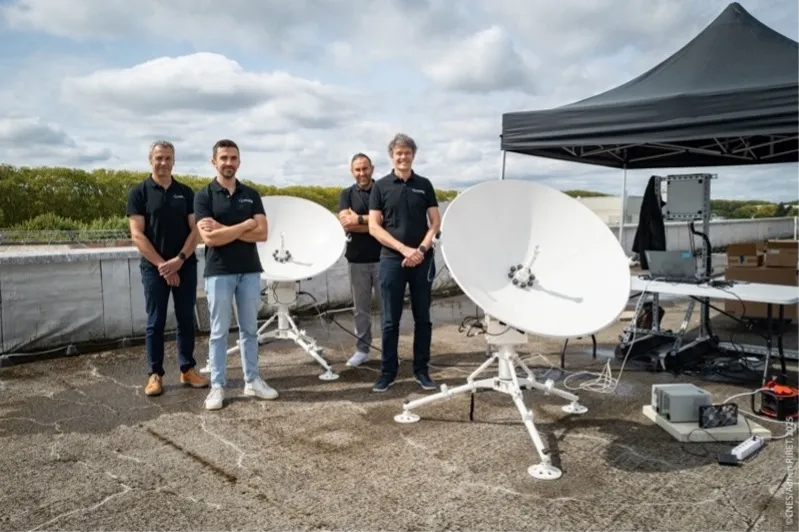
The demonstration was conducted from a CNES site in Toulouse as part of a program supported by France 2030.
Terrestrial 5G
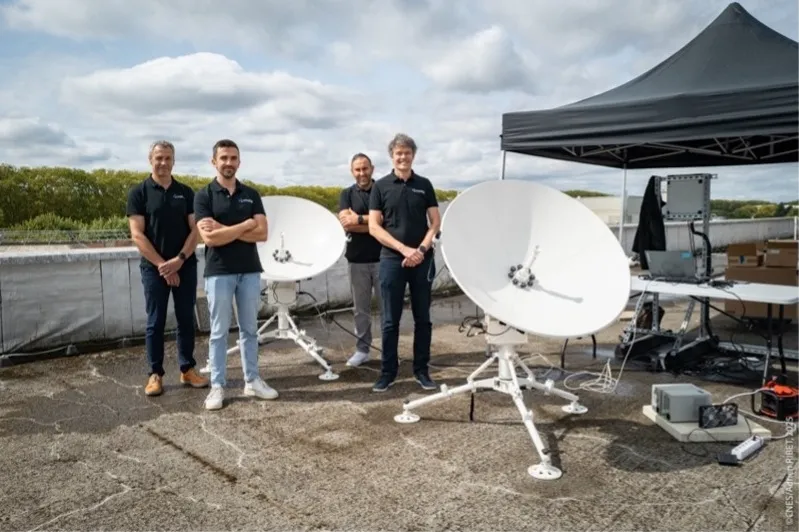
The company says the use of TDD in mmWave frequencies lies at the heart of its technological approach. Unlike a conventional Frequency Division Duplexing (FDD) architecture, which typically uses two separate spectrum resources for transmission and reception, TDD enables the same spectrum resource to be shared over time between uplink and downlink communications, it points out. And the millimeter-wave 5G bands used by terrestrial telecom operators operate precisely in TDD mode.
“By demonstrating that this architecture can operate in an orbital environment, Univity validates an important step toward its objective,” added Laurent Bouscary, CTO of the company.
“Beyond the performance of the link itself, this demonstration confirms the possibility of building a satellite infrastructure that relies extensively on technologies and developments derived from terrestrial 5G, rather than recreating an entirely separate ecosystem.”
First phase
Laurence Clarac, Head of Innovative Concepts and Satcom Applications at CNES, the French national space agency, said:
“By hosting the ground equipment for the demonstration, CNES contributed to the success of these in-orbit tests. This major milestone marks the completion of the first phase of Univity’s roadmap. It will be followed by a 5G service demonstration project, supported by CNES under the France 2030 program and signed in August 2025.”
Connectivity
“We are building the reference space infrastructure designed for telecom operators, covering the full range of connectivity needs — from ultra-high-speed broadband to direct-to-smartphone connectivity,” said Delfieux, previously.
“The convergence between terrestrial and space networks is inevitable. Our ambition is to enable operators to leverage space as a natural extension of their terrestrial 5G networks, combining performance, competitiveness, and sovereignty.”
Image: (top) Univity /Hugo Breams – uniSpark payload (bottom) CNES, the French national space agency – Univity’s antennas team in Toulouse 2025