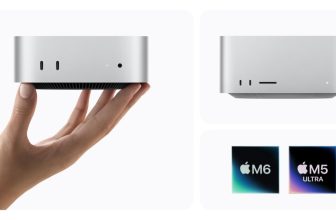
Both Studio models also come with nearly all the same ports. On the back, you’ll find four 120Gbps Thunderbolt 5 ports, a 10Gbps Ethernet port, an HDMI 2.1 port, and a pair of 5Gbps USB-A ports. On the front, both Studios have a UHS-II SD card reader, but the Max comes with two 10Gbps USB-C ports, and the Ultra comes with two more 120Gbps Thunderbolt 5 ports.
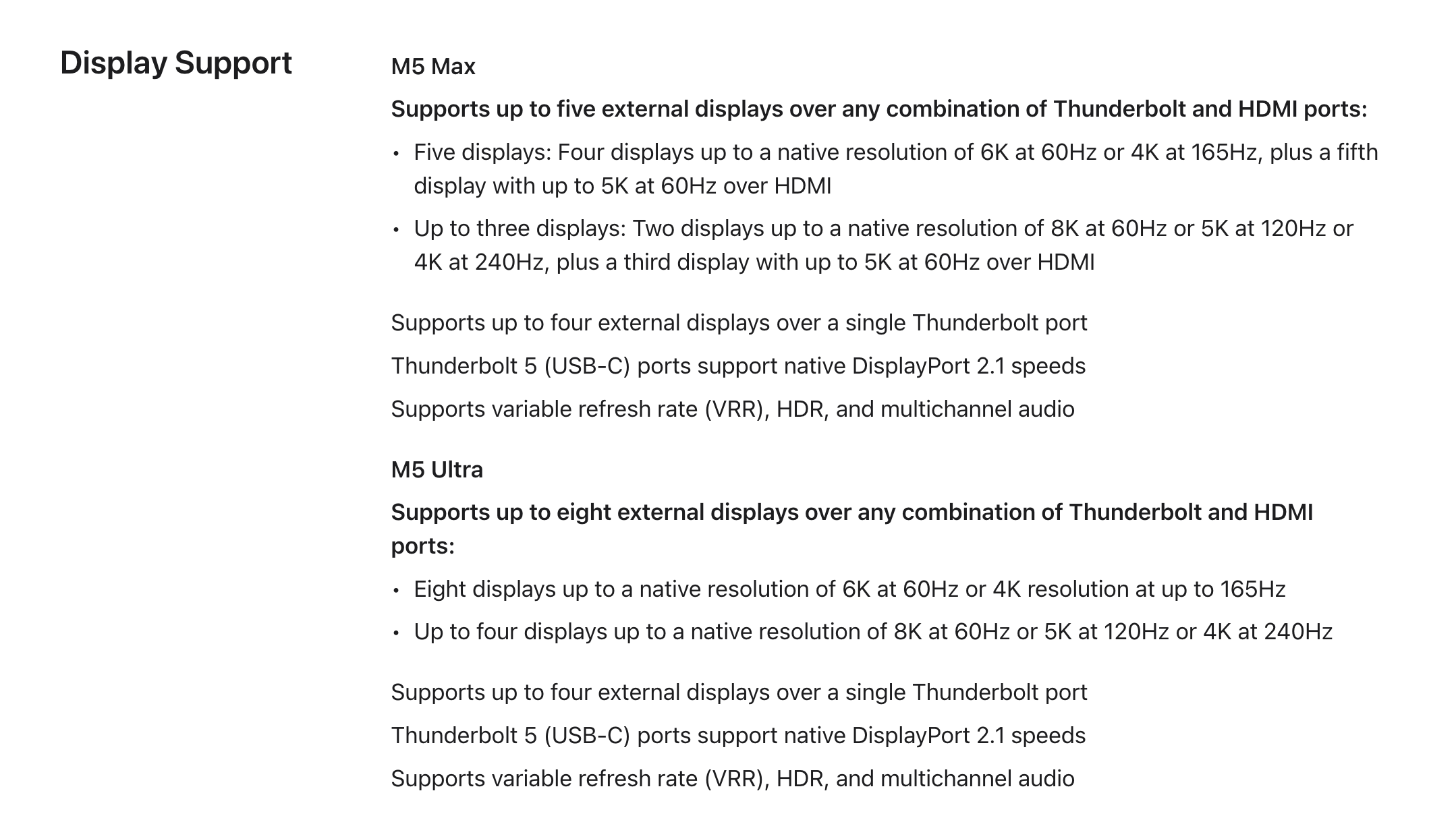
The Ultra’s additional oomph extends to external display support. The M5 Max supports up to five external displays, and the M5 Ultra supports up to eight, though both come with caveats depending on the resolution and refresh rates you’re using.
Credit:
Apple
Display support details for the M5 Max and M5 Ultra Mac Studios.
Credit:
Apple
The M5 Max is a known quantity at this point, and Apple has been shipping it since March in the MacBook Pro. It improved over the last-generation M4 Max by introducing new “super” cores for the CPU and nudging the maximum memory bandwidth up from 546GB/s to 614GB/s. The number of GPU cores stayed the same (40), but new neural accelerators built into each GPU core helped improve its performance for ML/AI-assisted technologies like MetalFX upscaling and frame generation.
The M5 Ultra is a bigger departure for a few reasons. The first is that there was no M4 Ultra, so we’re effectively hopping two processor generations despite only jumping a single product generation.
| CPU S/P/E-cores | GPU cores | RAM options | Memory bandwidth | |
|---|---|---|---|---|
| Apple M5 Ultra (low) | 10S/20P | 64 | 96GB/256GB | 1,228.8GB/s |
| Apple M5 Ultra (high) | 12S/24P | 80 | 96/256GB/512GB (planned) | 1,228.8GB/s |
| Apple M3 Ultra (high) | 24P/8E | 80 | 128GB/256GB/512GB | 819.2GB/s |
| Apple M2 Ultra (high) | 16P/8E | 76 | Up to 192GB | 819.2GB/s |
| Apple M1 Ultra (high) | 16P/4E | 32 | Up to 128GB | 819.2GB/s |
The second is that the way the chip is built has actually changed quite a bit. The M1 Ultra, M2 Ultra, and M3 Ultra were all essentially a pair of Max chips strapped together using a high-speed interconnect to get most of the benefits of making one huge chip without all of the manufacturing difficulties of making one huge chip.
The M5 Ultra is still basically a pair of M5 Max chips stitched together; that much is the same. The chip includes up to 12 super CPU cores, up to 24 P-cores, up to 80 GPU cores, 32 Neural Engine cores, two video decoding engines and four encoding engines, and a little over 1.2TB/s (yes, that’s TB with a T) of memory bandwidth. That’s a neat doubling of all the M5 Max’s major specs.