Reduced Capability (RedCap) is a 5G New Radio (NR) technology standardized by the 3rd Generation Partnership Project (3GPP). It closes the gap between full-capability 5G NR and LTE-based IoT technologies such as LTE Cat-1 and LTE-M. Engineers researching RedCap for IoT product development may encounter three related terms: Enhanced RedCap (eRedCap), feRedCap, and efeRedCap. Of these three, only eRedCap is a defined 3GPP device type.
This article reviews RedCap’s standardized capabilities and the status of related terms. It also discusses why Release 18 introduced eRedCap, how it differs from baseline RedCap, and why neither feRedCap nor efeRedCap has an established technical definition or a 3GPP work item.
Why Release 17 RedCap left a gap
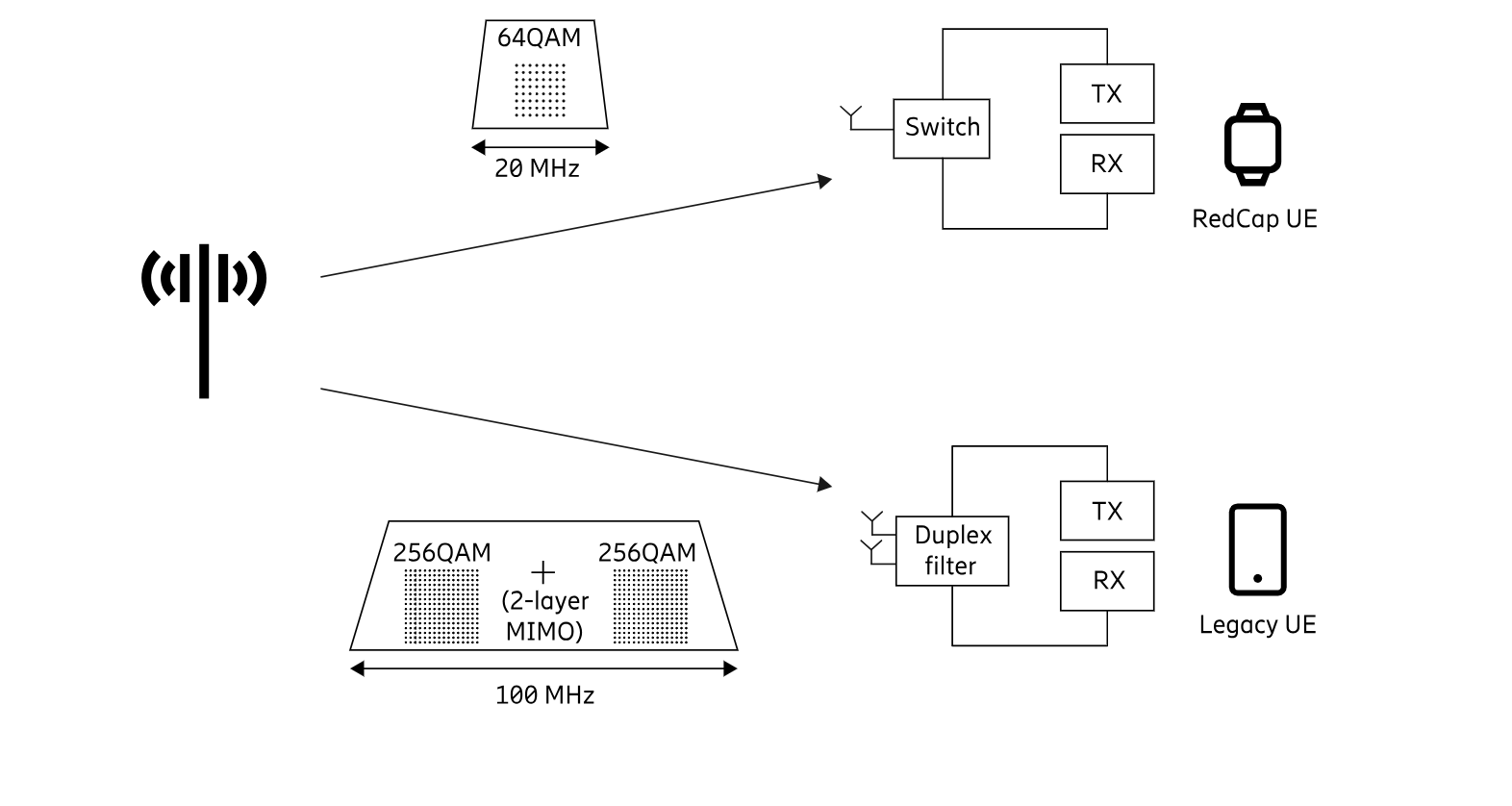
Introduced in Release 17, RedCap reduces the user equipment (UE) complexity typically associated with full-capability 5G NR by limiting bandwidth and using fewer antenna chains. Also known as NR-Light, RedCap allows half-duplex operation in frequency division duplexing (FDD) mode and omits carrier aggregation and dual connectivity. As shown in Figure 1, these reductions translate into a simpler FR1 radio architecture.

RedCap supports transmission and reception bandwidths of up to 20 MHz in Frequency Range 1 (FR1) and up to 100 MHz in Frequency Range 2 (FR2). In practice, the technology occupies a middle tier between low-rate sensing and full-capability 5G applications. An industrial camera, for example, can upload a compressed clip after detecting a defect, creating brief bursts above 10 Mb/s.
In contrast, cost-sensitive endpoints deployed at scale, such as point-of-sale terminals and utility meters, may not require baseline RedCap’s performance. For these devices, module cost and standby power outweigh peak rate. 3GPP addressed this gap through its Release 18 work item “Enhanced Support of Reduced Capability NR Devices.”
What Release 18 eRedCap changes
Despite its name, Enhanced RedCap (eRedCap) is not a higher-performance successor to RedCap. Instead, Release 18 narrows the RedCap feature set to further reduce device cost and power consumption. It caps peak rates at 10 Mb/s in both the downlink and uplink and restricts operation to FR1, eliminating the FR2 radio and beamforming requirements associated with mmWave.
Release 18 also defines an optional reduction in downlink and uplink data-channel baseband processing to approximately 5 MHz. The narrower processing path lowers buffering and thermal design requirements, while single-receive-antenna operation simplifies the hardware. These features allow eRedCap to target device costs comparable to LTE Cat-1bis.

To conserve power during long idle periods, Release 18 increases the maximum extended discontinuous reception (eDRX) cycle in Radio Resource Control (RRC) Inactive from approximately 10.24 seconds for baseline RedCap to 10,485.76 seconds, or about 2.9 hours. The longer cycle limits paging-related wakeups for reachable devices that rarely transfer data.
Positioning eRedCap against LTE Cat-1 and Cat-1bis
Baseline RedCap continues to address higher-throughput applications, while eRedCap targets lower-cost Cat-1-class devices. At this performance tier, LTE Cat-1 and Cat-1bis are the closest alternatives to eRedCap. As shown in Figure 2, RedCap and eRedCap occupy different positions in the broader 4G and 5G device hierarchy.
Both LTE tiers already support point-of-sale terminals and smart meters, and Cat-1bis delivers Cat-1-class throughput with a single receive antenna. eRedCap targets a similar balance of performance and cost on 5G NR, positioning it as a viable successor to Cat-1 and Cat-1bis
| Design consideration | LTE Cat-1 | LTE Cat-1bis | eRedCap |
| Network | LTE | LTE | 5G NR standalone |
| Peak rate, DL/UL | 10/5 Mb/s | 10/5 Mb/s | 10/10 Mb/s |
| Receive configuration | 2 Rx | 1 Rx | 1 Rx |
| Ecosystem availability | Mature LTE ecosystem | Mature LTE ecosystem | Varies with operator support and certified module availability |
Table 1. Comparing LTE Cat-1, LTE Cat-1bis, and eRedCap. Peak rates are standardized maxima; actual throughput depends on network and device configuration.
In practice, the choice between Cat-1bis and eRedCap often depends on whether the required network and modules are available when the product launches. Cat-1bis runs on mature, broadly deployed LTE infrastructure, while eRedCap requires confirmed 5G standalone (SA) support from the target operator and certified modules in the region. Engineers should specify Cat-1bis for near-term deployment and eRedCap for products launching once 5G SA and certified modules are available in the target market.
feRedCap is only a proposed direction
Sequans Communications has used the term “feRedCap” to describe a possible step beyond eRedCap toward low-rate, deep-coverage applications currently addressed by LTE-M and NB-IoT.
In the article “Preparing for 5G NR: What IoT Manufacturers Need to Know,” published by IoT For All, Sequans suggests that eRedCap might evolve into “something that we could call feRedCap.” The EU’s Hexa-X-II 6G research consortium also references a further enhanced RedCap variant within a 6G massive machine-type communications (mMTC) roadmap.
Importantly, neither source provides technical requirements or a release number for feRedCap, and 3GPP has not opened a work item under that name. At this stage, feRedCap remains speculative and provides no basis for product specifications.
efeRedCap and what Release 19 adds
It should be noted that efeRedCap is not a 3GPP Release 19 feature. Although its name suggests another step beyond feRedCap, the term lacks an established industry definition and does not appear in a 3GPP work item. Engineers should leave it out of design requirements. Relevant 3GPP Release 19 RedCap work includes:
- NR NTN operation: Extends non-terrestrial network (NTN) support to RedCap and eRedCap devices in FR1, enabling satellite connectivity for remote-monitoring applications.
- Power Class 2 RedCap: Defines Power Class 2 operation for RedCap UEs in FR1, increasing available uplink transmit power.
- RedCap network management: Adds operations, administration, and maintenance (OAM) support for configuring RedCap features and monitoring performance.
Summary
RedCap and eRedCap deliver a standardized 5G NR foundation for product design and certification. To move a product from planning to production and ensure wide interoperability, engineers must base their requirements on deployable 3GPP capabilities and avoid relying on speculative technology roadmaps.
References
3GPP: RedCap Overview and Specification Trail, 3GPP
3GPP Portal: Release 18 Enhanced RedCap Work Item, 3GPP
RedCap/eRedCap Technical Comparison, Ericsson
Preparing for 5G NR: What IoT Manufacturers Need to Know, Sequans via IoT For All
Hexa-X-II Deliverable D5.2, Hexa-X-II 6G project
3GPP Portal: Release 19 Power Class 2 RedCap UE, 3GPP
3GPP Portal: Release 19 Management Aspects of RedCap Features, 3GPP
Related EEWorld Content
How RedCap Fits into 5G and IoT
What Are 5G’s, the Different Types, and How are They Used?
6G: Does Anybody Know?
How 5G Network Slicing Works: Part 1
What to Expect From 5G-Advanced
Filed Under: Communications, Featured