By Karl Sinclair
Analysis
 June 2, 2025, © Leeham News: Boeing CEO Kelly Ortberg believes that lessons learned from the 737 MAX crisis and subsequent in-depth oversight by the Federal Aviation Administration (FAA) are key to certifying the 737-10 MAX and the 777X.
He explained why during an appearance last week at an investors conference organized by Bernstein Research.
“We’re watching real closely to make sure that we aren’t over committing in terms of how many different seat configurations we can get certified in a certain period of time and the complexity,” Ortberg said. “It’s something that we’ve got to watch, particularly the Dash 10s that have types of complex seat configurations.”
Ortberg added that the 777-9 also features complex configurations for international airlines, offering luxurious passenger accommodations.
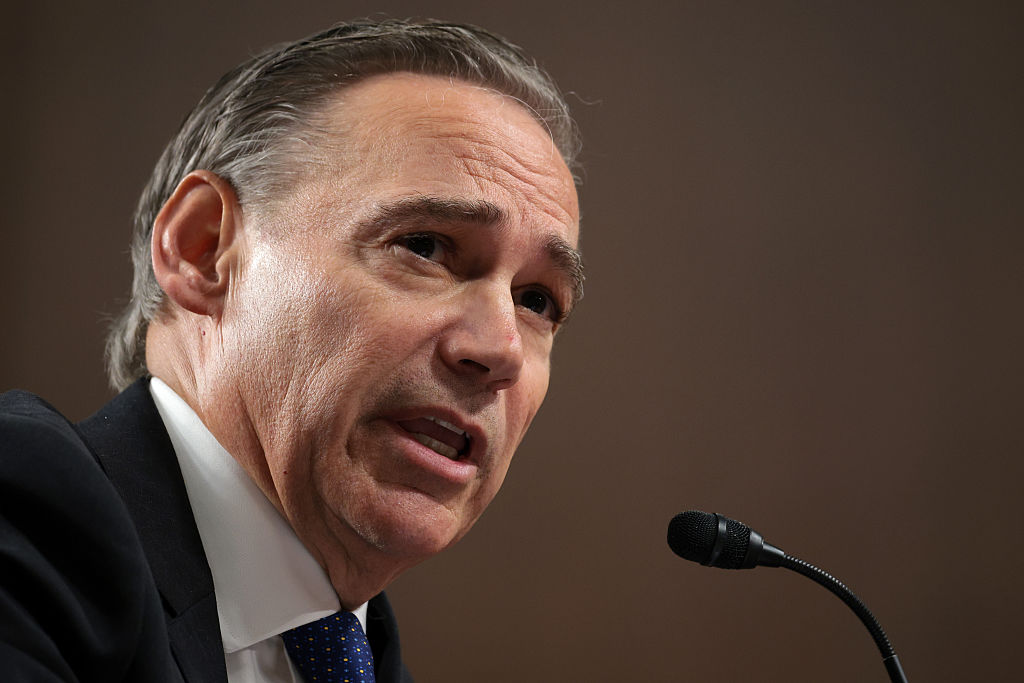
Kelly Ortberg, CEO of The Boeing Co. Credit: Getty Images.
“It’s going to be with us also on the 777-9 as we bring that into service, making sure we incorporate lessons learned here so that we don’t have seating delays on those aircraft,” he said. “Those aircraft will have the most complex configurations in the front of the airplane.”
Certification of the 777X stalled because of the MAX certification review. There have also been some technical issues that have been and must be resolved. But at long last, flight testing with all four test aircraft has resumed.
“I’m hopeful that we’ll get through the certification flight tests by the end of the year,” Ortberg told the Bernstein conference. “We may still be doing some ETOPS testing going into next year, but there is no real change to our forecast of getting that certification done so that we can start deliveries next year.
“It’s an airplane that has had the most flight testing done of any other aircraft we’ve ever done in terms of hours. We feel pretty good about the stability and our entry into service for the airplane that we’ve done enough flight testing on that it’s going to be a great airplane.”
Increasing 787 production
The CEO told Bernstein that 787 production will increase to 10/mo soon. The final assembly line at Charleston (SC) was designed for 7/mo, a number reached before the COVID pandemic began in March 2020. Production rates were reduced to a mere 0.5/mo during the pandemic. The rate has been slow to resume due to quality control issues that were discovered during the FAA’s crackdown on Boeing following the MAX crisis.
“When you look at production, going to seven [a month] soon on the 787 in Charleston, my understanding is that without a lot of capital investment, you could get to 10 there. With the demand now, particularly with these new orders, it looks like there is potentially demand pressure to go higher,” Ortberg said.
An analysis by LNA years ago concluded that the plant can go to 12/mo with some additional investment. The peak 787 production between Charleston and Everett (WA) was 14/mo. All 787 production was consolidated to Charleston during the pandemic, and the Everett 787 space is being reallocated to the expansion of 737 MAX production.
Boeing purchased more land in Charleston for expansion, presumably for the 787.
“Once we get to seven, we can get to that 10 within the existing production, generally within the existing production footprint,” Ortberg said. “I think to go beyond that’s going to require some additional investment in our facilities there. We’ve authorized that, so we are investing in expansions so that we can go to rates beyond 10 a month rate.”
Ortberg echoed many of the sentiments in the visit with the staff at Aviation Week in an in-depth interview at the Bernstein conference.
There was some fresh ground covered, however, on the appearance:
- Boeing expects that China will begin taking commercial aircraft deliveries again next month;
- Commercial aviation was confirmed to be sold out through the end of the decade;
- 737 MAX production rates are quickly approaching the FAA limit of 38/mo;
- Ortberg expects deliveries to hit 42/mo by the end of the year, 47/mo six months thereafter;
- The new fourth FAL at Everett will be for MAX10 production;
- The 787 program is also quickly gearing up to 7/mo in the near term;
- Supply chain stability was “in good shape;”
- Spirit AeroSystems’ quality has vastly improved;
- Interiors (seats) remain a sticking point; and
- Every customer is reporting a higher quality of delivered product.
All are very positive indications of the ongoing turnaround.
Annual air show Aviation Week interview
Aviation Week magazine has published interviews with the CEOs of Airbus and Boeing in advance of the Farnborough and Paris Air Shows for nearly two decades. The interview with Ortberg was published last week.
Kudos to Ortberg for openly admitting what has been known in the aviation world for some time.
Since 2018, when the first of two fatal 737 MAX crashes occurred, Boeing has either been marking time or regressing in its recovery efforts.
Some seven years later, this is a clear departure from the stance of previous leadership. Ortberg’s predecessor, Dave Calhoun, had been tasked with the overhaul of Boeing and continually reassured customers and investors alike that Boeing was on its way.
Related Article
The company is now in a watershed period, where clarity of direction and methodology is essential.
“[So] we’ve got what it takes to recover this business. I’m not worried that we’ve lost a step and can’t recover. We’ve just got to execute better,” Ortberg said in the Aviation Week interview, about the beleaguered Boeing Defense, Space and Security (BDS) division – one of the problem children.
Boeing Commercial Aircraft (BCA) and Tariffs
Ortberg’s wide-ranging and frank dialogue was part of an interview with the AW&ST editorial staff in Renton (WA), before his appearance at the Bernstein Strategic Decisions Conference.
“It’s a very dynamic time. Every day is a new day with tariffs,” he told the magazine.
With those few words, Ortberg perfectly (and gently) summed up the current political and economic climate in America.
Ortberg steps into the breech at a critical time in Boeing’s history, where uncertainty is a daily occurrence, and what held true at 9 AM is done and dusted by 4 PM.
None of which is the company’s doing, to be clear.
“I’m in regular contact with the administration, all the way to POTUS,” he told the magazine. The cynical amongst us might quote the famous line, “Keep your friends close. Keep your enemies even closer.”
On the subject of items that are within the purview of Boeing, even with limited (certification) control, Ortberg had this to say:
“We’re hoping to get the two variants of the 737 MAX wrapped up this year so we can start deliveries of the -7 and the -10, two airplanes that are very, very important to our customers and our backlog. And then the 777-9, which will be the largest dual-engine widebody in the market…we’re making great progress.”
FAA oversight process adds to delays
Why has certification of two more derivatives of the 737 taken so long? In part, it’s because the entire certification process underwent a top-to-bottom review after the 2018/2019 MAX crashes and subsequent discoveries of design, safety protocol, and quality control defects. And, as it has turned out, the Federal Aviation Administration (FAA) kept asking more questions as new areas of concern were uncovered.
It’s the issues we all know about, one Boeing customer told LNA. But additionally, the elapsed time is just allowing the FAA to dig further on different things. The passage of time adds more pressure to resolve these new issues now, before certification, rather than certify the aircraft and require retroactive fixes.
“The question being asked with all these delays, why don’t we just get it done now? Why don’t you deliver a definitive airplane rather than deliver aircraft and then have people do stuff in 18 months or two years?
It’s more of this holistic approach of saying, taking advantage of the delay and doing more than just what was acceptable in the past, because these airplanes should have already been in service for a year or 18 months.
Previously, it would have been impractical to delay things to incorporate fixes, revisions, or upgrades. But now, is it impractical to delay these actions?
Proceeding with a new aircraft
Boeing has been under years of criticism for failing to launch a new airplane program. The last time a clean-sheet program was launched was in December 2003, with the 787. All aircraft models since then have been derivatives of the 787, 737, 747, and 777.
Ortberg told Aviation Week and Bernstein that he does not believe the market is ready for a new aircraft.
The new technology, which would deliver the needed step-change in efficiency, is not there, Ortberg said. Notably, he clarified that the company is not yet ready to assume the financial burden of such a commitment.
Ortberg places great faith in the hope that when the MAX 10 and the 777X are certified for service, the gap between Airbus and Boeing will narrow.
The ongoing 777X certification delay is something he says he could never have imagined. He told Aviation Week, “I’m still shocked. Now, it’s partially driven by circumstances outside of the 777X program. The additional regulations that emerged and the entire certification process were driven more by the MAX situation than anything related to the 777X. It’s remarkable that it has not been out of service for years. But it isn’t, and the task at hand is to get it over the finish line.”
His was a realistic assessment without dodging the question of what must be done to remedy the situation.
There is, however, a bright light at the end of the tunnel, in that regard, he told the magazine. “Remember, we have half a trillion dollars of backlog, and most of that is commercial products. We have huge demand for those products, and I would say there’s more focus on upgrading existing aircraft, putting new engines and capability on them.”
Ortberg didn’t identify which aircraft fall into this category. But in Boeing’s stable, only one fits this description: the 787. The 737 and 777 received new engines and upgrades in the MAX and 777X. The 787’s design roots for the airframe and engines date to the late 1990s and early 2000s. The days are approaching when the 787 will need significant upgrading, including perhaps new or substantially improved engines.
Additional reporting by Scott Hamilton.
Related