Free for nonsubscribers
By Thomas Blackwood
July 28, 2026, © Leeham News: Safran delivered stronger-than-expected earnings results for the first half of the year, after robust demand in the civil engine aftermarket and a ramp up in LEAP engine deliveries drove record financial performance.
Against the backdrop of a Farnborough International Airshow last week where the French aerospace group and CFM International—its joint venture with GE Aerospace—signed major deals including orders for hundreds of LEAP engines, Safran reported an impressive performance across all of the key financial metrics.
Announcing its first-half results on Tuesday, Safran said its adjusted revenue reached €17.6 billion, up 19% compared to the same period in 2025, while recurring operating income stood at €3.24 billion, an increase of 29% year-over-year.
Key financial results
Safran hailed its first-half results as “outstanding” with “record-breaking profitability” over the first six months of the year.
The OEM benefited from a strong civil engine aftermarket, across both the best-selling CFM56 engines and its LEAP engine successor, on top of significant growth in defense activities. It also reported a solid performance in equipment with improving margins in aircraft interiors.
In terms of revenue, its Propulsion division was up by 28% (with spare parts sales for civil engines rising by 28% in dollar terms), Equipment & Defense saw 14% growth and Aircraft Interiors was up 6.6% over the period.

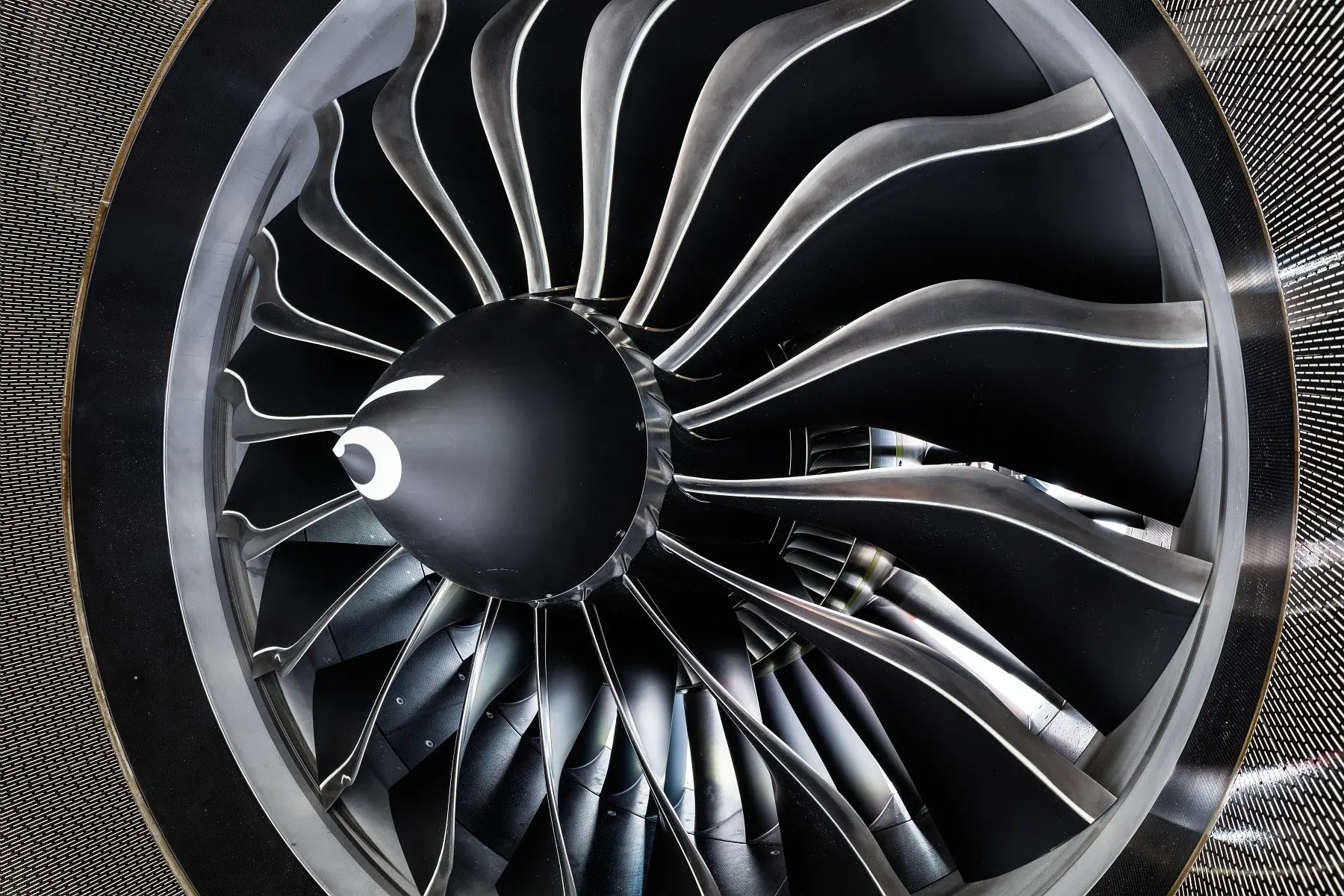
LEAP 1-A fan close up
The recurring operating income of more than €3.2 billion for the half-year was helped by original equipment revenue growth as well as robust aftermarket activity. The operating margin of 18% of revenue was up 1.4 basis points compared with the first half of 2025.
Safran reported an adjusted free cash flow of €2.62 billion and a €1.67 billion net cash position as of the end of June 2026, versus a €1.74 million cash position as of December 31, 2025.
Iran conflict ‘barely’ registers
Olivier Andries, the group’s chief executive, told analysts and investors on the Tuesday morning earnings call that the Iran conflict “barely impacted” the company’s performance.
Over the period, “civil aftermarket activities remained well above our pre-conflict forecast, spare part sales for civil engines increased by 28% in dollar value, and civil engine services also grew by more than 40%,” he said.
As a result of this strong performance, Safran has raised its full-year guidance. This includes a forecast for revenue growth in the mid-teens (up from a previously forecast rate of low to mid-teens), with recurring operating income of €6.4-6.5 billion (previously €6.1-6.2 billion), and free cash flow forecast at €4.7-4.9 billion (previously €4.4-4.6 billion).
These numbers include an estimated €500 million negative impact from the French corporate surtax.
Analysts concurred with Safran’s bullish assessment. RBC Capital Markets noted that first-half revenue was around 1% above the consensus while the €3.2 billion EBIT was 6% above the market average, with margins beating consensus by 90 basis points.
Bernstein described the results as “stellar.”
Robert Stallard of Vertical Research Partners noted that “these excellent results from Safran continue the pattern of strong momentum in the aero engine sector this quarter.”
“With continued tightness in new engine and MRO availability, we expect these conditions to continue, with increased work scopes being the icing on the cake,” he added.
Safran’s share price rose nearly 3% by mid-morning after the results were announced.
RTX and GE Aerospace reported similarly strong results earlier this month.
Strengthening demand for the LEAP engines
Insatiable demand for the Airbus A320neo and Boeing 737 MAX families of narrowbody aircraft has proved a boon for CFM and its LEAP program.
Production has exceeded 500 units for a fourth consecutive quarter and CFM delivered 1,030 LEAP engines in the year’s first half, up 41% year-over-year.
That momentum was reflected last week at the Farnborough, where CFM announced a memorandum of understanding with Indian low-cost-carrier IndiGo for more than 1,000 LEAP-1A engines to power 510 Airbus A320neo family aircraft.
The agreement was the largest single order ever placed for LEAP engines and a record for CFM.
BOC Aviation Limited, the Singapore-based leasing company, also used the show to finalize a firm order for up to 200 LEAP-1A and 100 LEAP-1B engines to power Airbus A320neo family and Boeing 737 MAX aircraft that BOC Aviation had previously ordered.
“LEAP is expanding with a fast-growing number of visits, significant work scope increase, and more shop visits being performed by third-party maintenance, repair and overhaul shops,” Andries said on the call.

An A380 front axle. Photo: Adrien Daste / Safran
However, the LEAP program, which celebrates its 18th birthday this summer, has only recently started turning a profit.
Pascal Bantegnie, Safran’s chief financial officer, said that the combined program of installed and spare LEAP engines has been profitable for Safran for only about three years, but the company still takes a loss on each of its installed engines, while EBIT is “strongly positive” on the spare side.
Airframers eye production ramp ups
One reason behind the positive outlook is a desire for the airframers to increase production.
Airbus and Boeing are both seeking to increase output: the former, to reach a capability of 75 A320neo family aircraft per month in 2027, and A350 output to 12 aircraft in 2028; the latter, to reach a target of 63 or even 70 737s per month in the coming years, from recently elevated target of 47.
Andries told analysts the ramp up objectives of both Airbus and Boeing were “very good news for us and for our equipment division,” especially regarding targets for A350 production, “because in our equipment division we are more exposed to widebodies than in our engine division.”
Another area of growth is defense. Safran’s military engine revenue increased year-over-year driven by M88 engine deliveries which reached 33 units, more than tripling last year’s figure, plus a robust level of aftermarket demand.
Safran’s defense activities are varied and include inertial navigation systems, optronics, and the AASM Hammer, an air-to-surface stand-off weapon.
Bantegnie also said that Safran was continuing to look for acquisition opportunities. “You may have seen that we have missed one of them very recently,” he said, referring to the failed attempt to acquire Exail Technologies, a French group specializing in maritime robotics, advanced navigation systems, aerospace, and photonics. “So, you can see that we continue to be active and disciplined [in pursuit of an acquisition]”.
Headwinds persist
While geopolitical instability has not yet dented Safran’s output, associated headwinds still exist. The Paris-headquartered company has suffered from currency volatility with a weakening euro leading Safran to register a €188 million foreign exchange loss.
Bantegnie said that the level of activity in the foreign exchange market observed in the first half meant it was “likely that we will need to revise upward the volumes to be hedged for the remainder of the year and for future periods.”
“Overall,” he added, “our hedge portfolio continues to serve as a key protection mechanism, providing us with solid visibility on future dollar exposure, despite currency volatility.”

Economy class seats on Safran’s final assembly. Photo: Frank Rogozienski / CAPA Pictures / Safran
Another hurdle is aircraft seating. Both a certification logjam and the increasingly complex, bespoke nature of seating orders is leading to delays in aircraft deliveries. This is particularly prevalent for premium cabin seating where sliding doors and innovative designs require additional testing and approvals.
The Safran Vue seat, for instance, is destined for Delta’s new Airbus A321neos. However, significant delays are reportedly leading the airline to consider alternatives.
Commenting on the problem of aircraft seating delays more generally, Andries said: “We’ve not yet turned the corner. It’s an industry issue that is now well understood and identified by the airframers and by the airworthiness authorities.
“The airworthiness authorities have elevated their interpretation of pre-existing rules in a view that is creating roadblocks for the certification of seats and therefore for deliveries of seats. It’s not a Safran issue. It’s an industry issue that we need to be tackled. I hope we will be able to turn the corner by the end of this year.”
Related