Free for nonsubscribers
By Karl Sinclair
July 28, 2026, © Leeham News: Boeing released its second-quarter financial results showing that, while its commercial segment is still generating red ink, the company was also able to produce modestly positive free cash flow during the April-June period.
The company reported a net loss of $428 million on $24.6 billion of second-quarter revenue, compared with a net loss of $612 million during the equivalent period of 2025.
Cash flow from operations hit $1.36 billion and free cash flow reached $631 million—an improvement over second-quarter 2025 figures of $227 million and negative $200 million, respectively.
Kelly Ortberg, Boeing’s chief executive, acknowledged that there is “more work ahead in the second half of the year,” while touting the company’s positive momentum coming out of the Farnborough International Airshow.
Boeing confirmed its free cash flow guidance of $1-$3 billion for the full year.
Boeing Commercial Airplanes (BCA)
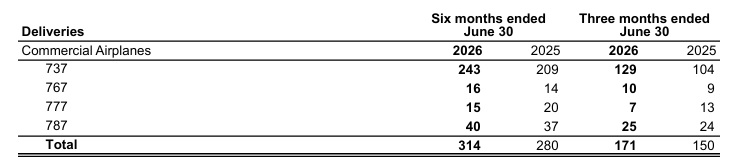
BCA increased its delivery tempo on the 737 Max program, handing airlines an average of 43 aircraft per month during the second quarter. The 767 and 787 Dreamliner programs remained relatively flat year over year, while 777 Classic deliveries slipped to an average of about two per month.

The 737 Max program began transitioning to a production rate of 47 aircraft per month, with the newly minted North Line starting low-rate initial production in Everett, Washington.
BCA now has four lines dedicated to producing its flagship narrowbody.

Losses narrowed during the quarter to $322 million on revenue of $11.8 billion, reflecting an increased delivery tempo. Expectations are that results for the full year of 2026 will still produce a loss for the division, with improvement to come next year.
777X program woes
As previously reported by LNA, the beleaguered 777X faces some of the issues that plagued the 787 Dreamliner program, with customers refusing to take early-production aircraft that have been sitting, waiting for certification and change incorporation.
Most notably, Emirates CEO Tim Clark recently stated that his airline will not take the first 10 777-9 airframes, which have been stored for more than five years. The carrier holds the 777X program’s largest individual orderbook at 270 aircraft.
Boeing has reportedly already begun scrapping aircraft, with Emirates-bound WH007—one of the initially produced aircraft—undergoing a teardown.
As reported during the company’s first-quarter earnings call, the 777X program is expected to burn through $2 billion in cash through 2027.

Since 2020, the 777X program has cost the company $15.7 billion in write-offs.
Expectations are for the first 777-9 to be delivered in 2027, as the program has proceeded into FAA-supervised flight testing under Type Inspection Authorization 4B.
737 Max complication
In a modest setback for the 737 program, the FAA is proposing a new directive to inspect seat track assemblies on 453 aircraft registered in the US.
While the directive does not immediately ground aircraft, it identifies a potential manufacturing issue which would require operators to inspect seat-track holes and take corrective action to address oversize dimensions. Corrective action must be taken before aircraft can resume flying.
Beyond US borders, international agencies may adopt similar requirements following the FAA’s proposed directive.
The directive is currently open for public comment until September 10, after which point a ruling will be issued.
Defense, Space & Security (BDS)
Boeing’s defense segment slid slightly into negative territory during the quarter, producing a net loss of $15 million on $7.47 billion in revenue.
This was driven by losses incurred on the VC-25B presidential aircraft. The program’s first delivery is expected in 2028.

Revenue topped $15 billion during the first half of 2026, a year-over-year increase of $2.17 billion. BDS checked in with a $218 million net profit during the first six months of the year.
Ortberg maintains that Boeing is done signing loss-making, fixed-price contracts, which have cost the division dearly.
Evidence of this might be BDS’ recent withdrawal from the US Navy’s T-7A Red Hawk trainer program, despite the company’s formal explanation that the design did not meet specifications.
Boeing Global Services (BGS)
Earnings produced by the company’s services division slipped slightly during the second quarter, as effects of the Digital Aviation Solutions divestiture began to take hold.
While revenue grew modestly by $63 million, both earnings and margins receded year-over-year by $81 million and 1.8 basis points, respectively.

BGS has recently served as a shining star in Boeing’s portfolio as other divisions have stumbled. But second-quarter revenue for BGS was relatively flat compared with the same three-month period of last year, and ticked up by $370 million during the first six months.
Earnings dipped slightly, dropping $53 million (3%) as compared to 2025, with margin decreasing by 1.2 basis points.
During the fourth quarter of 2025, Boeing sold off Digital Aviation Solutions (which included Jeppessen), receiving roughly $10 billion in return. That cash was used to pay off debt and fund investments in the reintegration of Spirit Aerosystems in Wichita, Kansas, as well as expansion of 787 production facilities in North Charleston, South Carolina.
LNA will publish another story after Boeing holds its earnings call on July 28.
Related