Soft, tender and still warm from the oven – what could be better than a fresh cheese scone?

What do I need to make cheese scones
You will need flour, butter/margarine, milk and cheese. No eggs.
- 270g self raising flour, cheapest value flour works wells as it has a slightly lower protein level, which is the gluten, the stuff that holds baked goods together and can toughen a tender item like scones. Or use plain flour and 3 tsps baking powder
- 40g butter or margarine, either is fine, there is only a small amount in the recipes, so you won’t taste it
- 150ml milk, any kind, but sour milk is wonderful here, it gives a lovely light result.
- pinch salt
- 100g mature cheddar. Mature cheese as you need the stronger flavour to be able to taste the cheese
How do I make cheese scones?
- Scones are at their best, still warm from the oven, and wonderfully light. I don’t usually sieve flour, but I do for scones.
- Sieve the flour into a bowl and rub in the softened butter with light as light fingertips.
- Into the bowl add the pinch of salt, the grated cheese and stir well
- Now add the milk and stir gently with a spoon, keeping that light touch, until you have a dough
- Tip the dough onto the work surface and gently press into a flat piece of at least 2cm thickness
- Cut into scones using the size of cutter you prefer. I use a 68mm / 2 5/8″ cutter and get 8 scones
- Press straight down with the cutter, don’t twist it at all. Any twisting will glue the layers of the sides together and mean the scones will rise unevenly
- Press any used dough together and repeat the steps above to cut out more scones. You should have about 8 in total
- Place your scones on a baking sheet that has been greased or lined
- Bake at 220°C/ 200°C fan/ 425°F/ gas 7 for 15 minutes. You really need to keep a close eye on the time as you can’t tell the usual way, from a golden brown colour, that they are cooked. Try not to leave them in any longer than they need or they will be rather dry.
What do you have with a cheese scone?
As with all baking, these are at their very best still warm from the oven when they will be tender and super delicious.
Enjoy them just as they are, or with a slick of butter or a sliver of cheese of any kind, sharp cheddar, tangy goats or blue, or my favorite soft cheese would work very well here.
You might like a little pickle on the side, or enjoy with a bowl of soup
How to store cheese scones

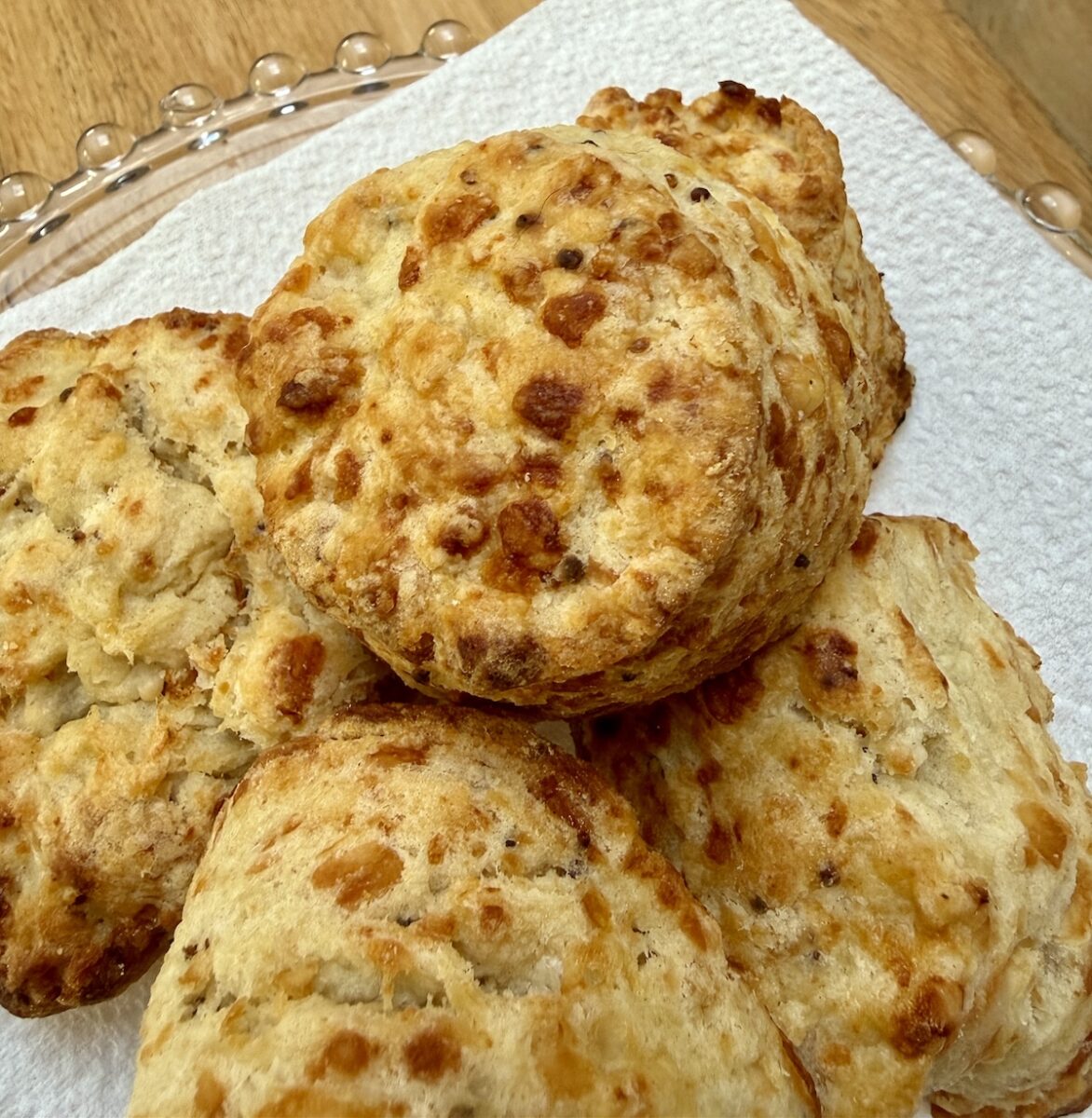
Cheese scones in a pile on a white paper towel.
Store your lovely fresh cheese scones in an airtight container for a couple of days.
Scenes typically stale quite quickly, so if you haven’t used them up in a couple of days, wrap them well and pop them in the freezer.
If your scones have gone a little stale try refreshing them in the oven for a few minutes, or a few seconds in the microwave, or even toast them.
What other ingredients could be used in a cheese scone recipe?

Cheese scones in a pile on a white paper towel.
- I sometimes use yogurt to add a bit more tenderness to the scones.
- When I was growing up, Mum used to save the soured milk to make the lightest of scones. Milk doesn’t go off as quickly as it did then. We had no fridge other than a large biscuit tin buried in the garden. And milk wasn’t treated in the same way at the dairy.
- Use a good quality, mature cheese like cheddar, gruyère, parmesan, or even a strong blue cheese for a rich and satisfying cheese flavor,
- Be generous with the cheese, you really want that cheesy flavour to come through
- You could even combine different cheeses, mozzarella for a bit of stretchiness and Parmesan for a deep flavour
- For some reason to do with science, mustard makes cheesy things taste even cheesier, so add a generous dollop of grainy mustard, Dijon or dry English mustard powder
-
Mustard—particularly English mustard powder—makes scones taste cheesy because it shares key aromatic compounds with aged cheese and acts as a flavor enhancer, amplifying the savoury notes already present in the flour and butter. Even without actual cheese, the mustard provides a “tangy,” “nutty,” and “savoury” bite that tricks the palate into perceiving a cheesy flavor.
Here is why this culinary illusion works:
- Complementary Aromatics: Mustard contains complex compounds that, when heated, mimic the pungent, savoury, and sharp flavors associated with sharp cheddar cheese.
- Enhancement vs. Flavoring: Mustard powder works by strengthening the existing savory notes in the dough (like butter and salt), rather than just tasting like “mustard”.
- The “Tang” Factor: The sharpness in mustard provides the same sharp, acidic “tang” that mature cheddar adds to a scone.
- Coloration: Mustard powder also contributes a bright yellow color, visually hinting to the brain that the scone is packed with cheddar.
-
- Cayenne pepper will add a little kick, or plain or smoky Paprika
- Herbs like finely chopped chives are great in a cheese scone
- If you have the cheese available, you could even sprinkle a little on top before baking
How much baking powder do I add to plain flour to make self raising?
How much baking powder to add to plain flour should have been an easy question. But it turns out to be a harder question to answer than I thought it would be. It all seems to be a matter of opinion!
Delia says 1 tsp to each 110g plain flour. Nigella says to add 2 tsp per 150g flour. A generic Google answer is to add 1tsp per 200g. I used 2 tsps baking powder to 240g flour and it seemed to work alright, so that’s what I use
Other scone options include

Freezes Well
Servings: 8
Calories: 222kcal
Click on the check box to cross off Equipment, Ingredients or Recipe Steps completed.
If you click and buy anything, I may get a small commission on the purchase. It won’t cost you anything extra. Some are just things that I like and/or use myself rather than necessarily best value 🙂
If you enjoyed this recipe, please consider leaving a review? It would really help
- I sometimes use yogurt to add a bit more tenderness to the scones.
- When I was growing up, Mum used to save the soured milk to make the lightest of scones. Milk doesn’t go off as quickly as it did then. We had no fridge other than a large biscuit tin buried in the garden. And milk wasn’t treated in the same way at the dairy.
- Use a good quality, mature cheese like cheddar, gruyère, parmesan, or even a strong blue cheese for a rich and satisfying cheese flavor,
- Be generous with the cheese, you really want that cheesy flavour to come through
- You could even combine different cheeses, mozzarella for a bit of stretchiness and Parmesan for a deep flavour
- For some reason to do with science, mustard makes cheesy things taste even cheesier, so add a generous dollop of grainy mustard, Dijon or dry English mustard powder
-
Mustard—particularly English mustard powder—makes scones taste cheesy because it shares key aromatic compounds with aged cheese and acts as a flavor enhancer, amplifying the savoury notes already present in the flour and butter. Even without actual cheese, the mustard provides a “tangy,” “nutty,” and “savoury” bite that tricks the palate into perceiving a cheesy flavor.
Here is why this culinary illusion works:
- Complementary Aromatics: Mustard contains complex compounds that, when heated, mimic the pungent, savoury, and sharp flavors associated with sharp cheddar cheese.
- Enhancement vs. Flavoring: Mustard powder works by strengthening the existing savory notes in the dough (like butter and salt), rather than just tasting like “mustard”.
- The “Tang” Factor: The sharpness in mustard provides the same sharp, acidic “tang” that mature cheddar adds to a scone.
- Coloration: Mustard powder also contributes a bright yellow color, visually hinting to the brain that the scone is packed with cheddar.
-
- Cayenne pepper will add a little kick, or plain or smoky Paprika
- Herbs like finely chopped chives are great in a cheese scone
- If you have the cheese available, you could even sprinkle a little on top before baking

Nutrition Facts
Cheese Scones
Amount per Serving
% Daily Value*
* Percent Daily Values are based on a 2000 calorie diet.