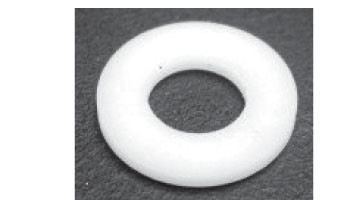

It’s a common misconception that all washers are made of metals and alloys. Washers are simply ring-shaped plates that are used in conjunction with a mechanical fastener, such as a screw or bolt. When driven directly into objects, mechanical fasteners can cause stress-related damage. Washers prevent this from happening by distributing the fastener’s load across a larger surface area of the object. While most washers are made of metals and alloys, however, some are made of synthetic materials like polytetrafluoroethylene (PTFE).
#1) Low Friction Coefficient
PTFE washers have a lower coefficient of friction than traditional washers made of metals and alloys. Friction coefficient is a measurement of how much friction two objects produce when they rub against each other. A high friction coefficient typically results in increased wear and tear, shortening the lifespan of the respective object. PTFE washers are made of PTFE, which is naturally soft. As a result, PTFE washers produce very little friction when they move and rub against other objects.
#2) Won’t Corrode
Corrosion isn’t an issue with PTFE washers. Corrosion is a chemical reaction that occurs when certain metals or alloys are exposed to oxygen, moisture or other substances. When left unchecked, it can cause objects to physically deteriorate, compromising their structural integrity. PTFE washers are entirely synthetic. Therefore, they won’t rust or corrode like other washers.
#3) Chemical Resistant
PTFE washers are resistant to a wide range of chemicals. Other washer materials can quickly deteriorate when exposed to fuels, acids, solvents, lubricants or other harsh chemicals. PTFE, though, is considered chemically inert, meaning it does not undergo chemical reactions. This means PTFE washers can withstand most chemicals while maintaining its structural integrity — even after long periods of exposure.
#4) Lightweight
A benefit of PTFE washers that’s often overlooked is their weight. They weigh less than most other washers, including those made of steel, titanium and aluminum. Why does this matter? In aerospace applications, using PTFE washers can reduce an aircraft’s total weight. Some airplanes have hundreds of thousands of bolts, washers and nuts. Switching from all-metal washers to PTFE washers will make the aircraft lighter and, therefore, more fuel efficient.
#5) Heat and Cold Resistant
PTFE washers are resistant to both heat and cold. They can handle a wide range of operating temperatures. Some synthetics, such as certain plastics, soften when exposed to heat and become brittle when exposed to extreme cold. These physical changes can affect their performance and longevity. PTFE washers, on the other hand, maintain their performance in both hot and cold environments.
#6) Electrical Insulation
Finally, PTFE washers don’t conduct electricity. Rather, they act as an electrical insulator. Other metals and alloys are highly conductive. Electricity can travel through them, causing damage to electrical parts and equipment. PTFE washers reduce the risk of such damage by creating a highly resistive barrier.