Updated: Bargain Unit Councils give thumbs down to SPEEA contracts recommended by negotiators

By Scott Hamilton
Aug. 6, 2026, © Leeham News: The Bargaining Unit Councils (or BUCs) of Society of Professional Engineering Employees in Aerospace (SPEEA) today did not recommend approval of the new contract unanimously recommended by the negotiating teams that union members approve the contract negotiated with Boeing.
A vote is expected before Aug. 21, the date by which some incentives in the contract to prompt a Yes vote expire. No date was set today.

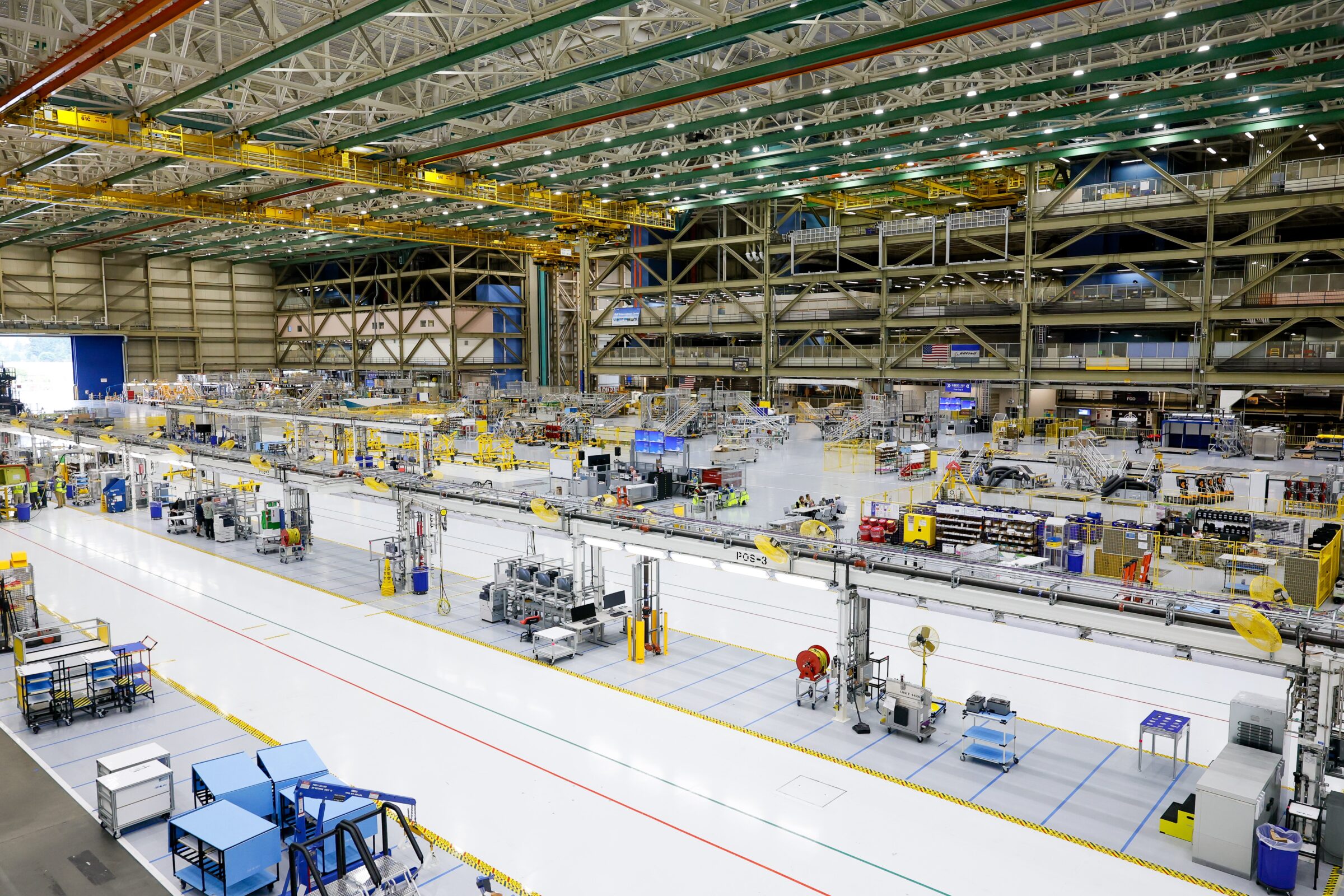
Boeing’s factory in Everett, Washington. Photo credit: Jennifer Buchanan/Seattle Times/Pool
In a statement, SPEEA said:
Both the Prof and Tech Negotiation Teams recommended the contract offer.
The Prof BUC vote did not meet the 60% threshold to issue a recommendation.
-
- The Tech BUC voted to recommend members reject the offer.
- Both BUCs voted to add a strike authorization vote to the contract vote ballot and recommended members vote to authorize a strike if called by the Negotiation Team.
- Both BUCs also voted to allow the contract vote to be conducted online.
The BUCs’ decisions are a blow to the negotiators, who praised not only the tentative agreement but also the collaborative tone of the contract talks with Boeing.
This has been the pattern of recent talks. Initially, the 2024 tentative agreement between Boeing and the IAM 751 was touted by both sides as the best contract ever offered. The 751 leadership endorsed the contract, but later distanced themselves from it after members made it clear on social media that they didn’t like the agreement. Boeing made three more offers, but members rejected the contract and struck for 53 days.
At Boeing’s Defense unit, the same thing happened with a different IAM District, No. 837. These members walked out for more than 100 days.
Related Stories
SPEEA represents engineers and technicians at Boeing. Each group has its own contract, and each must vote on whether to accept it.
Updated:
The engineers’ BUC fell a vote short of the 60% super-majority required to make a recommendation. The technicians’ BUC, filled out by shop stewards, rejected the contract due to misunderstandings about certain economic terms, LNA is told. Additionally, some felt that some past grievances were not adequately addressed in the tentative agreement.
As for the recommendation by both BUCs that a strike authorization vote be put on the ballot and that members pass this vote, LNA is told this is a standard tactic to give negotiators additional leverage in the event the contracts are rejected.
The election date will be set no later than next week. Electronic voting will speed the process, with the Aug. 21 deadline in the tentative agreement two weeks away. The contracts don’t expire until Oct. 6, so if the contracts are rejected, there won’t be any immediate strike, assuming one is authorized.
“We’re optimistic our employees will see the value in our offers which have the unanimous endorsement of SPEEA’s bargaining teams. We encourage our employees to use our wage modeler to see how they could personally benefit from the offer and then make their voices heard by voting. As we’ve said, we would much rather invest money in our team in these offers instead of diverting the dollars to our strike contingency plan,” said Ben Nimmergut, Boeing vice president and functional chief engineer for Production Engineering
Contracts synopsis
In a post on its website, SPEEA outlined the top terms of the contracts. There are no takeaways, a common tactic Boeing demanded in past labor contracts.
- Wage pools compounding to 29.4% over the four years of the contract – 31.9% when factoring in promotions and out of sequence. This is the union’s largest wage-pool increase since 1983;
- Guaranteed minimum wage increases tied to inflation;
- A 40% increase in the target payout for the union’s annual incentive bonus plan;
- An immediate pay increase of 3% retroactive to Feb. 20
- Plus an amount equal to 40% of each union member’s 2026 incentive bonus;
- 40 units of restricted Boeing stock, worth more than $9,000 at today’s price.
- Three extra days of paid leave for everyone.
- Lower limits on mandatory overtime.
- Improvements in health and dental benefits with no change in cost to union members.
- More opportunities for virtual work.
- A commitment for twice-annual meetings with the president of Boeing Commercial Airplanes and other senior Boeing executives to discuss how SPEEA members can best be deployed to aid the company’s growth plans.
- The creation of new union-represented workforce roles to ensure that union members have the right skills to fill those future jobs at Boeing.
- A commitment to create a joint labor-management committee to study potential uses of Artificial Intelligence.
“This offer addresses many of the longstanding issues affecting our members as well as providing security for future members to ensure that this isn’t just a job, but a career,” said Negotiation Team member Mike Berryhill, a production engineer.
Related