Nancy Shang | Founder & CEO, MICET | Published August 14, 2026
Industrial brewing equipment covers systems roughly 15 BBL and up, where heating method, automation level, and grain handling move from craft workarounds to purpose-built infrastructure. This guide covers what changes between a 15 BBL brewhouse and an 80 BBL four-vessel line, including budget ranges and certification requirements for procurement teams evaluating the move.
Capacity ranges, vessel configurations, and price bands referenced below reflect MICET’s published specifications as of August 2026. Confirm current figures before finalizing a budget, since equipment pricing and available configurations shift with material costs and order volume. MICET has supplied brewing equipment to customers in 100+ countries, with 800+ installations worldwide, spanning nano systems through regional-scale commercial lines.

Where Craft Brewing Stops and Industrial Capacity Starts
There’s no single regulatory line between “craft” and “industrial” brewing equipment. It’s a practical shift point, and it shows up differently depending on which spec sheet you’re reading.
At the small end, nano systems top out around 5 BBL, sized for taprooms and restaurant-attached brewing — a 3-barrel setup can fit into as little as 250–500 square feet. Microbrewery-class equipment covers operations producing 15,000 barrels or less per year, typically built around 30–60 BBL vessels, priced in the 30,000–80,000 USD range. Commercial brewery equipment starts where most people mean “industrial”: a 10 BBL minimum system, scaling up through 2-vessel, 3-vessel, and 4-vessel configurations to 80 BBL, with a four-vessel line capable of roughly 80 BBL per day of throughput. Most new commercial builds land in the 10–30 BBL band rather than jumping straight to the top of that range.
The practical trigger for calling a system “industrial” isn’t a barrel number by itself — it’s the point where heating infrastructure, control systems, and grain logistics stop being scaled-up versions of a craft setup and start being designed around continuous, higher-volume operation.
Craft-to-Industrial Tier Comparison
| Tier | Typical Capacity | Vessel Configuration | Published Price Band | Output Class |
| Nano | 5 BBL or less | Single-vessel, compact footprint | Not publicly listed | Taproom / restaurant-scale |
| Microbrewery | ~30–60 BBL vessels | 2–3 vessel typical | 30,000–80,000 USD | Up to 15,000 BBL/year |
| Commercial / Industrial | 10–80 BBL | 2, 3, or 4 vessel | 50,000–80,000 USD (10 BBL entry point) | Up to 80 BBL/day (4-vessel) |
Notice the price band only covers the 10 BBL entry point of the commercial tier. That’s not an oversight — it reflects how configuration-dependent pricing gets once you’re past a base system, which the budgeting section below addresses directly.
Heating Method: Why Steam Enters the Picture at Scale
Electric-element heating is standard practice at the craft tier because it’s simpler to install and doesn’t require boiler infrastructure. As batch sizes grow, steam-jacketed kettles become more common industry-wide, since steam distributes heat more evenly across a larger vessel surface and shortens the recovery time between brews. That’s a general vessel-engineering tradeoff, not a claim specific to any one manufacturer.
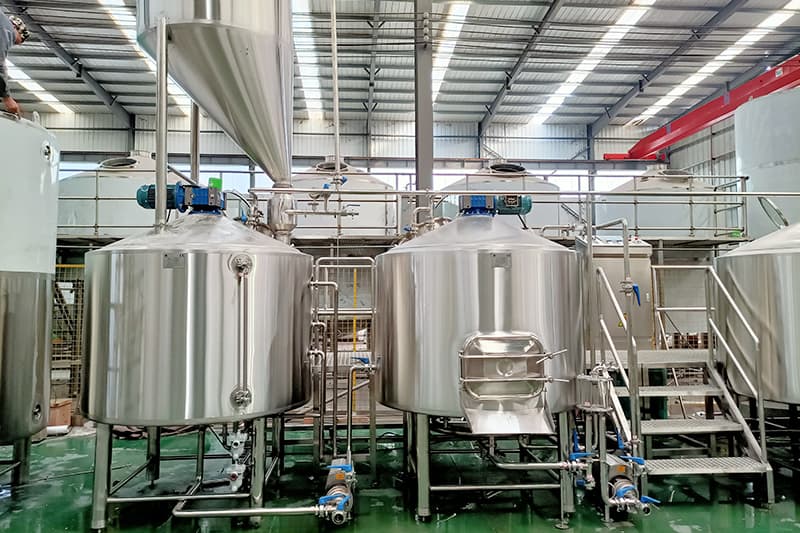
MICET’s commercial brewhouse line supports both heating approaches across its 2, 3, and 4-vessel configurations. In practice, the deciding factor is usually the site itself: available steam boiler capacity, gas supply, or three-phase electrical service determines which heating method is realistic before vessel size ever enters the conversation. Procurement teams evaluating a move past 15 BBL should get a utilities assessment done before specifying a heating type, not after.
Automation: What a Four-Vessel System Actually Controls
“Industrial” doesn’t automatically mean “hands-off.” At the commercial tier, the 2/3/4-vessel brewhouse configurations handle mashing, filtering, boiling, and whirlpool as distinct stages, and how much of that sequence runs under PLC control depends on the configuration ordered, not the barrel count alone.
MICET’s documented 1000L fully automated brewery build is a useful reference point for what full automation looks like in practice: a PLC control system managing the brewhouse, fermentation, and bright tank stages together, paired with an R449A eco-friendly refrigerant system, and CE certified. That level of integration scales conceptually into larger commercial builds, but it’s ordered as a specific automation tier — it isn’t the default configuration at every capacity point.
Compared to typical semi-automated microbrewery packages sold at the sub-15 BBL tier, three- and four-vessel commercial systems shift mash, lauter, and whirlpool sequencing into PLC-managed steps, which cuts down on manual valve operation during the boil-to-whirlpool transition. That’s the real automation gain — not a blanket claim that bigger systems run themselves.

The Grain Handling Misconception
Here’s a mistake procurement teams make regularly: assuming that crossing into industrial-scale brewhouse capacity automatically brings automated grain handling with it. It doesn’t, and treating it as bundled leads to budget surprises later.
Bulk malt handling — silos, augers, automated grist hydration — is typically a separate procurement line from the brewhouse itself. Plenty of 10–30 BBL commercial systems still run on manual malt additions at the mill or mash tun, even while the mash, lauter, and whirlpool sequence downstream runs under automated control. If bulk grain handling matters to your operation, it needs to be scoped and quoted independently of the brewhouse RFQ, not assumed as included.
Cooling and Glycol Load Don’t Scale in a Straight Line
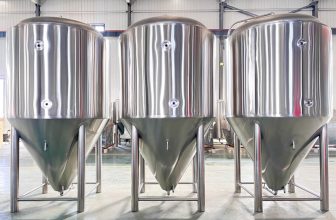
Fermentation tanks in MICET’s catalog run from 500L up through 2,500L and 40–60 BBL formats, built with glycol jackets, pressure-reducing valves, and CIP nozzles in 304 or 304/316 stainless. Bright tanks cover a wider span — roughly 1 BBL to 300 BBL — for the carbonation and storage stage after fermentation.
The mistake here is sizing glycol capacity off brewhouse output alone. Actual glycol load depends on total fermenter and bright tank volume running simultaneously, ambient plant temperature, and how fast a given brand needs to crash-cool. Two breweries at the same brewhouse capacity can need meaningfully different glycol chiller sizing depending on how many tanks they’re cooling at once and their turnaround schedule.
Certification Checkpoints for Procurement Teams
Pressure-bearing brewing vessels fall under EU pressure equipment rules regardless of where the equipment ships. MICET’s brewing, fermentation, and pressure vessel line carries PED Verification 3N231110.SICS093, issued by Ente Certificazione Macchine Srl under the 2014/68/EU Pressure Equipment Directive, referencing EN 1626:2008, valid through November 2028. A separate Verification of Conformity — ICR/VC/HM2507146, issued by ICR Co., Ltd., valid through July 2030 — covers the same PED scope under EN 1626:2008 and EN 10204:2004 as a voluntary conformity document.
Neither of those replaces asking a supplier for the actual certificate and its expiration date before signing a purchase order. At industrial scale, where a single pressure vessel failure has real downtime and safety cost, that verification step belongs in the RFQ process, not in a follow-up email after the deposit is paid.
Budgeting the Jump: What Published Price Bands Actually Cover
Microbrewery equipment publishes at 30,000–80,000 USD. The commercial tier publishes a 50,000–80,000 USD band, but only for its 10 BBL entry point. Once a build moves past that — into the 20, 25, or 30 BBL range, or into four-vessel configurations pushing toward 80 BBL — published pricing stops and quote-based pricing takes over, because vessel count, heating method, automation tier, and tank farm sizing all move the number independently.
That’s not an evasive way of saying “call us.” It’s a fair reflection of how many variables stack up at that scale. Treat any flat number quoted for a 30 BBL-plus system without a spec sheet attached with some skepticism.
How Procurement Teams Typically Evaluate the Move
- Confirm current output in barrels per year, plus a realistic three-year projection — not just current sales volume.
- Map that projection against vessel configuration options (2, 3, or 4 vessel) rather than picking a barrel number in isolation.
- Get a site utilities assessment done before deciding between steam and electric heating.
- Request PED verification documents and engineering drawings before issuing a formal RFQ, not after.
- Budget grain handling, glycol capacity, and packaging line changes as separate line items from the brewhouse quote.
Common Pitfalls When Scaling Past 15 BBL
- Underestimating utility upgrades — steam boiler capacity and three-phase power requirements are frequently missed until the site survey.
- Treating brewhouse capacity as the only constraint, when fermentation and cellar tank space is the more common bottleneck at scale.
- Assuming automation level is bundled with vessel size, when it’s actually a separate configuration decision.
- Skipping certification verification until after equipment is already ordered.
- Underestimating floor space and structural load requirements for a larger tank farm, especially in retrofitted buildings.
Every point on that list costs less to fix at the RFQ stage than after equipment arrives on site.
Once brewhouse and fermentation capacity are settled, the next bottleneck most commercial operations run into is packaging throughput — bottling or canning line speed that can’t keep pace with the new brewhouse output. That’s worth sizing before finalizing an RFQ, not after the brewhouse is already installed.
FAQ
Q: What capacity range actually counts as “industrial” brewing equipment?
A: There’s no fixed regulatory threshold. In practical terms, it starts around 15 BBL, where MICET’s commercial line (10–80 BBL, 2/3/4-vessel configurations) takes over from microbrewery-class equipment.
Q: Do industrial-scale systems require steam heating instead of electric?
A: Not strictly. MICET’s commercial brewhouse line supports both. Steam becomes more common at larger batch sizes because it distributes heat more evenly and shortens recovery time, but the choice ultimately depends on what utilities are available at the site.
Q: Can existing craft equipment be upgraded to industrial capacity, or does it need full replacement?
A: This depends heavily on the specific vessels and site layout, so it’s evaluated case by case rather than answered generally. A utilities and space assessment is the right starting point before deciding between retrofit and replacement.
Q: What certifications should a procurement team request for an industrial-scale brewhouse?
A: At minimum, PED verification for pressure vessels — MICET’s current documentation includes Verification 3N231110.SICS093 (Ente Certificazione Macchine Srl, valid to November 2028) and Verification of Conformity ICR/VC/HM2507146 (ICR Co., Ltd., valid to July 2030). Ask for the certificate itself, not just a reference to it.
Q: Is pricing published for 30 BBL and larger commercial systems?
A: No. Published pricing only covers the 10 BBL entry point of the commercial tier (50,000–80,000 USD) and the microbrewery tier (30,000–80,000 USD). Larger configurations are quoted individually based on vessel count, heating method, and automation level.
Q: Does moving to industrial-scale brewhouse capacity automatically include automated grain handling?
A: No — this is a common assumption that leads to budget gaps. Bulk grain handling is typically scoped and quoted as a separate system from the brewhouse itself.