Nancy Shang | Founder & CEO, MICET | Published August 22, 2026
A craft beer system is a brewhouse plus the cellar that feeds it: fermenters, brite tanks, glycol, CIP and water treatment. The brewhouse sets batch size once. The cellar decides how many batches per month you actually finish, and whether batch nine tastes like batch one.

The Brewhouse Is the Part Buyers Over-Research
Most first-time brewery buyers spend the bulk of their evaluation time on the brewhouse. Vessel count, direct-fire versus steam, automation level, the copper cladding option. It is the visible part, it photographs well, and it is what the taproom guests see through the glass.
Then the brewery opens and the constraint turns out to be somewhere else. The brewhouse can produce a batch in seven hours. The cellar can only receive one every ten days, because there are four fermenters and the flagship needs fourteen days on yeast. Brewhouse utilisation sits at 30%, capital is tied up in a system that idles five days a week, and the answer is not a bigger brewhouse.
Across the installations we have supplied in more than 100 countries, the pattern that separates breweries hitting their production plan from those that are not is rarely brewhouse specification. It is cellar ratio, glycol headroom, and whether the layout allows a person to actually clean the tanks.
Tank Ratio: How Many Fermenters Per Brewhouse
The governing arithmetic is simple and routinely ignored at quote stage.
Brewhouse turns per week × days a beer occupies a fermenter = the number of fermenters you need.
A 10 BBL brewhouse running two brews a week, with a 14-day average fermentation and conditioning cycle, needs roughly four fermenters occupied at any moment just to sustain that rate — before you add one for the seasonal, one for the beer that stalled, and one that is dirty because nobody had time on Friday.
| Brewhouse turns/week | Avg. days in fermenter | Minimum FVs to sustain | Practical FVs to specify |
| 1 | 14 | 2 | 3 |
| 2 | 14 | 4 | 5–6 |
| 2 | 21 (lager-heavy) | 6 | 7–8 |
| 3 | 14 | 6 | 8 |
| 4 | 10 (fast ale turns) | 6 | 8–9 |
The right column is not padding. A fermentation cellar running at 100% theoretical occupancy has no capacity to absorb a slow attenuation, a dry-hop schedule that runs two days long, or a tank that fails a swab and needs re-cleaning.
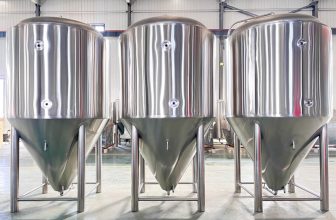
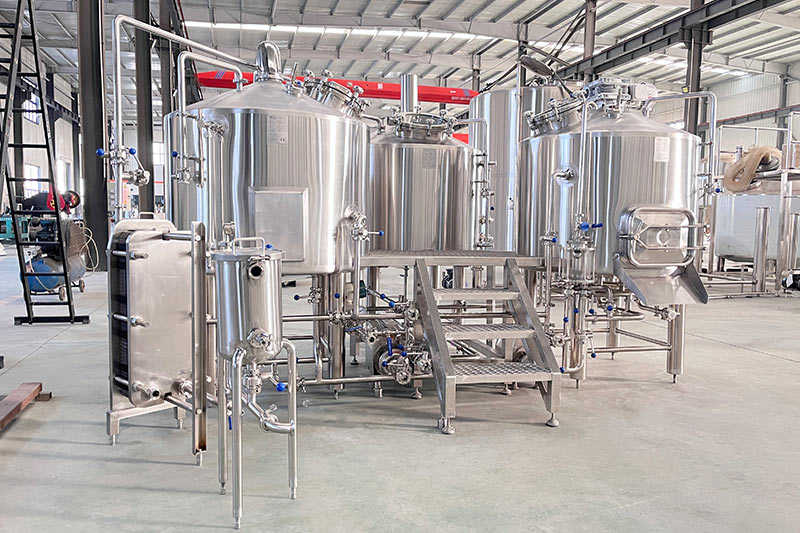
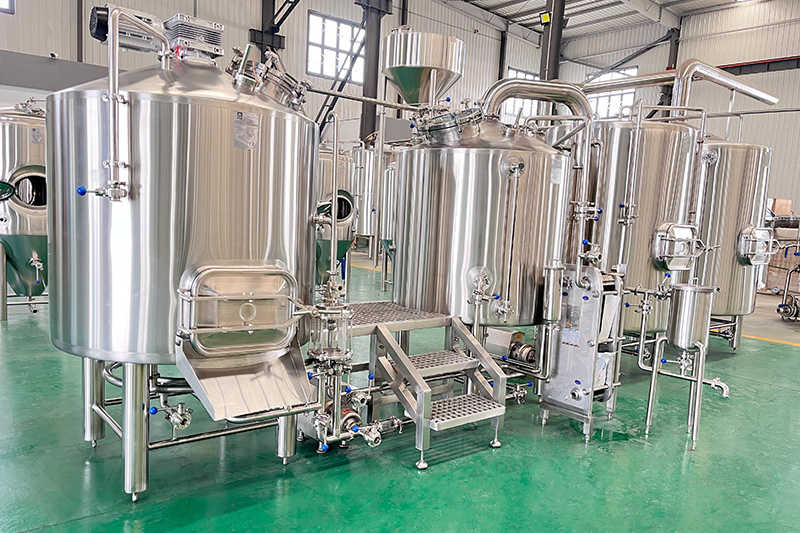
The reference build published on our site illustrates the ratio in practice: a 1000L fully automated brewery system pairs one 1000L brewhouse with eight 1000L fermentation tanks and two 2000L fermentation tanks. That is a fermentation-to-brewhouse ratio of roughly 12:1 by volume — a brewery built to run the brewhouse hard, not to look balanced on a floor plan.

Single-batch or double-batch fermenters
The other ratio decision is fermenter size relative to brewhouse size. Two options, each with a real cost.
Single-batch fermenters (one brewhouse turn fills one FV) give maximum flexibility. Every tank can be a different beer, and a recipe that fails costs you one batch. The cost is more tanks, more floor space, more valves, more glycol connections and more cleaning labour per barrel produced.
Double-batch fermenters (two brewhouse turns fill one FV) reduce tank count and cleaning labour for the same volume. The cost is a same-day double brew — a 14-hour day for the brewing staff — plus the risk that the second turn’s wort meets a fermentation already 8 hours underway. For flagship beer this is normal practice. For a brewery whose model is rotating one-offs, it removes the flexibility that is the entire business proposition.
Breweries with a stable flagship and a rotating tap wall usually end up with a mixed cellar: two or three double-batch tanks for the beers that sell every week, the rest single-batch. The published 1000L reference build follows this logic, with 2000L fermenters sitting alongside the 1000L units.
Brite Tanks: The Quietest Bottleneck in the Building
Fermenter count gets discussed. Brite tank count usually does not, and it is where a surprising number of breweries stall.
A brite tank is occupied from the moment beer transfers until the last of it is packaged or poured. If you serve directly from brite tanks to the taproom, that tank is tied up for as long as the beer sells — which for a slow-moving style can be three weeks. Meanwhile the fermenter behind it cannot release its beer, and the brewhouse behind that cannot brew.
Three configurations, with different tank counts:
- Serve-from-brite taproom model. Highest brite tank count. Each tap line on a dedicated tank. Simplest plumbing, lowest packaging cost, but tank-days per barrel are the highest of any model.
- Package-everything model. Lowest brite tank count. Beer carbonates in brite, goes into keg or can within a day or two, tank turns over quickly. Requires a filler and the labour to run it.
- Hybrid. Most common in practice. Two or three brite tanks in taproom service, the rest cycling through packaging.
MICET brite tanks are published in a range from 1 BBL to 300 BBL, with spec pages at 10, 15, 20, 25, 30, 35, 40, 50 and 60 BBL, plus a 3000L horizontal configuration. The horizontal option is worth flagging for low-ceiling buildings, where a vertical tank of equivalent volume will not clear the roof structure with its manway open.
Glycol: The System Most Often Undersized
If one component is systematically under-specified in first breweries, it is the glycol chiller.
The sizing error comes from a reasonable-sounding assumption: add up the jacket area of the tanks and size the chiller to hold them at temperature. That number is not the load. The real load is dominated by two events that do not happen at steady state.
- Wort knockdown. Bringing a full batch from whirlpool temperature to pitching temperature, in a window short enough that the wort is not sitting warm and unprotected, is a large short-duration load. If you rely on the glycol system for the final pull rather than a properly sized heat exchanger with adequate cold liquor, you have moved a huge load onto the chiller.
- Crash cooling. Dropping a fermenter from fermentation temperature to 2–4°C is the single largest sustained load in the cellar, and it becomes a problem specifically when two tanks need to crash on the same day. Which happens the week you are busiest.
Two design consequences follow. Size for concurrent peak events, not the average. And specify glycol reservoir volume with headroom, because a larger buffer tank absorbs short peaks that would otherwise cycle the compressor hard.
Refrigerant selection is a related decision that has moved quickly under European F-gas regulation. The 1000L automated system we publish specifies R449A, a lower-GWP refrigerant. If you are installing in the EU or UK, confirm the refrigerant on your quoted chiller against current regulation rather than accepting whatever the standard build uses, because a chiller specified against an older refrigerant standard can become expensive to service.
CIP, Drainage and the Layout Nobody Draws Until It Is Too Late
Cleaning is the operation that consumes the most cellar labour hours and receives the least design attention.
MICET fermentation tanks are supplied with CIP cleaning nozzles fitted and a glycol jacket as standard, in SUS304 with 304/316 available on selected configurations. The vessel side is straightforward. What varies enormously between good and bad installations is everything around the vessel.
Flow velocity, not pressure. Effective CIP depends on achieving turbulent flow in the return path. Roughly 1.5 m/s in the return line is a widely used engineering design target for CIP circuits. A pump that produces impressive pressure but insufficient return velocity leaves film in the tank. This is a pump and pipe-diameter decision made at layout stage, not something you can fix later with stronger caustic.
Floor slope and drain placement. Trench drains running between tank rows, with the floor pitched toward them, is the arrangement that works. Point drains under individual tanks fail the moment you dump a cone and the yeast slurry has nowhere to run.
Clearance around the cone. You need room to get a hose, a bucket and a person under the dump valve, and room to swing the manway. Tank spacing drawn to fit maximum vessels into minimum floor area produces a cellar that is technically full and practically unworkable.
Ceiling height. Measure to the lowest obstruction — sprinkler heads, ductwork, beams — not to the roof deck. Then add clearance for the manway to open and for a person to reach the top of the tank.
Water Treatment: Small Line Item, Large Consequence
Water chemistry determines whether your beer is repeatable across a year, because municipal supply is not constant across seasons.
The published 1000L reference build includes a 1000L/H RO water treatment unit. Sizing RO capacity is a scheduling question rather than a volume question: you need enough treated water in the tank at strike time, and RO produces slowly. A 1000L/H unit feeding a 1000L brewhouse means several hours of production per brew day, which is fine if it runs overnight and a problem if it does not start until the brewer arrives.
What MICET Turnkey Systems Include at Each Scale
The published catalogue splits into three tiers. The table below covers what is documented; where a figure is not published, that is stated rather than estimated.
| Nano | Microbrewery | Commercial | |
| Capacity band | 5 BBL or less | Systems around 30–60 BBL scale; up to 15,000 bbl/year output | 10 BBL minimum, supplied up to 80 BBL |
| Published spec pages | 100L, 200L, 300L, 500L, 700L, 800L, 1000L, 10 BBL | 1200L, 1500L, 2000L, 2500L, 3000L | 1000L through 5000L |
| Vessel configurations | Brewhouse spec pages published at 300L and 500L with 2/3/4 vessel options | 2, 3 or 4 vessel | 2, 3 or 4 vessel; 4-vessel peak output 80 BBL/day |
| Typical footprint reference | A 3 BBL facility from roughly 250–500 sq ft | Not published | Not published |
| Published price band | Not published; requires direct quote | 30,000–80,000 USD | 50,000–80,000 USD for the smallest 10 BBL commercial system |
| Typical buyer | Nano breweries, bars, restaurants | Established craft producers | New commercial breweries, commonly advised at 10–30 BBL |
Brewhouse spec pages are published at 300L, 500L, 2, 7, 10, 15, 20, 25 and 30 BBL, covering mashing, filtering, boiling and whirlpool functions. Fermenter spec pages run 500L through 2500L and 40, 50 and 60 BBL. Individual tank pricing outside the packaged system bands is not published and requires a direct quote, since it varies with capacity, jacket configuration, material grade and fittings.
On documentation: MICET brewing and brewery equipment holds a PED verification under Directive 2014/68/EU, certificate 3N231110.SICS093, issued by Ente Certificazione Macchine Srl on 10 November 2023, valid to 9 November 2028. A separate verification of conformity within PED scope, ICR/VC/HM2507146, was issued by ICR Co., Ltd. on 16 July 2025 and runs to 15 July 2030. For an EU or UK installation, request current copies of these during quotation — pressure vessel documentation is easier to obtain before shipment than after.
Laying Out the Cellar Before You Sign
A sequence that catches most of the expensive mistakes:
- Write down your production plan in barrels per year, by beer. Not capacity. Plan. What you intend to sell, in what proportions.
- Convert that into brewhouse turns per week. This gives you your batch size, working backward from output rather than forward from an aspirational tank size.
- Apply the fermentation cycle to get tank count. Use real cycle times for your recipes, including conditioning, not the fastest possible turn.
- Add the buffer. Minimum one spare fermenter beyond the calculated number. Two if your plan includes lagers.
- Decide the brite model. Serve-from-brite, package-everything, or hybrid, since this determines brite count and whether you are buying a filler in year one.
- Sum the concurrent cooling load. Knockdown plus the worst-case simultaneous crash, and size glycol against that peak.
- Draw the cellar to scale with clearances marked. Tank diameters plus the space to walk, clean, dump and swing manways. Mark the drain runs.
- Check the vertical dimension against the lowest obstruction. Then confirm the delivery path — door widths, corner radii, whether the tank can be stood up inside the room.
- Send the drawing to your supplier before the quote is final. A layout review at this stage is cheap. Discovering a clearance problem when the tanks are on a truck is not.
Where This Goes Wrong: Three Real Failure Modes
Buying the brewhouse first. The most common sequencing error. The brewhouse is chosen for batch size, then the cellar budget is whatever remains. This inverts the arithmetic — cellar capacity sets output, and it should be specified first.
Assuming expansion means more fermenters. It usually means glycol, CIP capacity and drain runs as well. A cellar designed with a chiller sized exactly to the initial tank count cannot accept the tanks you add in year three without a second chiller or a replacement.
Specifying material grade by habit. SUS304 is the standard and is correct for the overwhelming majority of brewing service. Where 316 becomes worth its cost premium is in specific chloride-exposure situations — some water sources, some cleaning regimes, certain coastal installations. Paying for 316 throughout a cellar that does not need it is a common way to spend budget that the glycol system needed.
Compared With the Common Alternatives
Against the scaled-up homebrew kits that occupy much of the search results for this term, a commercial craft beer system differs in one respect that matters more than the others: repeatability under continuous duty. A 200L pilot rig can make excellent beer. It cannot make the same beer 48 times a year while being cleaned daily by staff who did not build it.
Against the packaged single-vendor turnkey systems that dominate the category at the other end, the trade-off is different. A packaged system arrives with the tank ratio, glycol size and layout already decided by the vendor’s standard build. For a conventional production plan, that is a genuine time saving and reduces integration risk. Where it breaks down is a specific case: a buyer whose plan is unconventional — lager-heavy, high one-off rotation, or serve-from-brite with a large tap wall — accepts a standard cellar ratio designed around a different model, then finds the constraint within eighteen months.
The general point is that no cellar ratio is correct in the abstract. It is correct relative to a production plan, which is why the production plan has to exist before the quote does.
FAQ
Q: How many fermenters do I need for a 10 BBL brewhouse?
A: Four to six for two brews a week on a 14-day cycle, and seven to eight if your plan is lager-heavy. Calculate from your own cycle times and add at least one spare beyond the number that math produces.
Q: What does a complete craft beer system cost?
A: Published bands are 30,000–80,000 USD for microbrewery equipment and 50,000–80,000 USD from the smallest 10 BBL commercial system. Configurations outside those packages, including individual tanks and custom cellar builds, are not published and require a direct quote.
A: Buying tank capacity later is straightforward. Buying glycol capacity, drain runs and floor space later is not. If budget forces a choice, specify the infrastructure for your year-three tank count now and buy the tanks themselves as needed.
Q: Vertical or horizontal brite tanks?
A: Vertical for most installations. Horizontal — the published 3000L horizontal configuration, for instance — becomes the answer in buildings where ceiling height will not clear a vertical vessel with its manway open.
A: For most brewing service, no. SUS304 is the standard grade and MICET tanks are built in it, with 304/316 available on selected configurations. The case for 316 is chloride exposure specific to your water and cleaning chemistry, not a general upgrade.
Q: What certifications should I request for an EU installation?
A: PED documentation under Directive 2014/68/EU for pressure vessels. MICET holds certificate 3N231110.SICS093 from Ente Certificazione Macchine Srl and verification of conformity ICR/VC/HM2507146 from ICR Co., Ltd. Ask for current copies during quotation.