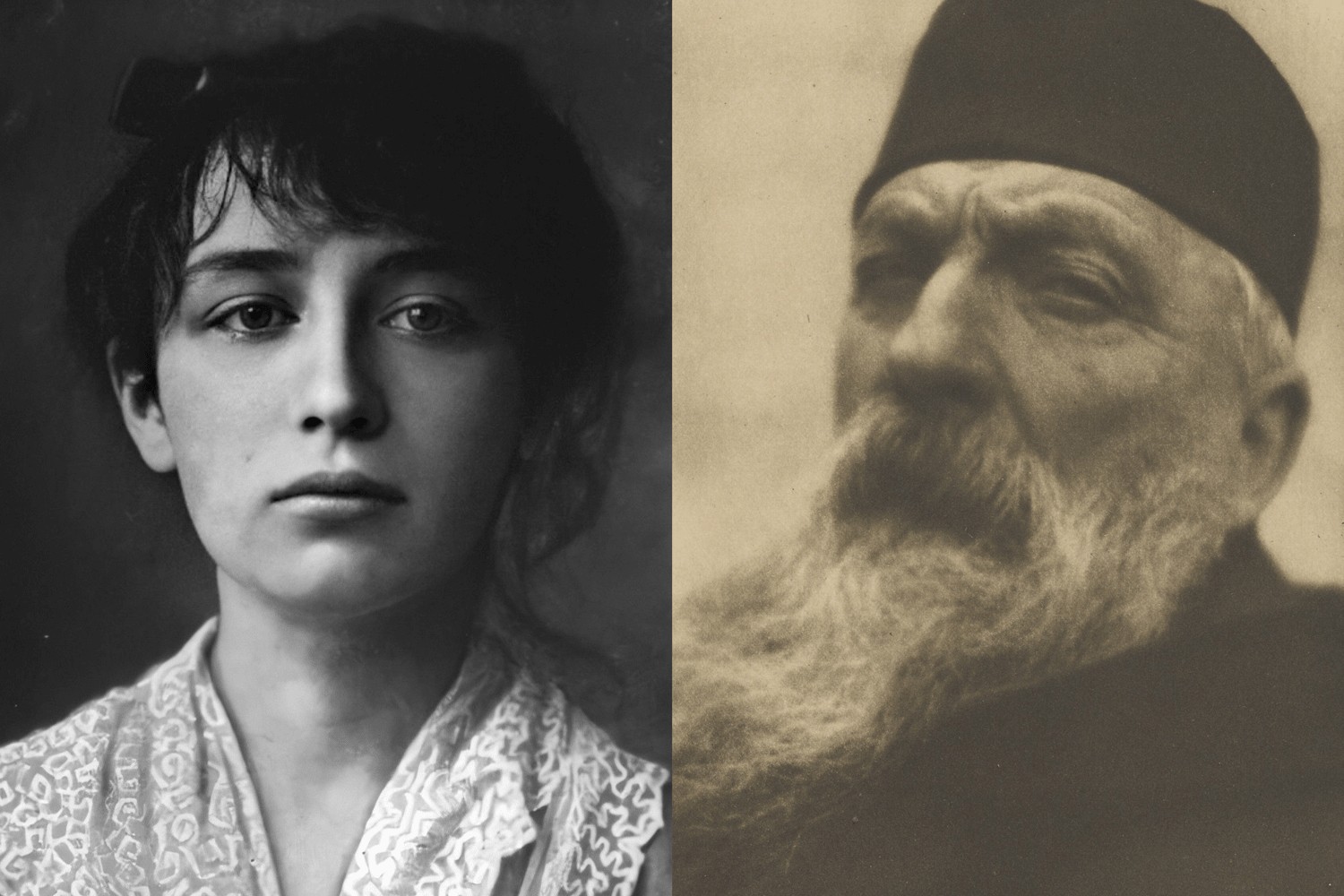
Camille Claudel defied convention by fearlessly pursuing sculpture regardless of the expectations placed on women in her time. At her side was one of the most famed sculptors of art history – Auguste Rodin – who she shared an intense bond with. Their relationship was both professional and romantic, built on a mutual passion for their work, yet ultimately destroyed by Rodin’s inability to commit to her. So how did their relationship influence each artist’s work, and what happened after their affair?
Connections between individual artists in art history remind us that at the core of art movements and the progress of visual culture were human individuals, with real personalities, fears, and dreams. Whilst we can never know their true feelings, documented relationships between artists – whether clashes or companionship – offer fascinating context to their lives. No artist truly creates in isolation, and competition and collaboration are as much facets of the art world as creation.
Introducing Francois Auguste René Rodin

Alvin Langdon Coburn
Photogravure, 21.4 x 16.2 cm | 8.4 x 6.4 in
Getty Museum
‘The main thing is to be moved, to love, to hope, to tremble, to live. Be a man before being an artist!’ – Auguste Rodin
Few sculptors have embedded themselves as a household name outside of the art world, yet Francois Auguste René Rodin certainly achieved this. His works like The Thinker, The Kiss, and The Burghers of Calais have been endlessly referenced in popular culture, enforcing his weighty legacy as the ‘founder of modern sculpture’. His work adapted the traditional themes of mythology, allegory, and experience, rendered with a mastery of naturalism that he was able to infuse with his characteristic flair.
Rodin sought to capture complex movement and emotion through innovative texture, form, and ‘unfinished’ surfaces to convey psychological states. He rejected the rigidity of academic sculpture by giving his subjects physical tactility and breaking figurative sculpture into its component parts. And he found that the expressive quality of the shattered form or individual limb had potency. Many of his sculptures were criticised in his time for their departure from convention, yet Rodin refused to change his course and was increasingly rewarded for it. Despite the international success he found within his lifetime, Rodin actually had a relatively slow start to his career.

Auguste Rodin
Plaster sculpture, 179.1 x 141.6 cm | 70.5 x 55.7 in
The Metropolitan Museum of Art
Rodin was born in 1840 in Paris, and was tutored at a specialist art school by Horace Lecoq de Boisbaudran between the ages of 14 and 17. Unconventionally for this era, Boisbaudran encouraged his students to develop personal character before observational skills, which Rodin credited with establishing his foundational attitude towards art making. On leaving the school, Rodin submitted his first application to join the École des Beaux-Arts. It was not to be his last. After three rejections, he was downcast, and in his disappointment, turned away from the possibility of a career in fine art. For much of the next 20 years, he worked as a craftsman and ornamenter, producing decorative objects and architectural embellishments for various employers.

Antoine-Louis Barye
Bronze cast, 22.9 x 34.3 x 17.1 cm | 9 x 13.5 x 6.7 in
The Metropolitan Museum of Art
In 1862, Rodin turned away from art making completely after his sister Maria died of peritonitis in a convent. He blamed himself for her death, and in his despair joined the Catholic order of the Congregation of the Blessed Sacrament as a laybrother. During this vulnerable period in his life, the head of the congregation noticed Rodin’s talent and encouraged him to return to making sculpture. After returning to working as a decorator, he also began making sculpture again at classes led by the animalier Antoine-Louis Barye. We can see traces of Barye’s influence on Rodin’s works in their emphasis on musculature and motion.

Auguste Rodin
Cast plaster sculpture, 27.1 x 16.2 x 16.8 cm | 10.7 x 6.4 x 6.6 in
The Metropolitan Museum of Art
In 1864, Rodin met and began living with Rose Beuret, who was a seamstress and one of his earliest muses. They remained partners for the rest of their lives, despite Rodin’s numerous affairs and his persistent refusal to marry her. In 1866, they had a son, August-Eugene Beuret, who Rodin rejected and allowed to be raised by his family for years at a time. During this period, Rodin worked in the studio of the sculptor Albert-Ernest Carrier-Belleuse, and was his chief assistant until 1870. At the beginning of the Franco-Prussian War that year, Rodin was called to serve in the French National Guard, but his poor eyesight had him discharged. In the wake of the war, decorative commissions in France dwindled, so he travelled to Belgium to again work with Carrier-Belleuse. When their professional relationship weakened, Rodin found work in Brussels, and in total spent six years working outside France.

Auguste Rodin
Bronze sculpture, 180.5 x 68.5 x 54.5 cm | 71 x 27 x 21.5 in
The Metropolitan Museum of Art
In 1875, Rodin spent two months in Italy, where he studied works by the Masters of the Renaissance. When he returned to Belgium later that year, aged 35, he was inspired by his research and began working on his first large-scale sculpture that would initiate his career, The Age of Bronze. On its debut at exhibition, the work was so successful in its naturalism that he was struck with controversy – he was accused of making a cast from a living model. In indignation for the rest of his career, Rodin intentionally made works that were larger or smaller than life, to prove that this wasn’t ever the case.
When Rodin and Rose Beuret finally returned to Paris in 1877, they saw the son that they had left behind for six years with Rodin’s aunt. Rodin continued to work for other sculptors to realise their projects, whilst working on his own in his free time. In this period, he was in the preparatory stages of making St. John the Baptist Preaching. He described the moment he was inspired to sculpt it, when the model Pignatelli walked confidently into his studio, ‘The peasant undressed, climbed onto the table as if he had never posed before; he stood firmly, head raised, torso straight, carrying himself at the same time on both legs, open like a compass. The movement was so right, so clear, and so true that I cried out: ‘But it’s a man walking!’ The bust below was made in reference to the full figure sculpture, capturing the intensity of expression that is characteristic of Rodin’s oeuvre, with hollows for eyes and undulating skin to catch the shadows.

Auguste Rodin
Bronze sculpture, 54.3 x 40 x 27.9 cm | 21.4 x 15.7 x 11 in
The Metropolitan Museum of Art
In 1880, he started a new job as a designer at a porcelain factory, and also won a commission to create a portal for a museum of decorative arts that was never built. He spent much of the next forty years working on the plans for his Gates of Hell, which captured scenes from Dante’s Inferno. Of the figures in this grand figurative work, individual sculptures like The Thinker and The Kiss were developed through the process. Whilst working on this commission, he was given a free studio and managed to stop working in the porcelain factory in 1882 with this financial support. Preparatory drawings for the commission, like the one below, show his proficiency and innovation as a draftsman, which supported his sculpture.

Auguste Rodin
Pen and ink, graphite, and wash drawing, 15.6 x 9.6 cm | 6.1 x 3.8 in
The Metropolitan Museum of Art
In 1883, whilst his professional reputation was accelerating, Rodin was asked by his friend Alfred Boucher if he would take over mentoring a group of young women sculptors. Camille Claudel was part of this studio – they met when she was just 18, and Rodin was 43.
Introducing Camille Claudel

Plombelec, via Wikimedia Commons
‘We are in the presence of something unique, a revolt of nature: a woman genius.’ – Octave Mirbeau
Camille Claudel made an indelible mark on modern sculpture in her short yet incredibly impactful career. Although she once fell into obscurity in the face of the patriarchal dominance of art history, her work has been increasingly valued and acclaimed. Today, she isn’t considered merely Rodin’s student, muse, or even collaborator – but as an incredible sculptor in her own right. Claudel’s influence on Rodin is just as notable as his on her, and it’s clear from records that he relied on her to execute many of his works as his studio grew. Claudel also had the skill to carve sculptures from stone, unlike Rodin, who relied on professional stonecarvers to replicate his sculpted models. Her efforts are especially poignant in an era when sculpture wasn’t yet deemed an acceptable pursuit for women. Her work embodies the Symbolist characters of myth and emotion, often centring the themes of love and loss. Her works are at once intimate, dynamic, and vulnerable – confessing the emotions of her own life through form.

Camille Claudel
Bronze sculpture, 35 x 27 x 26 cm | 13.8 x 10.6 x 10.2 in
Getty Museum
Camille Claudel was born in 1864 in Fère-en-Tardenois in the north of France, and began experimenting with sculpture as a teenager. She was initially tutored by the sculptor Alfred Boucher, who encouraged the family to relocate to Paris so she could pursue art. There she worked in a studio amongst other women artists – Amy Singer, Emily Fawcett, and Jessie Lipscomb. Boucher would visit them a couple of times a week, whilst they studied at the Académie Colarossi, which accepted women, unlike the École des Beaux-Arts.

New Photographic Society
Gelatin silver print, 8.8 x 17.9 cm | 3.5 x 7 in
Rijksmuseum
Since professional models were expensive and female artists were discouraged from working with nude models, Claudel produced sculptures of many of her family members and peers in her early period. She sculpted her brother Paul most often, including in Young Roman, pictured below, when he was aged 13. The sculpture adeptly conveys this classical character’s performed confidence, paired with an adolescent nervousness in his expression, anticipating danger.

Camille Claudel
Plaster with polychrome patina, 52 x 45 x 27 cm | 20.5 x 17.7 x 10.6 in
Art Institute of Chicago
When Boucher won the Paris Salon prize in 1882, he was required to travel to Italy. He asked his friend Auguste Rodin to continue Claudel and the other young women’s tuition in his absence. As his student, Claudel and Rodin quickly bonded over a love of their craft, before becoming key collaborators, muses, and lovers.
The Relationship Between Rodin and Claudel
After Rodin received major commissions in the early 1880s, he brought together a team of sculptors to help him execute his projects. Despite still being a teenager, Claudel joined the team in 1884 after Rodin recognised her abilities whilst tutoring her group of sculptors. Although it’s unclear exactly what each artisan worked on, Claudel reportedly sculpted many of the hands and feet of the figures for Rodin’s major works. Despite the intensity of the craft involved, she maintained her own practice, and between 1882 and 1889, Claudel was frequently exhibiting her own sculptures. During this time, several of her works were purchased by museums, and she benefited from some of Rodin’s connections.
Camille Claudel
Bronze sculpture, 12.7 x 9.2 x 10.8 cm | 5 x 3.6 x 4.3 in
Philadelphia Museum of Art
The influence between teacher and student wasn’t just beneficial to Claudel in learning the methods and flair of the modern master. Rodin also found Claudel essential through the exchange of ideas, the intensity of her dedication, and the preparation of his works. The direct influence of Claudel’s oeuvre on Rodin can be seen in specific works, where he borrows from her innovations. For example, a year after Claudel sculpted Young Girl with a Sheaf, Rodin produced his Galatea, which directly borrows from her composition.

Auguste Rodin
Marble sculpture, 97.2 x 88.9 x 76.2 cm | 38.3 x 35 x 30 in
The Metropolitan Museum of Art
The pair worked side by side in a shared studio. The height of their relationship is emulated in their works from the period – featuring entwined bodies in moments of passion – and both artists drew some criticism for the eroticism present in their works. In Pygmalion and Galatea by Rodin, Pygmalion isn’t depicted in the typical form of a young man, but a bearded older man. It’s thought that Rodin saw himself as something of a modern Pygmalion, who fell in love with a sculpture (or perhaps a sculptor). It’s impossible to look at works like these without considering the context of his relationship with Claudel in her youth.
In the spring of 1886, Claudel travelled to England with Jessie Lipscomb and her brother Paul Claudel, who was a poet and dramatist. She exhibited her Portrait of Jessie alongside work by Lipscomb at Nottingham Castle, and created a series of charcoal drawings. After months away, on her return to Paris in September of the same year, she asked Rodin to sign a ‘contract’ that he would accept no other women as students, that he would protect her within the art world, and that he would marry her following a trip abroad. The conditions of her contract would not be fulfilled – but they display her desperation to keep Rodin’s affection, which was not hers alone.

Auguste Rodin
Marble sculpture, 33 x 48.3 x 63.5 cm | 13 x 19 x 25 in
Philadelphia Museum of Art
In 1886, Claudel worked on Sakountala – inspired by a drama by the Hindu poet Kalidasa. A famous photograph of Claudel remains, showing her working in the studio on the female figure of the ensemble, next to Jessie Lipscomb. She wrote to her friend Florence Jean whilst working on the project; her words make her dedication and incredible work ethic clear:
‘I’m now working on my two larger-than-life figures and I have two models per day: a woman in the morning, a man in the evening. You can understand how tired I am: I regularly work 12 hours a day, from 7 in the morning until 7 in the evening, and when I get home, it’s impossible for me to remain standing and I go directly to bed.’
In 1887, Claudel and Rodin travelled to Touraine together to research and work on his Monument to Balzac, to honour one of France’s great writers. By bringing her along, we know she was essential to his process. It took him seven years to resolve the composition beyond his relationship with Claudel. He was accused by the sculptor Merdado Rosso of copying his ideas for the final work, which gives Claudel’s claim that he relied on her ideas while they were together further credit.

Auguste Rodin
Bronze sculpture, 106 x 44.5 x 41.9 cm | 41.7 x 17.5 x 16.5 in
The Metropolitan Museum of Art
By 1889, both Claudel and Rodin’s long-term partner, Rose Beuret, were exhausted with Rodin’s double life and his inability to commit fully to either of them. In 1892, Claudel had an unwanted abortion, likely pressured by Rodin, who refused to separate from Beuret, and their relationship ended from this point forward. She found herself alienated in the art world she’d made strides in since her teenage years, now working as a woman alone, and suddenly without the resources and support she had experienced in Rodin’s studio. It’s thought that Rodin increasingly viewed her as a rival, knowing the value of her skills, and turned potential supporters against her.
Beyond the Relationship

Auguste Rodin
Plaster sculpture, 22.9 cm | 9 in
National Gallery of Art
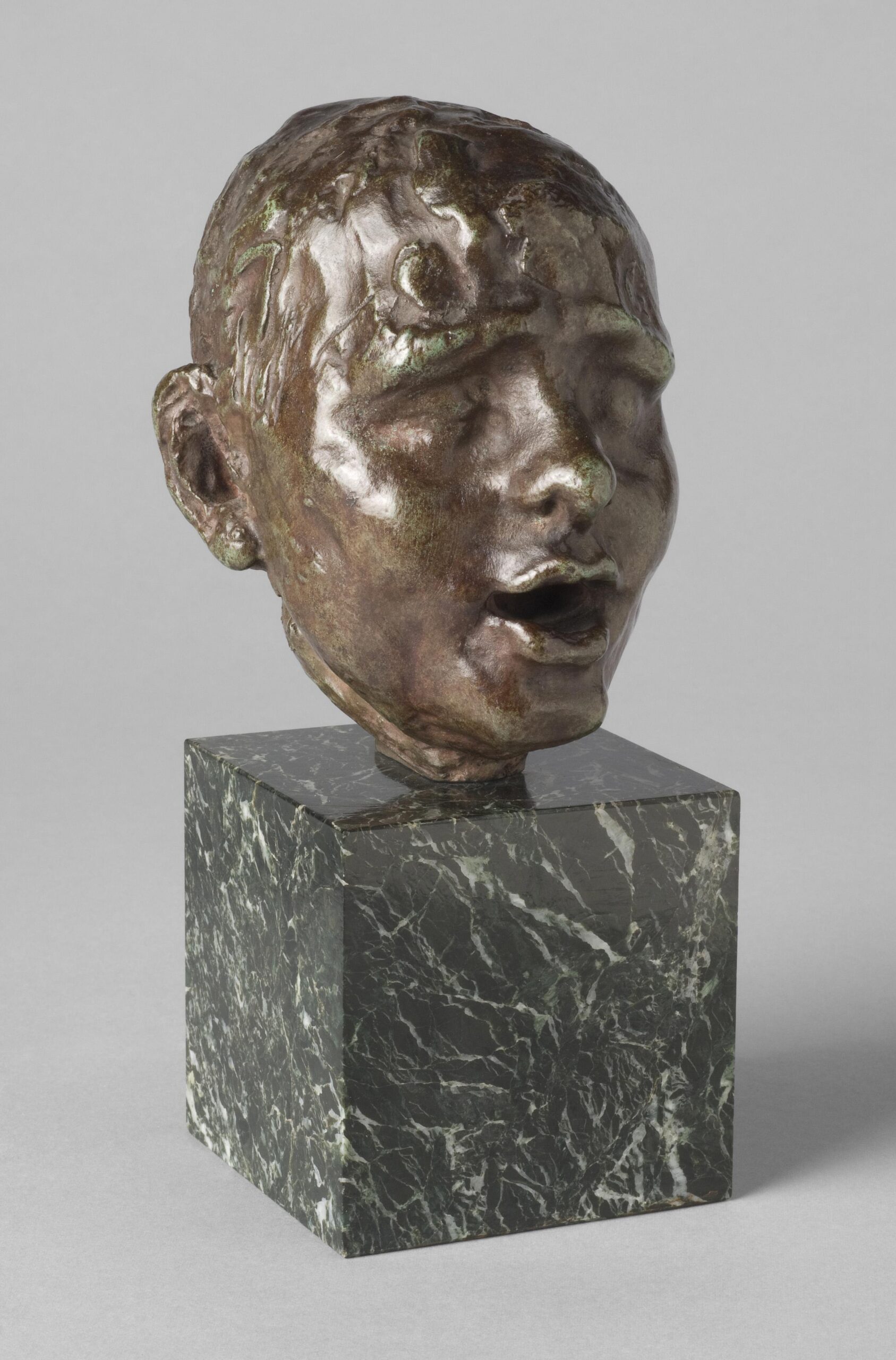
Claudel credibly accused Rodin of stealing her work and ideas, and there is plenty of evidence to support this. It’s a certainty that Rodin signed Claudel’s Head of a Laughing Boy when it was cast in bronze. It’s difficult to assess how many other works were wrongfully signed by Rodin. During their early relationship, they worked on one of Rodin’s masterpieces, The Burghers of Calais. We already know that Claudel worked on the hands and feet of Rodin’s sculptures, so we can assume she sculpted them in The Burghers, where they are oversized and essential to the impact of the work. Other art historians argue that the fabric draping from the figures, and the figure composition suggest Claudel’s hand rather than Rodin’s, in contrast with the clunkier choices made by Rodin before and after the end of their relationship. An art historian of their time, Mathias Morhardt, had written,
‘Rodin would deliberate with her on every decision that had to be taken, and not until she was in agreement would he venture to take a decisive step.’

Auguste Rodin
Bronze sculpture, 209.6 x 238.8 x 241.3 cm | 82.5 x 94 x 95 in
The Metropolitan Museum of Art
Claudel presented one of her most famous works, The Waltz, shortly after the end of their relationship. The work drew controversy for its blatant eroticism, showing two lovers dancing. In Claudel’s initial sculpted sketch, the figures were nude, which a government-appointed art inspector noted was a ‘violent accentuation of reality’. In response, she lightly draped the female figure in fabric, making the offensive details ‘sufficiently veiled’.
After the end of their relationship, Claudel isolated herself in the studio, determined to break away from Rodin’s shadow. She was upset by the constant comparison of her work to Rodin’s, rightly feeling that she deserved her own credit for the work. In this period of isolation, she began intentionally seeking out a completely new style that no one could associate with Rodin. These pieces took the form of everyday scenes of feminine community, such as her extraordinary work The Chatterboxes. The journalist Matthias Morhardt wrote in 1898, ‘By taking the ordinary parts of life and instilling them with art and plasticity, Mademoiselle Claudel has created a new art; she has struck gold. A gold that is hers alone.’

Camille Claudel
Bronze sculpture, 28.3 x 25.5 x 16 cm | 11.1 x 10 x 6.3 in
Nationalgalerie, Staatliche Museen zu Berlin
The Age of Maturity is Claudel’s masterpiece – ambitious in scale and execution. She worked on it over nine years, from 1890 to 1899. The work exists in the Symbolist tradition – broadly personifying the themes of mortality. Yet it is also deeply autobiographical. We see a spectral elderly woman clinging to a middle-aged man, who walks away from a begging young woman on the ground behind him. She reaches with futility toward his hand, but is ultimately left behind. It’s clear that the woman on the ground is a self-portrait of Claudel herself, unable to be married to Rodin. Claudel’s brother, the poet Paul Claudel, confirmed the identity of his sister in the work decades after its debut by lamenting,
‘My sister! My sister Camille. Imploring, humiliated, kneeling, this superb woman, this proud woman, this is how she is represented. Imploring, humiliated, kneeling, and naked!’
After the initial successful debut of the plaster work, Claudel sought out a commission from the French government to have it cast in bronze as a public sculpture. Although this seemed to initially go smoothly, her contract was abruptly cancelled for unclear reasons. It’s been thought that Rodin was furious when he saw the sculpture for the first time, and that, with his fame and influence, he intervened to prevent this work that exposed his private life from being publicly endorsed. Today, a bronze cast of the sculpture is in the permanent collection of Musée d’Orsay in Paris.

Auguste Rodin
Marble sculpture, 34.6 x 37.8 x 19.7 cm | 13.6 x 14.9 x 7.8 in
The Metropolitan Museum of Art
After 1905, Claudel tragically destroyed a significant amount of her own work. She had become mentally unwell and was distraught by Rodin’s treatment of her. About 90 statues, drawings and sketches survive her, which is a fraction of her theorised output. After the death of her father in 1913, Claudel was diagnosed with ‘paranoid psychosis’, and was interred at a psychiatric hospital for the last 30 years of her life. Her family was repeatedly informed by doctors that she could be released or moved closer to them and that she was sane, but they continuously refused.
It’s impossible to know for certain, but it’s thought her unjust confinement was enforced by her brother Paul’s jealousy of her genius. By putting her away, he attempted to aggrandise his own legacy by removing the obstacle of his inimitable sister. One telling example of this is that ten years after Camille’s death, her remains were transferred to an unmarked communal grave at the asylum she’d been trapped in for 30 years, with only a simple plaque acknowledging her. On the contrary, her brother Paul took great lengths to plan his own resting place, citing the exact words and location for a noble tomb. Camille’s own mother never visited her whilst she was institutionalised – she was notably perturbed by her daughter’s pursuit of art, and disgusted at her relationship with Rodin. Claudel was failed by so many people who should have uplifted her, making her story one of the great tragedies of art history.
Tragically, whilst she was institutionalised, Claudel refused to make any more sculptures. Her work was widely forgotten until her rediscovery in the 1980s, and she is now considered a pioneering sculptor, whose works are still being reassessed. Today, about half of Claudel’s surviving works are housed in the Musée Camille Claudel, which opened in 2017 in the Claudel family’s former home. A notable number of her works are housed in the Musée Rodin.

1890-1905
Auguste Rodin
Watercolour and graphite on paper, 44.5 x 31.7 cm | 17.5 x 12.5 in
Art Institute of Chicago
In 1904, Rodin formed a new relationship with the artist Gwen John. Over the next decade, they would constantly write to each other, but Rodin again could not commit and remained with Rose Beuret. At an insultingly late stage in life, Rodin finally married his long-term partner and the mother of his child, Rose Beuret, in 1917, just 16 days before her death. Rodin himself died just eight months later.
The relationship between Auguste Rodin and Camille Claudel is one of incredible artistic collaboration, passion, rivalry, and respect, but also one of deep betrayal, shame, and exploitation. It’s difficult to reassess the legacy of one of the most important sculptors in history – but Camille Claudel’s work and story truly demand it.
Further Reading
Rivalries and Friendships in Art History: Labille-Guiard and Vigée Le Brun
Rivalries and Friendships in Art History: Whistler vs. Ruskin
Behind the Movement: Symbolism
A Guide to Drawing in Galleries and Museums
Shop Art Materials on jacksonsart.com