The Baltimore Museum of Art has announced the acquisition of approximately 118 artworks over the past six months. The new additions to its collection—purchases, gifts, and promised gifts—span periods, cultures, and mediums, strengthening the BMA’s holdings of art from around the globe as well as work by Baltimore-area artists.
The acquisitions include 64 works gifted by Baltimore resident Constance R. Caplan, a former BMA board chair who has been actively engaged with the institution for more than 50 years. Her gift includes pieces by Janine Antoni, Bernd and Hilla Becher, Fernanda Gomes, Robert Morris, Stephen Parrino, Richard Tuttle, Lee Ufan, Jack Whitten, Lisa Yuskavage, and others.
Other acquisitions include paintings by Oswaldo Guayasamín, Amy Sherald, Louis Fratino, and Stanton MacDonald-Wright; sculptures, mixed-media works, and installations by Rina Banerjee, Ali Eyal, Sanaa Gateja, and Reverend Joyce McDonald; ceramics by Siphiwe Nala and Heidi Lau; photographs by Curran Hatleberg and Oumar Ka; and works on paper by Tarsila do Amaral, Margaret Burroughs, and Ben Shahn.
“Over the past several years, the BMA has invested strongly in several important strategies: enhancing the scope and meaning of collection diversification; developing deep relationships with private and public collaborators who share our institutional ideals; and uplifting Baltimore’s vibrant and growing artistic community. The acquisitions announced today are a beautiful and exciting encapsulation of those priorities,” said Asma Naeem, the BMA’s Dorothy Wagner Wallis Director.
Below, a look at seven works newly acquired by the Baltimore Museum of Art.
-
Myrlande Constant, Agou Zeclaire, 1999

Image Credit: Collection of the Baltimore Museum of Art. Artwork copyright © Myrlande Constant. Born in Port-au-Prince in 1968, Myrlande Constant emerged in the early 2000s as one of the first women makers of devotional Haitian drapo Vodou (Vodou flags). Her contemporary interpretations of these beaded and sequined artworks are often larger and more ornate than customary. They generally take as their subject the intersection of terrestrial and spiritual worlds, as in this piece dedicated to Agaou, the Vodou loa (spirit) of storms.
-
Louis Fratino, Studio Nude, 2025

Image Credit: Collection of the Baltimore Museum of Art. Artwork copyright © Louis Fratino. Drawing on the work of modernist masters such as Matisse, Picasso, Marsden Hartley, and Georgia O’Keeffe, Louis Fratino (b. 1993) creates figurative paintings and drawings depicting everyday life and intimate moments from a queer male perspective. His emotive artworks, based on personal memories and experiences, range from tender portraits of friends and family to explicit images of sexual encounters and, as here, variations on the time-honored subject of the nude model.
-
Reverend Joyce McDonald, Momma’s Love, 1998

Image Credit: Collection of the Baltimore Museum of Art. Artwork copyright © Joyce McDonald. Artist, activist, and “spiritual nurse” Reverend Joyce McDonald (b. 1951) was ordained as a minister in 2009, following a long battle with addiction and a 1995 HIV diagnosis. She began working with clay in 1997 while enrolled in an art-therapy program, creating figurative sculptures on themes of survival, love, and healing. McDonald considers her art inseparable from her advocacy: she has founded an HIV-awareness and creative-arts group for young girls and teens; worked with women in shelters and hospitals; written letters to incarcerated women; and coordinated her church’s AIDS ministry while serving as director of its children’s choir. She is also an active artist-member of Visual AIDS.
-
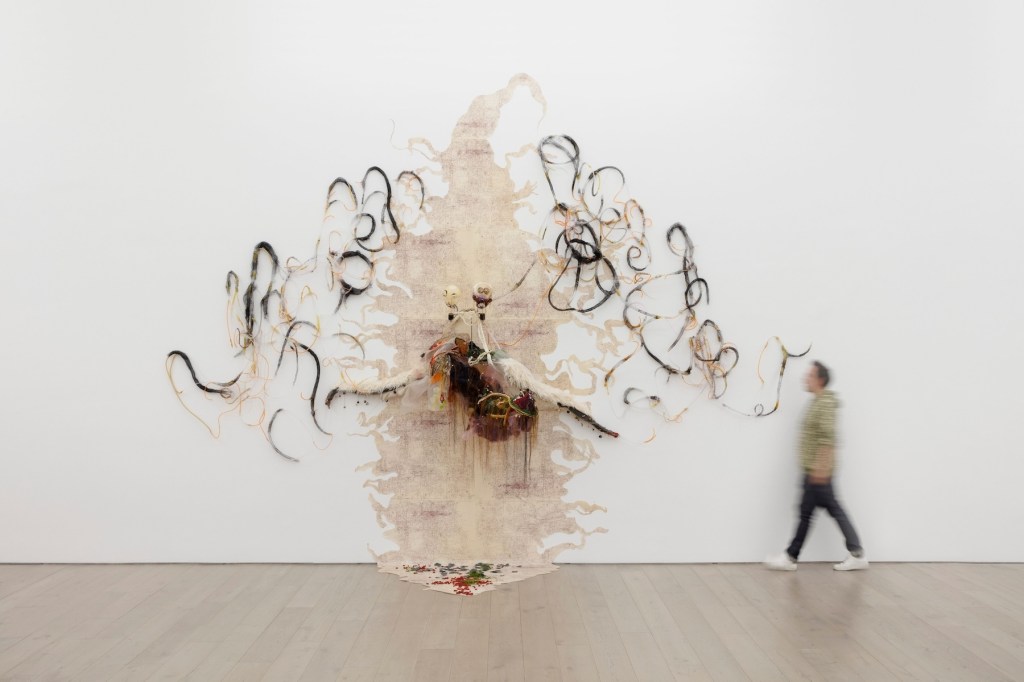
Rina Banerjee, Contagious Migrations, 1999–2023

Image Credit: Collection of the Baltimore Museum of Art. Artwork copyright © Rina Banerjee, courtesy the artist and
Perrotin. Photo: Guillaume Ziccarelli.In her sculptures, drawings, and installations, Indian-born artist Rina Banerjee (b. 1963) addresses migration, diaspora, and the construction of identity. First presented at the 2000 Whitney Biennial, Contagious Migrations considers the fear of disease—from flu outbreaks to the AIDS crisis—in relation to the aversion to difference. Layering unconventional materials such as false fingernails, spices, and Silly Putty, Banerjee evokes bodies on the move despite systems designed to contain them.
-
Oswaldo Guayasamín, Atahualpa, 1946

Image Credit: Collection of the Baltimore Museum of Art. Born in Quito to a Quechua father and mestiza mother, Ecuadorian painter Oswaldo Guayasamín (1919–99) is best known for his unflinching meditations on the struggles of Indigenous and other marginalized communities across Latin America. This depiction of a historical subject—the last Inca emperor, Atahualpa—is thus something of a rarity in his oeuvre. Guayasamín achieved significant recognition during his lifetime for both his art and activism, receiving a UNESCO special prize in 1994 for his career-long defense of human rights.
-
Oumar Ka, Reclining Woman, 1959–68 (printed 2024)

Image Credit: Collection of the Baltimore Museum of Art. During the independence-era heyday of African portrait photography, itinerant Senegalese photographer Oumar Ka (1930–2020) developed a distinctive approach to the form. Unlike urban studio photographers of the time, such as Mali’s Seydou Keïta and Burkina Faso’s Sanlé Sory, Ka worked outdoors, incorporating the edges of his portable backdrops and the scenery behind them into his compositions. In Reclining Woman, for example, the subject is captured from a respectful distance, allowing details of her environment to enter the frame.
-
Siphiwe Nala, Ukhamba (Drinking Vessel), c. 1960s

Image Credit: Collection of the Baltimore Museum of Art. Married into a South African family famed for its ceramics, Siphiwe Nala (1914–2003) was a renowned maker of traditional Zulu beer pots (izinkamba). Izinkamba and their contents are believed to attract ancestors to important life events such as births, marriages, and deaths, and Nala’s aesthetically refined examples were much sought after by community members. This burnished and incised vessel showcases her technical skill, while evident signs of use speak to its ritual and aesthetic value for its owners.