“Through art, I hope to imagine a posthuman utopia in which humans and animals may dwell poetically together, a Zoöpolis, a shared spiritual homeland.”
Where Solitude Became a Creative Beginning
Growing up in Chengdu, China, during the late 1990s, Yimin Wang discovered artistic expression through long periods of solitude. As part of China’s only child generation, she spent much of her early life without siblings, close childhood companions, or lasting opportunities to share daily life with the animals she loved so deeply. Those quiet hours gradually transformed pencil and paper into trusted companions, offering a place where imagination could flourish beyond the limitations of ordinary experience. Rather than viewing isolation as absence, Wang found within it an opportunity to observe the world carefully and construct personal narratives that reflected emotions too complex for words alone. Today, while continuing her studies in Florence, Italy, she carries those formative experiences into a practice that consistently explores memory, identity, and the enduring relationship between humans and animals. The emotional landscape established during childhood remains central to her artistic vision, providing a foundation that continues to inform both her visual language and philosophical concerns.
Before entering formal academic training, Wang worked almost exclusively with graphite, creating monochrome drawings that functioned as intimate visual stories. These early works became imagined environments where childhood feelings, forgotten desires, and emotional possibilities could exist freely beyond everyday reality. Her fascination with animals shaped these imagined worlds from the beginning, even though opportunities to live alongside them were limited to two brief experiences with pet dogs. Looking back, she recognizes that prolonged solitude encouraged a perspective rooted in observation rather than participation. This distance nurtured an awareness of subtle emotional shifts and encouraged sustained reflection on the ways living beings interact with one another. Instead of treating drawing merely as technical practice, Wang developed it into a personal language capable of preserving fragile memories while questioning the boundaries separating human and nonhuman experience.
That reflective foundation continues to influence every stage of Wang’s artistic development. She describes drawing as a silent conversation that sometimes unfolds inwardly and sometimes reaches toward an unseen audience. Each project becomes a visual constellation recording a distinct period of life while simultaneously affirming her own existence through carefully considered symbols and recurring imagery. Rather than seeking fixed narratives, she creates spaces where viewers may encounter emotional possibilities before they emerge within lived reality. This approach allows personal memory to become universally accessible, inviting audiences to consider their own relationships with childhood, imagination, and the living world. Throughout her evolving career, Wang has remained committed to creating work that values contemplation over spectacle, encouraging thoughtful engagement instead of immediate certainty.

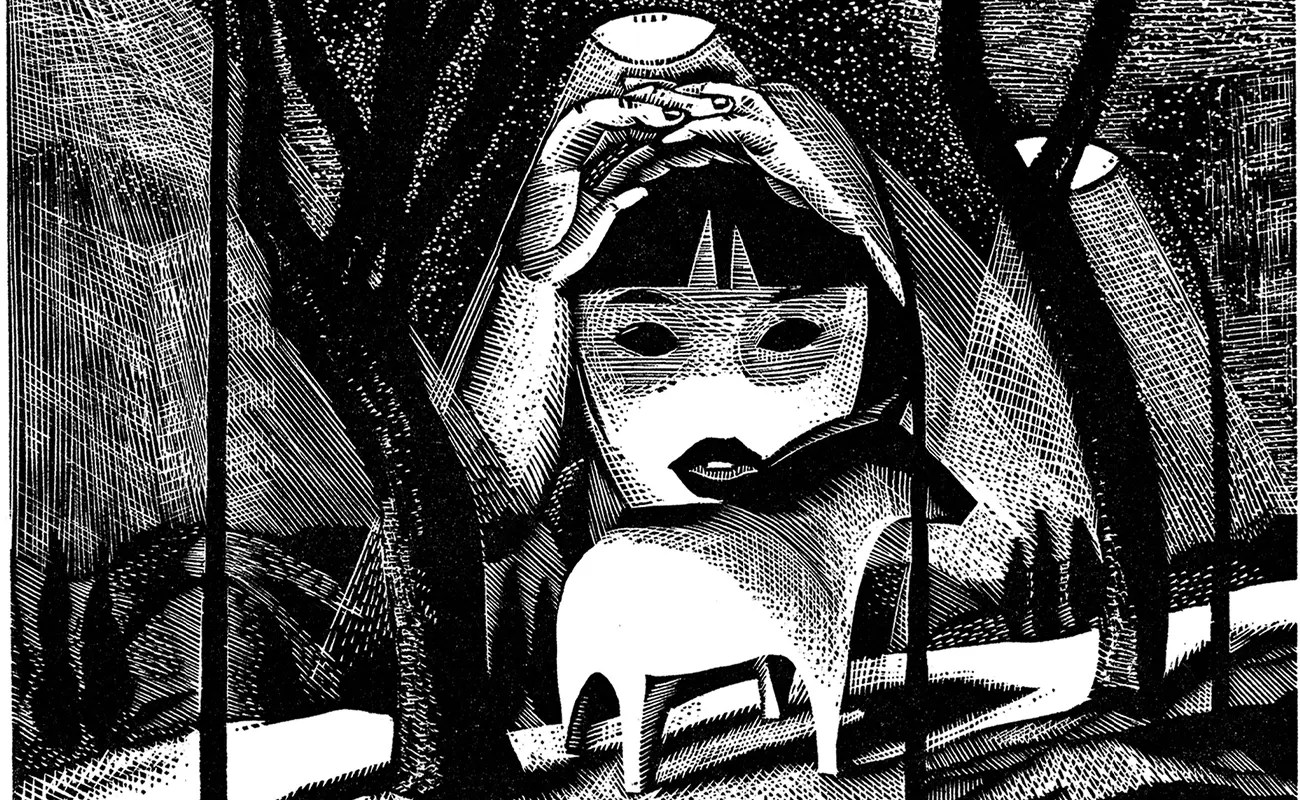
When the Night Falls
Woodcut print in black ink on paper
Hide & Seek
Woodcut print in black ink on paper
Yimin Wang: Animals as Teachers of Perception
Animals have shaped Wang’s imagination since her earliest encounters with books and language. During childhood, colors and illustrations fascinated her more deeply than written words, and learning Mandarin pronunciation became inseparable from vivid associations with wildlife. Galloping horses, singing cicadas, hedgehogs, snakes, and countless other creatures transformed abstract sounds into memorable experiences. Reading itself remained difficult until her father introduced her to the Chinese translation of Wild Animals I Have Known by Ernest Thompson Seton. That gift fundamentally changed her relationship with literature while reinforcing an already profound fascination with the natural world. Beyond the stories themselves, Wang became captivated by the restrained black and white illustrations accompanying each narrative. Their carefully structured lines, detailed cross hatching, and respectful depiction of animals demonstrated that visual representation could communicate dignity without relying upon human characteristics or sentimental exaggeration.
Unlike many children’s books featuring animals dressed, behaving, and speaking like people, Wang found herself consistently drawn toward representations that preserved each creature’s natural identity. This preference continues to define the conceptual direction of her work today. Throughout undergraduate studies focused on woodcut printmaking and later postgraduate research in Italy, she expanded into book illustration, film posters, picturebooks, and artists’ books without abandoning the central questions that first inspired her. Although her chosen media have diversified significantly, every project continues to investigate human and animal relationships from multiple perspectives. Her ambition extends beyond representation toward imagining a posthuman future where animals are recognized as subjects with intrinsic value rather than symbols existing solely for human interpretation. She envisions this possibility as a Zoöpolis, a poetic shared homeland where coexistence is founded upon respect, compassion, and mutual recognition.
Important artistic influences strengthened this evolving philosophy while encouraging Wang to discover her own visual voice. Early inspiration emerged from books featuring George Stubbs, traditional Chinese horse painting, and photographic studies of horses, all of which she repeatedly copied in an effort to understand form, movement, and presence. Later, the work of Henri de Toulouse Lautrec and Franz Marc introduced entirely different possibilities. Marc’s expressive blue horses, especially, revealed that emotional truth could possess greater significance than faithful naturalistic depiction. This realization encouraged Wang to move away from reproducing visible reality and toward interpreting inner psychological experience through visual language. The resulting transformation represented more than a stylistic evolution. It became a return to the deeply personal motivations that had first drawn her toward art, allowing emotional authenticity to take precedence over conventional realism while preserving her lifelong commitment to animals as independent living beings.

Searching the Memory Box
Woodcut print in black ink on paper
Lost in the Maze Within
Woodcut print in black ink on paper
Memory Carved into Wood
Among Wang’s most meaningful works, May You Still Retain Childlike Innocent occupies a uniquely important position within her artistic journey. Produced as her undergraduate capstone project in 2020, the series consists of thirty six pear wood blocks and prints, each measuring fifteen by fifteen centimeters, the maximum standard dimensions associated with an ex libris. Every image represents a different landscape connected to the first twenty one years of her life, transforming personal history into a carefully ordered visual archive. Rather than presenting memory as nostalgic reconstruction, Wang treats each print as part of a living collection that preserves emotional fragments while acknowledging the uncertainty accompanying adulthood. The project marked both a farewell to childhood and an embrace of unfamiliar possibilities waiting beyond that threshold. By arranging these intimate scenes into a coherent series, she created a body of work that simultaneously reflects individual experience and invites broader contemplation of remembrance, transition, and personal growth.
The physical qualities of woodcut play a central role in the project’s emotional significance. Some blocks were hand printed using black ink, while others remain preserved as carved matrices, allowing audiences to encounter both finished images and the surfaces from which they originated. Wang intentionally retained both forms because each communicates memory differently. Printed impressions evoke the timeless atmosphere of monochrome photographs, while the carved wood preserves the direct evidence of artistic labor. Running fingers across engraved grooves allows viewers to encounter traces of moments that once genuinely existed, creating an experience that extends beyond visual observation into tactile remembrance. The permanent incisions embedded within the wood suggest that memory survives despite the passage of time, while the stark contrast of black and white removes distraction and focuses attention upon essential emotional experience. Material and meaning therefore become inseparable throughout the series.
For Wang, childhood never completely disappears, regardless of age. Instead, it quietly resurfaces during ordinary moments that might otherwise pass unnoticed. She finds traces of that earlier self in the seconds before waking from an afternoon nap, while gazing absentmindedly at a computer screen, or during the simple act of waiting for public transportation before exchanging a brief glance with a passing dog. Such encounters remind her that memory remains active even when it appears invisible. The child within continues to observe the world with curiosity, openness, and wonder, offering moments of unexpected fulfillment amid everyday life. Through May You Still Retain Childlike Innocent, Wang extends that invitation to viewers, encouraging them to preserve an attentive relationship with the world rather than allowing adulthood to extinguish imagination or sensitivity. The work demonstrates that remembrance can function not only as preservation of the past but also as a guide for living more thoughtfully in the present.

Cul-de-Sac: A Way Out
Original woodblock matrix
Shadow Tricks
Original woodblock matrix
Yimin Wang: Slowing Down to See More Clearly
Wang’s creative process begins long before marks appear on paper or wood. She waits until life experiences and accumulated emotions reach a point where a new body of work feels inevitable rather than planned. Between projects, much of her time unfolds through activities that appear unrelated to artistic production yet continually nourish her imagination. Cooking, studying foreign languages, refining personal style, reading across varied disciplines, and embracing the rhythms of ordinary daily life all contribute to expanding her understanding of the world. These experiences encourage fresh perspectives while preventing artistic practice from becoming isolated within the studio. Instead of separating creativity from everyday existence, Wang allows daily observation to become an essential source of reflection, gradually shaping future projects through patience rather than urgency.
Contemporary technological culture represents one of the questions currently occupying her attention. Wang observes how rapidly developing digital environments encourage immersion within virtual experiences while quietly reducing opportunities for authentic perception. Simultaneously, increasing social pressure toward speed, efficiency, and constant stimulation risks distancing individuals from genuine awareness of themselves and the living world surrounding them. Rather than accepting these conditions unquestioningly, she asks how personal agency might be recovered within such an environment. This ongoing inquiry extends beyond artistic themes into her broader philosophy of living. Her work therefore responds not only to human and animal relationships but also to the changing conditions under which attention, presence, and meaningful experience become increasingly difficult to sustain.
Increasingly, Wang has embraced the value of thoughtful distance as both an artist and an individual. Observing rather than immediately reacting allows her to recognize qualities that might otherwise remain hidden beneath haste and distraction. She believes slowing down reveals unexpected landscapes that cannot be discovered through relentless pursuit of predetermined destinations. Equally important is maintaining reverence for every form of life, whether animal, plant, or human. Such respect acknowledges that every living being possesses an irreducible existence beyond human understanding or control. This perspective reinforces the ethical foundation running throughout Wang’s practice, connecting childhood memory, artistic exploration, and philosophical reflection into a coherent vision. Through drawing, printmaking, illustration, and related media, she continues to create work that encourages audiences to look more carefully, imagine more generously, and reconsider humanity’s place within the wider community of life.