Gabriel’s Winter Count – Judy Bradbury

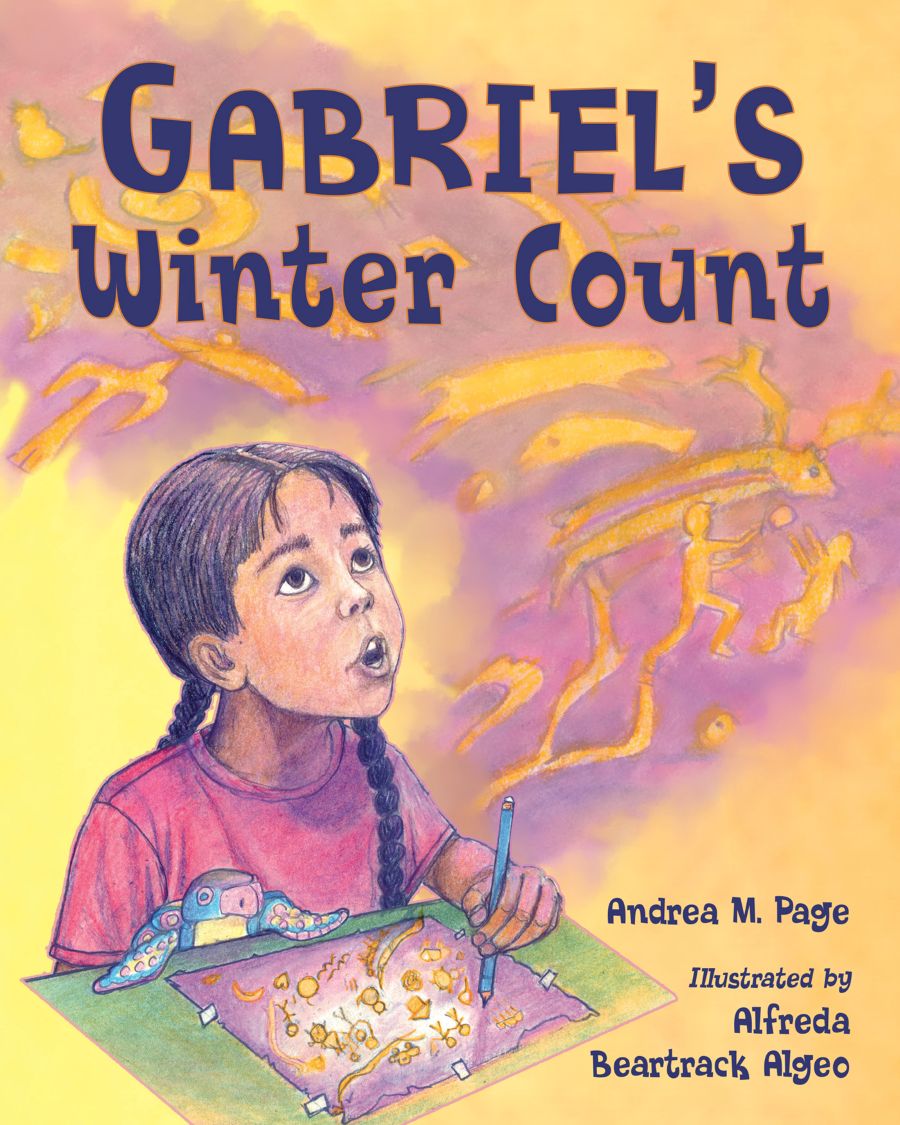
Last November (2025) I invited my friend, author and educator Andrea Page, to join me on Children’s Book Corner to celebrate the release of her chapter-book biography of Wilma Mankiller. She also participated on a panel I moderated at the New York State Reading Association’s annual conference shortly thereafter. When we were together, we always laughed. We reflected on our teaching careers, our writing for children, service to others, and gratitude grounded in faith for her health following an exhausting bout with breast cancer. We also shared Andrea’s excitement about a picture book she had written and the prospect of its publication. Gabriel’s Winter Count is that book. Though she never got to hold a finished copy because of the stunningly swift and devastating return and spread of her cancer just months later, we know this book mirrors her heart and joy. Andrea was a smart, courageous, generous, warm, and thoughtful woman who was passionate about sharing literature reflecting her culture with young readers.
It is with gratitude for their contributions that I introduce you to a few key children’s book creators who took the journey with Andrea in the making of Gabriel’s Winter Count: illustrator Alfreda Beartrack Algeo, and critique partners Kathleen Blasi and Jenn Moudahi. Their bios follow this interview.
Judy Bradbury: As one of Andrea’s critique partners, what struck you most about Andrea’s creative process in the conception and development of Gabriel’s Winter Count?
Kathleen Blasi: What struck me most was the passion and confidence with which Andrea embraced this project. Over the nearly 25 years of our relationship, I watched Andrea grow, starting out tentative, unsure of herself as a writer. Many go through this – we feel like imposters in the writing world. I thoroughly enjoyed watching Andrea’s love of and appreciation for her Native culture blossom to the point of what appeared to be an urgency to share with others.
Jenn Moudahi: Andrea had this unbelievable ability to zero in on a specific line or word that she wanted to be better in her story, even if it was already working. She cared about every detail and would call/text to brainstorm together until her words were just right. For example, she previously had a repeated line “I draw on my very own winter count” and she wanted it to pop and be more fun. Over time, it morphed into “Lines, design. Create, celebrate.” Or, one day we chatted about how she wanted to add some humor into the scene when Gabriel asks, “How can stars rain?”. Ultimately, Andrea added in “Ahh. You were the little mouse playing hide and sneak last night?” As you read GWC, you can feel the care and intention she put into each word, line, and spread.
JB: Freda, How did you conceive of the illustrations for Gabriel’s Winter Count?
Alfreda Beartrack Algeo: After seeing my artwork online, the Creative Director at Charlesbridge Publishing reached out to ask whether I might be interested in illustrating a book for them. When I learned more about the project, I quickly fell in love with the story and with Andrea’s beautiful, authentic Native voice. Andrea and I did not meet on Zoom until after I had submitted my final artwork, but every conversation we shared touched my spirit. I felt as though I had known her for a very long time. She was a special person with a meaningful mission, and I felt deeply honored to be part of her world, even for a little while. Before we spoke, I read her earlier work and the words she had shared online. Her Tribal Nation affiliation and the values she carried—bravery, fortitude, and generosity—felt very close to my own. We both came from large families separated by distance but held together by love. I knew in my heart that this was a good fit. When we talked, we always seemed to run out of time because she was so interesting, so thoughtful, and such a generous listener.
My ideas for illustrating Gabriel’s Winter Count came from many places—lived experiences, traditional stories and teachings, dreams, and especially my own life. Andrea set the scenes with notes on each page, but I still had to ask myself what I wanted the artwork to say and who I was creating it for. I also thought about what the characters might want or need in each moment. Those questions helped shape their facial expressions, body language, and color schemes. I began with rough graphite sketches on paper. Once the Creative Director approved them, I added color using watercolor and soft pastels. Because Andrea’s story centered on family and the special bond between a grandmother and grandson, I chose soft, heartfelt colors to create warmth, tenderness, and texture. I also included trees, water, animals, birds, and stars to reflect the natural world we love and belong to.
JB: Tell us about a challenge you recall Andrea facing in the writing of Gabriel’s Winter Count, and how she overcame it.
KB: I remember Andrea getting a recommendation from either her editor or agent (or both) to make the story more contemporary than its earlier iteration. She wondered how she could pull that off. She worked and worked. She did it, just as I knew she would! That was actually what was so special about our relationship – one of us might be feeling overwhelmed or frustrated, and the other would do the cheerleading.
JM: After Gabriel’s Winter Count was acquired by Charlesbridge, Andrea resumed her battle with cancer. This came with all sorts of challenges, but she always faced them head on…she was incredible. I remember during the first phase of treatment every week was different, and she said she was pacing herself, slow and steady. She relied on her faith and made sure to celebrate milestones: submitting edits to Charlesbridge, making it halfway through chemo, announcing the book, etc. Andrea would work on good days and take breaks/rest as she needed to. She continued to work on other manuscripts, spoke at conferences, taught at Boyd’s Mills (previously Highlights), and lived her life as fully as she could.
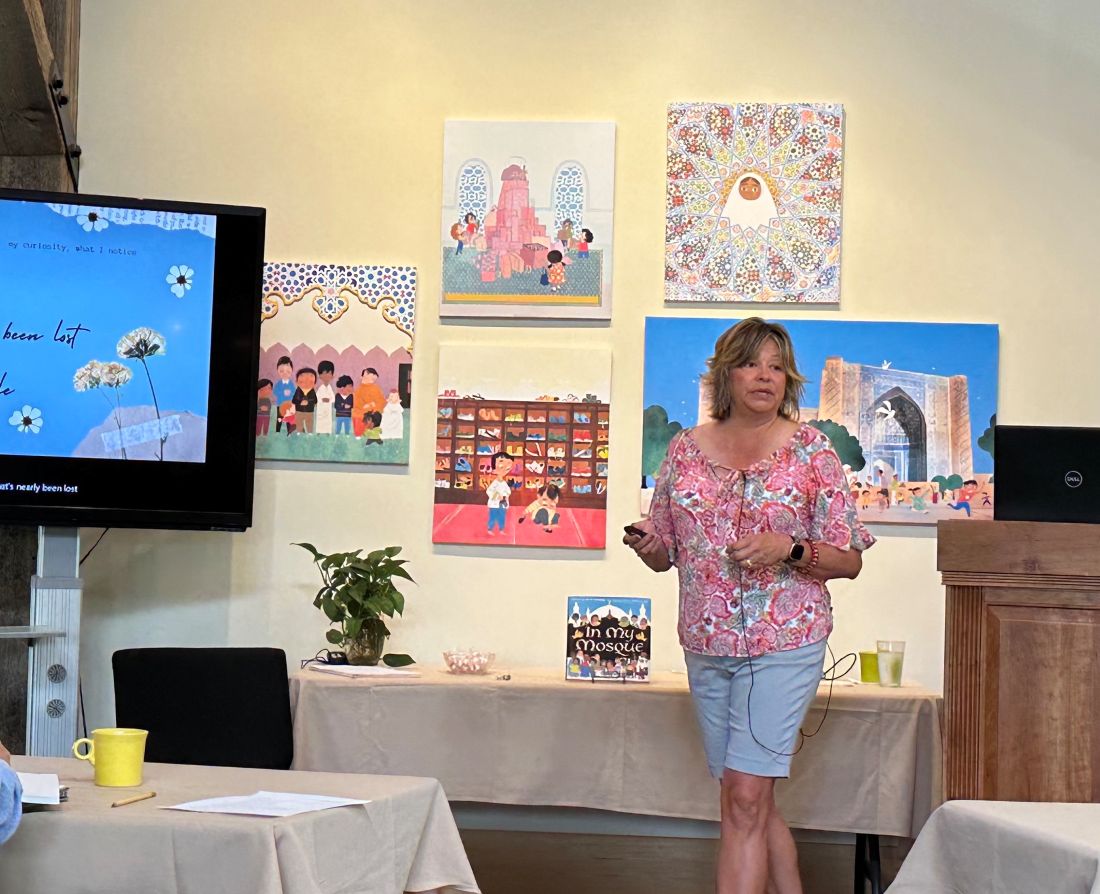
Andrea presenting at Highlights Foundation
JB: Freda, tell us about a challenge you faced in the creation of the art.
ABA: The main challenge was that several important events happen close together in just a few paragraphs. I wanted the artwork to honor the story’s pace without feeling crowded or confusing, and I wanted the emotion to come through clearly. I chose the moments that felt strongest emotionally or dramatically and built the art around them. I paid close attention to Gabriel’s face and body language, as well as to the expressions and movement of the other characters. I also knew I had to include a dog, because so many Native families have dogs and love them dearly. To help everything flow, I divided the images among spot illustrations, spreads, and sequential panels, using color to gently guide the viewer’s eye from one moment to the next.
JB: Provide a memorable (or humorous!) anecdote connected to the creation of Gabriel’s Winter Count.
JM: Andrea had a huge writing community and was a part of many critique groups. When I joined one of these groups, Gabriel’s Winter Count was the first story of Andrea’s that I had the pleasure of reading. I quickly learned that she didn’t mess around with giving and receiving critiques! She was extremely thorough at giving feedback and saw through messy drafts to the heart of the story, bringing it to the forefront. And when she asked for feedback, she was prepared, often coming with a list of questions she wanted to explore. She may have been retired from teaching, but she was still a teacher at heart. I sometimes felt like I was in high school English again, working on homework J (although, this was way more enjoyable). One time she sent the group these questions for GWC:
- Does Gabriel have a strong reason to make his own winter count? What piques his curiosity to find out more?
- Does grandma explain enough about the winter count? too much?
- Why does he ask to make his own winter count? Does it make sense?
- Does the story build up enough to when the parents come home?
- How does Gabriel make sense of his family, kinship, and celebrate community? What does it mean to him?
- What is the big reveal?
Andrea cared deeply for GWC and the reader experience.
KB: When Andrea received her F&G [folded and gathered copy, pre-publication], she brought it to a small gathering of her writer friends. To see the look on her face as we all took it in was priceless. She was so excited about this book, so thrilled working with her editor at Charlesbridge and with the illustrator, Alfreda. She took nothing for granted, and was delighted from start to finish.
JB: Freda, what is one unexpected joy that came from the creation of the art for Gabriel’s Winter Count?
ABA: I found so much of my own life was reflected in the story—from childhood memories on the reservation to my experiences living and working in urban settings. I especially appreciated the contemporary setting and the way Gabriel’s parents are shown serving their community, their country, and the land as a wildland firefighter and a National Guard service member.
Andrea wanted to honor the many contributions Native Americans have made to American history, including the military service of her great-uncle Johnny, a Sioux (Dakota) Code Talker in World War II. That meant a great deal to me, because I also come from a military family: my grandfather served in France during World War I before Native Americans became citizens in 1924; my father and three uncles served in World War II; other uncles served in the Korean War; older brothers and cousins served in Vietnam; younger relatives served in Iraq; and grandchildren have participated in color guard and ROTC. My son also spent his career in wildland management. In so many ways, this story felt close to my heart.
JB: Jenn and Kathleen, in your opinion, what is one unexpected joy Andrea experienced as a result of creating Gabriel’s Winter Count?
JM: The artwork! I remember when Andrea found out that a Lakota illustrator had said yes to GWC, she was thrilled. Later, when Andrea received the sketches, she cried because they were stunning and there were so many connections to her family. The faces of the characters strongly resembled members of her family, particularly her uncle Frank. Connecting with Alfreda about this was also meaningful for Andrea, and they engaged in many rich conversations together.
KB: It was such a special moment when Andrea secretly (shhhh – quietly?) shared with me a sample of the early art. She was blown away with its beauty and warmth. She felt so connected to Alfreda, and I have since learned that the feeling was mutual. The gratitude she felt, with being paired with Alfreda, was remarkable. Andrea revered the art in Gabriel.
JB: Clearly unanimous! Freda, if you had to pick one, what is your favorite illustration in the book? Why?
ABA: My favorite illustration is the scene where Gabriel looks out the window at the stars, with the image of his parents close beside him. I wanted that moment to feel tender and full of connection—to show the relationship we have with all things, including the stars, moon, and sun. Coming from a large family, I carry the belief shared by many Native and Indigenous people that family is everything. No matter where we live or how far apart, we are, we are never truly separated. In Lakota culture, we say Mitákuye Oyás’iŋ—we are all related. It is a deep spiritual teaching from our ancestors: all living things are connected as one family, and what affects one affects all.
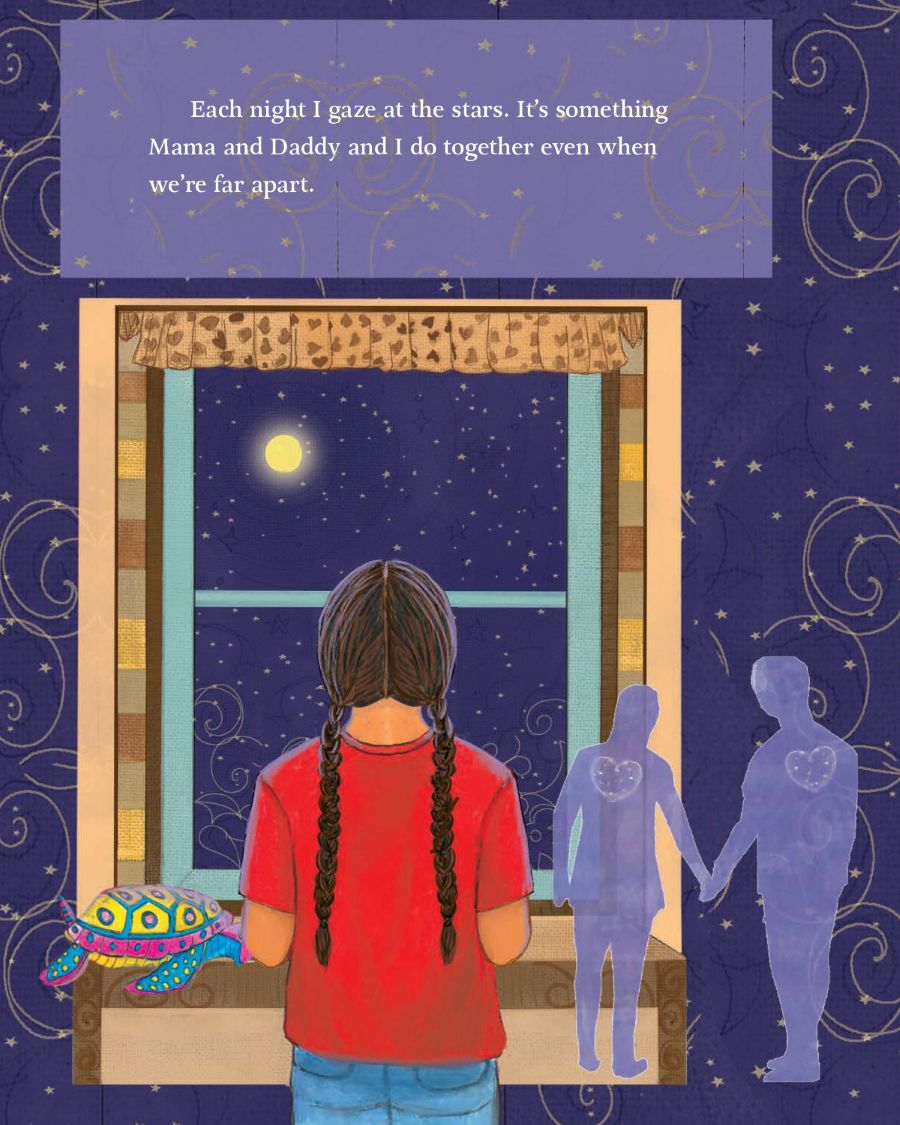
Illustration © 2026 Alfreda Beartrack Algeo
Note: Unbeknownst to Freda, this illustration was chosen by Andrea’s friend, author and talented quilter Sibby Falk, to adorn a keepsake quilt she created for Andrea’s family.
JB: What do you hope young listeners / readers will take away from Gabriel’s Winter Count?
ABA: I hope young readers feel encouraged by Gabriel’s resilience, imagination, and creativity. Gabriel learns from the Winter Counts of his ancestors, who recorded tribal and family histories through symbols painted on animal hides to mark important events over time. He creates his own modern Winter Count by using symbols to record his daily experiences. What begins as a gift for his parents also becomes a gift to himself, helping him feel close to them even while they are away. I hope the story invites young readers and listeners to use art to remember time, events, and the things they hold dear. It can become a beautiful way to set goals, celebrate milestones, and carry something meaningful forward in life.
KB: I hope as young readers, families, and educators read Gabriel, they will not only feel connected to Andrea, as her story lives on, but to each other. That readers will see the beauty and value in learning about Native stories and how they elevate the way we live in the world and how we see and treat one another. I hope that as Andrea celebrated family and tradition, readers will dig into their own and likewise celebrate and share.
JM: Overall, I hope readers experience the strength of community and family love in GWC and can connect to these things in their own life, drawing on them so they never feel alone. I also hope that learning about winter counts/Lakota values/Native American history prompts curiosity and a desire to learn more (both about Indigenous people and the reader’s own family history).
GWC has many layers, which means it can grow with readers/through multiple readings…young ones might focus on Gabriel’s journey to find the perfect gift, older ones might notice the value in Gabriel connecting to his culture, community, and history, and others might see how Gabriel is empowered to find his role in the family and keep traditions alive in a modern world. I hope that people read this book over and over and take in all the gifts it has to offer.