Memorising lines can cause all sorts of stress for actors. Ever had that nightmare where you’re on stage and suddenly realise, oh no… I’ve forgotten my lines?! It’s a classic one that haunts many an actor’s dreams. The fear of forgetting your lines can bring tension and frustration into what is otherwise an incredibly fun process. While most actors have some sort of a process for memorising a monologue or scene (even if it’s just repetition and hope), they can be left feeling less than confident. The good news is that there is a better way.
So, what’s the best way to actually get better at memorising your lines? Firstly, actors have to be aware that learning the lines is a process in and of itself, completely separate from the analysis of a script or the actual performance preparation. The keys to getting better at learning lines are: working in small doses, taking lots of breaks and using the memory principle of ‘spaced repetition’ to review. You should start learning your lines right away, and never leave it to the last minute or rely on long blocks of intense work to cram it all in.
The Science Behind Learning Your Lines as an Actor
Before we dive into the ‘how’, let’s look at what you’re actually doing when you memorise your lines. A quick (and super easy, don’t panic!) look at the science of memory will help us really understand what’s going on in our brains when we memorise something.

Short Term vs. Long Term Memory
There are two types of memory. First is short term memory, which holds information that our brain is actively processing. Short term memory is unreliable and prone to failure. This is because the less we have rehearsed a memory, the weaker the connection that is wired into our brains. It’s the reason that our lines can fall out of our heads as soon as our coach tells us to try doing them a different way, when only a few hours before we knew them all. Though, in a pinch, you can memorise lines quickly with some hacks. Just don’t expect them to stick around for long!
This second type of memory is called Long Term Memory. The more a memory is activated or rehearsed, the stronger the connection becomes. When the connections are strong enough, information becomes part of our long term memory. Long term memory, doesn’t buckle under pressure. It can withstand distractions, director curveballs, and even the shakiest of nerves. The key to learning your lines is committing them to your long term memory. There are plenty of proven techniques that can help you get there. We explore them below.
How To Get More Confident at Learning Lines
Studies have shown that our brains not only have neuroplasticity (a fancy word for growing new connections in the brain and strengthening existing ones) but can actually physically change their structure to process memory more effectively. In simple terms, this means that the more you practice learning lines, the better you get at it and the quicker it takes. How cool is that? Thanks, brain!
Now that we know it’s totally possible to not only memorise huge chunks of text, but that it gets quicker and easier with practice, we’re ready to dive in to the strategies.
Actor Strategies for Memorising Lines
Above, we talked about how learning your lines is a separate process from analysing the scene or making decisions about how you’re going to say them. Keep this in mind as we go through the next section.
When you sit down to start learning your lines, there are a few key principles for success:
- Start straight away!
- Keep sessions short (20 minutes maximum).
- Take lots of breaks, at least 40 minutes in between sessions.
- Review first thing in the morning and last thing before bed. Things sink in to memory while we’re sleeping and taking breaks.
- Don’t wait for the ‘perfect’ environment. You can do it on the bus, in the shower, or on a walk. Anywhere at all!
The key to success when you’re memorising your lines is to start early, keep your sessions short and focused, and to review often with spaced repetition. Spaced repetition is a key principle for retention and building long term memory. Your brain brain naturally forgets new things over time unless you refresh them. By spacing out sessions over hours, then in days (even weeks!) following, your brain marks the information as important to retain and keeps it readily accessible.
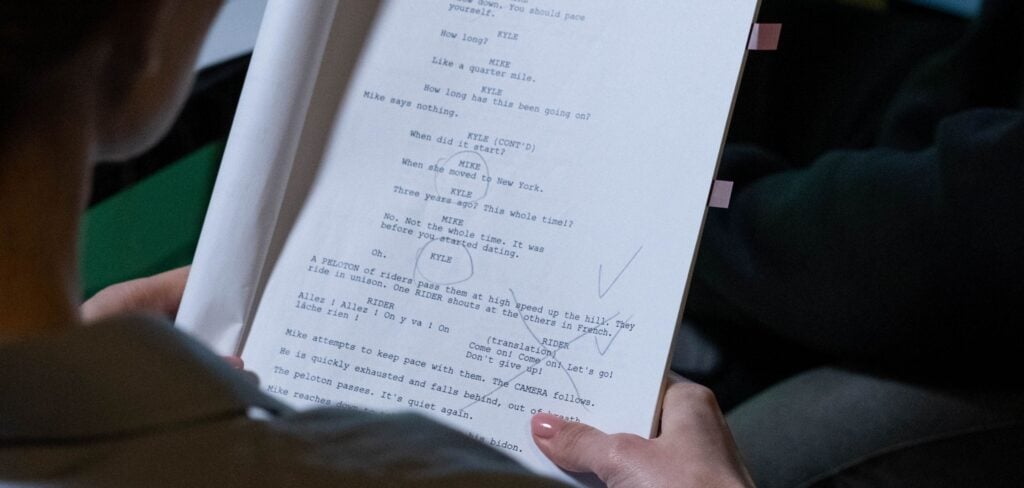
Actor Exercises for Memorising Lines
At different stages of memorisation, you can use different strategies to help you embed the lines into your memory.
First Steps to Memorising a Script
Remember that at this stage we’re not making any performance decisions, or locking ourselves down into any creative choices.
- Begin by simply reading the scene or monologue silently 5 – 10 times. Reading the scene silently helps to get an understanding of the script without making any creative or performance decisions about how something should be said.
- Understand what is really going on in the text. Comprehension helps your subconscious begin the task of committing information to long term memory.
- Remember to take a break after about 20 minutes of work.
- Paraphrase the text. Write the monologue or scene in your own words. Include the why as well as the what.
- Write out just your lines. Quickly look, cover it up, and write it from memory.
- The sooner you can start using your memory to provide the lines without looking at the text, the better!
After you’ve engaged with the text and thought about what your character is saying, why they’re saying it, and what might be going on for them emotionally, you’re ready for the next exercises.
Script Memorisation Exercises
After a few sessions of work (and plenty of breaks!) you’ll be ready to tackle the following exercises. Do them in any order that feels right to you, and remember all of these exercises can be done more than once. They key is to keep practicing, and to not get locked into one way of saying the lines. If rehearsing out loud, purposefully vary the way you say your lines by whispering, singing, doing a silly voice or accent. Different ways, always. Because if you keep reinforcing your brain by saying the lines the same way, your brain will oblige. But that won’t help us give a responsive, organic performance in the moment!
Exercise One: Break the Scene Into Chunks
- Break the scene or monologue into six mini-sections.
- Give each section a title like ‘THE WARNING’ or ‘THE CONFESSION’
- Focus on one section at a time.
- Learn each chunk separately, and build up (ex. Chunk 1 + 2, Chunk 2 + 3, then Chunk 1+2+3)
- Make sure you don’t favour only the first half of the scene! You want to know chunks 4, 5, and 6 just as well as the first three.
- You can play around by rehearsing only 1+2, 5+6, then 4+5, etc.
- Once you’ve learned everything, you can start running them all consecutively.
- Remember to keep sessions short and take breaks!
Exercise Two: Identify Trigger Words/Phrases
In life, there are always words or phrases that prompt us to think or talk about something. We can use these ‘trigger words’ to help us better learn our scripts.
- Go through the script and identify all your own trigger words or phrases.
- Then, look for the words or phrases they say that prompt your next thought, feeling, or piece of dialogue.
- Sometimes, it’s the last word of their line. But not always!
Exercise Three: Speed Run
You may have heard this called ‘the Italian run.’ It’s pretty fun, but can get kind of crazy.
- If you’re doing a scene, find a willing buddy to help you run the lines.
- As fast as you can, run through all of the lines in the script.
- Take note of anywhere you weren’t 100% confident with the lines.
Remember this isn’t ‘rehearsing’, its an exercise to help stress-test your memory. You can be silly and big. It’s not how you’ll do it on the day.
Exercise Four: Do The Lines While Doing Something Else
- Get stuck into cooking, cleaning, or (hard mode) playing sport or a game.
- Concentrate on the task at hand.
- Run the lines of the scene while remaining concentrated on the task. This applies pressure to our memory and helps us test if its sunk into our subconscious.
- Repeat with different tasks at different times.
Exercise Five: Get In Front of a Camera or Audience
Similar to the exercise above, the presence of a camera and tripod or audience can activate our stress response. When we get stressed, our memory can short circuit. By running the lines or doing the scene (not at full performance energy) in front of another set of eyes, or with those bright lights in our face, can help us get used to the pressure.
This helps you stay relaxed and present in the moment where it matters.
Final Thoughts on Becoming a Better Line Learner
Learning lines can be a source of frustration, especially when you just want the words to get in you brain so you can act, already! But truly anybody can learn even huge amounts of text if they use the right method. Don’t forget to focus on why you’re saying the words (not just how), the ideas (not just the words themselves), and the thoughts and feelings behind the text. With commitment to the right type of practice, the words will become second nature. Take heart in knowing that you can do this. It’s not only totally possible, but with the right effort, inevitable!