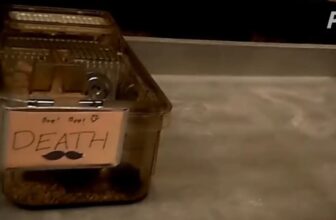
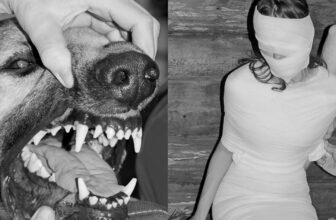
(Beth Clifton collage)
Out of Sight: An Undercover Investigator’s Fight for Animal Rights & Her Own Survival
by Gail Eisnitz
Skyhorse Publishing
307 West 36th Street, New York, NY 10018
www.skyhorsepublishing.com
250 pages, hardback, 2025. $32.99.
Reviewed by Merritt Clifton
These days Beth and I hear from Gail Eisnitz mostly as cc. on emails pertaining to investigations of cockfighting and steer-tailing conducted by Showing Animals Respect & Kindness, partially funded by the Humane Farming Association, her employer of the past 30 years.
I recall meeting Eisnitz just once.

Karel Van Noppen.
Already aware of her undercover investigative work on behalf of farmed animals for about five years, I received an unexpected call from her late one night in November 1994. She had somehow obtained a thick dossier of affidavits pertaining to illegal use of the synthetic steroid clenbuterol by the veal industry. She wanted to deliver copies of the affidavits to me, as the nearest sympathetic member of the press, in person, from two and a half hours away.
Eisnitz was afraid the information might otherwise be intercepted by some of the bad guys who were trafficking in clenbuterol––or that she herself might be.
I gave her directions. She arrived amid a blizzard, well after midnight, handed me the dossier, which became a page one investigative feature a few days later, accepted a refill of her coffee flask, and vanished as quickly as she came, on her way through the falling snow to investigate yet another slaughterhouse the following morning.

Gail Eisnitz.
Murder
Unknown to either of us then, Belgian livestock inspector Karel Van Noppen, 43, was also investigating illegal use of clenbuterol by vealers. The Dutch and Belgian vealers whom Van Noppen was investigating were linked by family and business relationships to the U.S. vealers whom Eisnitz had been looking into.
Van Noppen in February 1995 was shot dead in front of his home in Wechelderzande village, Antwerp province, Belgium, by alleged hit men for the clenbuterol traffickers.
Bringing Van Noppen’s killers to justice took until 2002. One is now serving a life sentence without parole. Three others were sentenced to serve 25 years each.
Eisnitz, in short, had been worried for good reason.

Veal calf.
(Humane Farming Association photo)
Clenbuterol kills
Clenbuterol itself can kill people. This is why use of clenbuterol in farmed animals is illegal. (See NFL warns players–22 years after Humane Farming Association.)
Pressured by the Humane Farming Association, the U.S. Justice Department during the 15 years after Gail Eisnitz’s late night visit won a string of convictions of veal industry leaders.
Among them were Pricor BV pharmaceuticals company owner Gerard Hoogendijk, who avoided extradition to the U.S. by remaining in the Netherlands, and Jannes “John” Doppenberg, who was in 1997 fined $25,000, sentenced to serve 44 months in prison, and ordered to make restitution of $1.1 million.
Both were former business partners of Aat Groenvelt, who had introduced the use of the veal crate to North America and popularized milk-fed spring lamb, the meat of lambs raised in essentially the same conditions as crated veal calves.
 One brief chapter

The last related conviction came in 2009, when the Brown Packing Company of Milwaukee pleaded guilty to felony conspiracy to commit mail fraud and wire fraud, and agreed to pay a fine of $2 million for illegally giving hormones and steroids to veal calves between 1997 and 2004, while marketing the meat as “all natural.”
Eisnitz gives just a few pages to her clenbuterol investigation in Out of Sight: An Undercover Investigator’s Fight for Animal Rights & Her Own Survival.
Though the convicted vealers were among the first and still almost the only bigtime factory farmers to face a semblance of justice for their crimes against both humans and animals, the clenbuterol investigation was only one brief chapter in Eisnitz’s long career as originally an illustrator of nature books, then a staff writer for the Animal Welfare Institute, an investigator for nine years with the Humane Society of the U.S., and as an investigator for the Humane Farming Association ever since.

(Beth Clifton collage)
David Wills
Eisnitz in Out of Sight credits former Humane Society of the U.S. director of investigations David Wills, who was easily the most corrupt executive in U.S. humane history, with pushing her toward her work with the Humane Farming Association.
(See David Wills, ex-Humane Society of the U.S. vice president, gets life in prison.)
As a highly motivated, highly ethical person, obsessed with the systemic cruelty inflicted on farmed animals throughout their brief lives, Eisnitz found she simply could not work with or under the meat-chomping, self-aggrandizing, bullying, and fundamentally dishonest Wills, even though she desperately needed her Humane Society of the U.S. medical insurance to help her cope with a rare, mysterious, often physically disabling neurological condition afflicting her vision and frequently triggering migraine headaches since she was four years old.
This affliction was finally medically recognized in 2014 as “Visual Snow Syndrome,” incurable and basically untreatable.

Timothy J. Walker.
(Gail Eisnitz photo)
Abuse of workers as well as of animals
Out of Sight veers frequently back and forth between Eisnitz’s unflinching efforts to document and expose slaughterhouse and factory farm cruelty, including systemic abuse of workers as well as of animals, and her own increasingly frantic and desperate struggle to find out what was, and is, destroying her health and stamina.
Indeed, her determination to keep working for farmed animals, no matter what, appears to have been at times her main means of coping with her physical infirmities, also including a bout with breast cancer during which she worked right through six months of chemotherapy.
Eisnitz in 1997 produced her exposé book Slaughterhouse, focusing on the abuses she documented at Carolina Food Processors in Bladen County, North Carolina, but including considerable information from investigations of other slaughterhouses as well.
(See Timothy J. Walker, 73, exposed slaughterhouse cruelty, by Gail Eisnitz.)
 16,000 hogs a shift

A passage from Slaughterhouse, repeated in Out of Sight, recounts a conversation with a “sticker,” the slaughterhouse worker who cuts each doomed pig’s throat.
“If you re killing 16,000 hogs a shift,” the sticker said, “those guys aren’t going to stun them hogs all the time. If a hog ain’t stunned correctly, then the shackler’s supposed to let it hit the floor. Somebody else is supposed to re-stun that hog and hang him up.
“But the supervisors don’t want the shacklers to do that. They want the shacklers to try to shackle the hog, hang him up, and keep on going. A shackler don’t have no choice but to hang hogs alive in order to keep his job. If a hog comes out kicking too much for the sticker, he’s going to let him go until somebody tells him that hog needs sticking.
“If it’s too late and that hog hits the tub,” where skin is scalded to facilitate de-hairing, “then he goes all through the scald tank and out to the de-hairer and to the dry kill [where workers eviscerate the hogs]. And probably by that time he gets around to where they cut off the feet and stuff, then they’ll stick the hog. I’ve stuck them,” the sticker testified, “after they’ve had their hooves off, their toes split down, and everything else.”
Eisnitz went on to detail similar at slaughterhouses throughout the U.S., using a combination of worker interviews with hidden camera confirmation.

(Beth Clifton collage)
Iowa Beef Processors
Eisnitz in April 2000 obtained video of shackled and hoisted cattle having their legs hacked off and being skinned alive at the Iowa Beef Processors [IBP] slaughterhouse in Wallula, Washington.
IBP, local authorities, state authorities, and the USDA all denied the video evidence, but the Humane Farming Association––as it has done many times since––published the evidence in newspaper and television ads, first aired by major TV stations in May 2000.
The IBP investigation confirmed that high-speed slaughter methods introduced decades earlier had made the Humane Slaughter Act of 1958 more an unenforced suggestion than a rule, and helped Senator Robert Byrd (D-W.V.) to obtain funding in the 2002 Farm Bill for improved Humane Slaughter Act enforcement.
Unfortunately the USDA diverted the funding. Humane Slaughter Act enforcement was still no better than it ever was when Donald Trump was inaugurated for his second presidency in January 2025 and immediately began firing much of the already thin USDA slaughterhouse inspection staff.

Sitting Bull, killed on the Standing Rock reservation in 1890; White Bull, a Sioux victim of the 1890 Wounded Knee massacre; marchers opposed to the Dakota Access pipeline.
Fighting alongside the Sioux
Eisnitz next helped Sioux opponents of factory pig farming to fight plans by Sun Prairie Inc. to establish pig barns on the Rosebud Sioux Reservation in South Dakota.
The Humane Farming Association had been assisting the Sioux since 1998. Most of the Sun Prairie scheme was eventually stopped by a 2002 U.S. Circuit Court of Appeals verdict, but Sun Prairie had in 1999 begun producing 96,000 pigs per year at two Rosebud facilities.
Eisnitz gathered 65 pages of employee testimony detailing conditions in the Rosebud barns falling short of even the basic animal welfare and sanitation standards that factory pig farms usually claim to meet.
While that effort was underway, Andrew Martin of the Chicago Tribune in March 2004 used information collected by another Humane Farming investigator, Robert Baker, at the HKY Farm in Bloomfield, Nebraska, to publish an exposé of comparable conditions there.
Eisnitz meanwhile received the 2004 Albert Schweitzer Medal, presented by the Animal Welfare Institute for outstanding achievement in animal welfare. This produced renewed media attention to Slaughterhouse, seven years after first publication.

(Beth Clifton collage)
Factory farmers indemnified for losses
But even then, and in the 21 years since, animal agribusiness has never instituted substantive reform, and has instead grown even larger and more abusive of animals than ever.
Eisnitz in the latter chapters of Out of Sight describes how USDA indemnification programs shield factory farmers from the economic consequences of preventable animal deaths due to disease and neglect of basic care.
Federal indemnification makes even the “depopulation” of millions of pigs and poultry, by methods as self-evidently cruel and prolonged as “ventilation shutoff,” almost as profitable for agribusiness––after selling the carcasses for rendering––as raising the animals to slaughter weight.
Meanwhile the advertising clout of the meat industry keeps most mass media reluctant to publish exposés that might permanently turn readers and viewers away from supermarket meat counters.
Readers themselves, further, tend to turn away from articles and images that upset their stomachs.

Gail A. Eisnitz.
Frustration
Much of the animal advocacy sector learned long since that it is much easier to persuade the public to give up meat and animal byproducts for positive reasons, if only for a day or two, than to rally sufficient public support through exposés to achieve meaningful support for enforcing humane laws on behalf of farmed animals.
Fewer people eating meat, permanently, is the longterm answer to the unconscionable and ongoing systemic cruelty of animal agriculture, but translating the shock value of exposés into lasting behavioral change comes slowly, while farmed animals continue to suffer by the multi-billions.

(Beth Clifton collage)
“Does anyone know I’m here?”
Late in Out of Sight Eisnitz acknowledges having immersed herself in Holocaust memoirs in her quest to keep on going, regardless of the seeming futility of her lifetime of frontline witnessing and testifying about atrocities hardly anyone else seems to care about enough to go vegan.
Eisnitz recalls a Holocaust survivor wondering, during time at Auschwitz, “Does anyone know I’m here?”
Eisnitz imagines this as the voice of each animal’s despair, trapped in the factory farm to slaughter system. And then she gets another migraine headache.
Out of Sight: An Undercover Investigator’s Fight for Animal Rights & Her Own Survival is not easy reading, but it is easily readable, fluent, articulate, and compelling.

Merritt & Beth Clifton with Henry the rooster.
Most people who pick it up in the first place are likely to complete all 250 pages in a single sitting, and then have at least a plant-based next meal.
That alone will be progress.
Please donate to support our work:
More related posts:
Discover more from Animals 24-7
Subscribe to get the latest posts sent to your email.