
Draft carriage horse ban to go before the full New York City council
NEW YORK CITY––Horse-drawn carriages have never before appeared closer to being banned from New York City.
New York city council speaker Julie Menin on October 13, 2026 announced that she and Mayor Zohran Mamdani had reached agreement on draft legislation to end horse-drawn carriage use, effective in 2028.
The draft carriage horse ban is expected to go before the full New York city council for a vote on October 22, 2026.

(Family photo)
“Romanch’s Law” zooms through
“Romanch’s Law, which has 29 listed sponsors, has zoomed through the typically-lengthy legislative process,” observed Josephine Stratman and Evan Simko-Bednarski of the New York Daily News.
New York City has already, since 1989, restricted horse-drawn carriages to hauling passengers in and around Central Park, and otherwise to traveling only along the routes to and from their stables, without passengers.
(See NYC horse-drawn carriage war began with Dublin Carriages Act of 1853.)
Explained Stratman and Simko-Bednarski, “Menin said the legislation will include requirements [for the city] to develop a plan to employ, give job training, or [provide] career counseling to horse carriage drivers.”

Mayor’s office seeking “a just transition”
Affirmed Mamdani spokesperson Sneha Choudhary, “We have been working closely with the City Council, union partners, carriage drivers, animal welfare advocates, and community leaders to deliver a just transition that protects workers while ending horse-drawn carriages in Central Park once and for all.”
Pointed out Stratman and Simko-Bednarski, “Efforts to ban the carriages have gone one for decades, as animal rights activists have long criticized the industry. But the death of Romanch Mahajan, an 18-year-old boy killed in Central Park after falling from a runaway carriage horse in June, changed the tide, giving calls to ban the industry more urgency and turning the political tide.”
(See Will human sacrifice end the New York City horse-drawn carriage trade?)

Reworked version of “Ryder’s Law”
“Romanch’s Law, the bill to ban horse carriages from Central Park, is a reworked version of a [failed] bill formerly known as Ryder’s Law, named after a carriage horse who collapsed and died in 2022,” Stratman and Simko-Bednarski continued.
“It would immediately end the issuance of new medallions for carriage horses, and end the industry entirely in the summer of 2028.
Responded Transport Workers Union International president John Samuelsen, “Council Speaker Menin used the tragic death of a tourist to contrive a public safety crisis. This is disgraceful political opportunism. Zohran should not simply go along with it, particularly when immigrant families’ livelihoods are being destroyed,” a reference to the prevalence of drivers with foreign horse-driving experience among New York City carriage horse operators.

“Reprehensible,” says union boss Samuelsen
Argued Samuelsen, “Council speaker Menin’s bill has no meaningful economic relief for workers. It only says the city should prepare a worker transition plan by April 2027 and include weak measures like job fairs and job counseling.
“It says the city should ‘consider’ financial compensation for carriage owners who spent hundreds of thousands of dollars to buy city-issued medallions and build up their businesses.
“This entire situation is reprehensible,” finished Samuelsen.

Al Sharpton disagrees
Countered Baptist minister, civil rights activist, and longtime New York City media personality Al Sharpton, in an October 14, 2026 New York Daily News op-ed column, “Carriages belong to a New York that no longer exists. Today’s Central Park, with its traffic, crowds, and noise, is no place to ask a frightened animal to haul a thousand-pound carriage.
“The carriages are not still standing because anyone has made a serious case that they are safe,” Sharpton charged. “They are standing because of a style of politics New Yorkers have rejected. Voters are tired of leaders who govern by grievance and treat every disagreement as a personal war.”
Samuelsen, Sharpton suggested, “could have sat down with the city council to negotiate a fair transition for his members. Instead, he has spent months waging a personal campaign in the press against speaker Julie Menin.

“New York City can move on”
“He has aimed the same combative style at [New York state governor Kathy] Hochul, former transit president Sarah Feinberg, and former Metropolitan Transit Authority inspector general Carolyn Pokorny,” Sharpton recalled. “It is a pattern, and it is hard not to notice who so often ends up on the receiving end: women in positions of leadership.
“I have fought for workers my entire life,” fumed Sharpton, “and I know what real solidarity looks like. It does not look like this. Standing up for carriage drivers cannot mean chaining their futures to a dying trade that risks lives every time a horse panics in traffic.
“Philadelphia, Chicago, San Antonio, Paris and London have already moved on from carriages,” Sharpton reminded. “New York City can too.”

Mamdani supports “the spirit of the bill”
“In the summer,” recounted Ivan Pereira for ABC News, “mayor Zohran Mamdani told reporters that he supported ‘the spirit of the bill,’ but stressed that he wanted it to include strong worker protections.
“At the time of Mahajan’s death,” Pereira added, “eight other incidents took place in Central Park over the span of 13 months involving horse-drawn carriages, including some where horses collapsed with drivers and passengers onboard, according to the Central Park Conservancy, which manages the greenspace.”
Said Central Park Conservancy president Betsy Smith, “For the Central Park Conservancy, this has always been a matter of public safety. We hope carriages can be phased out efficiently and humanely so that no one else ever suffers the fate of Romanch Mahajan.”

Former mayors did diddly
Resumed Pereira said, “For years, the conservancy, animal advocates, and some elected officials, including mayors Bill de Blasio and Eric Adams, pushed to end the carriage rides in the park. However, there was not enough support in the City Council.”
But whether either Bill de Blasio and Eric Adams ever actually expended political capital on trying to ban horse-drawn carriages has long been questioned by New York City animal advocates.
(See Coalition to Ban Horse-Drawn Carriages to picket NYC mayor de Blasio for failing to keep promise.)
De Blasio, in office from 2014 to 2021, appeared to do little or nothing toward a horse-drawn carriage ban after inducing the animal advocacy group NYCLASS to support him in the belief that he would act to ban horse-drawn carriages.
Adams, in office from 2022 to 2025, only moved decisively against the horse-drawn carriage industry after clearly having little or no chance of being re-elected.
(See NYC mayor Eric Adams endorses bill to phase out horse-drawn carriages.)

“Working on this issue for close to 15 years”
“I personally have been working on this issue for close to 15 years,” recalled Voters for Animal Rights executive director Julie Cappiello.
“I remember every activist I stood out in the cold and brutal heat with, every horse who went missing, and every tragic accident,” Cappiello said. “Now, with speaker Menin’s backing, more than half the council signed on, and mayor Mamdani committed to signing, we’re closer than anyone has ever been.”
The impending likelihood that horse-drawn carriages will be banned upstaged the release of a report from Humane World for Animals, “showing why another round of promises and regulations is not enough,” summarized Humane World for Animals media relations manager Emily Snow Gugel.

Who is responsible?
Detailed the report, Who is responsible for protecting New York City’s carriage horses, “For decades, New York City has tried to regulate the risks associated with commercial horse-drawn carriages through licensing requirements, veterinary certifications, inspections, work limits, weather restrictions, mandatory furloughs, and driver training.
“Yet records reviewed by Humane World for Animals (formerly called the Humane Society of the United States) reveal a persistent accountability problem: responsibility is divided across agencies, routine fitness certification begins with owner-selected veterinarians, and the city still struggles to answer basic questions about individual horses. The gaps become clearest when the records are examined horse by horse.

Five agencies
“The New York City Department of Health & Mental Hygiene,” the Humane World for Animals report explained, “is responsible for carriage horse health licensing and reviews veterinary certifications and furlough documentation.
“The Department of Consumer & Worker Protection licenses drivers, carriage owners and carriages.
“The New York Police Department performs some enforcement. Parks personnel enforce rules in Central Park. The Department of Transportation regulates activity on streets. The Mayor’s Office of Animal Welfare participates in coordination.”
In short, “One agency licenses the horse. Another licenses the driver and carriage. Another may enforce a weather suspension. Another enforces park rules. And the veterinarian ordinarily certifying that a horse is fit to work is chosen by the horse’s owner.”

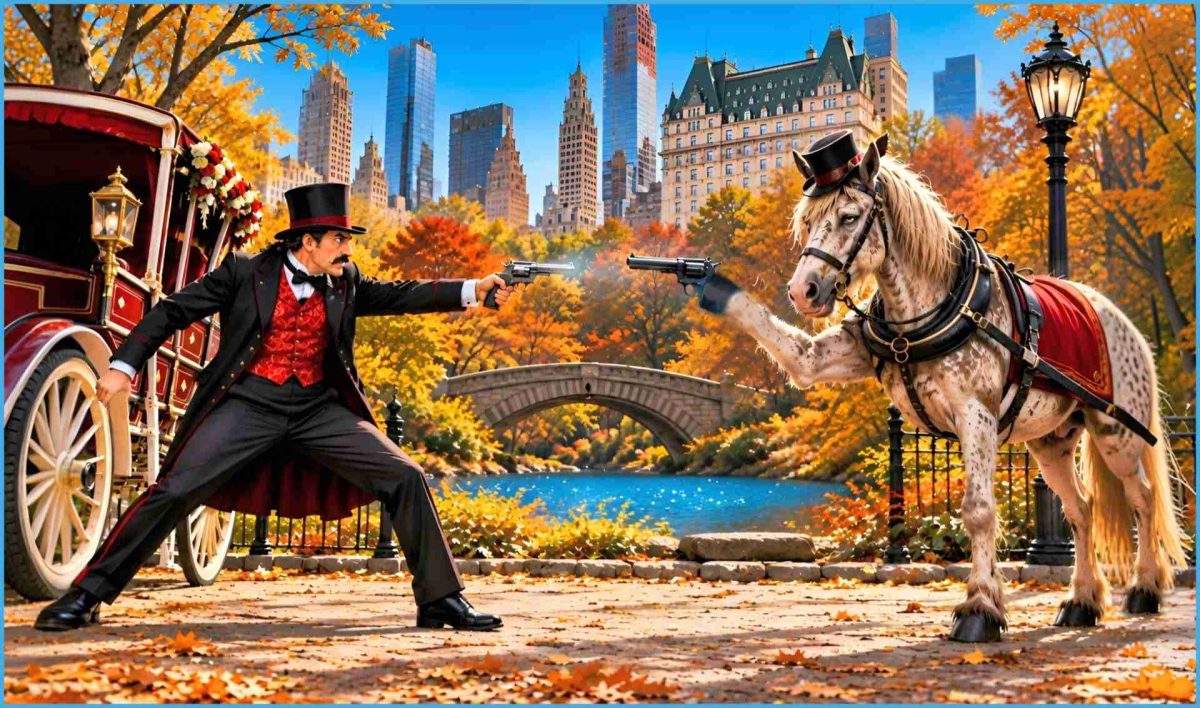
(Beth Clifton collage)
Jockeying for position to claim victory
While Humane World for Animals jockeyed for position from which to claim an apparently imminent campaign victory, and the New York City-based American SPCA as usual on the horse-drawn carriage issue said and did nothing visible, despite the prominent opposition of founder Henry Bergh to the use of horse-drawn transportation at the peak of horse use in the 19th century, Animal Wellness Action and Center for a Humane Economy president Wayne Pacelle pledged that his organizations “will assist with the placement of the horses if the drivers relinquish them to humane organizations.
“As the former CEO of a major national organization with the two largest horse sanctuaries in the nation,” meaning Humane World for Animals back when it was the Humane Society of the United States, “I can attest that the animal welfare community will have no problem placing the horses,” Pacelle said.

“The network of hundreds of horse sanctuaries and rescue organizations will welcome these beleaguered animals,” Pacelle predicted, “just as so many shelters and rescue groups were eager to help us place 2,000 beagles after we negotiated their release from laboratory-animal-supplier Ridglan Farms.”
For sure, former New York City carriage horses will have more donor appeal in the most affluent city in the U.S. than, for example, the estimated 63, 000 to 67,000 formerly wild horses currently kept in Bureau of Land Management holding facilities.
Please donate to help our work:
More related posts:
Discover more from Animals 24-7
Subscribe to get the latest posts sent to your email.