Tour de Big Bear has become one of Southern California’s premier cycling events, drawing riders from across the country to the mountain community of Big Bear Lake each August. While many riders come for the cool mountain air and scenic alpine roads, the 2026 edition had a very different feel. Temperatures climbed to nearly 90°F, approaching record highs for the area on the day and turning what is already a challenging century into an even greater test of pacing, hydration, and patience.
Despite the unusual heat, the event once again attracted an excellent turnout. Hundreds of riders lined up after sunrise for road, gravel, and MTB routes ranging from shorter recreational rides to the signature 100-mile century. Volunteers, aid stations, and spectators created an outstanding atmosphere throughout the day, making it clear why Tour de Big Bear continues to be one of California’s favorite organized rides.
The 100-mile route packs a surprising amount of climbing into a relatively compact course. Riders finish with roughly 8,000 feet of elevation gain, split across two major ascents and several smaller rollers that continue all the way to the finish. While none of the individual climbs are especially steep by mountain standards, the cumulative elevation and high-altitude (riding between 6,700ft to 8,500ft) make the course considerably more demanding than the profile first suggests.
The Opening Miles
The day began with a neutral rollout through Big Bear Lake as riders settled into position and enjoyed the cool morning temperatures before the heat arrived. These opening miles are a nice opportunity to move to the front for competitive riders, or relax, chat with other riders, and avoid the chaos for those just looking to finish.


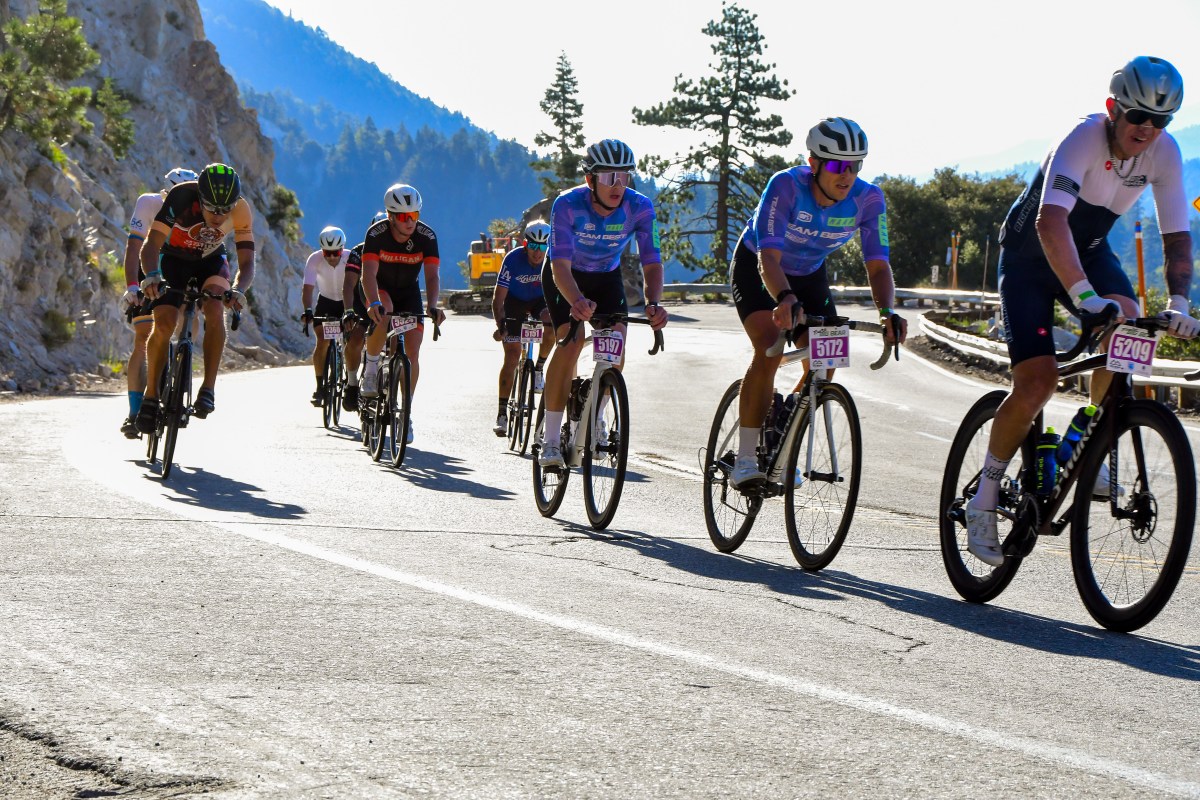
The neutral section continues until reaching the north side of the lake near Fawnskin. Once the ride officially begins, the pace accelerated like a rocket and I was on my limit trying to hang on to the lead group. The route heads east along the shoreline of SR 38 before reaching a turnaround, where riders reverse direction and make their way back toward the east end of the lake near the Big Bear Airport. I was able to stick with the second group until this point, but the short climb on the return had me dropped to the third.

Although the opening portion of the ride is relatively flat, it has two ~400ft climbs, and they serve an important purpose. Strong groups begin to organize, riders find others traveling at similar speeds, and everyone has a chance to settle into a rhythm before the real climbing starts. With the temperatures already climbing much faster than expected, it was also a good reminder to begin drinking early rather than waiting until the first major climb.


The First Climb: Onyx Summit
The first aid station I stopped at came at a welcome time, just before the route turns toward the day’s first significant ascent.
After topping off bottles and grabbing a quick snack, it was time to begin climbing toward Onyx Summit. Compared to what would come later, this is the shorter of the day’s two major climbs, but it still requires steady pacing. The grade is generally consistent without any extreme ramps, making it tempting to push harder than necessary.

The scenery changes noticeably as the road leaves the lake behind. Pine forests gradually open into broader mountain views, and traffic becomes sparse. Even with the increasing temperatures, the climb remained enjoyable thanks to the quiet roads and long stretches of uninterrupted riding.
Reaching the summit felt like the first major milestone of the day. From there, the reward was a fast, sweeping descent that carried riders down State Route 38 toward Jenks Lake.

Down SR 38 to Jenks Lake
The descent off Onyx Summit is one of the highlights of the entire course.
The road is smooth, visibility is excellent through most of the corners, and riders can recover while descending through the forest. After spending the previous miles climbing at relatively modest speeds, it was a welcome opportunity to breathe easy and enjoy the speed.
Eventually the route reaches the turnaround near Jenks Lake. This section offers a wonderful aid station and is a nice place to prepare mentally before facing what is arguably the hardest part of the entire ride.
Because once you turn around, everything you just descended has to be climbed back.
The Long Climb Back
If the first ascent of Onyx is a warm-up, the return climb from Jenks Lake is the main event.
The backside of Onyx is considerably longer, and by the time riders begin the climb, the afternoon heat is fully established. Temperatures near 90°F at elevation (110F asphalt temps!) are not what most people expect in Big Bear, and the conditions added another layer of difficulty to an already demanding climb.
This became a climb about patience rather than speed.

Trying to force the pace would almost certainly end badly, so the goal became maintaining a sustainable effort, drinking consistently, and taking every opportunity to cool down with my extra bottle of ice water. The grades remain manageable throughout, but the length of the climb means there is very little relief. Every mile feels earned.
The higher elevations eventually bring slightly cooler air, but the climb seems to stretch on far longer than expected. Looking at the profile beforehand gives an idea of the distance, but riding it in the afternoon sun is something entirely different.
Fortunately, the event’s support continued to be outstanding. Well-stocked aid stations and enthusiastic volunteers made a significant difference on such a hot day. Having cold water available whenever possible became just as important as taking in food.
Eventually the summit finally arrived.
After such a sustained climb, reaching the top brought a tremendous sense of relief.
A Fast Return to Big Bear
The reward for all of that climbing is another outstanding descent.
The downhill back toward Big Bear is fast, flowing, and simply enjoyable. After spending an hour climbing, gravity finally does most of the work, allowing tired legs a chance to recover before the final miles.
Of course, the ride isn’t completely finished yet.
The route still includes several shorter climbs before reaching Bear Mountain Resort. None are individually difficult, but after nearly a hundred miles and thousands of feet of climbing, even modest rises demand attention. Fortunately, each one is brief enough that they never feel overwhelming.
Once those final rollers are behind you, it becomes smooth sailing toward the finish.
The final approach into Bear Mountain Resort is a satisfying way to conclude the ride. Riders who have spent the day spread across the mountains begin coming back together as they roll toward the finish line, sharing congratulations and stories about how the day unfolded.

Final Thoughts
Tour de Big Bear continues to deserve its reputation as one of California’s premier cycling events.
The combination of alpine scenery, well-organized support, challenging terrain, and welcoming community makes it an event worth returning to year after year. While the near record heat made the 2026 edition significantly more demanding than most, it also highlighted how well organized the event is. Volunteers remained enthusiastic throughout the day, aid stations were well supplied, and riders continued encouraging one another from start to finish.
The course itself offers an excellent balance. The opening miles allow riders to settle into the day before the climbing begins, the first ascent of Onyx provides an early challenge, and the long return climb from Jenks Lake delivers the ride’s defining test. Add in two enjoyable descents and a handful of rolling miles back to Bear Mountain, and the route provides plenty of variety across its 100 miles.
Every organized ride has something that riders remember most. For Tour de Big Bear 2026, it will almost certainly be the heat. Nearly 90-degree temperatures transformed an already demanding mountain century into an endurance challenge that rewarded smart pacing and careful hydration.
Even so, crossing the finish line at Bear Mountain Resort brought the same feeling that makes rides like this so memorable. It was a difficult day in the mountains, but one filled with beautiful scenery, well-earned climbs, and an event that continues to showcase some of the best cycling roads Southern California has to offer.