
Everybody wants to make the most of agentic AI in advertising.
The winners will do it with purpose. Here’s how to make a plan, step by step.
Get specific
Pick a clear goal. A media buying agency might aim to reduce the cost of producing an approved campaign plan by 25% within 90 days, while maintaining its current quality and client approval standards.
Establish clear budgets and timelines: What will it cost to prove the business case?
Set up clear guardrails. Specify what the agent may do independently, where human approval is required and the budget and timeline for proving the business case. Ask whether existing software could achieve the same result more reliably and economically than agentic AI.

The power of hybrid architecture
Consider a hybrid architecture, which assigns each kind of software to handle the things it does best.
Deterministic software handles what needs to happen and under which conditions, while AI handles how to interpret, synthesize or propose options where there is ambiguity or unstructured data.
McKinsey, BCG and Gartner all agree: The single most powerful lever CIOs have for maximizing the value of their AI spend is cutting token usage and routing predictable, rules-based tasks to deterministic software. This typically saves companies 20%-30% on AI costs. And when you use layered architectures that combine multiple models with rules-based logic, you can slash blended token costs by as much as 87% compared to relying on a single frontier model for everything.
The objective is better performance at a cost the business can justify. A larger deployment budget should follow evidence of business value. The number of agents deployed is not a measure of success.
Agentic AI is a consumption economy
As the Jevons paradox tells us, the more efficient AI gets, the more AI your company will want to use. The more powerful your agentic workloads get, and the more of your business gets agentified, the more tokens those systems will consume. That kind of spend is totally justified if you’re getting a 10x or 100x return on it, but it’s a colossal waste if your ROI is only incremental or nonexistent.
The full cost extends beyond tokens. Account for implementation, data preparation, integration, software licenses, human review, error correction, monitoring, maintenance and employee training. Include the cost of failed tasks and any required remediation. An agent that appears inexpensive to run can become expensive to supervise.
Hybrid architecture combines deterministic software for predictable execution with agentic AI for work that benefits from interpreting ambiguous inputs or coordinating actions. It provides a foundation for disciplined experimentation, but the architecture alone does not establish ROI.
Make a 90-day plan
First 30 days: Establish the baseline, confirm data readiness, assign ownership and approve targets and spending limits.
By day 60, a controlled pilot should demonstrate performance on representative work against the existing process.
By day 90, the business owner should present the evidence and recommend whether to scale, revise or stop. Adjust the timeline to the complexity and risk of the use case.
Each milestone needs an acceptance threshold. Review results weekly during the pilot, including time to an approved outcome, successful completion rate, material error rate, human review and rework hours and total cost per successfully completed task. Include the expense of unsuccessful attempts in that cost calculation.
Do the math
Calculate agentic ROI over a defined period as the incremental financial benefit attributable to the deployment, less its total incremental cost, divided by that cost. Use the same period and baseline for both sides of the calculation.
Distinguish actual savings from staff capacity that has merely been freed up and recognize additional revenue at its contribution margin. Finance and the business owner should agree on the assumptions before the pilot starts.
Scale only when the agreed quality, cost and business outcome thresholds are met. If the pilot misses them, revise the workflow or stop the investment. Continue measuring after launch because usage patterns, model behavior and support costs can change. A successful demonstration is the start of evaluation, not the end.
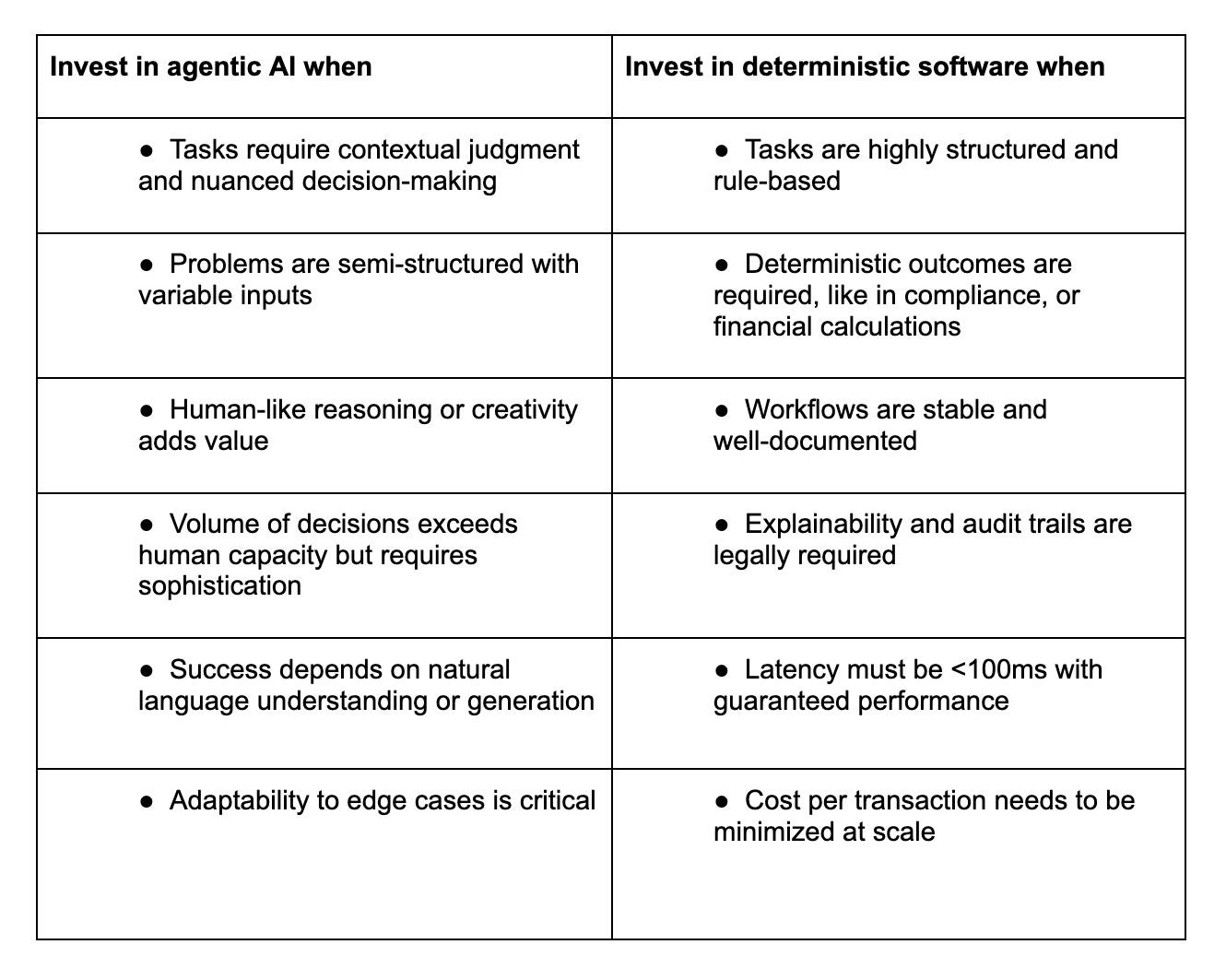
Agentic AI vs. deterministic software
As you start whiteboarding and really determine goals and KPIs with your team, you’ll find that when you’re booking, running and billing a transaction, deterministic software is faster, cheaper and safer than agentic systems.
Finding the highest value use cases for agentic AI
Figuring out where agentic AI can return the best value requires asking the right questions.
Do you already have API-level integrations with your partner? If so, it pays to ask whether inserting AI into that workflow is smart. Instead, you might find that putting agents on the other side of those APIs could make natural language interfaces within your organization more efficient.
How often does the use case arise? It makes more sense to start with tasks you encounter daily than ones that only pop up once every few months.
How much time will it save? If you’re a media buying agency, using generative AI as a campaign planning and strategy agent could shrink planning times from two weeks to two hours.
How much human oversight is required? While agentic AI automates, it often requires some level of human oversight and understanding.
Can it help you improve accuracy? If there’s a lot of pattern matching in the work, that’s what agentic AI was born to do.
Can it surface insights humans might miss? For example, a performance analyst agent that synthesizes authorized data across walled gardens, television and the open web could reduce manual reporting and streamline cross-media optimizations. But measure both the reporting effort saved and the business effect of acting on its recommendations.
How clean is my data? Bad data will result in AI delivering bad agentic results, with confidence.
To help AI agents work better together, the IAB Tech Lab is launching as part of our updated AAMP 3.0 protocol a feature called OpenProposal. It aligns how buyer and seller agents evaluate proposals in accordance with existing standards for media buying, execution and reporting. That’s just one example of how standards lay the groundwork for actual workflow improvements from emerging AI tech.
What to prioritize (and deprioritize)
Since the greatest value often comes from connecting fragmented data sources (DSPs, ad servers, CRMs), you’ll probably want to prioritize AI investments that work with your existing mar tech stack and that are API-first.
There’s no faster way to lose client trust than to get the numbers wrong. Use AI for insights and recommendations, not financial calculations. Stick to deterministic software for booking campaigns, validating prices and billing. Agent recommendations should pass the appropriate validation and approval controls before they create a financial commitment.
Focus on advantages rooted in proprietary data and a clear understanding of your customers, with appropriate rights and permissions.
Implementing AI for the sake of implementing AI can cost more than you think. The exposure includes wasted spending, avoidable operational errors, lost client trust and the opportunity cost of pursuing the wrong problem. Leadership must insist on a clear purpose, achievable milestones and credible measures of progress and agentic ROI. Invest with intent, validate the return and expand only when the results justify it.
Proceed with purpose.
“Data-Driven Thinking” is written by members of the media community and contains fresh ideas on the digital revolution in media.
Follow IAB Tech Lab and AdExchanger on LinkedIn.
For more articles featuring Anthony Katsur, click here.