Operator Refuses to Help After She Ignores Repeated Warnings, Then Claims Pregnancy
A woman who refused to leave a construction site excavator ended up stuck inside the machine’s bucket, and the operator refused to help her out. The 97-second clip, posted on X by @Neutral_OC, has gained over 9.4 million views and sparked major discussion about personal responsibility and safety protocols.
The footage shows the woman seated near the excavator arm despite repeated requests from the operator to move. She eventually climbs into the bucket, loses her footing, and becomes trapped inside its smooth metal interior. When she asks for help, the operator repeatedly says no.
Repeated Warnings, Ignored Requests
Initially, the woman was positioned near the excavator’s arm on an active construction site in California. She wears a white crop top and black pants, her midriff exposed as she squats or sits on or immediately adjacent to the machine’s arm. Dirt piles, rocks, and debris surround the yellow excavator, and a red truck is visible in the background. The operator, who appears to be recording from nearby, repeatedly tells her to move. “Can you get off my machine?” he says, his tone calm but insistent.
The woman does not comply. Instead of moving, she talks back to him. Her responses are confrontational and dismissive, and she makes no effort to leave. The operator continues to ask her to move, but she refuses to listen. At one point, she places a leopard-print head covering on her head and pulls a black top over her existing shirt, as if settling in rather than preparing to leave.
The operator eventually tells her she’s going to get stuck if she doesn’t get out of the bucket. She ignores him. She continues talking trash, unfazed by his warnings. The operator’s repeated requests go unanswered as the woman seems intent on staying where she is.
The Fall Into the Bucket
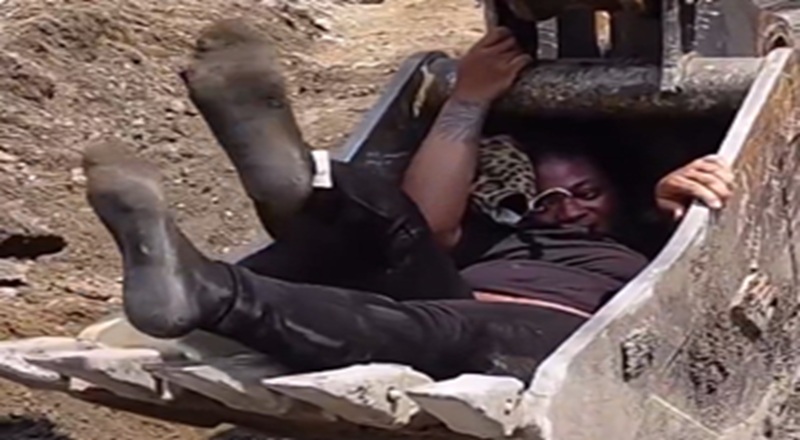
The woman shifts her position and eventually enters or falls into the excavator’s open metal bucket. The bucket’s smooth, curved interior is designed to hold dirt and debris, not people. Once inside, she reclines awkwardly with her legs extended and her feet dirty from the site. Her hands grip the edges of the bucket as she tries to find a stable position. The design of the bucket makes self-extraction nearly impossible, as there are no footholds or handholds inside.
The operator remarks on her situation with amusement in his voice. “Boy, you’re stuck now,” he says, the irony of the situation not lost on him. He had warned her repeatedly to move. She had ignored him. Now she was trapped inside the very machine she refused to leave. The operator’s tone is not malicious; it is matter-of-fact, a simple acknowledgment of the predictable outcome of her choices.
When she asks for help, he refuses. “No,” he says. “Nope. I’m not touching you.” The refusals are repeated, and he does not assist her in getting out. Other voices are audible in the background, with expressions of surprise and commentary on the situation. The woman remains wedged in the bucket, continuing to hold on and vocalize.
The Pregnancy Claim
The woman then states that she is pregnant, apparently to prompt assistance. The claim, if accurate, could introduce additional medical and legal considerations. Pregnancy is a condition that would typically warrant immediate help in any situation, and her statement appears designed to appeal to the operator’s sense of responsibility. However, the timing of the claim—only after she becomes stuck—raises questions about its credibility.
The operator continues to refuse help. Other voices are audible in the background, with expressions of surprise and commentary on the situation. The woman remains wedged in the bucket, continuing to hold on and vocalize. The pregnancy claim did not change the operator’s response. He had already decided not to assist, and her statement did not alter his position.
The veracity of the pregnancy claim has not been confirmed in public accounts. No reports have surfaced to verify whether she was actually pregnant or whether the claim was made in an attempt to manipulate the situation. The operator’s refusal to help suggests he may have doubted the claim, or he may have simply decided that he had done enough by warning her and was not going to involve himself further.
On X, People Laughed and Called the Woman Out
The post by @Neutral_OC generated over 60,000 likes, several thousand reposts, and 9.4 million views. Reactions were predominantly amused and critical of the woman’s actions. The dominant tone was one of mockery, with many users framing the situation as a classic case of consequences catching up to poor decisions.
“Clock out, head home for the day. Leave her there,” one widely liked comment stated. Another remarked on the pregnancy claim as a form of manipulation: “Oh, now she’s pregnant. Of course.” Comments framing the situation as “instant karma” or “play stupid games, win stupid prizes” appeared repeatedly and received strong positive engagement. One reply noted, “You’re not supposed to interfere with indigenous wildlife, just let nature take its course if it doesn’t listen,” using ironic distance to underscore the perceived absurdity of the situation.
A minority of responses expressed concern for the woman’s safety or criticized the lack of immediate help. “Being pregnant is not an excuse to be stupid but the guys were more stupid laughing and not helping her immediately,” one user wrote. Another raised the possibility of suffocation risk in the position, though subsequent discussion clarified that an open bucket does not restrict airflow.
Political or identity-framed comments appeared in some threads. Reposts and quote posts often reproduced the original caption or added short humorous overlays. Overall, the dominant public reaction on the platform treated the sequence as a self-inflicted predicament resolved through natural consequence rather than external rescue.
The Broader Implications
The incident illustrates tensions that can arise at active construction sites between equipment operators responsible for safety and productivity and individuals who approach or remain near machinery. Unauthorized proximity to heavy equipment represents a recognized hazard category. OSHA and industry standards emphasize exclusion zones, signaling, and operator authority to clear areas precisely to prevent accidents.
Entry into a bucket converts a standard work tool into an unintended confinement space with smooth surfaces that hinder self-extraction. The open design of a bucket does not create an enclosed suffocation risk in the manner of a confined space with limited air. The pregnancy claim, if acted upon, could introduce additional medical considerations, though its accuracy remains unverified.
Potential consequences include physical risk to the individual who entered the bucket, operational delays for the site, and possible legal or liability questions. Operators who refuse immediate physical assistance after a self-initiated entry may cite personal safety, liability avoidance, or the principle of not encouraging further interference.
What Happened Next
No confirmed resolution details have been reported. It is unclear how the woman ultimately exited the bucket, whether she received medical attention, or whether formal complaints were filed. The video itself constitutes the primary record of the incident.
Local California news outlets did not appear to cover the incident beyond viral circulation. The sharing of the video in last week led to rapid amplification on X and other platforms. Secondary postings on Facebook and video aggregation sites repeated the same clip with similar captions.
The incident remains a viral phenomenon rather than a formal public-safety or legal matter requiring official investigation. Its significance is tied to the concrete sequence captured on camera.