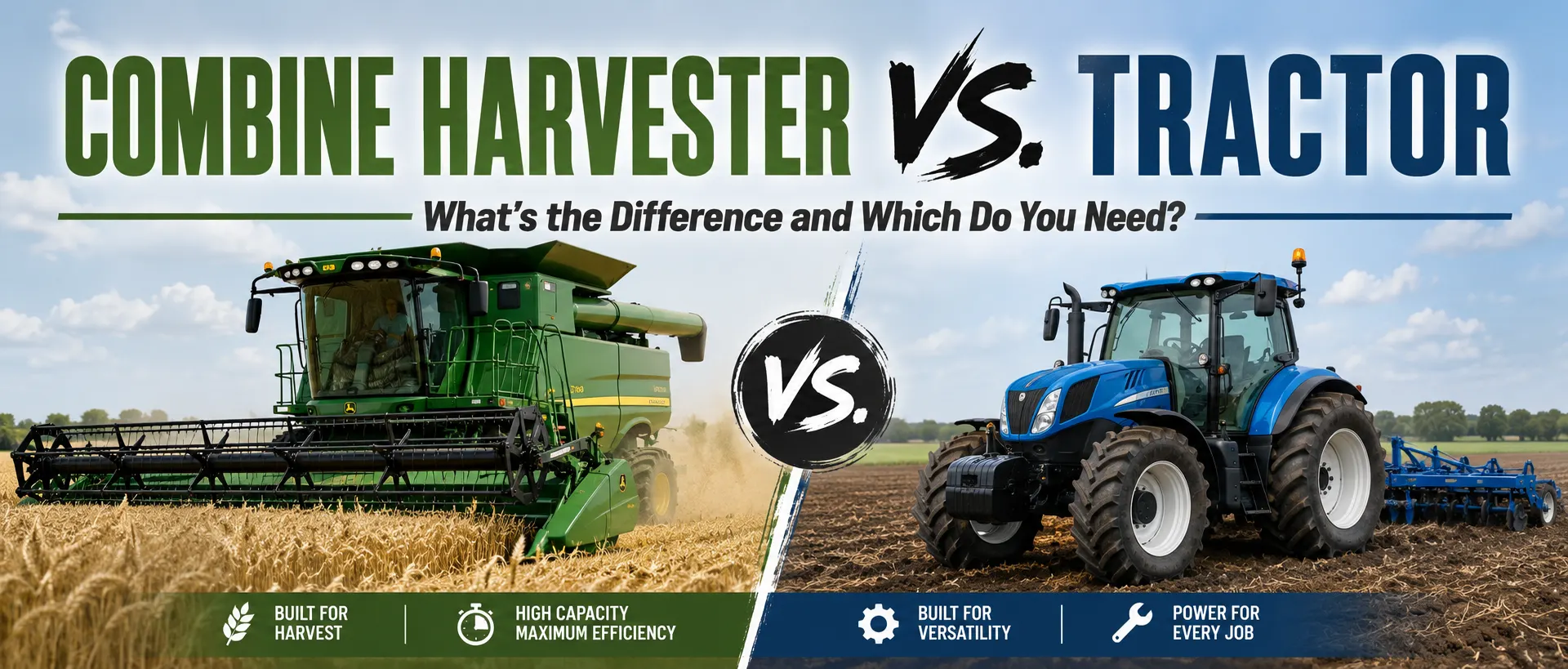
Ask ten people outside of farming to explain the difference between a tractor and a combine harvester, and most will struggle. Even inside agriculture, the terms get blurred – searches for “combine tractor” and “tractor combine” show up constantly, usually from people trying to figure out if these are two names for the same machine or two entirely different pieces of equipment. They’re different machines with different jobs, and understanding exactly how they differ matters if you’re planning equipment purchases, budgeting for a season, or just trying to get your terminology straight before talking to a dealer.
- A tractor is a power source built to pull and operate other implements; a combine harvester is a self-contained machine built specifically to harvest grain.
- Tractors work almost year-round across tillage, planting, spraying, and hauling; combines are typically used only during harvest season.
- New tractors range from roughly $9,000 for compact models to $600,000+ for large articulated units, while new combines typically run $100,000 to over $1,000,000.
- “Combine tractor” is a commonly searched phrase, but it usually refers to the combine harvester itself or to older tractor-pulled combine setups, not a hybrid machine.
- Most mid-size and large grain operations need both machines — a tractor for the rest of the season, a combine for the harvest window.
What Is a Tractor, and What Is It Actually Built For?
A tractor is a power unit. It doesn’t do farm work on its own — it provides the horsepower, hydraulics, and PTO (power take-off) that other implements need to function. Attach a plow and it tills. Attach a planter and it plants. Attach a sprayer, a baler, a grain cart, or a mower, and it becomes whatever the job requires that day.
That versatility is the entire point of a tractor. A single machine can plow ground in spring, cultivate through summer, and haul grain carts at harvest, provided you own the right attachments. Tractors are classified largely by horsepower: compact tractors under 30 HP run small operations and specialty tasks, mid-size tractors in the 30–80 HP range cover general-purpose farm work, and large tractors at 100 HP and up handle heavy tillage and pulling loaded equipment across big acreage. Price follows horsepower closely — compact models start around $9,000 to $12,000, mid-size tractors run $25,000 to $50,000, and large tractors span $50,000 up into the hundreds of thousands depending on features and size.
What Is a Combine Harvester, and How Is It Different?
A combine harvester does one job, but it does three things at once to get there: it reaps (cuts the crop), threshes (separates grain from stalk and chaff), and cleans (removes remaining debris from the grain) — all in a single pass through the field. That’s where the name “combine” comes from; it combines multiple harvesting steps that used to require separate machines and passes.
Unlike a tractor, a combine doesn’t run implements for other jobs. It’s purpose-built, self-propelled, and generally sits idle for most of the year outside of a few intense weeks during harvest. Combine horsepower ranges considerably by class, with most modern units falling somewhere between 300 and 650 HP depending on size and crop capacity. Pricing reflects that scale: new combines typically run from around $100,000 for smaller commercial models up past $1,000,000 for high-capacity flagship machines with full precision-ag packages. Used combines can be found anywhere from $10,000 for older, smaller machines to $400,000+ for late-model units with low separator hours.
Tractor vs. Combine Harvester: Side-by-Side Comparison
| Category | Tractor | Combine Harvester |
|---|---|---|
| Primary function | Pulls and powers implements for multiple tasks | Harvests grain in a single pass (reaps, threshes, cleans) |
| Versatility | High — changes function with attachments | Low — built for one job only |
| Typical horsepower | 25–400+ HP depending on class | 300–650+ HP depending on class |
| Seasonal use | Nearly year-round | Primarily during harvest weeks |
| New purchase price | $9,000–$600,000+ | $100,000–$1,000,000+ |
| Self-propelled | Yes, always | Yes (most modern models); tractor-pulled versions still exist for smaller operations |
| Common tasks | Tillage, planting, spraying, hauling, mowing | Grain harvest only |
Do You Actually Need Both Machines?
For most working grain farms, yes. A tractor and a combine handle completely different parts of the season, and one can’t substitute for the other in any meaningful way. A tractor can’t reap, thresh, and clean grain, and a combine can’t till a field, pull a planter, or haul equipment between fields. Farms that try to get by with only one usually end up renting or hiring custom services to cover the gap, which works for smaller operations but becomes a scheduling risk once acreage grows and harvest timing gets tight.
The decision isn’t really “tractor or combine” — it’s “how many of each, and what size.” Smaller operations under a few hundred acres often lean on custom harvesting instead of owning a combine outright, since the machine sits unused most of the year and the cost is hard to justify against limited acreage. Larger operations, particularly anything managing several thousand acres, typically find that owning both outright pays for itself through control over harvest timing alone — a narrow weather window doesn’t wait for a rented combine to become available.
Pros and Cons of Owning Both
Pros
- Full control over harvest timing instead of waiting on rental or custom-service availability
- A tractor’s versatility spreads its cost across nearly every task on the farm calendar
- No dependence on outside labor or equipment schedules during weather-sensitive windows
- Long-term ownership typically costs less per acre than repeated custom hire on larger operations
Cons
- A combine represents a large capital investment that sits idle most of the year
- Storage, insurance, and maintenance costs apply to both machines regardless of how often they run
- Tractors need a growing collection of implements to stay fully versatile, which adds to the real cost
- Smaller operations may never generate enough acreage to justify combine ownership over custom harvesting
5 Common Mistakes Farmers Make When Choosing Between Tractors and Combines
- Assuming a bigger tractor can cover harvest gaps. No amount of tractor horsepower replaces what a combine does — they’re not interchangeable, regardless of size.
- Buying combine capacity for acreage you don’t have yet. A larger combine than your current operation needs sits underutilized and ties up capital that could go toward tractor implements or working capital.
- Underestimating tractor implement costs. The tractor itself is only part of the investment — plows, planters, sprayers, and grain carts add up fast and are easy to overlook when budgeting.
- Overlooking the threshing and separation system when pricing a combine. The base machine price rarely reflects what the concave and separator setup will cost to maintain or upgrade over its working life.
- Ruling out custom harvesting too early. For operations under a few hundred acres, hiring a custom combine crew is often more cost-effective than ownership, even though it feels like giving up control.
Frequently Asked Questions
What is the difference between a tractor and a combine harvester?
A tractor is a versatile power source that pulls and operates different implements for tasks like plowing, planting, and hauling. A combine harvester is a specialized, self-propelled machine built to harvest grain crops by cutting, threshing, and cleaning them in one pass.
Is a “combine tractor” the same thing as a combine harvester?
Not exactly, but the confusion is common because of how the terms get used online. Most people searching “combine tractor” mean the combine harvester itself. The phrase can also refer to older tractor-pulled or tractor-mounted combine attachments, which some smaller operations still use, but modern self-propelled combines are the standard for most grain farms today.
Do farmers need both a tractor and a combine harvester?
Most established grain operations need both, since they perform completely different jobs across the season. A tractor handles tillage, planting, and general farm work most of the year, while a combine is used specifically during harvest weeks.
Can a tractor be used to harvest crops without a combine?
A tractor alone cannot harvest grain crops. It can pull an older-style pull-type combine header in some setups, but it has no ability to reap, thresh, and clean grain on its own the way a combine harvester does.
Which costs more, a tractor or a combine harvester?
A combine harvester almost always costs more than a comparable tractor. New combines typically start around $100,000 and can exceed $1,000,000 for high-capacity models, while tractors range from around $9,000 for compact units up to $600,000+ for the largest models — with most working farm tractors falling well under combine pricing.
Key Takeaways
- Tractors and combine harvesters are built for entirely different jobs and aren’t interchangeable
- Tractors offer year-round versatility; combines are specialized and used mainly during harvest
- Combine harvesters generally cost significantly more than tractors due to their specialized design
- “Combine tractor” is a common search term, but it usually refers to the combine harvester itself
- Most mid-size and large grain operations benefit from owning both, while smaller farms may lean on custom harvesting
Conclusion
A tractor and a combine harvester aren’t competing purchases — they’re two different tools solving two different problems on the same farm. The tractor keeps the operation running through planting, spraying, and everything in between, while the combine’s entire job is getting the crop out of the field efficiently once it’s ready. Understanding that distinction makes equipment budgeting, dealer conversations, and long-term planning a lot more straightforward.
Once the combine is in the barn, what happens inside it during harvest matters just as much as the purchase decision. Worn or outdated concaves are one of the most common reasons combines lose grain and capacity regardless of how much the machine itself cost. The Estes XPR3 Concave System is built to run all crops without reconfiguring, stop rotor loss, and get more out of every pass. Get a free XPR3 quote and see what it can do for your combine this season.