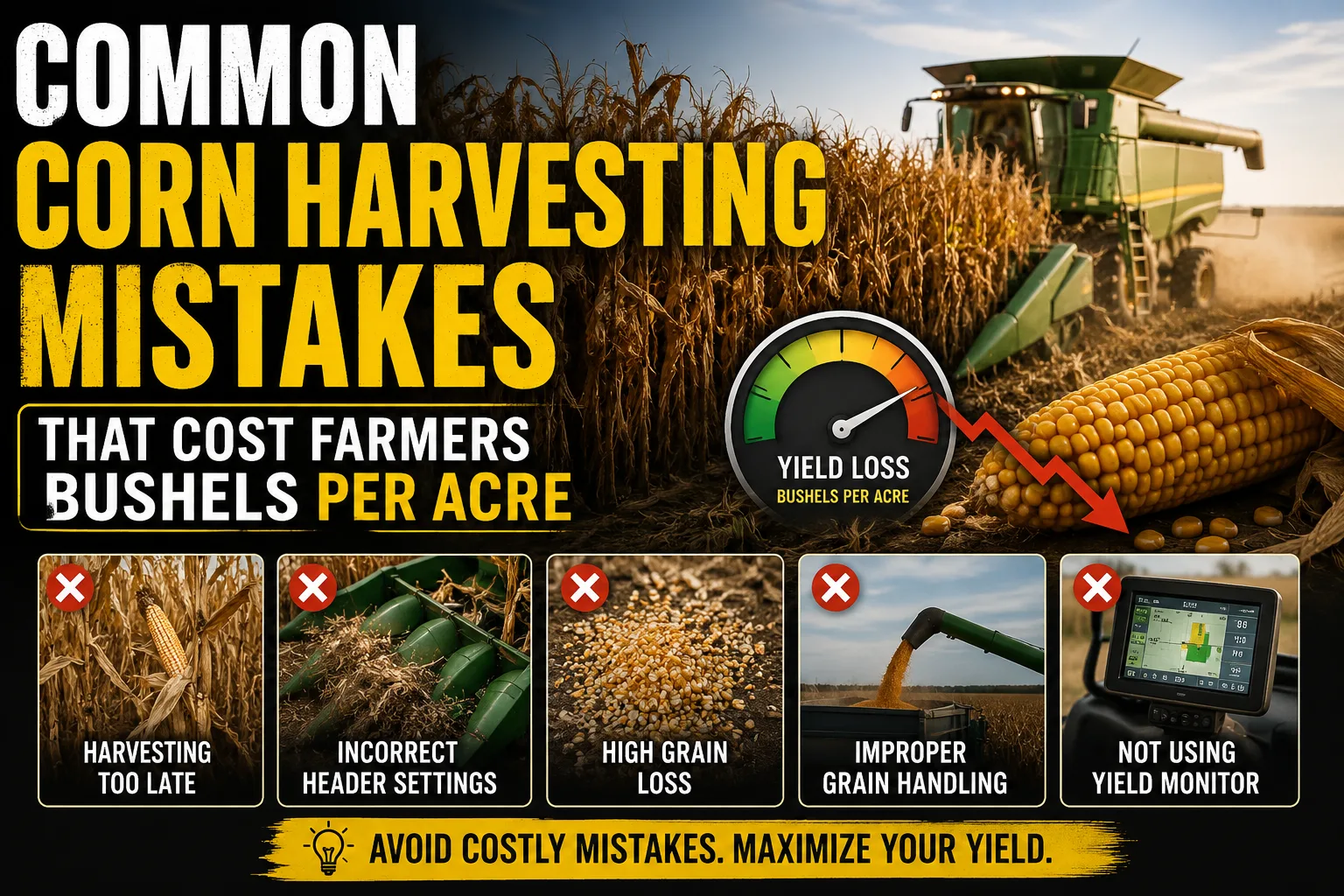
Corn prices move up and down every season, but there’s one loss farmers rarely talk about because it never shows up on a settlement sheet: grain left in the field. With 2026 bringing record harvested corn acreage nationwide and disease pressure from anthracnose and tar spot pushing some growers toward earlier harvest dates, the margin for error at the combine has never been thinner. Small, repeatable corn harvesting mistakes – a header set half an inch too high, a rotor spun too fast, a concave that hasn’t been checked since spring – quietly cost 2 to 5 bushels per acre on almost every pass. On a 1,000-acre operation, that’s not pocket change. It’s the difference between a good year and a great one.
This guide walks through the most common combine and setup errors that drain corn yield before it ever reaches the bin, why each one happens, and what an experienced operator does differently. Whether you’re running your first season or your thirtieth, a quick gut-check on these habits can put real bushels back in the tank.
Key points in this article:
- Most yield-robbing errors happen at the combine, not the planter — ground speed, rotor settings, and concave wear are the biggest yield thieves.
- A rotor combine typically loses 3 to 5 bushels per acre from separation loss alone when settings and equipment aren’t matched to conditions.
- Harvesting outside the ideal moisture window increases both field loss and drying costs.
- Worn or outdated concaves are one of the most overlooked culprits, since they’re rarely inspected mid-season.
- Simple daily checks — grain loss monitors, header height, snapping roll condition — catch most problems before they add up.
Why Do Small Harvest Setup Errors Add Up So Fast?
A single setting that’s slightly off doesn’t feel like much in the cab. Ground speed a half-mile-per-hour too fast, cylinder speed set for last week’s moisture level, a concave that’s been in the machine for three seasons — none of these throw an alarm. But the losses are cumulative. A loss of just 2 bushels per acre across 1,000 acres, at recent corn prices, adds up to thousands of dollars that never show up as a line item. It just shows up as slightly lower yield monitor numbers that everyone chalks up to “the field.”
The problem is compounded in 2026 by two realities hitting Corn Belt growers at once: record harvested acreage means combines are covering more ground under time pressure, and disease pressure from tar spot and anthracnose is forcing some farmers into earlier, wetter harvest windows where equipment settings matter even more. Setup errors that were forgivable in a normal, dry fall become expensive fast when stalks are down, ears are lighter, and the harvest window is compressed.
Are You Harvesting Corn at the Wrong Moisture Content?
Starting the harvest too early or waiting too long are both classic timing errors. Corn harvested above 25% moisture threshes harder, increases kernel damage, and runs up your propane bill at the dryer. Wait too long, past the low teens, and you’re fighting stalk lodging, ear drop, and dry-down field loss that no combine setting can fully recover.
Most agronomists recommend targeting 20-22% moisture at the start of harvest for standability and threshing quality, adjusting earlier if disease pressure or wind events threaten stalk integrity. If tar spot or anthracnose has weakened stalks in your fields this season, that calculation shifts — protecting the crop from going down may outweigh waiting for the “ideal” moisture number.
Is Your Ground Speed Too Fast for the Conditions?
Pushing ground speed to cover more acres per day is one of the most common combine errors, and one of the easiest to fix. Every combine has a threshing and separating capacity ceiling. Push past it and the rotor can’t process material fast enough, so grain rides out the back with the residue instead of dropping through the concave.
A faster, well-matched concave system changes this equation. Estes Performance Concaves’ XPR3 system is built to let operators run 2 to 3 mph faster ground speed without sacrificing separation, because the increased threshing surface area processes more material per rotor revolution. That’s the difference between fighting your equipment limits and actually using them.
Are You Skipping Daily Concave and Rotor Adjustments?
Field conditions change hour to hour — moisture drops through the afternoon, stalk quality varies field to field, ear size shifts across hybrids. Running the same concave clearance and rotor speed all day, every day, is one of the quieter yield thieves because it doesn’t cause a visible problem, it just steadily bleeds bushels.
Experienced operators check concave clearance and rotor RPM at least once per field, more often if moisture is swinging. Concaves that are too tight for the material cause excess kernel damage and cob shattering; too loose and unthreshed ears pass straight through.
Is Your Combine Set Up for Down or Lodged Corn?
This is the mistake catching more farmers off guard in 2026. With widespread anthracnose and tar spot weakening stalks across parts of the Corn Belt, more acres are going into the combine down or leaning than in a typical year. Running standard header and reel settings on lodged corn is a fast way to leave ears in the field entirely, separate from any threshing loss.
For down corn, slow ground speed, drop the header closer to the ground, and angle gathering points to pick up leaning stalks rather than push them over. On the threshing side, a concave designed to handle inconsistent, stressed material — rather than one calibrated for ideal, upright stalks — makes a measurable difference in how much of that crop actually makes it to the tank.
Are You Overlooking Worn or Outdated Concaves?
Of everything on this list, this is the one most farmers don’t think about until yield checks come back disappointing. Concaves wear gradually over multiple seasons, and OEM designs weren’t built to flex across corn, soybeans, and wheat without swapping components between crops. That means many combines run mid-season on concaves that are already past their performance window, quietly costing bushels every single pass.
Industry data shows every rotor combine loses roughly 3 to 5 bushels per acre to rotor loss under standard conditions — on 1,000 acres of soybeans, that’s close to $30,000 left on the ground in a single season, and corn loss follows a similar pattern. Estes Performance Concaves built the XPR3 Concave System specifically to close that gap. Its 143-disrupter-finger grate keeps the crop mat suspended instead of letting it wrap tight around the rotor tube, which is exactly where free grain typically gets trapped and carried out the back of the machine. With 135% more threshing surface area than standard concaves and up to a 70% capacity increase, the XPR3 also gives operators room to run faster without the separation loss that usually comes with speed. Because it’s an all-crop system, there’s no swapping covers or bands between corn and soybeans either — one of the small logistical mistakes that quietly costs harvest-day time every fall.
Are You Ignoring Header Height and Snapping Roll Wear?
Header height that’s set too high skips over shorter ears and leaves them standing. Worn snapping rolls, meanwhile, shell kernels directly off the ear before it even reaches the threshing cylinder — a loss that a yield monitor sometimes won’t even register as separation loss, because it never got that far.
Check snapping rolls for wear at the start of each season and again mid-harvest if you’re running high acreage. A rule of thumb: if you’re finding shelled kernels on the ground ahead of the header, before the crop mat even enters the machine, snapping roll wear is the first place to look.
Are You Skipping Grain Loss Monitor Checks?
Modern combines come equipped with grain loss sensors, but plenty of operators either don’t calibrate them correctly or stop paying attention to them once harvest gets busy. Running blind on grain loss is one of the errors that compounds fastest, because a setting that drifts out of range at 8 a.m. can run unnoticed for the rest of the day.
Beyond the electronic monitor, a simple manual check — walking behind the combine and counting kernels in a measured square foot of ground — should be a standard part of the daily routine, not a once-a-season habit.
Comparing Common Setting Mistakes and Their Bushel Impact
| Mistake | Typical Cause | Estimated Loss Impact | Quick Fix |
|---|---|---|---|
| Ground speed too fast | Pushing acres per day | 1-3 bu/acre | Match speed to rotor capacity, not the clock |
| Worn or outdated concaves | No mid-season inspection | 3-5 bu/acre | Inspect wear points; consider an all-crop upgrade |
| Wrong concave clearance | Static settings all day | 1-2 bu/acre | Re-check clearance per field or moisture shift |
| Header set for standing corn only | No adjustment for down/lodged stalks | 2-6 bu/acre | Lower header, slow speed, angle gathering points |
| Worn snapping rolls | Deferred maintenance | 1-2 bu/acre | Inspect and replace before season start |
Pros of Fixing These Harvest Errors Early
- Higher grain recovery per acre without buying more land or inputs
- Reduced kernel damage, which supports better grain quality and storage life
- Fewer volunteer corn plants next season from grain left behind
- Better fuel efficiency when ground speed and rotor load are properly matched
- Less strain on combine components from correct, consistent settings
Cons and Trade-Offs to Plan For
- Daily setting checks take operator time during an already busy season
- Upgrading worn concaves is an upfront cost, even though it pays back through recovered bushels
- Slowing down for down or lodged corn can extend harvest days when weather windows are tight
- Training newer operators on proper adjustment takes time away from other harvest tasks
5 Most Costly Corn Harvesting Mistakes at a Glance
- Harvesting outside the optimal moisture window for the crop and conditions
- Running ground speed beyond what the rotor and concave can actually process
- Leaving worn or outdated concaves in the machine season after season
- Using standard settings on down or disease-weakened corn instead of adjusting for it
- Ignoring grain loss monitors or skipping manual field loss checks
Frequently Asked Questions About Corn Harvesting Mistakes
What is the most common corn harvesting mistake?
Running ground speed too fast for the combine’s threshing and separating capacity is the most common mistake, because it happens gradually and doesn’t trigger an obvious warning — it just shows up as lower yield numbers over the season.
How many bushels per acre does poor combine setup typically cost?
Depending on the specific mistake, growers commonly lose anywhere from 2 to 6 bushels per acre. Worn or mismatched concaves alone can account for 3 to 5 bushels per acre in rotor loss under standard conditions.
Does down or lodged corn really change how I should harvest?
Yes. Down and lodged corn requires slower ground speed, a lower header angle, and gathering points positioned to catch leaning stalks. Skipping these adjustments in disease-affected fields, like those seeing anthracnose or tar spot pressure in 2026, is one of the fastest ways to lose whole ears rather than just threshing loss.
How often should I check my combine’s concave clearance during harvest?
At minimum, once per field, and more frequently if moisture content is shifting through the day. Static settings that worked in the morning often don’t hold up once conditions change in the afternoon.
Can upgrading concaves actually reduce corn harvesting mistakes?
An upgraded concave system doesn’t eliminate operator error, but it does widen the margin for it. Systems like the Estes Performance Concaves XPR3, built with a disrupter-finger grate and higher threshing surface area, are designed to handle a broader range of moisture and stalk conditions without the same sensitivity to small setting mistakes that standard OEM concaves have.
Key Takeaways
- Corn harvesting mistakes are rarely dramatic — they’re small, repeatable habits that add up over a season.
- Ground speed, concave condition, and header height are the three biggest sources of avoidable grain loss.
- 2026’s disease pressure and record acreage make setup precision more important than in a typical year.
- Daily checks on grain loss monitors and concave clearance catch most problems before they become expensive.
- Equipment upgrades, particularly to worn concaves, offer one of the highest-return fixes available before the season starts.
Protect Every Bushel This Harvest
Most corn harvesting mistakes aren’t about a single bad decision — they’re about small settings and worn components that quietly cost bushels all season long. If your combine has been running the same concaves for multiple seasons, or you’re heading into a harvest with more down or disease-stressed corn than usual, it’s worth taking a hard look at what’s actually happening inside the rotor. Estes Performance Concaves’ XPR3 system was built to close that gap, giving farmers an all-crop concave designed to reduce rotor loss and hold up across the conditions that standard OEM setups struggle with. Explore the XPR3 Concave System from Estes Performance Concaves to see what it could mean for your next harvest.