


AI agent implementation always starts nice and simple. You deploy an agent for automating workflows. And another one for summarizing reports. Everything seems under your control until it isn’t. One agent in your organization opens a floodgate for further agent implementations that spread more quickly than you may realize.
The only way to avoid this sprawl is to have enterprise AI governance in your mind right from the start. However, agentic AI governance is different from traditional AI governance. It’s much faster in pace and deals with a lot of ifs and buts rather than fixed rules.
And that necessitates a playbook that is created for the unique peculiarities of governing AI agents. In this piece, we have outlined such a playbook for CIOs for their agentic AI game plan.
What enterprise AI governance means when agents multiply
Enterprise AI governance becomes more demanding when your company is using dozens of AI agents and autonomous tools. Because then you’re responsible for micromanaging separate tasks at a time, each with their own risks and consequences.
More agents do not mean less management work. It often means more.
AI agents need micromanagement
AI agents do not behave like human employees. Human workers don’t like being micromanaged. And nor should they be because humans bring their best when their judgment is trusted without being constantly monitored. As Steve Jobs brilliantly put it, it doesn’t make sense to hire smart people and tell them what to do.
However, AI agents must be micromanaged because they can’t be trusted like human coworkers.
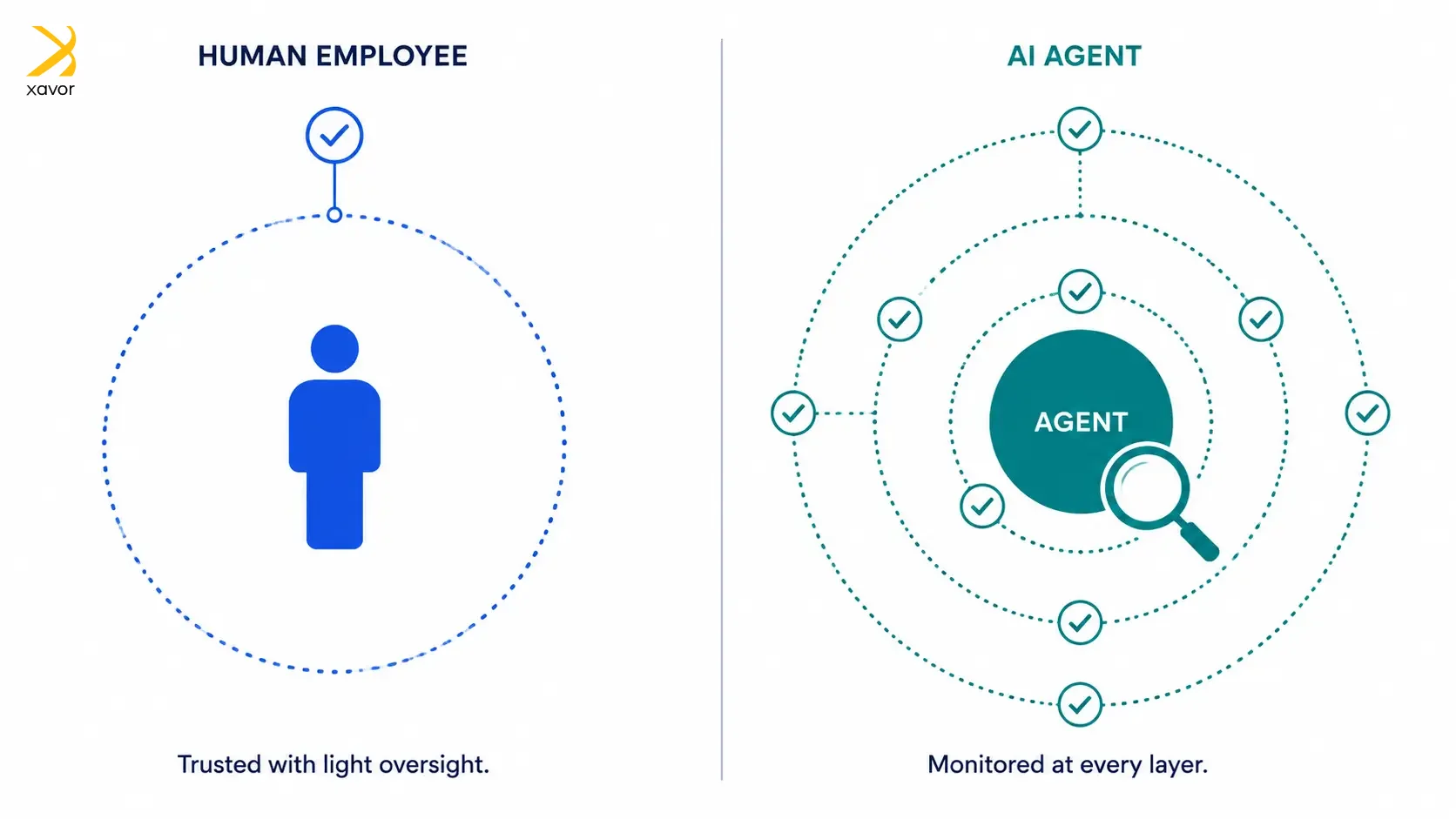
Your human employee will ask you for clarification or recognize that he/she is uncertain about a task. And on the flip side, they can also question a poor instruction by their superiors if they feel something looks wrong.
But AI agents don’t do that. They are great at sophistry. AI agents can keep producing flawed outputs and sometimes complete nonsense in a very convincing way. And you won’t find the problem with their work until you look very closely.
So, with more agents running, enterprise AI governance becomes difficult. You have to nitpick the work of every AI agent for reliability and accuracy, then you would normally do for even an intern. AI agents are still software tools. They need calibration at every step.
Creating an agentic enterprise AI governance playbook from scratch
Here’s the six-step framework for building agent governance from the ground up. Each step handles one part of the problem. Visibility. Scope. Identity. Risk. Data quality. Skip a step and that part can become unreliable.
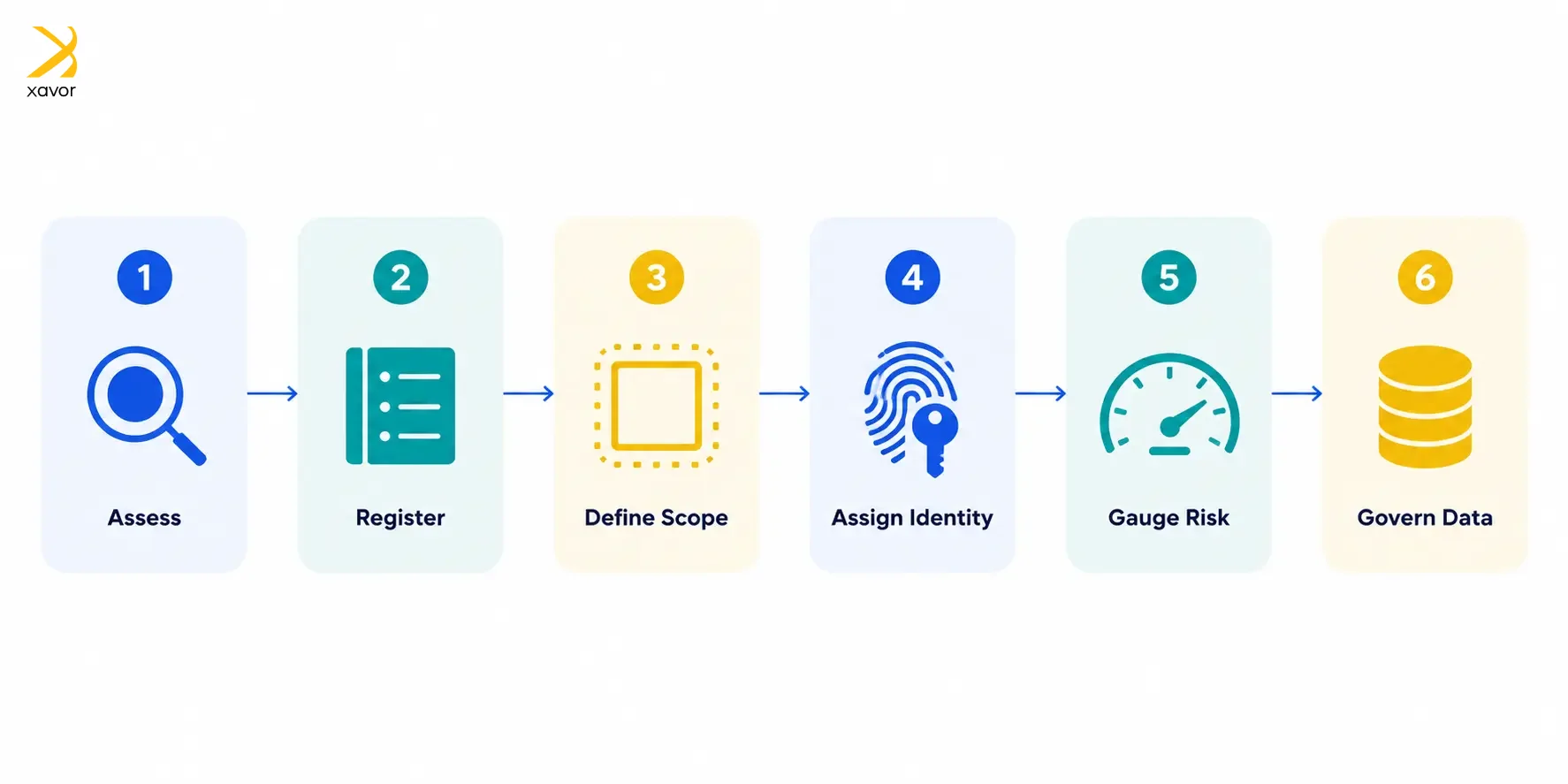
1. Assess the ethical purpose and impact of agents
You must be cognizant of the ethical impact of AI agents before you start developing or deploying them. This assessment is one of the AI governance best practices to identify the benefits and risks of the AI systems.
- Confirm the task is appropriate to delegate to an agent at all. The degree of automation should match the actual necessity of the task.
- Check the use case against factors that undermine human dignity or discriminate against a particular group.
- Document anyone or anything that is affected downstream of the agent’s actions.
Any agent that shows red flags in any of these steps, bin it immediately and start again.
2. Register the agent
You can’t govern what you don’t know exists. Companies end up with AI sprawl because they race to deploy dozens of agents, and six months later nobody can tell you how many agents they actually have deployed within their organization.
So, you need to do something radically simple. One place. One list. Every agent that exists in this company, in one registry. And for every single agent in that list, you ask the questions that actually matter:
- What’s it called, and how do we know it’s this one and not some other one?
- What is it actually for? The problem it solves, right now, for this business?
- Who owns it? And we don’t mean “the platform team.” It must be a name. Someone whose job is on the line if this thing goes sideways.
- How risky is it? Is this agent sending an internal Slack summary, or is it moving money?
- What’s it plugged into? Which models, which tools, which APIs, whose data?
- Is it actually live, or is it one of those pilots that quietly died six months ago and nobody bothered to turn off?
- And where does it run?
The idea is to bring discipline. It’s not complicated. Because if you skip this, five different agents can do almost the same thing because nobody knew the other four existed. You get zombie pilots still holding live credentials to systems nobody remembers granting them.
2. Define the scope and allowed actions of the agent
Next in enterprise AI governance, you must clearly set the boundaries around what the agent is allowed or prohibited to do. And those boundaries can’t be vague. For example, “It helps with customer service, but can also do ITSM.”
Every agent must have an authority profile in plain language. What’s it built to do. What decisions it’s actually trusted to make on its own. What systems it’s allowed into. What tools it’s allowed to export.
Then comes the prohibited list in enterprise AI governance. AI agents never quit. They lock onto a specific goal like a heat-seeker missile relentlessly, single-mindedly trying to complete the objective you gave them.
And a system that’s relentlessly trying to help you is exactly the system that will talk itself into something it shouldn’t do. Because in its head, in that moment, it would help. But in reality, it creates new risks.
So, you don’t leave that to the judgment of the agent. You write down that these actions are off the table. Full stop. These actions can’t be performed no matter what the agent thinks it’s optimizing for.
Take a simple case of a customer service agent. It can look up an order or issue a refund under a hundred pounds. It can update a case note. Fine. That’s the job.
But it cannot touch someone’s bank details, nor can it go wandering into an employee’s file that has nothing to do with the ticket in front of it.
3. Assign a unique identity and minimum permissions
As we said earlier, an agent can’t ever be a human worker. Therefore, it should never borrow a person’s login and slip through the system wearing someone else’s badge. And it should never get broad access just because it’s part of a workflow everybody trusts.
Every agent gets its own identity, which is not shared. Its own service account, its own role-based access, tokens scoped down to exactly what it needs. Credentials that expire when they should, with permissions that map, one to one, to the actual approved purpose of that agent.
And this matters most when you’ve got agents talking to other agents. Give each agent exactly what it needs to do its job. Not one permission more.
4. Gauge the agent’s risk
In enterprise AI governance, not every agent is the same. And if you treat them like they are, you’re wasting effort on frivolous things. Plus, you’re not spending nearly enough on the things that actually matter.
Think about it. An agent that drafts your meeting notes? Fine. If it gets a sentence wrong, someone rereads a document. That’s the whole downside.
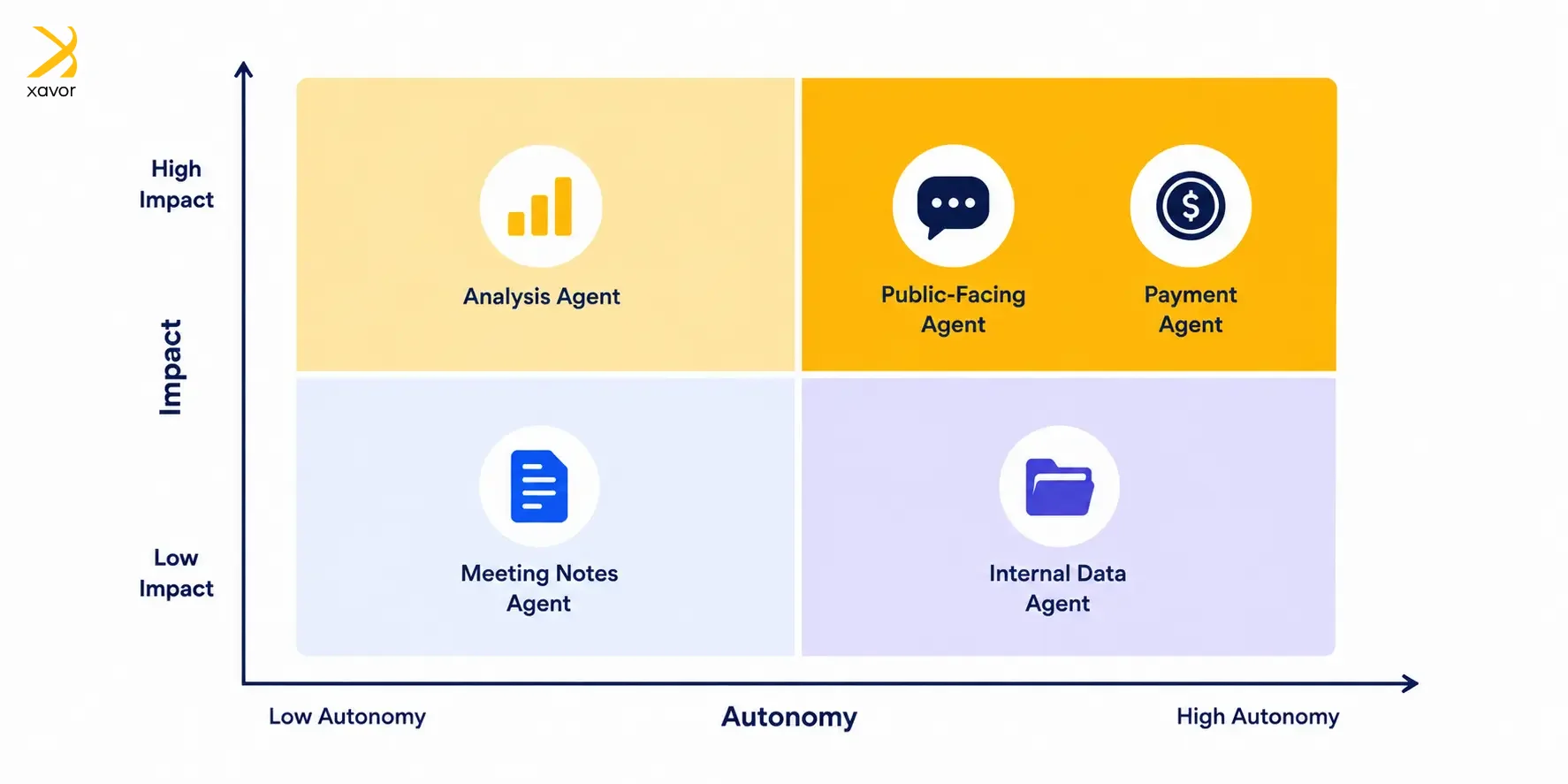
Now think about an agent that authorizes a payment in a fintech app. Or changes a patient’s medical record. Makes a recommendation about who gets hired. Runs an industrial process. Speaks publicly, in your company’s voice, to the entire world.
Those are not the same valence. And treating them the same is how some good companies ended up in very bad headlines.
So, before you build or deploy an agent, do a risk assessment on it. And autonomy is that one signal that tells you more than all the others.
The more independent an agent can act, the deeper you have to look before you let it loose.
Great governance isn’t treating everything as dangerous. It’s knowing exactly where the danger actually is, and putting your attention there.
5. Govern the data the agent relies on
An agent is only as good as the data it’s looking at. You can build the most elegant system in the world, and if you feed it bad data, biased data, stolen data, stale data, it doesn’t matter how smart the thing looks. Garbage in, confident garbage out. And confident garbage is worse than obvious garbage, because people believe it.
And this isn’t just about training data. Today, it’s everything the agent touches in the moment. What an agent retrieves, what’s in the database, what’s in the prompt, what’s in the conversation history, what an API handed back, what one agent passed to another agent down the chain.
Every one of those is a data source. Every one of those needs the same discipline.
Because the truth is simple: an agent doesn’t have wisdom. It has whatever data it was given, and the judgment it exercises on top of that. Govern the data, and you’ve done more for reliability than any amount of clever engineering downstream.
Why is governing AI agents different from governing AI models?
TL; DR
An AI governance framework for LLMs controls the model’s outputs by controlling what it knows and how it’s trained. On the other hand, AI agent governance adds another layer that controls how an agent acts in real-world settings.
Traditional AI governance frameworks are centered around LLMs because generative AI is the most commonly used strand of artificial intelligence right now. That means they are designed for predictable systems where governance is needed mostly to validate the output.
But the only thing predictable about AI agents is their unpredictability. They have the power and autonomy to take actions as they see fit. And that power to take action comes with a tradeoff. It also makes them vulnerable to making mistakes that affect live systems and the people dependent on them. Such as the problem of lethal trifecta, where agents can be tricked by hackers to hand over sensitive information.
So, an enterprise AI governance framework for AI agents requires attention towards controlling the system’s actions as well, instead of just validating the output. And this pivots the whole direction of an enterprise AI governance for AI agents.
Here’s a comparison showing how model governance and agent governance are different:
| Area | Model Governance | Agent Governance |
| Main Focus | How the model is built and behaves | How the agent acts in live systems |
| Core Benchmark | Is the model reliable and safe? | What is the agent allowed to do? |
| Key Controls | Data governance and model testing | Permissions and identity access management |
| Subject of Scrutiny | The output produced by a model | The action taken by an agent |
| Desired Results | A trustworthy model | A controlled and accountable agent |
Top AI accountability frameworks for governing agents
AI accountability frameworks provide you with a set of rules and guidelines to create an enterprise AI governance playbook.
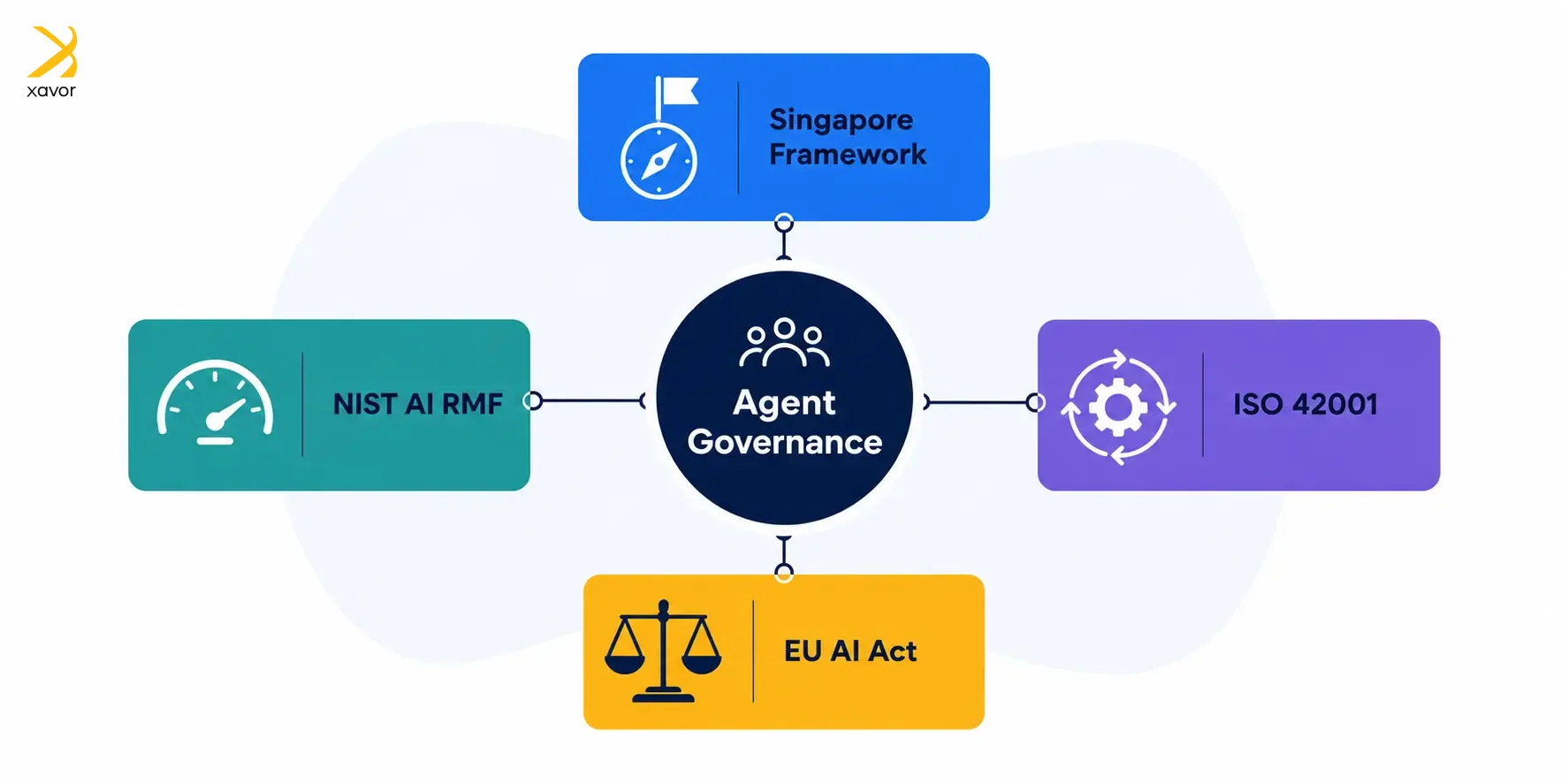
Most of these frameworks are voluntary but widely adopted, like NIST’s AI RMF. Others are management standards that turn accountability into a repeatable internal process rather than a one-time check.
1. Singapore’s agentic AI framework
Singapore introduced the world’s first comprehensive accountability framework for AI agents on 22 January 2026 at the World Economic Forum. It’s an excellent guide for CIO’s to mitigate the risks associated with implementing agentic AI solutions.
It was developed by the Infocomm Media Development Authority of Singapore using real-world test data from tech giants like Google and AWS. They updated it in May 2026 with added case studies and AI governance best practices for multi-agent environments.
2. ISO 42001
ISO 42001 is an international standard for an Artificial Intelligence Management System (AIMS). It helps organizations turn AI governance into repeatable operating processes. The framework provides the operational backbone for agent governance.
It helps formalize leadership responsibilities, lifecycle controls, risk assessments, documentation, audits, performance reviews, and continuous improvement. Its Plan-Do-Check-Act model ensures governance becomes an ongoing management discipline rather than a one-time policy exercise.
3. The EU AI Act
The EU AI Act became law in 2024 as the world’s first comprehensive legal framework for AI. It entered into force on 1 August 2024 and applies in phases, with most provisions taking effect on 2 August 2026.
It provides the strongest legal accountability layer for AI governance compliance. The Act classifies AI according to risk and assigns obligations to providers, deployers, importers, and other actors.
4. NIST AI risk management framework
The US National Institute of Standards and Technology released the NIST AI Risk Management Framework in January 2023. It is a voluntary and industry-neutral framework designed to help organizations manage AI risks through four connected functions:
- Govern
- Map
- Measure
- Manage
NIST provides the risk-management engine for agent governance. It helps teams understand how an agent will be used, considering all its possible harms. NIST measures whether controls are working, and decides whether risks should be accepted or not.
Conclusion
“Trust is good, but control is better.”
That old governance instinct becomes even more important in enterprise AI governance when AI agents are very powerful technologies. An agent may look like a helpful digital worker, but it still needs clear, continuous human oversight.
Enterprises can deploy as many agents as they want. That is not even a question. However, what matters is whether accountability, monitoring, and intervention can scale at the same speed. Strong agentic AI governance allows organizations to pursue the benefits of agentic AI without surrendering control.
Xavor helps enterprises design, develop, and integrate agentic AI solutions with governance built into their architecture. Contact us at [email protected] to govern your next AI agents with Xavor and scale autonomy without losing control.
About the Author

Farhan is the AI Lead and Data Architect at Xavor, specializing in transforming enterprise data into sovereign automation. He architects resilient, scalable AI ecosystems for Fortune 500s and SMEs, leveraging his expertise in multi-agent systems, cognitive architectures, and robotics R&D.
FAQs
There’s no single best option. It depends on what your main priority is to achieve with an enterprise AI governance framework. Most mature enterprises combine at least two frameworks. They choose one for legal grounding and one for day-to-day operational discipline.
Costs vary widely based on scope. A governance audit or framework design engagement can run from tens of thousands to well into six figures for large multi-agent enterprise rollouts. Ongoing costs also depend on whether governance is handled in-house or through continuous consulting support.
Start by registering every agent in a central inventory, then apply platform-native controls. Agentforce’s permission sets and ServiceNow’s AI Control Tower both offer built-in guardrails, but they still need to be configured against your own risk tiers and ownership model.


