By Jennifer Meszaros • Contributing Writer
October 13, 2026
Comac’s C929 widebody program is gaining momentum on the manufacturing front with suppliers taking on major structural work and preparing to deliver components for development aircraft.
The baseline aircraft is designed for 290 seats with a range of 12,000 km (6,480 nm), according to the state-owned manufacturer, with layouts accommodating between 282 and 440 seats. Speaking at the China Air Transport Association conference last month, Comac’s general manager Shen Bo described the C929 as being in “steady detailed design,” state broadcaster CCTV reported.
The remarks came shortly after Cotesa China, the Chinese subsidiary of Germany’s Cotesa GmbH and part of the ATCC Group, announced that its five-meter-class composite frame for large widebody airliners had completed process validation and could support C929 development and serial delivery. The company unveiled the technology on September 1, the opening day of the 29th China International Composites Industrial Technical Exhibition in Shanghai.

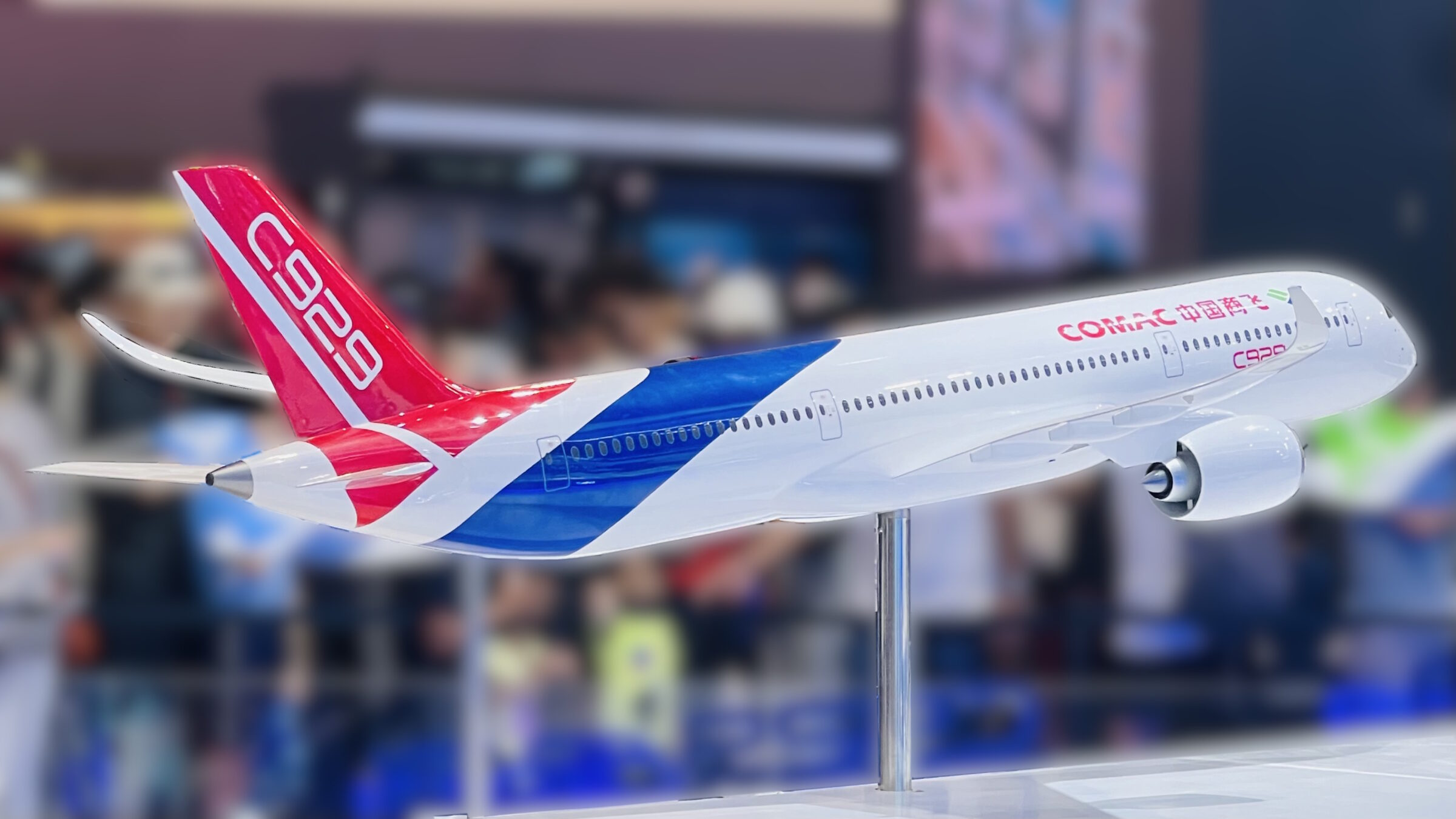
A model of the Comac C929 presented at the Singapore Airshow in 2024. Photo credit: Wikimedia Commons
According to Cotesa China, the frame met its design targets for dimensional accuracy and internal porosity during in-house testing. Its production process combines automated fiber placement (AFP) with thermal diaphragm forming; the team paired the forming step with tooling compensation to eliminate ply wrinkling, a common defect in large composite layups.
Engineers also ran full-scale AFP simulations and end-to-end finite element analysis to refine the tooling design and control cure-induced warpage and spring-back. The company added that the process is protected by a patent portfolio and represents independent control over automated manufacturing technology for aviation composites.
Comac, which has yet to identify a target date for the C929’s first flight, is targeting service-entry in the mid-2030s.
Breaking Down C929 Suppliers
Tasked with the C929 midsection fuselage is Huarui Aviation, selected as the sole preliminary supplier for the work package in March 2021, when the program was still the Sino-Russian CR929. This July, Chinese media reported that the company had signed the main contract with Comac Shanghai Aircraft Manufacturing, moving the relationship from preliminary selection into implementation.
The midsection connects the forward fuselage, mid-rear fuselage, center wing box, landing gear, and fairings. According to Huarui, it is expected to contain more than 6,000-part types totaling over 165,000 individual pieces, of which more than 1,700 types are composite parts. Using a panel assembly system supplied by Germany’s Broetje-Automation under Shanghai Electric, its Hangzhou production line targets annual capacity of 45 sets, or four composite midsections per month.
Both Cotesa China and Huarui Aviation are existing Comac suppliers, as are several others advancing on C929 components.

Diagram produced with assistance from Anthropic’s Claude AI
AVIC Xi’an Aircraft, a supplier of structures across the C909 and C919 programs, confirmed in August that it had won the bid for four C929 work packages—the rear fuselage forward section, slats, ailerons and winglets. In a September follow-up disclosure, the company said it is advancing trial component development and validation in line with Comac’s program plan.
On the systems and avionics front, Aviage Systems, a 50-50 joint venture between GE Aerospace and AVIC, signed a letter of intent during February’s Singapore Airshow to provide the C929’s core avionics processing system, supporting navigation, communications, flight control and system monitoring. Aviage supplies the C919 with its integrated modular avionics system, covering core processing, displays, on-board maintenance and flight recording, under a 2013 contract.
Two existing foreign suppliers to the C919, Safran and Crane Aerospace & Electronics, secured C929 roles in 2025—Safran through a memorandum of understanding covering braking control, tire pressure, oxygen and icing detection; Crane through selection for the door signal system.
Liebherr-Aerospace and FACC, which supply the C909 and C919, have yet to be confirmed.
On materials, Zhongfu Shenying Carbon Fiber has obtained Comac PCD pre-approval for its Y603H prepreg, a T800-grade material, for applications on C919 and C929 typical components, according to an August government inspection report. Weihai Guangwei Composites has received PCD approval for its GW300-grade carbon fibre and flame-retardant prepregs for interior non-primary structures, according to a February 2026 company disclosure.
Meanwhile, Jiangsu Hengshen holds four C929 work packages—fuselage window frames, the rear pressure bulkhead, landing gear bay doors and boarding doors. The rear pressure bulkhead was produced using the company’s self-developed carbon fiber, according to industry reports from 2024.
High Composite Composition
The C929 program targets 51% composite content, compared with approximately 12% on the C919. (For comparison, the Boeing 787 Dreamliner is about 50% composite material by weight.) The aircraft is also to be powered by the domestically developed CJ-2000 high-bypass turbofan from the Aero Engine Corporation of China (AECC), a scaled-up derivative of the CJ-1000A being developed for the C919.
In 2025, Chinese media said the CJ-2000 completed a 3,000-hour full-state high-altitude test campaign, with the engine simulating low-pressure and low-temperature conditions at altitude.
CCTV reported a peak thrust of 35.2 tonnes, broadly comparable to the engines powering the Boeing 787 and Airbus A350.
According to AECC’s official product page, takeoff thrust is at least 35,000 kgf (77,162 lbf). Media accounts describe design parameters and features including a 12:1 bypass ratio, a three-meter fan, a 1,700C turbine inlet temperature, and a 3D-printed combustor credited with reducing part count by 40% and nitrogen oxide emissions by 30%.
The CJ-2000 is currently in the engineering test phase, having not yet entered China’s airworthiness certification process. Industry reports point to certification by 2027, a target AECC has not confirmed. The CJ-1000A for the C919, by comparison, entered the final stage of certification in 2026.
Related