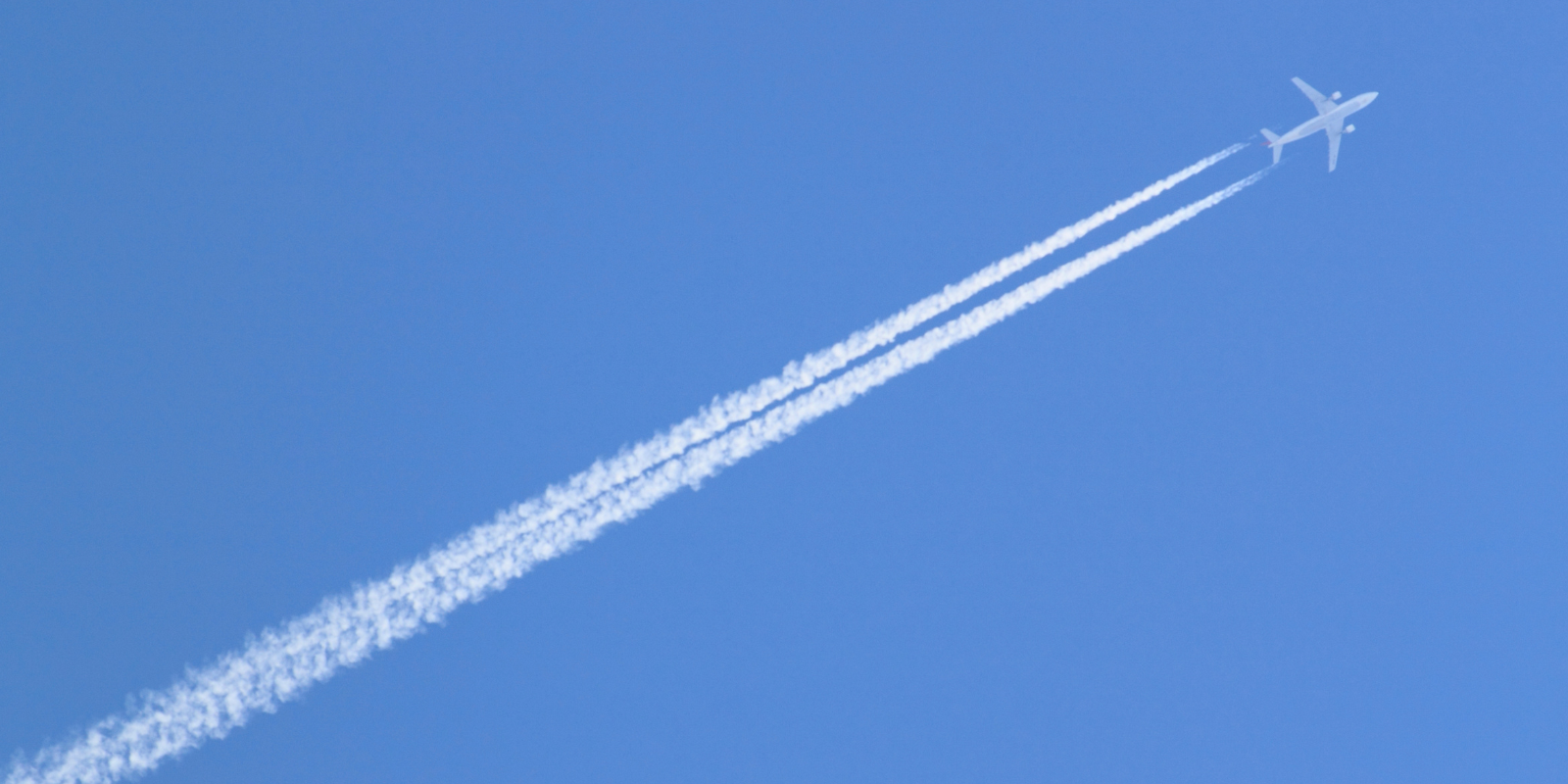
When discussing aviation’s climate impact, carbon dioxide (CO₂) emissions usually dominate the conversation. Yet it’s estimated that at least half of aviation’s warming effect comes from non-CO₂ impacts, with contrails among the most significant contributors. This is because as they spread into cirrus clouds, they can trap heat in the atmosphere.
The good news is that reducing these effects may not require new aircraft or breakthrough technologies. Instead, smarter flight planning could help aircraft avoid the surprisingly thin atmospheric conditions where persistent contrails form.
A complex problem
The warming caused by aviation’s non-CO₂ emissions has attracted much attention ever since a study estimated that their contribution to climate change may be between half and twice as much as that of the total CO₂ emissions by aircraft. Though the impacts are large in any case, researchers around the world are working to narrow this range. While the jury is still out on the exact value, even conservative estimations tell us that action on these emissions is likely to be successful and indeed necessary.
Considering the potential benefits, and the context of the worsening climate emergency, NATS has for many years supported research on non-CO₂ mitigation concepts. While we cannot solve the climate science questions, we can enable experiments by scientists trying to mature forecasting tools, and we can develop the operational systems and procedures required for fast action once these tools are ready for deployment.
Where are the quick wins?
Since an outsized proportion of the non-CO₂ warming is coming from contrails, a lot of effort has been devoted to finding ways to mitigate them. Fortunately, research has indicated that their impacts are highly concentrated. Studies suggest that just 2–3% of flights account for around 80% of global contrail warming, meaning even limited interventions could deliver climate benefits of up to 70%.
Naturally, it is one thing to do this theoretically, and quite another to do this in reality. Trials in Europe and the United States have demonstrated that modest altitude adjustments can significantly reduce observable contrails. While these trials remained relatively small, they demonstrated that contrail avoidance is operationally feasible and increasingly practical.
A major step forward
Based on prior research, the SESAR project CICONIA, led by Airbus and supported by NATS, has over the last three years made major contributions to the understanding of both the scientific and operational understanding of non-CO₂ mitigation.
On the scientific side, forecasting schemes were improved and the impact of using different metrics and prediction tools was explored.
On the operational side, we established requirements for flight planning systems to plan the avoidance and identified three main approaches how contrail avoidance could be done. These are shown in Figure 1.

Figure 1.
What still needs to happen?
Although a lot of progress has been made, significant challenges remain before contrail avoidance becomes routine. On the science of science, forecast accuracy must be improved, and climate impacts must be validated.
On the side of operations, more validation is needed to understand the impacts at scale. While CICONIA has found that overall, fuel impacts are manageable and can be small especially if common-sense limitations are applied, the impact of entire fleets of aircraft mitigating contrails every day has not been accurately established. NATS champions further research and development to be ready when called to act on contrails.