November 11, 2025
Today’s topic is supposed to be the U.S. government shutdown. I’m supposed to offer “hacks” (a gruesomely overused term these days) that’ll help you deal with the delays and long lines, and assure you that the skies remain safe.
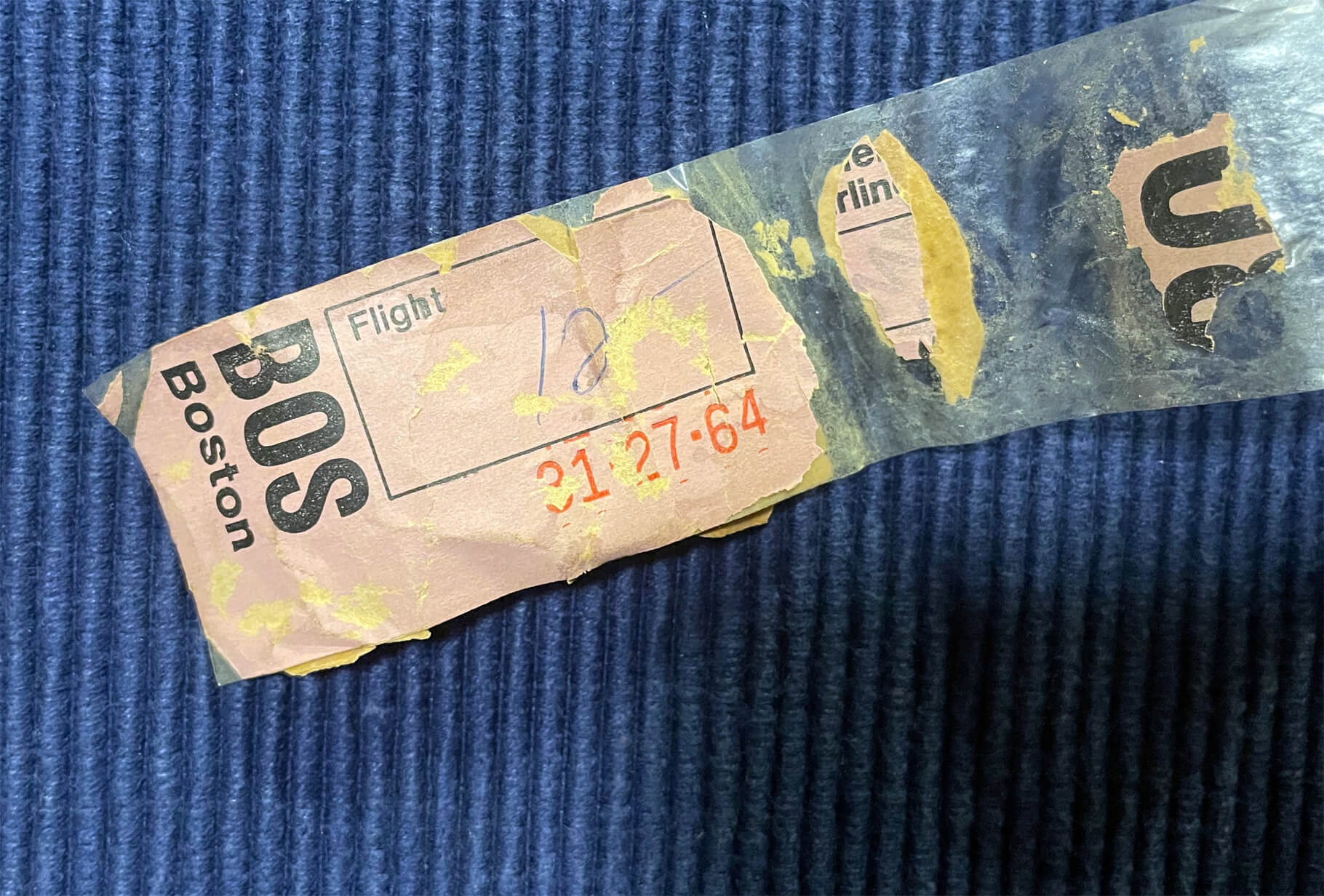
I can’t think of anything more boring, however, so instead I’m going to talk about this vintage American Airlines luggage tag that I found in the attic at my father’s house.
The tag — what’s left of it — was affixed to a suitcase that belonged to my mother in the 1960s, when she worked briefly as a flight attendant for American. An address on the suitcase is hers from before she was married.
I’m pretty certain the tag is from 1964. This jibes with both the address and her dates of employment. There’s also a “64” as part of the coding, visible in red.
You also can see where the flight number, 12, has been inked in by hand.
Flight 12 was, for decades, American’s Los Angeles-Boston nonstop. The reciprocal, flight 11, left Boston for Los Angeles each morning.
In the late 60s, flights 11 and 12 would’ve been run with a Boeing 707. Later it was a DC-10, and a 767 after that. I remember flying to LAX on flight 11 in 1980, when I was a freshman in high school.
The pairing no longer exists. These flight numbers were retired as of September 12th, 2001, the day after flight 11 crashed into the World Trade Center.
There’s a science of sorts to flight numbers that you probably didn’t know about:
Ordinarily, flights going eastbound are assigned even numbers; those headed westbound get odd numbers. Another habit is giving lower, one- or two-digit numbers to more prestigious or long-distance routes. If there’s a flight 1 in an airline’s timetable, it’s the stuff of London–New York.
Numbers might also be grouped geographically. At United, transpacific flights use three-digit numbers beginning with 8, which is considered a lucky number in some Asian cultures. Four-digit sequences starting with a 3 or higher are, most of the time, indications of a code-share flight.
Technically, a flight number is a combination of numbers and letters, prefaced with the carrier’s two-letter IATA code. Every airline has one of these codes. For Delta, American, and United, it’s DL, AA, and UA, respectively. Lufthansa uses LH; Emirates uses EK. Often they’re intuitive, other times they’re mysterious. British Airways is BA, while jetBlue uses the alphanumeric B6.
If you didn’t know about this practice, you no doubt got familiar with it after the disappearance of Malaysia Airlines flight 370, which from the start was referred to as “MH370.”
All this inspired by some fragments of a sixty year-old luggage tag.
Air travel forensics, you could call it. I’m good at it.
And I imagine you can find thousands of these sorts of curiosities — numbers and codes that tell a story — sitting in attics and basements all over the world.
Related Stories:
THE DAY OF THE COCKROACH
THE WEIRD WORLD OF AIRLINE COLLECTIBLES
Photo by the author.