On America’s 250th Anniversary, Tracy Weisman Loves and Mourns Her Country at Once

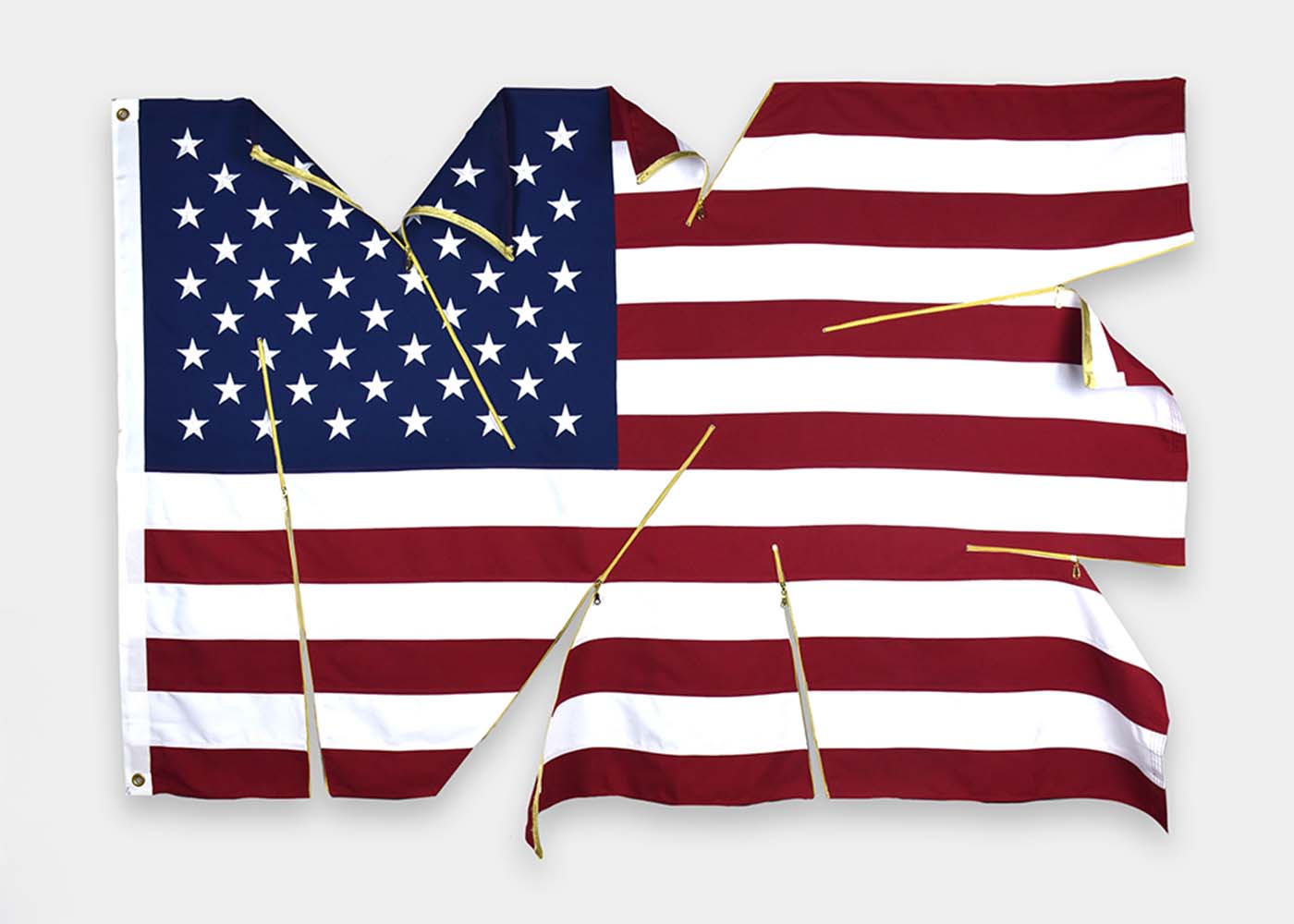
In 1976, Tracy Weisman watched the Tall Ships sail into Newport Harbor and felt what she calls a shared sense of great national pride. Fifty years later, she’s not so sure. “Some Birthday, America,” her solo show at CUSP Gallery in Newport, Rhode Island, timed to the country’s 250th, is the work of an artist who loves her country and grieves for it at the same time. A speechwriter for two decades, Weisman now tells stories in materials instead of words: flags sliced open and stitched back together with golden zippers, quilts and textiles in a palette of red, white, blue, and black she couldn’t seem to put down. It is candid, sometimes angry, and, she insists, still hopeful. We asked her how it came together.
The Child at the Harbor
In 1976 you watched the Tall Ships sail into Newport Harbor for the Bicentennial and felt, in your words, “a shared sense of great national pride.” Fifty years later, “our 250th? That’s a different story.” What happened in the space between the child at the harbor and the artist making this show?
Tracy Weisman: Children take their cues from the adults around them. In 1976, America was having a big birthday and everyone was invited. There was also a sense of relief that the long Vietnam War was finally over and that perhaps better times were ahead.

Mixed media: acrylic on canvas, netting,
vintage French tin sign letters, 33 × 45 inches.
Courtesy of the artist.

Textile: inkjet print on cotton, patchwork,
machine embroidery, 24 × 42 inches.
Courtesy of the artist.
As an adult, I’m very proud of America at our best, but we must be able to acknowledge contradictory views as well. While our founding documents declared that all persons are created equal, our country grew on stolen land and prospered on the backs of enslaved humans. Our inability to reconcile that evil is a weed that has never stopped growing, and it’s become even more pernicious in the post-Obama era. Institutions that once felt stable have been shoved off their foundations. We’re seeing voting rights, reproductive rights, the independence of the judiciary, and even basic norms of civic behavior unravel. Antisemitism, Christian nationalism, anti-immigrant sentiment and political violence have reemerged in ways I never imagined I would see in my lifetime. Some Birthday, America.
I can think of no better time to look critically at who we are and rededicate ourselves to the never-ending work of creating a more perfect union.
The exhibition grew out of that tension. Familiar but altered American symbols—flags, quilts, textiles, the human figure—encapsulate the affection and unease I and many others are feeling right now. Creating this work was cathartic; perhaps viewing it will be, too.
I believe in the connectedness of all things and try to stay open to the messages we are sent. To wit, late in my preparation for the show, I learned that a Rhode Island ancestor on my father’s side, Lt. Jonathan Brownell, age 56, fought and was wounded at the Battle of Bunker Hill in 1775. He died of his injuries a year later, a mere three weeks before the signing of the Declaration of Independence. 250 years later, I still love the imperfect country he and so many others gave their lives to establish, and have dedicated Some Birthday, America to my 5x great-grandfather Jonathan. I can think of no better time to look critically at who we are and rededicate ourselves to the never-ending work of creating a more perfect union.

To Persecution No Assistance.”
Mixed media: salvaged quahog shells, type.
Courtesy of the artist.
You’ve said that looking back at a year of work, you realized you kept returning to the same palette of red, white, blue and black, “almost as though I were designing a couture collection,” and that the tension between patriotism and unease became the impetus for the show. How did the show come together?
Weisman: The studio is where I work through complex feelings, and color provided the language I needed to love and mourn my country simultaneously. The firehose of norm-shattering behavior allowed the work to just flow. As the work accumulated, I felt an urgent responsibility to share it during the 250th. It’s not an easy show, and I’m deeply grateful to Curtis Speer at CUSP Gallery for his unflinching support and partnership.
We’ve been torn, but we also have tools for healing. Which way we’ll zip is up to us.
For two decades you were a speechwriter, and you’ve described it as training you to think about “emotional architecture” and “the weight that language carries in public life.” Now the stories are yours, told in materials instead of words. How does writing in someone else’s voice turn into creating in your own?
Weisman: I’ve always told stories, beginning when I was a child imagining conversations between the stuffies and dolls on my bed. As a speechwriter, I encouraged my clients to embrace storytelling as a way to make ideas stick, and I do that today in my visual arts practice. The only difference is I’m now using objects instead of words to communicate.
Cutting and Mending “Some Birthday, America”
In “Some Birthday, America,” you slice into an American flag and stitch it back together with zippers. You’ve said cutting can mean “disruption” and stitching can mean “repair, care, labor, inheritance.” What were you cutting into, and what were you trying to mend?
Weisman: A zipper is a brilliant metaphor: it can either separate two sides or unite them. To me, merging that metaphor with America’s most recognizable symbol epitomizes our 250th; we’ve been torn, but we also have tools for healing. Which way we’ll zip is up to us.
History isn’t something that happened in the dusty past; it happens every day. Whether through our action or inaction, we’re all signatories. In 2076, what will be said of us?

Mixed media: upcycled and embellished hat
and clothing, ball chain, vinyl, paintbrush.
Courtesy of the artist.
A recent New York Times piece by Adam Liptak, marking the 250th anniversary, revisited how uneasy the founders were about the office they were inventing, and asked whether their design still holds the balance they wanted. Benjamin Franklin warned at the 1787 convention that the executive would keep “increasing… till it ends in a monarchy”; Hamilton cautioned that those who “overturned the liberties of republics” often “begin their career by paying an obsequious court to the people; commencing demagogues, and ending tyrants.” When a viewer stands in front of your work, what do you want them to remember about what the founders built, and what they feared?
Weisman: Our founders were students of history enough to know that without guardrails, humans inevitably succumb to the temptations of power. Their model for our republic and its experiment in self-governance was a blueprint (full of compromises) of how we might avoid that fate. I appreciate this question, because as I worked on Some Birthday, America, I did imagine having a pint with John Adams and Ben Franklin, who were shaking their heads at me. “For heaven’s sake, we tried to warn you! Did you even read past the first paragraph?”
I would never prescribe what viewers should remember, and I look forward to hearing the many responses to my work. For me, this show has reinforced the idea that history isn’t something that happened in the dusty past; it happens every day. Whether through our action or inaction, we’re all signatories. In 2076, what will be said of us?
Tracy Weisman on Helping the Helpers
The fundraiser turns on George Washington’s 1790 letter to Newport’s Touro Synagogue, his promise of “to bigotry no sanction, to persecution no assistance,” stamped onto hundreds of quahog shells you gathered at Narragansett and hung on a fishing net. Why those words now, and why was it important to give visitors a way to do something constructive rather than only to look?
Weisman: While Washington was referring specifically to religious liberty, I’m expanding his definition to include bigotry and persecution of all kinds. Authoritarians gain power by dehumanizing marginalized communities, and it’s shocking to see our government adopting Gestapo tactics in 2026. One way to push back against authoritarianism is to “help the helpers,” as Fred Rogers used to say, so all funds raised from the shells and other small items will be donated to a Newport social service agency that’s been providing support for those in need for decades. Reflection is most valuable when it leads to action and the show provides an opportunity for visitors to act if they feel moved to do so.
You’ve said you “welcome ideas that don’t necessarily have a tidy ending,” that a lack of closure “gives viewers agency.” In a show this politically charged, how do you hold the work open enough for affection and unease to live in the same room?
Weisman: As an American artist, I have chosen the occasion of our 250th anniversary to exercise my First Amendment right to speak candidly about my government. I will also believe—to my last breath—in the fundamental good of the American people, and that gives me hope…which also happens to be the state motto of Rhode Island!
As such, and despite its candor, Some Birthday, America is ultimately a hopeful show. I hope it invites discussion, creates community and reminds us that by focusing less on our differences and more on what we share, we can still get closer to the America our founders had in mind.

Tracy Weisman’s solo exhibition “Some Birthday, America” is on view at CUSP Gallery in Newport, Rhode Island, June 27 to July 19, 2026, with an opening reception on June 27 from 5 to 8 p.m.
Featured image: Tracy Weisman, “Some Birthday, America,” 2026. Textile: cotton American flag, zippers, 48 × 72 inches. Courtesy of the artist.