“Letter to a Young Contributor” Revisited: How Thomas Wentworth Higginson Shaped Emily Dickinson’s Poetry

This is a guest blog post by Griffin Gee, a recent graduate of the University of Massachusetts, Amherst where he earned his Bachelor of Arts in History with a minor in Education. Griffin is a 2026 Buchanan Burnham Fellow.

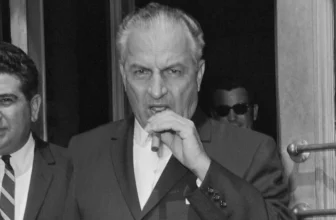
Photograph of Thomas Wentworth Higginson, (1823-1911). New York Public Library Digital Collections. Accessed June 29, 2026. https://digitalcollections.nypl.org/items/dd4a81e0-c616-012f-ea11-58d385a7bc34.
In 1862, between his efforts to raise regiments in Worcester for the Union Army during the Civil War, abolitionist, suffragist, and reverend Thomas Wentworth Higginson (1823-1911) submitted a series of essays and poems to The Atlantic Monthly. He wrote for the magazine since it was founded in 1857 and wrote in other papers to supplement his income. Among the works Higginson sent were a couple of essays about long wintry walks and one essay called “Letter to a Young Contributor.” The essay was by no means remarkable and outlined how to navigate the process of working with a publisher. It called upon the female writers, who “offered manuscripts in very masculine names in very feminine handwriting.”[1] Shortly after The Atlantic published the essay, Higginson received an envelope from Amherst, Massachusetts, with four poems and a short note from which said, “Are you too deeply occupied to say if my Verse is alive?” Inside a smaller envelope, there was a card with the signature of Emily Dickinson (1830-1886), who became one of 19th century’s most famous American poets.[2]
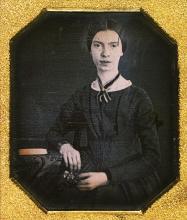
Photograph of Emily Dickinson at sixteen years old, from the collection of Amherst College.
https://www.amherst.edu/ library/archives/holdings/ edickinson/dickinsondag.
Dickinson’s outreach went on to spark a correspondence and relationship with Higginson that lasted twenty-four years until her death. About 70 letters and some 100 poems of their correspondence survive today. While Dickinson published very little during her life, Higginson helped co-edit and publish her poems with Mabel Loomis Todd, writer and founder of the Amherst Historical Society.[3] Todd maintained a complex relationship with Dickinson and her family, including a thirteen year long affair with Dickinson’s married brother.[4] Higginson was a prolific writer who submitted 100 essays to the Atlantic by the end of his career, and wrote dozens of books including historical and military accounts, social commentaries, biographies, and fictional works.[5] Higginson moved to Newport following the Civil War, where he published Malbone: An Oldport Romance, a novel broadly based on his own family and friends set in Victorian Newport. While living in Newport, Higginson also wrote his most influential book, Army Life in a Black Regiment, a memoir recounting his service as colonel of the 1st South Carolina Volunteer Infantry.[6]
To fully capture how Higginson inspired Dickinson’s literary inquiry, this blog will reexamine “Letter to a Young Contributor” 164 years later. Higginson’s timeless advice not only offers insight to contemporary writers, but also illuminates Dickinson’s visionary contributions to literature.
When Dickinson first read “Letter to a Young Contributor,” she might not have agreed with Higginson’s advice to avoid the use of dashes, which she used in abundance, but she might have found encouragement in his championing of the imagination. In the essay, Higginson critiqued the “pure and the colorless” standard of writing established by Dr. William Ellery Channing[7] for “renouncing all the great traditions of literature, and ignoring the magnificent mystery of words.”[8] Higginson believed that by overprioritizing clarity, the art of language would be reduced to banality. Dickinson’s poetry was untraditional and irregular by the standards of the day and impressed Higginson throughout their correspondence.

Thomas Wentworth Higginson, “Letter to a Young Contributor,” Atlantic Monthly, April 1862,
https://archive.emilydickinson.org/higgyc/yc8.html.
Rather than seek fame and fortune, success, Higginson suggests, is earned by learning. In the case of Dickinson, she was thirty-one years old when she sent her reply to Higginson’s “Letter to a Young Contributor.” Before then, she wrote extensively, sharpening her style. Higginson wrote that “wealth of accumulated materials is essential; and whether this wealth be won by reading or by experience makes no great difference.”[9] Dickinson had an abundance of both reading and experience by this time. During her youth, she read voraciously, enjoying the novels of Lydia Marie Child, Dickens, and the Brontë sisters. She read and reread the King James Bible, which inspired some of her poetry, and kept up to date by reading The Atlantic Monthly and The Springfield Republican.[10]
In his essay, Higginson urged aspiring writers to avoid the spotlight in pursuit of a career. He said, “Do not trouble yourself about the light on your status; it is the light of the public square which must test its value.”[11] In her lifetime, Dickinson’s poetic pursuit was for everything but fame. Dickinson was not motivated by contemporary validation. Although Higginson’s essay gave advice and encouragement for writers to publish, Dickinson preferred to share her poems through private correspondence with friends, including Higginson. Dickinson’s secretive nature illustrated how personal her writing was.
When Dickinson passed away, Higginson co-edited the first two published volumes of her poems. Higginson and co-editor Mabel Loomis Todd were criticized for their edits, which changed her punctuation and gave titles to the poems, stripping away part of Dickinson’s authentic voice. Understanding Higginson’s experience as a published writer helps explain why certain elements of her poems were changed. With the common audience in mind, Higginson removed many of the dashes Dickinson notoriously used in her writing. He made foreseeable edits knowing what he wrote is his essay: “Do not habitually prop your sentences on crutches…Reduce yourself to short allowance of parentheses and dashes; if you employ them merely from clumsiness, they will lose all their power in your hands.”[12]
Only after her death was Emily Dickinson’s voice brought to life, as her poems on mortality and nature were unveiled to the world, partly thanks to Higginson. The Newport Historical Society has a collection of Higginson’s correspondence letters from 1848-1862. The collection does not include any correspondence with Dickinson, but does include an assortment of poems by Higginson and others. Higginson’s transcendentalist poetry might not have inspired a generation of writers, but his advice did ignite Dickinson’s extraordinary literary contributions.
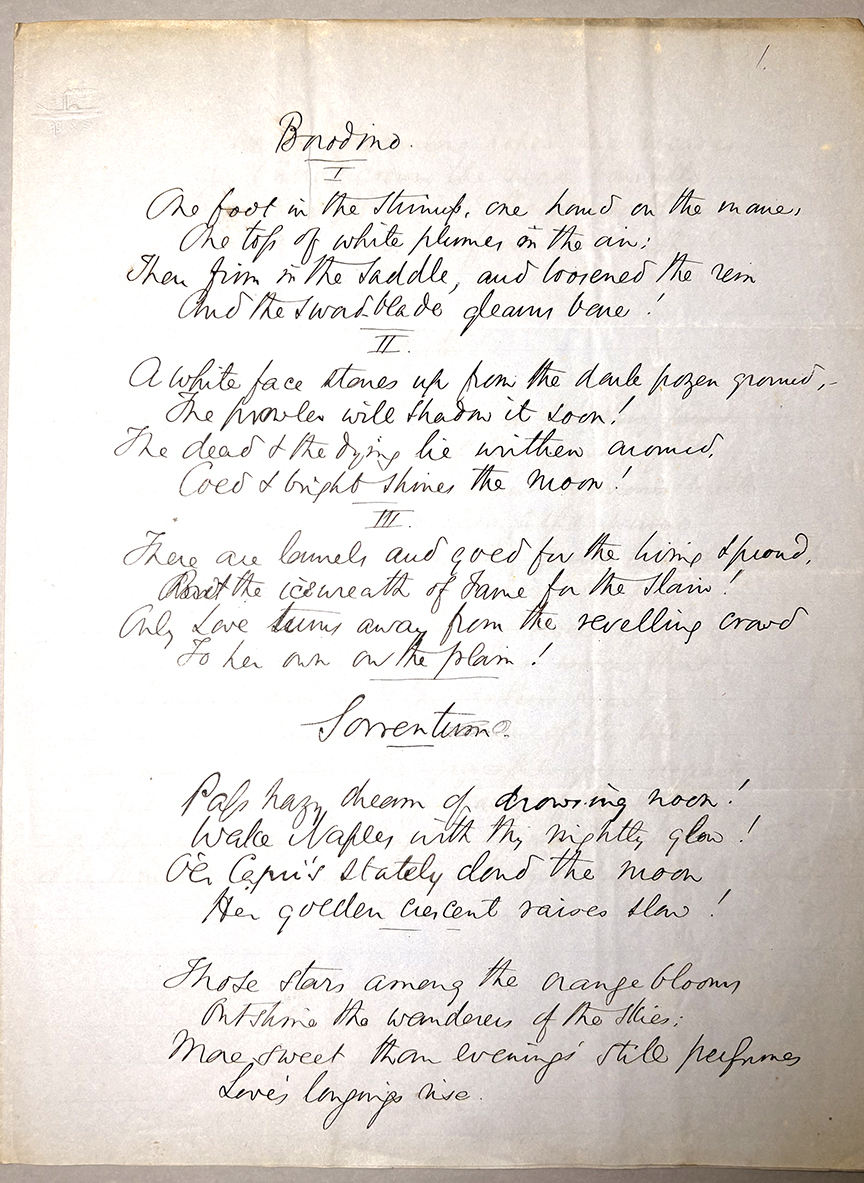
Poem by Thomas Wentworth Higginson, “Brodino” October 14, 1861, Ms. 145 Folder 13, Thomas Wentworth Higginson Collection, Newport Historical Society.
[1] Thomas Wentworth Higginson, “Letter to a Young Contributor,” Atlantic Monthly, April 1862, https://www.theatlantic.com/magazine/archive/1862/04/letter-to-a-young-contributor/305164/.
[2] Douglas R. Egerton, Man on Fire: The Worlds of Thomas Wentworth Higginson (Oxford University Press, 2025), 167–68.
[3] “Thomas Wentworth Higginson (1823-1911),” Emily Dickinson Museum, accessed July 21, 2026, https://www.emilydickinsonmuseum.org/thomas-wentworth-higginson-1823-1911-correspondent/.
[4] “Mabel Loomis Todd (1856-1932),” Emily Dickinson Museum, accessed July 28, 2026, https://www.emilydickinsonmuseum.org/mabel-loomis-todd-1856-1932-correspondent/.
[5] Egerton, Man on Fire, 8.
[6] Egerton, Man on Fire, 228–30.
[7] William Ellery Channing was the son of Rhode Island Attorney General of Rhode Island, William Channing, and grandson of William Ellery, signer of the Declaration of Independence. Dr. William Ellery Channing was a prominent preacher and leading theologian of Unitarianism.
[8] Higginson, “Letter to a Young.”
[9] Higginson, “Letter to a Young.”
[10] “Emily Dickinson and Reading,” Emily Dickinson Museum, accessed July 27, 2026, https://www.emilydickinsonmuseum.org/emily-dickinson/biography/special-topics/emily-dickinson-and-reading/.
[11] Higginson, “Letter to a Young.”
[12] Higginson, “Letter to a Young.”
The post “Letter to a Young Contributor” Revisited: How Thomas Wentworth Higginson Shaped Emily Dickinson’s Poetry appeared first on Newport Historical Society.