TOCWOC Editor’s Note: This one grew out of a research project I’ve been working through for The Siege of Petersburg Online, cataloging the ordnance officers of the Army of Northern Virginia one Compiled Military Service Record at a time. Philip Beverley Stanard was the Third Corps’ Chief Ordnance Officer under A.P. Hill from 1863 to Appomattox. What his own service record adds is an earlier chapter that doesn’t show up in the standard references. It is a good one, so I wanted to find a way to tell the tale.
Philip Beverley Stanard was born February 2, 1835, in Spotsylvania County. When Virginia left the Union in the spring of 1861, he didn’t go straight into ordnance work. Instead, he went to Richmond and organized an artillery battery. The Thomas Light Artillery was raised there in early May 1861 for one year’s service. An index card in Stanard’s own service record suggests the specific date was May 2, and the company initially armed itself with four 6-pounder smoothbore field guns. Stanard stepped in as captain, with Charles H. Thornton as first lieutenant, and Edgar Macon as second lieutenant1. It numbered around seventy men by the following June, but got into the fight early2. A quartermaster’s receipt from July 2, 1861, the earliest document in his file, already has him signing as “Philip B. Stanard, Capt., Thos. Artillery,” the battery’s shorthand name from almost its first week3.

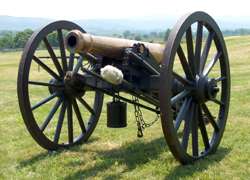
Stanard’s Richmond Thomas Light Artillery used 4 6-lb guns similar to this model located at Antietam National Battlefield. The guns were obsolete by the Civil War.
In July 1861, the battery moved by rail to Strasburg and marched on to Winchester, where it was assigned to Brig. Gen. Edmund Kirby Smith’s Fifth Brigade, Army of the Shenandoah, and posted along Red Bud Run. On July 21, the Thomas Artillery supported Jackson’s men at First Manassas. The intense tactical reality of that initial engagement is documented in the Official Records, where the friction of combat cost the battery its second lieutenant. Edgar Macon was killed in action that day, marking one of the battery’s first permanent losses of the war4. Eight days later, the paperwork of army life resumed regardless. On July 29–August 1, 1861, Stanard requisitioned forage for forty horses at Manassas, a mundane errand carried out in the immediate aftermath of the battle5. By that October, a separate requisition shows the battery drawing 120 blank cartridges for a “James” 12-pounder rifle gun. This was an attempt to modify the obsolete 6 lb smoothbores to fire rifled 12 lb James shells. It is unclear if one or more of the 4 6-lb guns were converted in this way in an attempt to upgrade the battery’s capabilities.6.

Stanard’s wartime service is summarized on page 143 of his CSR file.
Stanard’s own Compiled Military Service Record (CMSR) fills in what came next, and it isn’t the stuff of battle reports. Through the spring of 1862, a run of provision returns (Form 14 in the Confederate organizational structure) shows him signing for rations for his company at entrenchment lines identified only as “Breast Works,” and, separately, for the sick of his command at Lebanon Church. This involved seventy-some men for three to six days at a time, reflecting the ordinary bookkeeping of an army in camp. One return, dated April 21–23, 1862, carries a note from an assistant surgeon insisting that a molasses ration was necessary to the health of the men, which is as close as these administrative documents get to a complaint7. A separate slip shows Stanard applying for two weeks’ leave that spring; it was withdrawn May 23, 1862, and apparently never taken8.
The battery was in the thick of the Seven Days Battles that followed, engaged at Gaines’s Mill on June 26 and at Frayser’s Farm on June 30, assigned by that point to Wilcox’s Brigade, Wilcox’s Division, in Longstreet’s command9. And then, abruptly, Stanard’s own war changed direction. On July 29, 1862, he was appointed captain and ordnance officer to Maj. Gen. A.P. Hill, who was then commanding the “Light Division”10. The very next day, July 30, his own first lieutenant, Edwin J. Anderson, was promoted to captain and took over the battery. Stanard stepped out of line command, and the man who had been serving under him stepped up to fill the vacancy. His pay voucher for October 31-November 30, 1862, is the first in his file to carry the annotation “On ordnance duty”11.
The Thomas Light Artillery carried on under Anderson for a short time, but the structural realities of the army soon caught up with it. By October 1862, as documented in Lee A. Wallace’s Guide to Virginia Military Organizations, the unit was officially disbanded12. Its men and remaining materiel were folded into the Hampden Light Artillery, another Richmond battery, a process further detailed in Robert H. Moore II’s extensive regimental history of several Richmond artillery units13. That kind of consolidation was a tactical necessity as the army reorganized its artillery in the war’s second year; small, understrength batteries got absorbed into others rather than kept on the rolls at half capacity or with poor quality and obsolete weapons.
Stanard, meanwhile, built the rest of his career in ordnance. His correspondence still carries the “Light Division” designation as late as June 2, 1863, when he sold two pairs of spurs out of his own ordnance stores at Camp Gregg for eight dollars, still signing as “Capt. & Ord. Officer, Light Division.” This helps date exactly when the army’s shorthand caught up with its new Third Corps organization following Chancellorsville14. The clearest marker comes just two weeks later, in a June 17, 1863, letter Col. Josiah Gorgas wrote to Secretary of War James Seddon, recommending a slate of ordnance officers for promotion. Gorgas named him directly: “Captain P.B. Stanard, Chief of Ord. of the 3rd Army Corps, to be Major”15.
From there, the record shows him running the relentless business of a corps ordnance office straight through the grinding logistics of the Richmond-Petersburg Campaign. He was tasked with chasing lost paperwork, pricing swords, and moving thousands of cartridge boxes and cap pouches at a time through the Richmond Arsenal to supply the trench lines. He was granted fifteen days’ leave in December 1864, before returning to manage the final, crumbling supply chains of the Third Corps. When the end came in April 1865, Stanard was present at the surrender, signing his Appomattox parole formally as “P. B. Stanard, Maj. and Ch’f Ord. Officer, 3d Corps, A. N. V.”16.
Stanard is probably more “well-known” for being the Chief of Ordnance, Third Corps than for his earlier work as commander of a relatively short-lived battery. But it’s a reminder that a CMSR built around one man’s later staff assignment can still carry an earlier unit’s operational story inside it. In this case, that story belongs to a battery that existed for a year and a half, fought at First Manassas and the Seven Days, and then quietly folded into another command the same week its captain moved on to a different kind of war.
After the surrender at Appomattox, Stanard’s civilian life was relatively brief. He died on March 6, 1878, at the age of forty-three, and is buried in the Goshen Baptist Church Cemetery in Rockbridge County, Virginia17. While modern genealogical databases and cemetery transcriptions frequently misspell his middle name as “Beverly,” the wartime administrative paper trail remains consistent with the “ey” spelling. For researchers tracking the veterans of the Third Corps, his gravesite serves as the final physical marker for an officer who transitioned from the tactical front lines of 1861 to the vital, grinding logistical machinery that struggled to keep the Army of Northern Virginia in the field through to the very end.
Philip B. Stanard’s Full Service History
Compiled from Robert E. L. Krick, Staff Officers in Gray (Chapel Hill: UNC Press, 2003) and Stanard’s own CMSR at Fold3.com
| Date | Event | Source |
| April 25, 1861 | Original date of commission, per an index card in his CMSR – the earliest confirmed date in his service record, about a week before the Thomas Light Artillery was organized | Stanard CMSR, p.82 |
| May 1861 (possibly May 2, per an index card – see note below) | Organizes/commands the Thomas Light Artillery, a Richmond battery raised for one year’s service (four 6-pdr smoothbores), with 1st Lt. Charles H. Thornton and 2nd Lt. Edgar Macon | Civil War in the East; NPS Battle Unit Details; Stanard CMSR, p.52 |
| July 2, 1861 | Receipts, as Capt., Thomas Artillery, for camp stores/equipage (knapsacks, haversacks, canteens, lanterns) from Asst. Q.M. A.H. Selden, Richmond | Stanard CMSR, pp.50-51 |
| July 21, 1861 | Thomas Light Artillery engaged at First Manassas, supporting Jackson; 2nd Lt. Edgar Macon killed in action | Civil War in the East |
| July 29-Aug. 1, 1861 | Requisitions forage for 40 private horses at Manassas, eight days after the battle; an overissue of corn and hay is separately noted | Stanard CMSR, pp.55-56 |
| Aug. 30, 1861 | Requisitions horseshoes/nails and, separately, forage, both at Manassas — the first of four transactions this quarter with Capt. W.W. Weisiger, Q.M. | Stanard CMSR, pp.81,93-94 |
| Sept. 4, 1861 | A second horseshoe requisition from Capt. W.W. Weisiger | Stanard CMSR, pp.89-90 |
| Sept. 13-15, 1861 | A third forage requisition, 58 horses, again through Weisiger | Stanard CMSR, pp.91-92 |
| Oct. 1861 | Requisitions, then receipts for, 120 blank cartridges for a James 12-pounder rifle gun, at Manassas | Stanard CMSR, pp.48-49 |
| March 5, 1862 | Receives $393 (per the written amount; the header reads $392, a discrepancy) at “Camp Thomas Artillery” for payment of soldiers on extra duty | Stanard CMSR, pp.46-47 |
| April 2, 1862 | Requisitions camp equipage for the Thomas Artillery, explicitly noting the unit’s strength as 100 men | Stanard CMSR, pp.76-77 |
| April 1862 | Commands the Thomas Light Artillery on entrenchment lines (“Breast Works”) and at Lebanon Church; a run of provision returns spans April 4–25, 1862 | Stanard CMSR, pp.21-37 |
| May 23, 1862 | Application for two weeks’ leave withdrawn (not taken) | Stanard CMSR, p.21 |
| June 26 & 30, 1862 | Thomas Light Artillery engaged in the Seven Days’ Battles (Gaines’s Mill, Frayser’s Farm) | Civil War in the East |
| July 29, 1862 | Appointed Captain, ordnance officer to Lt. Gen. A. P. Hill (then commanding the “Light Division”) — leaves the Thomas Light Artillery at almost exactly this time | Krick, Staff Officers in Gray, p.323 |
| July 30, 1862 | 1st Lt. Edwin J. Anderson promoted Captain, taking command of the Thomas Light Artillery — one day after Stanard’s ordnance appointment, consistent with a direct handover | Civil War in the East |
| Oct. 1862 | Thomas Light Artillery disbanded; personnel transferred to the Hampden Light Artillery | NPS Battle Unit Details |
| Oct. 31-Nov. 30, 1862 | Pay voucher for this period is the first to carry the annotation “On ordnance duty” | Stanard CMSR, pp.44-45 |
| Dec. 17, 1862 | As Capt. & Chief of Ordnance, Light Division, reports a box of ordnance stores lost in transit via the R.F.&P. Railroad; a railroad dispute over receipting/baggage status follows | Stanard CMSR, pp.4-5 |
| Jan. 2, 1863 | Reports a separate box of blank forms/stationery lost in transit, obtained from the Quartermaster’s Blank Depository and Col. Gorgas’s office | Stanard CMSR, pp.6-7 |
| Jan. 20, 1863 | Writes directly to Col. J. Gorgas reporting a Dec. 11, 1862 stationery shipment from Maj. W.S. Downer never arrived, despite inquiries at stations near Fredericksburg | Stanard CMSR, pp.8-9 |
| undated (context: before May 1863) | Receives an ordnance transfer from the Chief Ordnance Officer of Jackson’s (Second) Corps — officer’s surname begins ‘Bar’ or ‘Bur’ (confirmed NOT William Allan) — confirming A.P. Hill’s Division drew supply through Jackson’s Corps chain before the Third Corps was organized | Stanard CMSR, pp.74-75 (p.75 for the transfer itself) |
| April 18, 1863 | Issues 35 guns and bayonets, tools, and 54 canteens to Lt. J.S. Blackburn, ordnance officer of Thomas’s Brigade (not to be confused with Stanard’s own former Thomas Light Artillery) | Stanard CMSR, pp.78-79 |
| May 17, 1863 | Still styled “Capt. & Ord. Officer, Light Division”; requests price list for sabres, knapsacks, and canteens from Maj. W.S. Downer | Stanard CMSR, pp.16-17 |
| May 20, 1863 | Receives a large turn-in from Lt. C.G. Thompson, ordnance officer of McGowan’s Brigade: 16 boxes/14,450 rounds cal. .69, 126 muskets, 81 bayonets, and more — likely reflecting the brigade re-arming to a standardized caliber | Stanard CMSR, pp.85-86 |
| May 31, 1863 | Issues 15,000 rounds of ammunition, shoulder belts, and ammunition boxes to the ordnance officer of Archer’s Brigade, at Camp Gregg | Stanard CMSR, pp.72-73 |
| June 1, 1863 | Receives a second turn-in from Lt. C.G. Thompson, McGowan’s Brigade: a damaged rifle, muskets, bayonets, cartridge boxes, and ammunition | Stanard CMSR, pp.83-84 |
| June 2, 1863 | Sells 2 pairs of spurs at cost ($8) out of ordnance stores at Camp Gregg, still styled “Capt. & Ord. Officer, Light Division” (filed in duplicate — see pp.57-58 and pp.87-88) | Stanard CMSR, pp.57-58 |
| June 17, 1863 | Col. J. Gorgas recommends Stanard — named explicitly as “Chief of Ord. of the 3rd Army Corps” — for promotion to Major, in a letter to Sec. of War J.A. Seddon | Stanard CMSR, pp.10-12 |
| June 18, 1863 | Promoted Major, ordnance officer to Hill (Third Corps) — the CMSR’s own June 17 recommendation letter (above) predates this by one day | Krick, Staff Officers in Gray, p.323 |
| Aug. 15–17, 1863 | Now styled Major; requisitions pen holders, ink, india rubber, and blotting paper via Maj. E.B. Smith, “In Charge of Bureau” | Stanard CMSR, pp.14-15 |
| Aug. 27, 1863 | Baldwin’s office turns over ordnance stores (1,000 cartridge boxes, cap pouches, waist belts, shoulder belts, bayonet scabbards) ‘for’ Maj. P.B. Stanard, invoiced to his assistant Lt. W.A. Brockenbrough | Baldwin CMSR, pp.199-200 |
| Sept. 1863–Feb. 1864 | Pay vouchers continue at $162/month, paid consistently by Capt. Henry S. Field, A.Q.M., through the fall, confirming continuous service as Maj. & Chief Ord., Third Corps; pay for Dec. 1863 is not received until Jan. 11, 1864 | Stanard CMSR, pp.42-45,53-54,68-71 |
| 1864 (day/month not given on the form; probably Mar. 24, 1864 per a paired docket) | Receives a major accoutrement shipment from Capt. O.W. Edwards, Richmond Arsenal: 375 cartridge boxes, 210 waist belts, 465 bayonet scabbards, 410 haversacks, 210 canteens, 200 gun slings, and more, in 4 boxes (1,140.8 lbs) | Stanard CMSR, pp.39-40 |
| March 1864 | Receives a SECOND, much larger shipment from Edwards at Orange C.H.: 1,257 cartridge boxes, 1,329 cartridge box belts, 1,111 waist belts, and more, in 2 boxes (6,767 lbs) | Stanard CMSR, p.41 |
| May 4, 1864 | Turns over 99,200 cartridges and 98 ammunition boxes to the quartermaster for transportation (recipient not clearly legible) | Stanard CMSR, pp.66-67 |
| May 10, 1864 | Receives 45,000 more cartridges (50 boxes) from Richmond Arsenal at Hanover Junction, Va. | Stanard CMSR, pp.64-65 |
| May 31, 1864 | Receives 172,000 more cartridges (191 boxes) from Richmond Arsenal, and separately turns over an invoice of stores to the quartermaster for transportation — all shortly before the Overland Campaign reached the Siege of Petersburg | Stanard CMSR, pp.60-61 |
| Dec. 17, 1864 | Granted 15 days’ leave per Special Orders No. 309, Army of Northern Virginia (falls within the Siege of Petersburg window) | Stanard CMSR, p.20 |
| April 1865 | Present at the surrender, Appomattox | Krick, Staff Officers in Gray, p.323 |
Unfortunately I could find no image of P. B. Stanard. Some online have mistaken his son’s photo from the 1890s for the elder Stanard. If you know of an image, please comment here.
Sources: