by Andrew Spannaus –
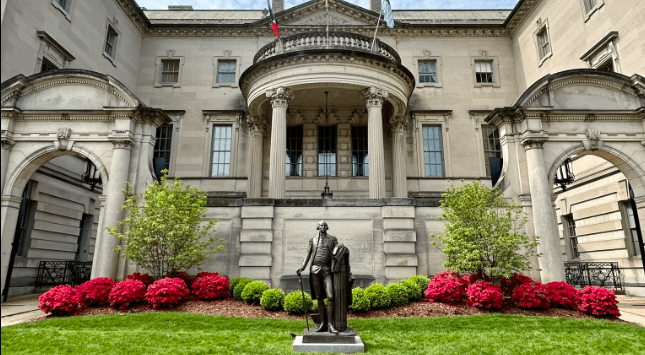
When visiting Washington, D.C., the first thing that stands out is the architecture: the classical buildings and monuments, many of them imitating what one might have seen in Ancient Rome. That is no coincidence: The construction of the Capitol and the White House was heavily influenced by Thomas Jefferson, who made it a point to adopt the style and language of Rome, from copying ancient temples to using the word “Capitol” itself, derived from Rome’s Capitoline Hill.

America’s Founding Fathers were intensely focused on this period in history, as they viewed the years of the Roman Republic (509-37BC) as the high point of human history. Educated Americans studied the time extensively, and references to key historical figures were quite frequent, both in the press and in public discussions. It was common to hear men like George Washington compared to classical figures: the reference to Cincinnatus is well-known, the military leader and statesman who led Rome briefly and then returned to a life of farming. Yet Washington was also compared to the great orator and politician Cicero or the senator and philosopher Cato the Younger, men who placed civic duty over personal gain, were committed to the laws and incorruptible. In contrast, those seen as a threat to the republic were branded as akin to Julius Caesar, who became dictator for life, or Catiline, who organized a conspiracy to overthrow the elected rulers of Rome in 63 BC.
It is important to be clear on which aspects of Ancient Rome were important for the nascent United States. In recent years, there has been an upsurge of discussion about the Roman Empire: a viral trend emerged on social media citing surveys showing that many men think of it surprisingly often — from daily to several times a week. The narrative is that they are attracted by masculine ideals of power, war, and the systems that sustained an empire which lasted for over 1,000 years (although it went through several divisions).
Yet it is essential to distinguish between the Roman Empire — which indeed dominated Europe and the Mediterranean for many centuries, but with sometimes disastrous consequences — and the Roman Republic, a society with significant democratic elements whose governance structures fell apart shortly before the birth of Jesus Christ. The founders were not laying the basis for a global empire which would dominate the world through military force and preferential economic arrangements; they sought to create a lasting republic based on democratic institutions, supported by the virtue of its leaders and the resilience of its structure.

It’s hard to overstate how common references to the ancients were in the 1700s. In the Federalist Papers, Alexander Hamilton wrote that “The Roman Republic attained to the utmost height of human greatness.” Among the 85 articles in the series written by Hamilton, James Madison, and John Jay, there were dozens of references to classical authorities, albeit more to Greece than to Rome. Ancient Rome was seen by many as a pinnacle of human society due to its attachment to freedom, although viewed from today’s perspective, we would certainly say that it was limited to only part of society. Yet, the cultural influence of classical societies was widespread at the time of the Revolution – considered here as a span of decades leading up to the war itself, as explained in multiple articles on the American System Now website.
There was certainly an elite class among the Founders, those who were directly involved in the political process. Interestingly though, only about half of the signatories to the Constitution had been educated at the colonial period colleges such as Harvard, Yale, William and Mary, and Princeton. Classical learning extended beyond this elite: knowledge of Greek and Latin, for example, was widespread among those who did receive schooling. The state of Massachusetts passed a law in 1647 requiring any town with more than 100 families to teach the two classical languages to young boys to prepare them for college. Even those who were able to go to grammar school, but not college, still spent considerable time in learning Greek and Latin.
Some years later, this led to public debate on how useful it was to be so concentrated on the ancient world. Noah Webster sometimes considered the father of American education, once complained that boys could recite the speeches of figures such as Cicero and Demosthenes, but were less versed in their native language of English. (This led him to create the first Webster’s Dictionary and encourage American, rather than British spelling, for words such as “colour/color” and “centre/center.”) The debate extended to the influence of classical culture throughout society, including on farmers and skilled workers; a reflection on what was considered the most literate populace in the world at the time, despite the denial of education under slavery, as well as the general lack of schooling for girls until the 1800s.
A central issue in the creation of the Constitution, as documented by Thomas E. Ricks in his 2020 book First Principles: What America’s Founders Learned from the Greeks and Romans and How That Shaped Our Country (New York: HarperCollins) was how to avoid the fate of the Roman Republic, which collapsed due to political polarization, extreme inequality, and the rise of private armies. There was intense debate on the structure of our institutions, on how to create an architecture that would last longer than the republics of the past.
As Ricks explains, the discussion often started with “virtue,” i.e., a sense of public-spiritedness, or putting the common good above one’s own interests. This concept was considered essential to public life, appearing more often than “freedom” in the documents produced by the Founders. George Washington is said to have modeled his public image on Cato, as un upright, honest, and patriotic citizen. This guiding principle inspired Washington’s view that division into factions — what we would call political parties today — was a mortal danger to the republic.
Yet it became clear that the quality of virtue wasn’t enough. It is a noble ideal – that people sacrifice their own interests in favor of the common good, but hard to count on such abnegation as the basis of a system of governance. A structure needed to be created with a mixture of powers, separate branches of government that could balance out different interests. This became the focus of the debate over the Constitution. Hamilton stressed the importance of central government authority, an element lacking among the republics of Ancient Greece, which became divided and easy prey for their neighbors. Madison drew on the history of Rome to argue for an independent judiciary, and to keep separate the executive branch and the legislature.
In First Principles, Ricks refers to the debate regarding the lessons of ancient societies: whether a large nation could survive as a republic. The French political philosopher Montesquieu, who was widely read in the 1700s, wrote a book entitled Considerations on the Causes of the Greatness of the Romans and Their Decline, in which he argued that large countries could not be republics. The claim was that the public good would be sacrificed to many different views and interests, and that leaders would become detached from the public. The founders, led by Madison, turned this critique on its head, arguing that in an “extended republic” such as the United States, the large population and society would actually serve to avoid tyranny and prevent a single, limited faction from exercising too much influence. Ultimately, this debate would lead to the mechanisms of representative government, rather than direct democracy, and federalism, allowing the states, being closer to the people, to manage local affairs.
The checks and balances that resulted from the process creating the U.S. Constitution of 1787 have been quite effective, if seen in historical terms. Despite some crises, our nation’s institutions have stood the test of time for almost 240 years. Today, the level of knowledge among the citizens regarding Ancient Greece and Rome is much lower than it was, not only in the late 1700s, but even up to the 1960s, when Latin, for example, was still widely studied in public schools. It is our good fortune that men such as Washington and Hamilton looked to antiquity to develop the principles on which to organize our society.

Yet it is clear that considerable dangers threaten the republic today: Our polarized politics — while not new — have reached a level at which fundamental structural elements of our institutions are being called into question. From evident conflicts of interest — far from putting the common good above one’s own gain — to the erosion of the independence of the judiciary, as well as the expansion of executive power as Congress relinquishes its authority on issues as important as war and trade, the risks cannot be ignored. Greater knowledge of the historical basis of our institutions is a necessary goal to work toward, however difficult it may seem for our current political class. The Founding Fathers put in the work to create a system that could limit corruption by private interests and avoid destruction by would-be dictators – drawing on the lessons of the ancient world. It’s one thing to talk about the Roman Empire on TikTok, but another to understand the principles of the republic, which were developed in opposition to the model of empire, which uses force to oppress its citizens and others, rather than to create a community for the development of human society.
The urgent task is to prevent our country today from falling into the trap of imperial decline, with grave consequences for ourselves and the rest of the world.


Related Posts