My first impressions of Lisbon, way back in 2015, included the yellow trams powering up and down the steep hills, the shiny cobblestones (we saw more than a few people on crutches who had fallen victim to those) and of course the pastel de nata: Belém’s famous custard tarts. I’ve been back many times since – not least because it’s generally on my way to wherever I’m off to next in Portugal – and I try to stay in a different neighbourhood every time. Not only has it helped me explore the sheer breadth of what the city has to offer; it’s also meant seeking out the best Lisbon restaurants, cafés and bars in different locales…

Editor’s note: this guide was last updated in October 2026, but many of these listings are based on restaurant and bar visits on multiple trips to Lisbon over the past decade. While I’ve done my best to make sure all information is as current as possible, please check opening hours and menus with the venues themselves.
Planning your trip to Lisbon
Before you can find the perfect pastel de nata, here are a few trip essentials:
- Getting to Lisbon: In Europe, KLM, TAP Air Portugal and Transavia fly direct from Amsterdam, while British Airways, TAP, easyJet and Ryanair all fly direct from London. In the US, United flies direct from Newark. Compare connecting routes on Expedia, or see train, bus and flight options on Omio.
- Getting around: Lisbon is compact but hilly – bring walking shoes or take the iconic yellow trams! To reach other cities, trains run from Lisbon to Porto or you can do as we did and rent a car to get to places like Ericeira and Évora.
- Where to stay: We’ve stayed in a few places, from the airport hotel to apartments in the old town and Alfama, including Downtown Lisbon. You can browse more places to stay in Lisbon on Booking.com.
- Tours and experiences: Take Eating Europe’s Undiscovered Lisbon Food and Wine Tour, a 3.5-hour walk through the Baixa and Mouraria neighbourhoods. Or browse more food tours in Lisbon.
- Further reading: Planning to explore more of mainland Portugal? Check out my guides to Ericeira, Porto, Lagos and Évora.
16 of the Best Restaurants, Cafés & Bars in Lisbon
When it comes to food in Lisbon, I’m all about the bacalhau (salted cod, prepared every which way), octopus (generally grilled but I’m partial to the salad versions too) and of course the pastel de nata. Wines from the Lisboa region are also worth ordering, as is the ginjinha – a cherry-based liqueur often served in a tiny dark chocolate cup. Here’s where to taste it all, split by neighbourhood so you can create your own foodie route through the city:
Manteigaria, city-wide
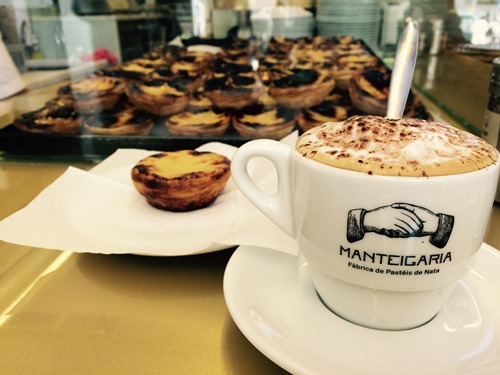
Pastéis de nata are sold in practically every bakery in Lisbon, but not all custard tarts are created equal. I’ve sampled a lot of them, and two bakeries in Lisbon stood out. The first is Manteigaria, which started in Chiado but now has branches all over the city. The tarts are baked more or less non-stop while you watch, and a bell by the door rings every time a fresh batch comes out of the oven, which was roughly every ten minutes when I visited. Of the several varieties I tried around town, Manteigaria’s were by far the best, and you skip the queues that wind around the block in Belém.

The most amazing custard tarts in Lisbon – without the queues in Belém!
Fábrica da Nata, two locations
The other contender is Fábrica da Nata, which has its original shop on Praça dos Restauradores and another on Rua Augusta. Where Manteigaria is a quick counter stop, Fábrica is more of a sit-down café, with sofas indoors, azulejo tiles on the walls and a terrace. It also does savoury snacks such as pastéis de bacalhau (cod fritters) if you fancy a break from sweet things. I must admit, I did not try these here, but stuck to the flaky, wobbly, scorched-on-top pastel de nata instead.
Arca, Bairro Alto
A small bistro on the edge of Bairro Alto, Arca has a natural-leaning wine list and a menu that changes with the season. It also boasts excellent Google reviews, and for good reason. Dinner involved tender braised beef cheeks, char-grilled octopus and fresh sea bream (dorada), followed by a richly creamy chocolate mousse. Bom appetite!
Park Lisboa, Bairro Alto
For a drink with a view before or after dinner, head to Park Lisboa: a bar on the roof of a carpark overlooking the river (go in through the carpark, take the lift up and follow the signs). Try the sangria – red or white – or a port-tonic cocktail, which is generally my aperitif of choice when in Portugal.

White sangria with a rooftop view at Park
Lambe Lambe (formerly O Povo), Cais do Sodré
While the Alfama neighbourhood is the area more closely associated with fado – the famously tear-jerking genre of Portuguese music – there are good fado spots to be found elsewhere if you know where to look. One such spot was O Povo, where you could eat at the tasca while listening to the musicians. It’s subsequently rebranded as Lambe Lambe, but it still puts on fado nights and it’s still in a fascinating historic location in what was once a sailors’ red-light district.

Fado is a real tear-jerker… (better eat and drink to cheer yourself up!)
Mercado da Ribeira (Time Out Market), Cais do Sodré
Staying down on the quay, those who love a market should make a beeline for the Mercado da Ribeira – half of which is a huge food hall called Time Out Market. When I visited, I had piri-piri chicken: a whole seasoned bird, grilled and cut into pieces, slathered in spicy piri-piri sauce. That particular stall may well no longer be there, but you’re guaranteed to find plenty of other food stalls to sate your every appetite.
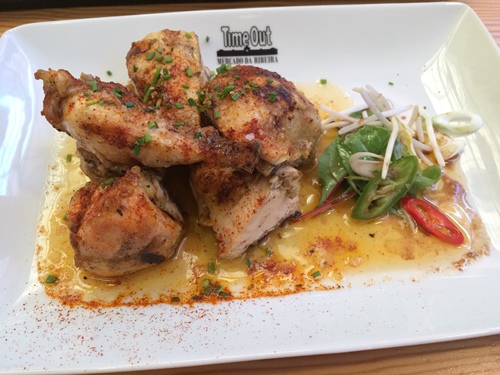
Piri-Piri chicken at Time Out Market
Ginjinha da Ribeira, Cais do Sodré
Outside the market, the quay is lined with old bars pouring the famous ginjinha: a sour cherry liqueur that reminded me a lot of the Polish cherry vodka. I tried it at a couple of other places and it tasted like cough medicine; but the version at Ginjinha da Ribeira (right outside the market, by the river) was a revelation – and a fruity contrast to the dark chocolate cups in which it’s served.
Gunpowder, Chiado
Gunpowder is the first restaurant outside the UK from a popular London group. It serves sharing plates inspired by India’s west coast, from Mumbai to Goa, where the Portuguese left their mark on the food for centuries, and it combines those influences with Portuguese seafood. The creative menu includes things like Algarve oysters with moilee (a fish curry sauce from Kerala), Goan black tiger grilled prawns and soft-shell crab curry. A veritable melting pot of flavours, but done outstandingly well.
Tágide, Chiado
Tágide has been a Chiado institution since 1950, and it’s two venues in one building. The restaurant upstairs is the formal, more expensive option (with great views), and the bar downstairs, now called Tágide Wine & Gastrobar, is where I ate. It was an excellent spot for petiscos with a glass of Portuguese wine: we tried the deep-fried runner beans, clams in white wine and garlic, black pudding with apple compote, and some incredible (and smelly!) cheese. Since I last visited, it looks like the menu has gone more upmarket, but I’ve still heard good reports from friends who have been more recently.
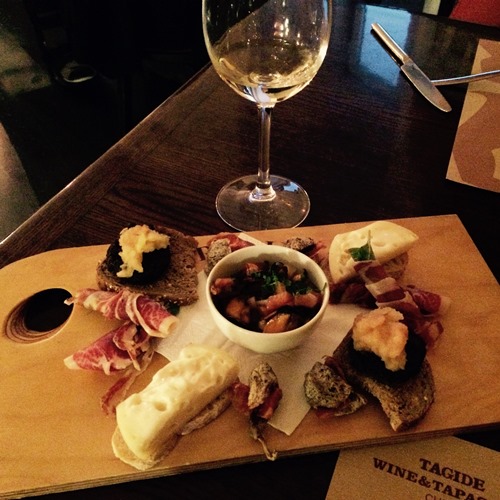
Tasty tapas at Tágide
By the Wine, Chiado
By the Wine is a wine bar and shop that was originally the Lisbon flagship of famous Portuguese wine producer José Maria da Fonseca. The ceiling is covered in literally thousands of wine bottles, and it’s worth a visit just to look up. Alongside delicious local wines, they also served us ocean-fresh oysters and Ibérico ham (admittedly, this isn’t Portuguese – it is, however, delicious).
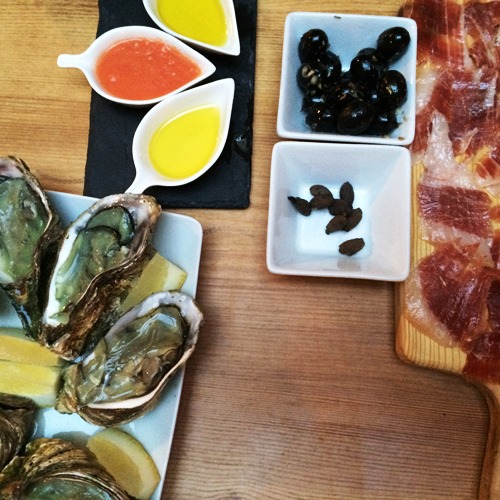
Oysters, ham, olives and wine – what more could you ask for?
Da Prata 52, Baixa
In the heart of the downtown Baixa neighbourhood, Da Prata 52 is a petiscos restaurant (Portugal’s answer to tapas) that feels like a diamond in the rough in the middle of the main shopping area – full of local people despite its touristy location. The menu is built for sharing: think feijoada (bean stew), swordfish ceviche, the usual octopus and cod prepared in a variety of ways, and meaty black pork cheeks in red wine. Can’t decide? Leave your choice in the hands of the chef and go for the “nine moments” surprise menu.
Mil Sabores, Baixa
Next morning, Mil Sabores (translating as “a thousand flavours”) is a brunch spot on the corner of Rua da Prata and Rua da Vitória, with a terrace that’s good for people-watching on a sunny day. I had poached eggs on toast with presunto (Portuguese cured ham) and confit tomatoes, which hit the spot. The coffee and freshly squeezed OJ were also top-notch.

Brunch at Mil Sabores
O Beco, Alfama
Moving east to Alfama now, you’ll find a rabbit’s warren of narrow lanes lined with fado houses and tourist-trap restaurants (although it’s very much worth a wander nonetheless). Down one of the quieter alleyways is restaurant O Beco, which describes itself as home to “the tradition of bacalhau”. It seemed rude not to work our way through this local preparation of salted cod in all its forms, including crispy bacalhau croquettes, golden-fried cod fritters and a steaming bowl of seafood rice. All were washed down nicely with a couple of glasses of Encruzado, one of my favourite Portuguese white grape varieties.

O Beco: “the tradition of bacalhau”
Antiga Wine Bar, Alfama
Near Alfama’s cathedral is Antiga Wine Bar, a cosy, locally-owned wine bar recommended for its interesting selection of wines by the glass. It balances old-world charm with a relaxed, modern vibe, making it an excellent spot for a personalised tasting journey through Portuguese wines. Just tell the knowledgeable staff your tastes and they’ll come back with curated selections by the glass to introduce you to local Portuguese varieties.
Espresso Arte, Alfama
Down another of Alfama’s maze of tiny streets, you’ll find two of my favourite coffee shops. Espresso Arte is a cosy little spot where we stopped for excellent cappuccino and a hot chocolate so thick you could stand a spoon in it. There’s books and pastries too – what more could you ask for of a lazy morning in Lisbon?

Coffee hidden in the labyrinthine streets of Alfama
The Coffee, Alfama
Just across the alley, at number 87, is The Coffee. For some reason, you have to order on an iPad, which feels like overkill when all you’re asking for is a flat white. But once you’ve mastered the system, the coffee is worth it. Mine even came with a little heart etched in latte art. If you like The Coffee, you’re in luck because they have around a dozen branches all over the city.
Planning to visit more of mainland Portugal? Check out my guides to Ericeira, Porto, Lagos and Évora.