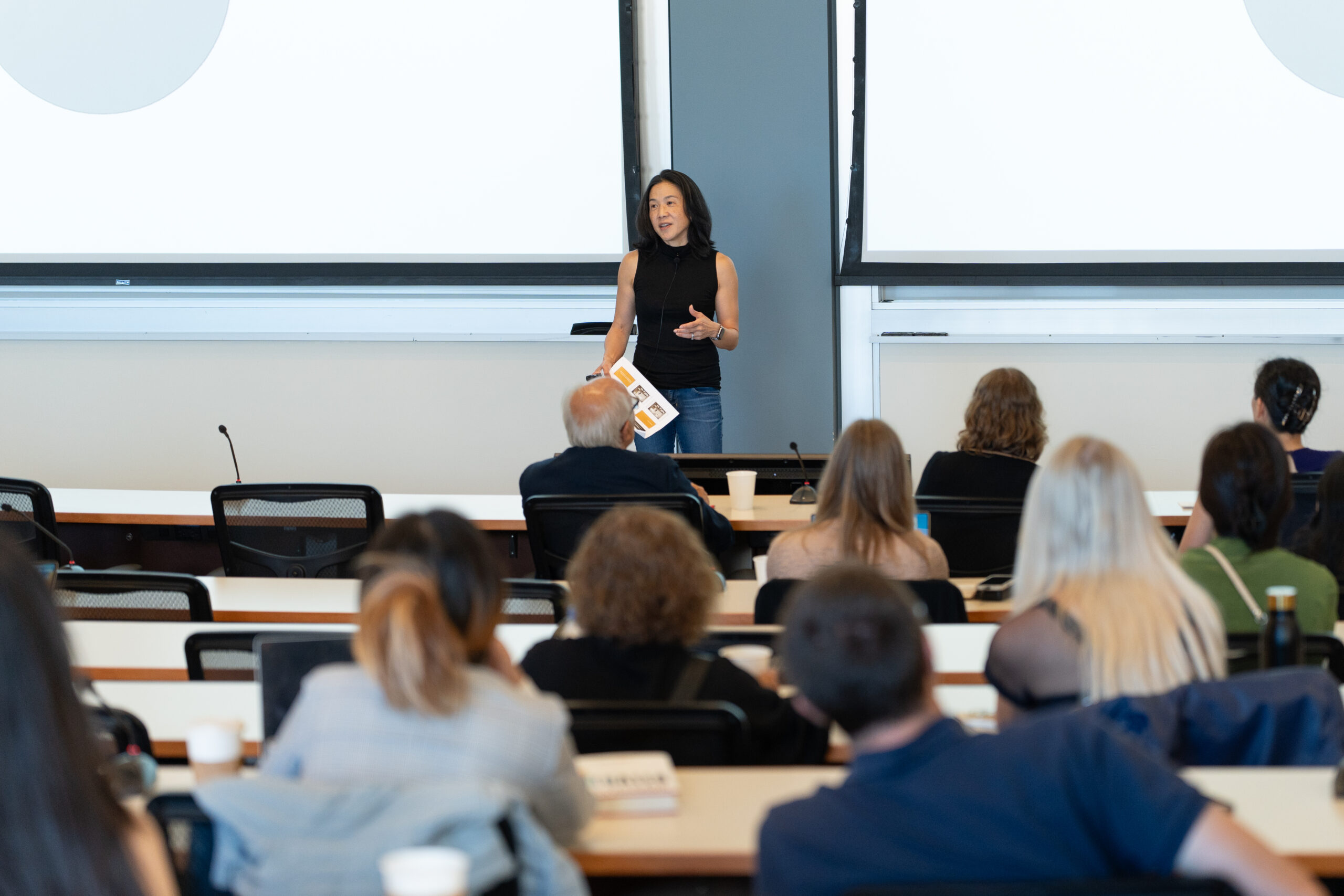
Beyond the keynotes, the conference agenda featured dozens of researchers investigating how generative AI is changing work, healthcare, marketing, digital platforms, personalization, and human decision-making. Two plenary presentations offered a closer look at the kinds of questions this research community is working to answer.
Hemant Bhargava, distinguished professor of management; Suran Chair in Technology Management; director of the Center for Analytics and Technology in Society, University of California, Davis, examined the rapidly expanding, and increasingly fragmented, landscape of state AI legislation. His research asks what states are attempting to regulate, how their priorities differ, and what factors help determine whether an AI-related bill becomes law. Using a multidimensional policy taxonomy and a multi-agent classification system, the work offers a framework for interpreting thousands of bills according to who is being constrained, whom the legislation is intended to protect, and what potential harm it addresses. The project illustrates how AI can help researchers study the institutions emerging to govern the technology itself.
Hema Yoganarasimhan, professor of marketing; Michael G. Foster Faculty Fellow, University of Washington, approached AI improvement from a different direction. Her presentation introduced TextBO, a framework designed for settings in which generating possible solutions is inexpensive but evaluating them is costly. Generative AI can rapidly produce advertisements, prompts, designs, or other candidates, but determining which ones actually work may still require experiments, expert review, or real-world testing. TextBO applies ideas from Bayesian optimization in language space to help AI systems improve while using fewer evaluations — an increasingly important capability for business and societal applications.
Together, the presentations reflected the conference’s broader emphasis on studying generative AI in context. The central questions extended well beyond what models can produce: How should AI be evaluated? How can experimentation become more efficient? What rules should govern deployment? How will those rules affect organizations and markets? By bringing faculty members, postdoctoral researchers, doctoral students, and industry experts into the same conversation, the conference connected technical advances with the managerial, behavioral, economic, and policy environments that will ultimately shape their impact.
Learn more about the 2026 Business & Generative AI Conference and explore the complete conference agenda.