

The readers haven’t been keeping close-enough tabs on me lately. I recently self-caught three notable omissions from my past articles in this series, definitely fitting the subject category, which the readership failed to call me to task about for overlooking. Pull out those Sherlock Holmes magnifying glasses, and keep those eyes open for such situations in the future. I can use all the help I can get in keeping treatment of these subjects as comprehensive as possible. We’ll start with the omitted three, then move into completing the late 1940’s and on into the early years of the 1950’s.
 Perhaps the first, and possibly most notable, of the three omitted titles is to a degree a situation where overlooking was excusable, as it sadly is unavailable to my knowledge on the internet, and is of recent re-discovery, available only on hard media. Ali Baba and the Forty Thieves (George Pal, 1935) is a true rarity. Billed as “George Pal’s Dolly Follies”, it is nearly a double-length stop-motion puppetoon, running just over eleven minutes. (Did Max Fleischer know of this film and its extended length when planning the Popeye Arabian trilogy?) It was filmed in a three-strip process known as Gasparcolor. (Did Europe somehow evade the Technicolor patents and Disney’s exclusive on the use thereof, or was this released just as those exclusive rights expired?) Though the surviving titles appear to be in French, the soundtrack is in English, making for easy viewing today. And perhaps more surprising than all of these facts, it is not an advertising film, as so many if not all of Pal’s other European creations were, but purely for entertainment – possibly marking his first production to be commercial-free. It is said that it was intended to be followed by other Arabian nights stories, but no follow-ups actually made it to production (unless you count, with apologies, the short commercial film produced a bit later based on the Aladdin tale). For those unfamiliar with and curious about this production, it may be found exclusively on the DVD/Blu-ray combo, “The Puppetoon Movie v. 2″, to which a free shout-out is justifiably due.
As this was among the earliest of Pal’s stop-motion efforts, his techniques are a bit in the developmental stage, and at times roughshod as to registration of the characters and sets from frame to frame.
 Characters’ feet and limbs have a tendency to shift around a bit in shape as one carved figure is replaced with another. An elaborate rotating set within the cave of the thieves is photographed awkwardly, the turntable failing to maintain an even speed from exposure to exposure. Yet, the beginnings of Pal’s European style are here. Faces are crude and more puppet-like than would be typical of later American films – a trait which would continue right up to Pal’s departure for America. But the effort and manpower expended in attempting to breathe life into these little wooden dolls remains amazing and a feast to the eye, even in its infancy.
Plotwise, the film attempts to retain many of the more well-known aspects of the original literary work. Woodcutter Ali is surprised by the passing of the thundering horde of the 40 thieves. (Pal doesn’t cheat much on the thieves’ count in this one, having many thief-and-horse dolls visible together in many shots.) The chief sings an introductory song similar to the later Bluto, though less-clearly recorded, making some references to cutting throats of those who cross them. They stop in front of a massive white boulder in a mountainside. Ali shimmies up a tall palm tree, and trembles, hiding himself behind a shaking palm leaf. The bandit chief pronounces the magic words with different syllable emphasis than any other version I’ve heard, shouting, “Open, ses-SAM-mee”. In an unusual touch, a portion of the boulder slowly swings open on side hinges, the opening panel shaped like the concentric circles of a steel bank vault door. The chief briefly enters the cave, presumably to drop off some booty, then emerges again, galloping away with the thieves. Already, Pal was choosing some interesting dramatic camera angles, one shot showing several of the riders charging at close range past the camera in their exit, then the camera tracking forward and changing focus slightly to highlight Ali, still trembling high in the tree.
 Ali cautiously slips down the tree trunk, then engages in likely the first version of a walk cycle we would see re-created years later in several Jasper films – a slow and stealthy creeping forward on tiptoe to the face of the boulder. Again, the registration is somewhat off, making the stealthy steps appear uneven and jittery – but the Pal style is already manifesting itself to come into being. With a tremulous sound in his voice, Ali repeats the magic words, and the cave once again opens, revealing a blinding glow within. Ali enters, as his eyes and ours adjust to the light. Here we get the turntable-stage panorama of the cave’s interior, still needing considerable work on how to regulate the distance of turning from one frame to the next. But the set is elaborately decorated in the manner of a miniature palace, with stately marble columns, trays of baklava and other middle-Eastern food delights, a large hookah, more trays overflowing with valuable coins, and a central fountain which emits not streams of water, but of gold coins. Ali’s eyes are dazzled by this wealth and splendor. He steps toward the fountain, attempting to reach his hands in for the showers of coins. The fountain’s spray immediately stops cold. Ali shakes his head in puzzlement. He tries to reach into one of the trays of coins, but a lid snaps shut upon it, much like the shutting of a clamshell. Ali turns away from the tray, and surprisingly it reopens again. Ali attempts to leap upon it, but the tray beats him to the punch, snapping shut in his face. Burlap sacks of jewels nearby clamp padlocked cords upon themselves as Ali attempts to reach out for them. And the hookah retracts all of its smoking pipes. Frustrated Ali whistles for his horse outside, who trots into the palatial cave. Ali confides to the horse that nothing will stay in his hands, so what is he to do? The horse whispers to Ali in horse talk that only Ali can understand, making a useful suggestion. Ali brightens, and tries repeating the magic words inside the cave. Suddenly, everything opens up, the fountain begins to flow again, and everything is now accessible to Ali’s eager hands.
 Ali begins to load sacks of coins, jewels, rare Persian rugs, and the like upon the back of his horse. The poor horse perspires and cries from the excessive weight, but manages to keep pace as Ali skips along happily, leading him out of the cave and toward home. (It is notable that we never see the cave door closing, either when it first somehow shut after the bandit chief’s exit or when Ali leaves, so we must assume it maintains some form of magical electric eye to know when one who has opened it has departed so as to close again.) A storyteller narrates that for weeks thereafter, Ali would regularly visit the cave, making off with more and more wealth. For reasons unknown (perhaps with so many ill-gotten gains in the cave, it would take a while to notice if anything was missing), the thieves do not get wise in all that time. Thin and poor Ali becomes a fat rich merchant, now residing in a palace of his own. Without much in the way of exposition, somehow the bandit chief gets wind of this change, and puts two and two together to peg Ali as prime suspect of the reverse-thievery. And so, in one of the few animated adaptations to touch upon this half of the tale, the chief appears at Ali’s home, himself posing as an oil merchant seeking lodging for the night. Within his oil jugs await the thieves. In Pal’s version, it is Ali’s horse who spots one of the thieves popping his head out from a jug. Instead of boiling the thieves in oil, the horse kicks at the jug, toppling it and causing a chain-reaction that sends all the jugs rolling down a grade and off of Ali’s property.
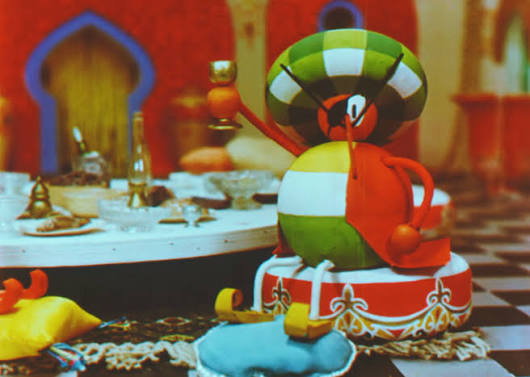 Within Ali’s home, Ali shares food and drink with the chief. While Ali drinks wine from a bottle, the chief steps behind him, pulling out a dagger with intent to make use of it upon out hero. But the sound of a gong announces entertainment, as a band of Arabian musicians provide backing for a seductive female belly-dancer. The dancer is a far cry in facial development and structure from the later Philippa Ray or Judy of Punchy and Judy, but, despite seeming to be partially constructed out of ball-bearings, she moves surprisingly smoothly and sensuously – perhaps the best animation in the short. When she seems to have captured the attention of the bandit, diverting him from his revenge upon Ali, she draws from beneath her garments a dagger of her own, and, in a surprising act of realistic cartoon violence, does as in the original tale, deftly tossing the weapon to plunge into the chest of the chieftain. The villain keels over, dead upon the floor. Ali shouts, “What have you done?”, until the girl calmly replies, “Wait”, and rotates the belt around the chief’s waist, revealing an arsenal of knives concealed by his robes behind his back. Ali understands instantly, and embraces the girl, as the narrator proclaims that she and Ali were soon married, and lived happily ever after. A surprising and sophisticated mix of comedy and drama, foretelling bigger and better things for Pal to come.
• A small clip from the Pal “Ali Baba” can be found on Facebook.
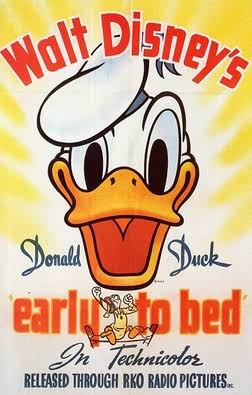
 Another overlooked moment appeared in Donald Duck’s “Early To Bed” (Disney/RKO, 7/11/41 – Jack King, dir.). Donald solos, spends nearly eight minutes involved in an elaborate bedroom battle between himself, a folding Murphy bed, and a pesky alarm clock. The film benefits greatly from some superior directing for King, nicely nuancing Donald’s facial and body-language reactions to situations in the best traditions of classic silent comedians. It would receive several homages from other studios in subsequent years, no doubt inspiring such tales as Woody Woodpecker’s “The Coo Coo Bird”, and the Pink Panther’s “In the Pink Of the Night.” Though nothing is directly borrowed by this film, it may also be thought of as loosely inspired by the Charlie Chaplin classic, “One A.M.”
 Donald needs to get up early. He starts out of the wrong foot – that is, head – by missing the pillow, and clanging his head upon the bed’s metal headboard. He re-fluffs up the pillow, shifts down on the bed slightly, and tries again – causing all the feathers to fly out of the pilowcase, landing on Donald’s head. Donald gets some unusually good dialogue in portions of this script, such as his remark when he attempts to tuck himself in after getting the pillow restuffed: “Why don’t they make these covers man-size?” He finally settles into the pillowcase, but the ticking of his alarm clock begins to resonate in his ears. His tail starts to twitch to the ticks like a metronome. Then, the ticking becomes irregular, throwing Donald’s rhythm off, and awakening him even more. As Donald attempts to bury his face in the pillow, he tries a move which the Pink Panther would directly copy years later – grabbing the clock with one foot, and tossing it into a drawer of his end table. The idea backfires, as the empty wooden chamber makes the ticking even louder. Donald tosses the clock across the room into a large vase, and the ticking is magnified in volume once again. Determined to show the clock who’s boss, Donald throws it out the window. It catches in a sock hung on a clothesline, takes a whirl around the clothesline pulley, and shoots back in the window. Donald, his beak open in the middle of a yawn, swallows it! “What the heck was…” mutters the duck, as the ticking resonates from his insides. Donald looks under his nightshirt at his belly, seeing through his skin and feathers the glow of the luminescent clock face within his digestive system. The poor duck tries various stunts to inflict harm to himself, hoping to wreck the clock inside him in the process – but the somewhat battered glowing clock face still keeps on ticking. Not until an exercise stretch device mounted to the wall breaks loose, driving the duck through a wall and headfirst through a portrait of Whistler’s Mother, is Donald able to spit out a loose pile of gears and springs that once was the clock.
 At last without that incessant ticking, Donald lays back upon the bed again – but now it is the bed’s turn to be obstinate. It develops a habit of folding up in the middle, when least expected. Donald gets whammed, whacked, doubled up in Half-Nelsons, and propelled by bedsprings puncturing through the mattress fabric. Donald even assumes fighting pose, standing on one half of the bed, and challenging the other half to spring up and “get tough, get tough.” It does so, whacking the duck right in the kisser again. The springs propel Donald into the ceiling light fixture, which breaks off, sending Donald into the middle of the bed, which clamps upon him like a bear trap, beams of light streaming from every gap in the mattress edges for a dazzling light show. Finally, the Duck reaches his limit, tying down the bed with ropes and stakes, and devising a sort of wooden stock overlay to clamp himself down into sleeping position without stirring, locking himself in with a padlock. Donald delivers a great line, that proves that at least some audiences must have understood him, allowing Clarence Nash to finally do more than quack. “Maybe I’m just a duck, but I’m human! A body can stand just so much!” He at last nods off to sleep – just as one of the loose springs of the clock parts on the floor shifts slightly and begins to vibrate, causing one gear to intersect with another, and another, and another – and finally activate the clock’s alarm bell. The ringing shocks the duck right out of his imprisonment, and sets the bed off wildly again. The mattress pops off, and springs fly everywhere, leaving exposed nails where the springs were mounted. One spring remains, which becomes covered by the sock, while the duck plops down upon what is left of the bed, his blanket landing in a coil around his brow. The visual result qualifies this film for inclusion in this article – Donald is left looking like a turbaned fakir, sitting on a bed of nails, while the sock seems to bounce and slither around before him like a charmed snake. Iris out upon the hopelessly frustrated duck.
• “Early To Bed” is at Disney.com
 A brief Egyptian reference appears in the renowned “Pink Elephants” sequence of Disney’s Dumbo (RKO, 10/23/41). As most will remember, the circus clowns, celebrating their new idea to raise the height of a platform Dumbo jumps from in a clown fire-fighting act to 1,000 feet, have left behind an opened bottle of champagne, which topples over, spilling into an elephant watering pail. Dumbo and Timothy Mouse take liberal drinks from the pail, and are immediately deeply intoxicated. They hallucinate that bubbles from the champagne are transforming into a never-ending flock of pink elephants on parade – leading to one of the most imaginative and eye-popping dream nightmares in all of Disney animation – or anyone else’s, for that matter. All manner of transformations of the “Technicolor pachyderms” take place, the elephants becoming race cars, canoes, bobsledders, fountains, ballet dancers, jitterbuggers – you name it. One such transformation has the irises of a giant, screen-filling elephant face transform into pink pyramids. From between them strides an elephant who looks more like a camel, his head and back seeming to form into two visible humps, while one of the pyramids transforms into a huge elephant playing a snake-charmer flute. The charmed camel-elephant changes shape into a pachyderm belly-dancer, undulating its midriff , then becoming a snake altogether, wriggling before the camera, then compresses itself into a pink sphere, which rotates to reveal a solitary eyeball staring directly at the camera, for a fade to black. How many kids developed their own nightmares after witnessing such a far-out sequence, decades before a “bad trip” became part of urban parlance?
 Moving on to the point we left off at last week, we find Popeye at it again, in A Balmy Swami (Famous/Paramount, Popeye, 7/22/49 – I. Sparber, dir.). Sort of a three-way cross in vivid Technicolor, mashing together setups of three black and white Fleischer episodes: “A Dream Walking”, “The Hyp-Nut-Tist”, and “Nix on Hypnotricks”. Yet, the cartoon entertains with some class, as it is not a cheater, but a reworking, hardly lifting gags at all from the prior works, and instead writing new ones to go with the scenarios. Audiences would not have been disappointed.
As in 1935, it is Vaudeville night at the local theater. Olive and Popeye again have choice seats near the stage in a side balcony (though on the opposite side of the stage than their previous appearance). Popeye is enthused by a juggling seal act, to which Olive displays no reaction. Her attention-span is on hold, awaiting the next performer on the bill – Swami Bluto. As the turbaned mystic appears in a puff of smoke on the stage, it is now Olive leaping in the air and whistling up a storm in anticipation, while Popeye’s interest turns utterly cold, the sailor remarking “Seals is my meat.” Bluto also reacts with amorous interest at the sight of Olive. The fabric of his turban nearly pops off his head like a coiled spring, and the pupils of his eyes transform into the silhouettes of himself and Olive, the Bluto silhouette crossing over into the eyeball where the Olive shape is located to get better acquainted, then pulling down Bluto’s eyelid from the inside for a little privacy from the audience. Bluto approaches the balcony, produces a rosebud out of one hand, and a watering can from the other. Dedicating his trick to “a budding romance”, Bluto waters the rose, producing an instant bouquet of multiple flowers to present to Olive. Next, he pulls Popeye out of the balcony box as a volunteer to observe a card trick. He asks Popeye to watch closely a deck of cards he holds in one hand. With a flex of his hand, the cards (all strung together by a string) disappear up his sleeve. But Bluto asks everyone to further observe, as he insists there is “nothing up my sleeve”. He rolls the sleeve of his coat back, revealing no wrist, but thin air between his coat and the glove which held his hand. Popeye feels around within the void, and mumbles, “There’s somethin’ tricky about this icky.” Popeye finally takes the bait, and asks, “Where’d them cards go?” “Right HERE!” says Bluto, his arm suddenly returning from nowhere to place a choke-hold on Popeye’s throat, causing Popeye to spit out the entire deck of cards one-by-one. After catching his breath, Popeye repeats a slightly-reworked bit from “The Fistic Mystic”, remarking that Bluto “can’t make a jack-ass out of me.” Bluto pulls down a small windowshade curtain in front of Popeye’s face, reading “Oh no?”, then lifts the shade to reveal Popeye’s head replaced with that of a donkey. However, it is only an illusion, as Bluto has slipped a rubber mask over Popeye’s face, and yanks it off the sailor as he replaces him into his balcony seat, much to the laughter and applause of Olive.
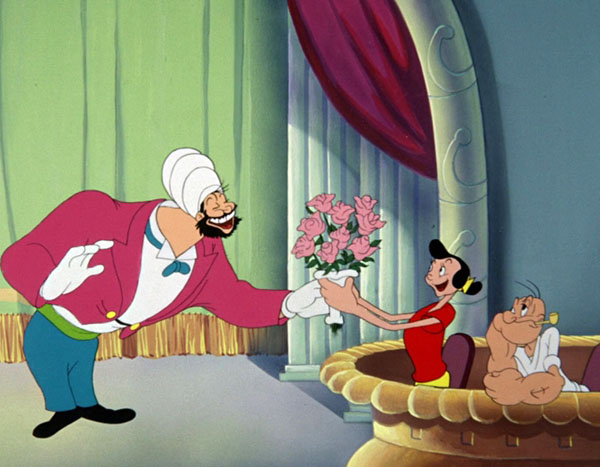 Now Bluto moves into the specialty of his performance – hypnotism. With a zap from his eyes and a few magic words that toss in a few Yiddish syllables, Olive is placed in a trance. “Rise”, commands Bluto, causing Olive to ascend to the ceiling of the stage. He commands her to be a high-diver. Olive takes a few steps forward and leaps as if launching herself from an invisible diving board, plunging headfirst toward the stage below. “Stop, you’ll get hoited!” shouts Popeye, racing to beat Olive to the center of the stage. But Olive reaches bottom first, and, to everyone’s surprise, does not get a mouth full of old plywood. Instead, water springs up upon the stage from nowhere, allowing Olive to plunge in in graceful safety, while Popeye is swept sideways by the resulting wave. Popeye lands together with the water back in the balcony box, and up from the depth of the now-flooded box pops the performing seal, juggling Popeye on his nose! Olive continues to perform swimming strokes, water or no water, hovering in mid-air a few feet above the stage. “On your feet – Approach me, my sweet”, commands Bluto. It looks like Olive will walk into Bluto’s embrace – but Popeye reappears, lifting and turning her around to walk in the opposite direction. Popeye’s had enough of this hypno-stuff – but Bluto’s not through with Popeye for his interfering. Bluto literally “looks daggers” at the sailor, his eyes emitting a series of small knives, which act as if in a knife-throwing act, pinning Popeye by his suit to a target-board. Then Bluto turns, to discover that Olive, still in her walking trance, has disappeared into the wings and out the rear entrance of the theater. Bluto leaves Popeye pinned, and walks out on his audience to discover what has become of Olive. Popeye pries himself loose from the board, and also follows.
 We know the drill. When Olive walks in a trance, she always winds up on a high-rise construction site. The boys play the usual games of trying to be first to rescue her, with some magical twists. A shout of “Abracadabra” by Bluto causes a load of bricks to construct itself into a wall atop a girder, to block Popeye’s way and make him slam into it head-first. Bluto climbs into an elevator to catch up with Olive as she rides a crane-supported girder upwards, but Popeye outraces Bluto with the use of a compressed-air tank and a construction helmet placed upon it as a cap, jet-propelling the sailor upwards atop the helmet. However, Popeye fails to calculate for what is above him, crashing into an overhanging beam, leaving the beam bent in the shape of his head. Bluto intercepts Olive in the nick of time, as she leaves the crane-suspended girder and almost marches off one end of the building. Bluto states he will, “awaken thee, miss, with a kiss.” He lays a large smooch upon Olive’s cheek, which has the awakening results of the story of Sleeping Beauty – though Bluto is certainly no prince. Olive snaps out of it, and instantly realizes Bluto is no gentleman. She attempts to back away, and steps over the edge again, but this time grabs onto the fabric of Bluto’s turban. She thus dangles helplessly from Bluto’s brow, screaming for Popeye’s assistance. Bluto is in no position to assist, being spun around like a top, then dangling from the girders by his mere fingertips. Popeye, somehow out of his girder-pretzel-twist, responds by swinging a crane hook at Olive. Olive is caught by the hook, letting go of the turban fabric. She swings through the window of an adjoining apartment tower, shattering it, then swings back, clutching to a grand piano. The crane rope intercepts an extended girder, the hook-end winding around the girder, smashing the piano against the metal beam and also dropping Olive. The harp-like string-frame of the piano falls first, catching between two beams below, and acting as a string-net to catch the falling Olive, then elastically propel her back into the air, where she lands at the very top of the construction, caught only by one shoe hooked onto a girder.
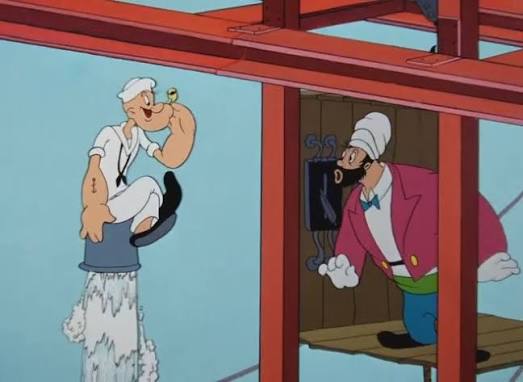 Popeye and the now loose Bluto race for the same elevator. They fight for its occupancy, with Popeye the one finally landing in the car as it begins to descend instead of rising. “Abracadabra”, shouts Bluto again, materializing a heavy-duty pair of wire cutters, which he uses to sever the elevator cable. The car goes into free-fall, and Popeye’s spinach can is swept by the air-flow and G-forces out of his pocket, and pressed against the roof of the car. Popeye yanks the can down, and ingests his secret weapon, which transforms each of his mighty arms into air brakes. Pressing them against the girders forming the framework of the elevator, Popeye brings his car to a stop (though doing quite a number upon the structural integrity of the building, warping the supporting beams in the process). He looks up to find Bluto scaling the structure as if he were climbing a tree, almost to Olive’s level. Popeye yanks out a main beam from the corner of the building, taking with it Olive hanging at the top. With a shake, Popeye initiates a “pancaking” effect (are we predicting 9/11?), causing the sections of the beam to fold upon themselves, bringing Olive down, while Popeye catches each folding section of steel in his mighty arms. Olive is returned to the ground, just as Bluto also shimmies his way down to ground level. Bluto approaches the sailor menacingly, only to receive a sock in the jaw, knocking his turban loose and flipping Bluto into the air. Popeye dons the turban, and shouts “Abry-cadabry”. Who should appear under Bluto but Popeye’s favorite – the performing seal, who ends the film juggling Bluto upon his nose, while Popeye bows to the applause of an appreciative Olive.
• The restored print of “A Balmy Swami” is at Tititudorancea.tv or, if such site is not easily linkable, a small screen version from the same source complete with animator breakdown, is on Facebook.
 Rather than reissue over the years the Max Fleischer two-reel specials of Popeye’s Arabian trilogy as Paramount Champions (which might have necessitated giving screen credit to Max, whom the studio had taken great pains to oust from control, and which also might have rubbed distributors’ fur the wrong way at being charged at a two-reel booking rate), Paramount chose to condense each of the specials into long one-reelers, with a little new wraparound storyline thrown on so as to pass the films off as a “new” title – essentially letting the re-releases take the form of “cheaters” passing for new material. To keep the films “current”, original soundtracks were also excised, with Bluto’s voice now supplied by Jackson Beck, and Popeye’s and Olive’s lines newly dubbed and often re-written to change the ad-libs. Each of the old featurettes got this treatment. The first (which we will not discuss here, avoiding the numerous retellings of Aladdin), was “Popeye’s Premiere”, condensing “Aladdin and his Wonderful Lamp”. The next in line was “Popeye Makes a Movie” (Famous/Paramount, 8/11/50 – Seymour Kneitel, dir.), condensing “Meets Ali Baba’s Forty Thieves”. Some of the condensing moves were often easy, as the first things to go were the original songs, reducing running time considerably. So, Beck is not asked to reprise Gus Wickie’s basso on “Abu Hassan”. Generally, however, the new ad-libs are rarely as inspired as the originals, nor are the musical underscores as lush, so the loss of the original sound is a bit saddening and detrimental to each film’s impact. Some degree of visual consistency, however, is retained by having Popeye appear in his old multi-color uniform in the new incidental shots, though no explanation is offered as to what happened to his navy whites. Consistency, however, is not the rule for Olive, whose new scenes fail to match her original Plain-Jane look in the Fleischer footage, depicting her as far too pretty as she dolls up in front of a studio make-up mirror.
 The small amount of new animation has Popeye’s nephews visiting at Paramount Pictures. (No effort was made to remove the studio lettering from the main gate in television prints – so why was it necessary to remove the mountain logo from both ends of the film for so many years?) They want to see Uncle Popeye make a movie. Popeye seats them off to one side of the set, and makes them promise to be quiet during the filming. A director sets Popeye, Olive, and Wimpy up for their lost-in-the-desert sequence (skipping the Coast Guard plane opening), and with the call of “Action”, the old stereoptical Fleischer footage begins. Things proceed from there into the sequence where Bluto and Popeye face off in the open-air restaurant. Just as Bluto gets Popeye caught up in the suspended lamp-fixture, new animation has the nephews believing that their Uncle needs help, and leaping onto the set, to gang up in a pile upon Bluto, laying punches upon him and telling him to leave Popeye alone. The director shouts “Cut”, and orders Popeye to remove the kids from the scene. Popeye places the four of them upon a bench, and uses some spare plywood to construct a set of stocks accommodating four sets of heads and hands, then padlocks the boys in for the duration of the filming. The old footage resumes with the call of “Action”, proceeding until the climactic moment when the tied Popeye dangles from a rope over the shark pit. Cutting to new footage, the nephews again realize Popeye is in real trouble this time, and get an idea how to escape from the stocks. “Open, sesame”, they shout at the padlock – which magically snaps open. Now the boys race to Popeye’s dressing table, locating near his make-up a spare can of spinach. They toss the can onto the set, where Popeye catches it. Cut to the original footage of Popeye addressing the can, “Open, sez’ me!” Follow through to the picture’s ending. The last shot is however substituted (losing the three-dimension effect of the jewels piled in the wagon pulled by the thieves). Popeye still sings, “I may be a shorty, but I licked the forty…”, but is interrupted by the nephews popping up between Popeye and Olive, interjecting “He’s our Uncle – Popeye the sailor man!”
• “Popeye Makes a Movie” is on DailyMotion.
 King Tut’s Tomb (Terrytoons/Fox, Heckle and Jeckle, 12/29/50 – Mannie Davis, dir.) – If it was good enough for Waffles and Don, and Gandy and Sourpuss, why not Heckle and Jeckle? This would mark the classic studio’s last venture into the forbidden tombs of ancient Egypt. Though John Foster escapes any credit for this one (writing honors going nominally to Tom Morrison), his influence is clearly felt, right down to liberal “borrows” of material and animation from his past productions.
Explorers Heckle and Jeckle (you can tell they’re explorers because they begin the film wearing pith helmets) arrive in the Arabian desert via a flying carpet (chartered for the occasion, or perhaps an artifact acquired in a previous expedition?). Their destination requires no exploring skills to locate, well-marked by directional and warning signs spread across the sands in the vicinity of the Sphinx – “To King Tut’s Tomb” – “No Digging Allowed” – “Do Not Disturb the Mummies” – “Or the Daddies”. The site itself is clearly indicated, not by a flashy surface temple, but by a stone “X” marking the spot on the ground. The magpies save a great deal in time and expense by eliminating excavating tools – instead, one positions a chisel in the center of the stone X, while the other pecks upon the handle in the manner of a jack hammer. The noise raises a bit of a commotion locally. A giant asp-like creature passes, and can only utter “tsk tsk tsk.” The ghost of a mummy rises from the sands, startling the magpies, and remarks, “I wouldn’t do that if I were you.” Heckle (who ought to know about the subject given his name) says to pay no attention to “those hecklers.” But the most important reaction comes from the Sphinx, who extricates himself from his stone foundation, runs to a secret panel in a nearby pyramid, enters it, and reaches for a telephone, calling for the number, “Pyramid-0000″. He is connected with King Tut (or perhaps, his ghost), and informs the King that a couple of magpies are pecking upon his tomb. Tut tells Sphinx not to worry – “We’ll take care of them.”
 While the birds’ chiseling has seemed to have no effect, suddenly the points of the “X” pivot downwards as if on hinges, opening a hole in the middle, and causing the birds to fall deep into the earth, and smack into the middle of the tomb’s interior. Heckle’s eyes scan around, and the first thing he spots is a large vault door. What luck! The royal treasures should await within. Using sandpaper upon his fingertips like a safecracker, Heckle twists a combination lock dial (though such locks hadn’t even been invented in Tut’s day). The dial begins to wildly spin on its own, and Jeckle cautions him to “Look out!” Both birds hide in large urns, as the vault door swings open, revealing the surprise of an extended parade of mummies, carrying marching band instruments, followed by a ten-humped camel twirling a drum majorette’s baton with its tail, a mummy hawking ice cream from a Good Humor wagon, and five floating mummy cases, the last opening to reveal a mummy resembling Harpo Marx, playing cymbals while his eyes twirl in opposite directions. (This creative set of random surprises probably got the biggest laugh of the film.)
Now it’s time for some flashes from the past. Jeckle discovers another equally-unexpected modern convenience inside the vault room – a royal juke box. He inserts a coin, causing the device’s neon to light up in rainbow colors, and Arabian music to play. With a simple jump cut, breaking into the middle of a pan across the room, opportunity present itself to use verbatim two old shots from “Somewhere In Egypt”, of the fading-in of two rows of phantom harem cats as drummers, and the emergence from a mummy case of a seductive cat harem dancer. We’ve never known the magpies to display romantic inclinations toward cats before, but how else do you reuse the animation of the harem cat’s dance? So Jeckle winds up standing in for Sourpuss, as animation from “Egypt” continues to be reused for a few bars of dancing. Then, with no explanation, the attractive cat transforms into, of all people, Frankenstein’s monster! Every circulating print I know of cuts abruptly at this point, unwilling to show us exactly what the monster does, or how he disappears, as presumably “too horrific for the kiddies”. I’ve asked on multiple occasions if anyone knows what the missing gag was – and I again implore anyone with information to contribute to solving this mystery.
 We rejoin the action with both magpies falling on the floor, and Jeckle wishing that they were “out of here”. Heckle reassures him not to worry – “This is only a cartoon.” The previously-seen mummy ghost rises into view again, and dispels Heckle’s belief, stating, “That’s what YOU think.” Back to reused animation again, as the birds again substitute for Gandy and Sourpuss, while the skeleton fireman and chariot first seen in Van Beuren’s “Gypped in Egypt” makes its final reappearance, complete with the skull head falling upon Heckle. New animation follows, as the confused birds finally stumble upon the royal treasure chest. A large keyhole is visible at its center, and Heckle remarks, “If we only had a skeleton key.” The skeleton fireman, in a new shot, returns in helpful fashion, offering such a key to Heckle. Slowly, the birds turn the key in the ancient latch, and the chest lid pops open. The scene is presented much too suddenly for proper impact, as a swarm of insects emerges from the chest, which Heckle is somehow able to identify instantly (is he an insect expert?). “TERMITES!” The setup is strained to say the least, as no previous animated character I know has reacted to first sight of a termite as a lethal threat. Yet the birds zip out of the scene and flee in terror. To place greater strain upon credibility, these bugs don’t eat wood, but seem to devour everything else. A clay urn the magpies hide in. Stone spiral steps the magpies climb. Their flying carpet once they escape the tomb. And finally, the birds’ coat of feathers. Just to kill all plausibility, the featherless birds do not fall helplessly, but are able to merely blush, then fly away into the sky. Talk about being stuck for an ending. Perhaps it might have been better had they stolen the wrap-up from “Egypt”, with Heckle awakening from a dream, and asking Jeckle to put him back to sleep by playing an Egyptian tune on a flute.
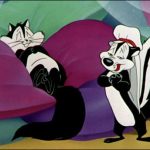
 Little Beau Pepe (Warner, Pepe Le Pew, 2/9/52 – Charles M. (Chuck) Jones, dir.) – A cartoon marking a couple of firsts. One, it is the first Warner cartoon to officially name the Jones skunk as Pepe Le Pew, giving prominent name credit to the character in the titling. The name choice might have also prompted the idea for the story and the clever title, spoofing Foreign Legion pictures by the “Beau” reference to the classic “Beau Geste”, but crossing it with nursery-rhyme reference to “Little Bo Peep” – exactly suiting Pepe’s new name! Secondly, this cartoon appears to be the first animated film to play upon what was an old cliche of the Foreign Legion epic back when Laurel and Hardy used it in their featurette “Beau Hunks” in 1931 – the notion of joining the Legion to “forget” an old romance. No one could be more suited to having such a need than Pepe – the poster-boy for having loved and lost time and again, and already of French nationality. So the brilliant Michael Maltese script is a pure natural, and one of the best of the series.
 A motley crew of Legionnaires drills at a desert fort, to a stirring broken-French march. The company is dismissed, and sets about their regular duties. One of them paints a ladder with white paint, while another pets the company mascot (a femme pussee cat), as both exchange banter about a sure thing in the third race at Hialeah. Of course, the cat eventually rubs underneath the ladder, acquiring a white stripe. But she is not yet the center of attention. A recruiting office within the fort displays a poster reading “Uncle Francois Wants You.” A knock at the door brings a new applicant, suitcases in hand. It is Pepe, announcing himself as the “disillusioned” one, seeking to forget. The sergeant in charge of recruiting is a man of efficiency and routine, and fails to even look over his shoulder to view exactly what species his new charge is. Instead, he busies himself in filling out for him an application questionnaire, asking for Pepe’s socialty securetee number. Only when a wafting aroma hits his nostrils does he leap out of his chair, shouting “HOLY UN SMOKE!!” “Something?”, asks a puzzled Pepe. Shooting through the fort grounds like a comet, the sergeant spreads the alarm: “Le skunk de pew!! Le terrible odeur!!” The entire personnel of the fort disappear over the sands. Pepe stands in the open doorway, puzzling as to why all the soldiers run away. Then, his confidence returns, realizing that it can only be that he has already been given the position of great honor – to guard the fort single-handed.
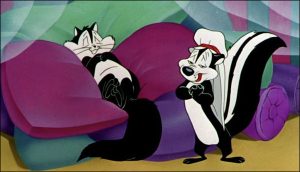 Soon, Pepe is wearing a legionnaire hat, carrying a rifle, and patrolling the fort’s upper walls. The only other remaining occupant of the fort – the cat – awakens, and Pepe is not only struck by a view of her figure, but that white stripe. The post of honor can wait. Pepe is quickly on the prowl as usual, and as the cat attempts to retreat, Pepe tries the come-on line, “But darling, tomorrow I may be shipped overseas.” As the cat makes laps around the fort walls, Pepe remarks that it is one of the great mysteries of his life why women always run away, when all they really want is to be captured. As the cat finishes her third lap, Pepe simply waits for her on the wall, with a quick change of costume to outfit himself as Napoleon. “Josephine?”, he calls. The cat zooms down from the wall railings, and attempts to hide in a barrel – but Pepe is already inside, chilling a bottle of champagne over ice. The cat bursts through the wooden slats, and races for the fort exit, while Pepe remarks, “Almost like shooting fish in a barrel.”
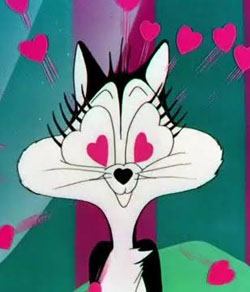 Over the dunes races the cat, while Pepe follows behind at his usual, leisurely bouncing pace. The desert heat becomes too much for the cat, and when she attempts to stop for a drink at an oasis, Pepe is already there. One look at him, and the cat collapses in a faint. Pepe comes to the heroic aid of the damsel in distress, converting tactics to that of the romantic sheik a la Rudolph Valentino, and carrying the cat into a luxurious tent. The cat remains unconscious while Pepe places her upon velvet pillows, and Pepe wonders how this innocent one can rest “when I am so near.” He decides he must restoke the furnaces of love, and explores the tent (probably the home of a real sheik) for something to do the job. He finds it, in the form of a large collection of bottles of exotic perfumes and oils, including such products as “En Guard”, “Jette Propelle”, and three bottles marked “L’Amour”, “Toujours”, and “L’Amour” (a popular song reference, a few bars of the tune played on track by Stalling). Pepe leaves nothing to chance, mixing the entire content of the bottle collection together into one vat, then spraying himself with it from an atomizer. “A little subtle, perhaps…but…” Then, Pepe begins singing, strumming out a standard Arabian riff on a lute, while ad-libbing lyrics: “Sweetheart, Pepe Le Pew loves you. Sweetheart, fortunate lucky you!” The scent of the powerful perfume overcomes Pepe’s natural aroma, and wafts over to the cat’s nostrils. Her eyes pop open, displaying hearts within, which dart to gaze at Pepe, while her real heart visibly thumps within her chest. With a zing, the roles are reversed, and it is now the cat who plays the aggressor, seizing Pepe in her embrace. “I have overstoked the furnace, yes?” asks Pepe of the audience. Then, to the cat, he pleads, “Control yourself, madame. Your conduct is unseemly!” In full role-reversal, Pepe races out of the tent and across the sands at full speed, while the cat gingerly hops at Pepe’s usual measured pace, turning to the audience to remark “Le rowr rowr!” Pepe gets the curtain line, reversing his earlier question on the mysteries of life. “Why is it that whenever a man is captured by a woman, all he wish to do is get away?”
 Big Bad Sindbad (Famous/Paramount, Popeye, 12/12/52 – Seymour Kneitel, dir,) – I just caught, by the way, my typo in previous comments upon Fleischer’s 1936 featurette – not noticing that the titles of Paramount’s works refer to the character as “Sindbad the Sailor”, not “Sinbad the Sailor” as in Ub Iwerks’ version, or in Sam Singer’s and Hanna-Barbera’s later “Sinbad Jr.” series. Why the extra “d”? Who knows?
This of course is the final reworking of the Fleischer two-reelers, set as a trip by Popeye and the nephews (now only three of them) to a nautical museum. Popeye shows off displays of famous sailors in history. First, a statue of Washington crossing the Delaware. The kids are inspired to leap into the stone seats of the dinghy, and row it in dragging fashion across the museum’s floors. Popeye has to drag it back to where it belongs. Next, a display honoring Noah, the first sailor. Popeye notes that on his maiden voyage, it rained for forty days – at night. Suddenly, he feels drops of rain – indoors. Two of the boys have turned on a fire hose, while the third holds an umbrella over the statue of Noah. Popeye cautions the boys that pranks like that will get them thrown out of here. Finally, a huge statue of Bluto as Sindbad, with inscription at its base, “The greatest sailor in the world”. “But you said you were the greatest sailor in the world”, the boys remind Popeye. Popeye is a bit at a loss for words, as if past bragging has caught up with him. Appearing to ad-lib to cover up for past tall tales, Popeye concocts on the spot his tale of having once met Sindbad, and knocked the tar out of him. Only one cutaway to new footage takes place during the original sequences (suffering in the middle from removing entirely all Greek-accented voicing for the giant Boola). The new shots show the spinach can rolling away from Popeye, followed by a brief return to the present as the nephews ask, “Were you killed?” “Let me finish”, says the sailor, returning to the old footage in flashback. When the story concludes, Popeye adds, “And that’s why I’m the greatest sailor in the world.” He then notices the kids aren’t sitting around him. Instead, they have briefly left the building, and return with hammers and chisels. They leap upon the Sindbad statue, and assault it, chipping away vigorously at the stone, and transforming its core to an image of their uncle, finally etching his name at the base as the greatest sailor in the world. Popeye heartily laughs, for the iris out.
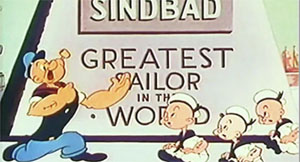 For the sake of argument, the version of the film embedded below, which appears to have near-perfect colors, depicts the original 1936 footage with the darkest portions of Sindbad’s outfit suggesting only the slightest traces of blue (consistent with the Library of Congress’s Technicolor nitrate), rather than the neon blue which appears on the Warner “restoration”. More evidence that the lobby card from which Warner chose to match its blue had itself been doctored for appearance and differed from the actual camera images. An advertising inaccuracy of almost 90 years ago thus carries over to artificially affect the viewing of future generations. Will Warner ever correct it if they choose to convert the film to blu-ray? Probably doubtful – unless enough people give them a little nudge.
NEXT WEEK: Tex Avery, Goofy, Woody Woodpecker, Donald Duck, Pepe Le Pew, and Bugs Bunny will all make appearances. Keep your camels saddled!


![Your Sci-Fi Turret Looks Great. Until It Rotates from Under the Floor [$]](https://som2nynetwork.com/wp-content/uploads/2026/09/Thumbnail_1920x1080_NoLogos-800x450.png.webp-336x220.webp)