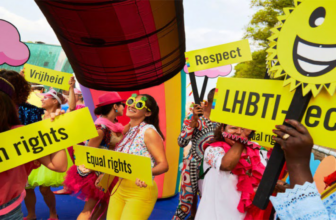
It’s a Ramadhan morning in the port city of Mombasa, early April 2023. I’m standing behind an audience of about 100 people who have turned up to a makeshift stage on the edge of the neighbourhood of Old Town. A performance of Lisemwalo Lipo: A play about vaccine rumours is in full swing (see https://jukwaaarts.co.ke/lisemwalo.html to watch a 3-minute clip of the show and ensuing discussions).[1]
The characters on stage are sitting around a charcoal-fired pot, where Mama Jay, a Mombasan woman in her 40s, ekes out a living selling viazi karai, deep-fried potatoes. The play is set during the Covid-19 pandemic – Mama Jay and her clients are discussing the rising number of people in Kenya getting vaccinated. Auntie Rehema, a woman whose eye shadow is almost as spectacular as her wit, is dismayed by the increase in people getting the jab. She’s convinced the vaccines are ‘fake’ or ‘feki’ (both the English and Kiswahili words are used interchangeably by the characters on stage, reflecting typical language use in Mombasa) and ponders aloud whether there will be space in the city for all the vaccinated to be buried – Rehema has heard that people will die within two years of inoculation. Mama Jay thinks this is ludicrous and tuts loudly at the potato she’s peeling. Peter, a microfinance officer who is out to collect debts from Mama Jay, offers another take: adamant that the Covid vaccine ‘ni fake’ (is fake) he believes the global inoculation campaign is being used to control people, by inserting microchips into their arms. Baba Hamisi, an older and worldly uncle, offers his triumphant verdict on such efforts: “This is called bioterrorism. Neo-bioterrorism.” Baba Hamisi argues that the powerful are using the vaccine to control bodies and health through electromagnetic waves. The characters debate whether these rumours are true or not: what they all agree on is that people seem to be dying, even after getting vaccinated.

At the end of the performance, the audience is invited to join the discussion. One woman expresses her wholehearted agreement with the character of Baba Hamisi: “The vaccine is a bioweapon, being used to finish us!” A man in his early twenties stands up to reject this: “Why would the government want to kill their own citizens and have no one to rule over?” He goes on to point out that everyone in the audience bears the scars of the BCG vaccine (used to control tuberculosis) on their left forearms – BCG vaccines are given to everyone born in Kenya. “If they’d wanted to control us [through vaccination] they’d do so from birth!” he insists.
Conversations like these – that posit the Covid vaccine as fake, intended to harm and kill rather than reduce the threat of SARS-COV-2 – occurred around the world during and after the pandemic, including in East Africa (Dahir 2021; Rédaction AfricaNews 2021). Social commentary on Covid vaccines in Mombasa and beyond did not simply dismiss the vaccines as fake in the sense of being fraudulent or phoney, but as actively harmful and life-threatening – bioweapons masquerading as vaccines.
What immediately comes into view with these comments is, first, the ontological instability and expansiveness of the notion of ‘fake-ness’ as it relates to Covid vaccines. As Hornberger and Hodges (2023) have powerfully demonstrated, claims about fakes or ‘fake-talk’ are mobilised to explain all kinds of pre-existing discomforts and anxieties – inequitable, disreputable and ambiguous things, people and circumstances – offering a new way to name and frame otherwise insurmountable or unspeakable social tensions. As I explore further in what follows, claims about ‘fake’ or ‘feki’ Covid vaccines in Mombasa offered a language for highlighting local and global inequalities, as well as making visible the tensions between global health’s mission to promote better health for all and the reality of its uneven success.
Second, the above excerpts from Lisemwalo Lipo and the audience discussions that followed the three performances in Mombasa challenge conventional accounts of who circulates fakes and why. This piece calls for a radical rethinking of who constitutes ‘middlemen,’ and what constitutes acts of brokerage in the world of fakes. Focussing on the circulation of fake Covid vaccines, I argue that the brokers of fakes are not evil middlemen, but ordinary people who distribute fakes primarily through discourse. In the introduction to this series, Hodges, Hornberger & Thakur (2026) assert, ‘[m]iddlemen are nobody and everybody.’ In the world of fake Covid vaccines in Mombasa, I argue, middlemen are everybody.
Finally, I offer an account of why fakes circulate, using the theatre production to show how claims about fakes operate in practice. Theatre as a tool to support specific public health goals has a long and sometimes fraught history. It is a powerful medium to challenge health and social inequalities (Boal 2008 [1979]), but can equally be used to oppress and exclude (Baxter and Low 2017). Theatre has been used extensively in health campaigns in Africa, particularly around HIV (Mbizvo 2006).
Rather than focussing on the power and pitfalls of theatre to support particular health messaging (e.g. ‘use condoms’), this piece brings into view the potential of participatory theatre to question prevailing norms within global health itself. Specifically, I consider what ‘staging fakes’ makes visible about middlemen and fakes to a global health audience. A participatory play that centres claims about fakes or “fake-talk” (Hornberger and Hodges 2023), I suggest, compels a reckoning of the alleged ‘threats’ that middlemen and fakes pose to global health.
Who brokers fakes?
In conventional accounts of global health, fake drugs and the people who trade them are portrayed as a pervasive and ever-present threat – it is criminal masterminds, dodgy mafia dons, and venal tricksters who circulate fake drugs (Przyswa 2013; Kupatadze 2020). Calculating and cunning, these individuals are always in search of new ways to extricate profits from helpless consumers, inept customs regulators and gullible manufacturers.
These narratives begin to unravel in light of the empirical data: namely, that there is very little evidence of fake drugs in circulation. As Hodges & Garrett (2020) point out in their comprehensive review of the literature on fake drugs, there is very little pharmacological data about the circulation of fakes in the public domain. Fearing damage to their reputations and profit margins, pharmaceutical companies keep any testing they do a closely guarded secret; state drug authorities lack the capacity and political will to do much more – indeed, the power of Big Pharma to shape national drug policies is well documented (Sismondo 2018).
What happens to the dastardly middlemen, circulating fake medicines to amass profits, when the pharmacological basis of their trade unravels? This is not a rhetorical question. If fake drugs are not in circulation (we have very little evidence of their circulation, in any case), we are forced to confront the fact that trading in fake drugs primarily happens discursively. And, if fake drugs are a discursive affair, then fakes brokers are ordinary people who circulate claims about fakes.
What I am saying is that fake drugs are not ‘out there’, being circulated by evil middlemen – rather, fakes (like other social constructs such as ‘race’, nations and gender) are constantly made thing-like through everyday discourse. Fake-talk makes fakes – fake-talk is fakes – there are no fakes outside of fake-talk (or at least: we know very little about fakes outside of fake-talk).
Like other discursive constructs, fakes have real effects – they are made and re-made as things, problems, threats and solutions by ordinary people – by us. This includes the characters in Lisemwalo Lipo and the audiences who watched the shows. Fakes middlemen are everybody – and staging fakes helps demonstrate this.
Lisemwalo Lipo, a participatory play and accompanying short film,[2] was co-created by myself and Jukwaa Arts Productions, a Mombasa-based performing arts company. The collaborative scriptwriting process drew on ethnographic research on vaccine distrust that I had conducted in Mombasa in 2021-22 (Goodman 2024), as well as on the personal experiences of the Jukwaa Arts team and discussions with local health experts and community stakeholders.
Lisemwalo Lipo takes place at a time when international travel is becoming possible again, but only with proof of vaccination. The plot centres around Jay, a young man preparing to leave Mombasa for the Gulf in search of work, where he hopes to pay off his own and his mother’s debts – these have been exacerbated by the economic hardships wrought by Covid-19. Jay has not yet been vaccinated, and throughout the play he encounters a wide range of views on the matter: many of the people he meets are sure that the vaccines are fake – created to cause harm or death rather than reduce the threat of the virus. Others only got vaccinated in order to keep their jobs; some are in favour of the jab. The performance ends with a dilemma to which the audience is invited to respond: should Jay get vaccinated or not?
The scene from the play I described at the outset depicts a group of recognizable Mombasan characters, gossiping while they wait to buy a popular local snack. The dialogue demonstrates how claims about fake vaccines emerge and are circulated as part of everyday life in Mombasa. Challenging the notion of fakes being traded by morally vacuous mafia-types, operating in smoky back rooms and badly-lit alleyways, this scene (and others) puts front and centre the utterly mundane way fakes are brokered – by ordinary people in ordinary places. Putting fakes on stage helps detach fakes from the villainous middlemen that have long been a concern to global health audiences. Looking for fake Covid vaccines in Mombasa, in other words, reveals ordinary people as middlemen – middlemen are everybody.
Staging fakes: showcasing what fake-talk enables
In addition to demonstrating how fakes circulate, the play helps illustrate why – staging fakes shows the work that fake-talk does.
In the world of global health, claims about fake drugs are often positioned as being as much of a threat to public health as the fakes themselves – and this is particularly true of vaccines. Those who voice claims about fake vaccines (‘anti-vaxxers’) are frequently portrayed as irrational, malicious or ignorant, threatening collective health through a refusal to get vaccinated (Salali 2020; Ackah et al. 2022). Claims about fake vaccines, in the prevailing logic, are something that need to be dispelled through ‘true’ and ‘scientific’ information campaigns (WHO 2021) – claims about fake vaccines are typically dismissed as fake news.
Staging fakes reveals the merits of moving beyond this approach, and, I argue, shows why global health practitioners would instead do well to take claims about fakes seriously (including claims about fake vaccines). This move, to go beyond questions of veracity in debates about fakes, is at the root of the Wellcome Trust project behind this collection of articles (see fakedrugsproject.org). Our radically relativist approach to fakes does not seek to determine whether claims about fakes are true or false, but instead examines how these claims emerge and what effects they have in the world. Staging fakes through Lisemwalo Lipo supported this goal.
What was clear from the performance and audience discussions is that the language of fakes (i.e., fake-talk) enables ordinary people to express their frustration with seemingly intractable aspects of the status quo. Let me illustrate with examples. In the show, the character of Baba Hamisi voiced his concern that Covid vaccines were part of a Malthusian plot by Bill Gates to reduce fertility on the African continent. Peter, the debt collector, was concerned about vaccines containing zombie-inducing microchips. Mama Jay felt she had been forced to get vaccinated by her employer, and only got the jab in order to keep her job at an Economic Processing Zone on the outskirts of the city. These claims were all commonly held positions in Mombasa, as attested by my earlier ethnographic research (Goodman 2024).
During the discussions that followed each performance, audience members often similarly positioned the vaccines as some form of control by the powers that be. An older woman at one show waggled her finger at Jay, exclaiming that the magnet inside the vaccine would undoubtedly affect his ability to think clearly. A man in his 50s had a lot of sympathy for Mama Jay – like her, he had experienced compulsory vaccination at work and saw vaccine mandates as a tool for the rich to control the poor, through the threat of redundancy. Echoing Baba Hamisi’s concerns about the vaccines being designed to leave people infertile, many urged Jay to protect his ability to procreate by finding alternatives to vaccination – either by paying for a vaccination certificate or by seeking work within Kenya (and thereby avoiding international travel). One audience member explained how, following the punitive lockdown of the Muslim neighbourhood of Old Town where she lives, it was difficult for her community to see the vaccines separate from the Kenyan state’s ongoing efforts to subjugate Muslims.

Each of these narratives about fake vaccines were both condoned and contested, during and after the performances. One young woman in the audience at the Little Theatre Club received a long round of applause after announcing she had been vaccinated three times – she urged Jay to do the same. A community health volunteer vehemently rebuked the fertility fears of her fellow theatregoers, assuring the audience that a woman could get vaccinated and still have 15 children. A young man at the show in the southern neighbourhood of Likoni contested claims about the use of vaccines to harm those of Islamic faith, arguing that if the vaccine had something to do with controlling Muslims the government would have locked down the neighbourhood of Likoni as well Old Town – both have large Muslim populations.
These heated and lively dialogues, both within the performance and after it, contain many claims and counter claims about fake vaccines. Crucially, staging fakes helped foster discussions that went beyond questions of truth and falsity. Rather than offering resolution, or a particular stance on fake vaccine claims, the play was an invitation to be curious about others’ positions. There was no resolution during these discussions – nor were we seeking one. What they offer, however, are insights into why claims about fake vaccines circulate in the first place. Staging fakes helped show the work that fake-talk does.
Staging fakes helped demonstrate that claims about fakes are expressions of frustration and distrust. Claims about fake vaccines offered a language through which to question the assumed ‘benevolence’ of vaccination. Fake vaccine talk reflected the ways in which some Mombasans experienced Covid vaccines as bound up with profit maximization, repression, surveillance and neglect – whether by the Kenyan state, Western governments or the global health industry (see also Goodman 2024). This echoes recent critical scholarship on vaccine distrust elsewhere (Charles 2022; Larson 2020; Storer and Anguyo 2023; Leach et al. 2022) – and suggests that it is not so much fake vaccine talk that is a problem, but the social conditions that give rise to it.
Putting fakes on stage allowed, in other words, for a public surfacing of the enduring inequities and tensions that fake-talk gives expression to. A good example of this is demonstrated by the fact that many Christians who participated in performances of Lisemwalo Lipo – including some of the cast – were surprised to see how many Muslim attendees saw the vaccine as part of state efforts to harm Muslims. The Islamophobia of state policing and policy has a long history in Kenya (see Prestholdt 2011; Mazrui 1993), but this is often not visible to or acknowledged by the country’s Christian majority. The language of fakes, in the form of claims that Covid vaccines would kill or harm Muslims, offered a way for Muslim Mombasans to express frustration with this enduring discrimination – and, through the performances, illuminated this suffering to some Christian participants.
Lisemwalo Lipo represented how ordinary Mombasans broker fakes as part of everyday life, through claims and counter claims about fake vaccines. The play and ensuing discussions call into question conventional framings of middlemen and fakes as ‘problems’ for global health. Rather than being concerned about these alleged threats, Lisemwalo Lipo helped demonstrate that fakes brokers are ordinary people, and that (claims about) fakes circulate because they offer a language through which to voice frustration with social inequities. I have argued that global health practitioners would do well to take claims about fakes seriously – and that participatory theatre offers a compelling medium through which to do this. More than a tool for health messaging, participatory theatre emerges as a means through which to unsettle the norms and assumptions that underpin global health itself. Global health is threatened – not so much by middlemen peddling fake drugs, but by the failure to listen to and address the pervasive social inequities which claims about fakes give expression to.
[1] The Kiswahili phrase lisemwalo lipo (literally: “that which was said, is there” i.e. “that which was said, is true/exists”) is used colloquially like the English expression “where there’s smoke there’s fire,” alluding to the fact that rumours contain important truths. The title and script of the play, like typical language use in Mombasa, combines both Kiswahili and English.
[2] A clip of the film is available here: https://jukwaaarts.co.ke/lisemwalo.html. Full film and facilitated screenings available on request, contact zoe.goodman@kcl.ac.uk.
References
Ackah, Betty B. B., Michael Woo, Lisa Stallwood, et al. 2022. “COVID-19 Vaccine Hesitancy in Africa: A Scoping Review.” Global Health Research and Policy 7 (1): 21. https://doi.org/10.1186/s41256-022-00255-1.
Baxter, Veronica, and Katherine E. Low. 2017. Applied Theatre: Performing Health and Wellbeing. Bloomsbury Methuen.
Boal, Augusto. 2008. Theatre of the Oppressed. Pluto Press.
Charles, Nicole. 2022. Suspicion Vaccines, Hesitancy, and the Affective Politics of Protection in Barbados. Duke University Press.
Dahir, Abdi Latif. 2021. “Kenya, Expressing Concern about Counterfeit Vaccines, Blocks Private Imports of Doses.” World. The New York Times, April 3. https://www.nytimes.com/2021/04/03/world/kenya-covid-vaccine.html.
Goodman, Zoë. 2024. “‘They Will Not Police Us’: Fake Vaccine Rumours in Mombasa.” Cambridge Journal of Anthropology 42 (2): 65–82. https://doi.org/10.3167/cja.2024.420206.
Hodges, Sarah, and Emma Garnett. 2020. “The Ghost in the Data: Evidence Gaps and the Problem of Fake Drugs in Global Health Research.” Global Public Health 15 (8): 1103–18. https://doi.org/10.1080/17441692.2020.1744678.
Hodges, Sarah, Julia Hornberger, and Nishpriha Thakur. 2026. “Middlemen and Global Health: What We Found When We Searched for Fake Drugs.” Somatosphere.
Hornberger, Julia, and Sarah Hodges. 2023. “Fake-talk as concept and method.” Medicine Anthropology Theory 10 (3). https://doi.org/10.17157/mat.10.3.7291
Kupatadze, Alexander. 2020. “How Smugglers Are Shifting Staggering Amounts of Contraband despite the Pandemic.” The Conversation, July 16. http://theconversation.com/how-smugglers-are-shifting-staggering-amounts-of-contraband-despite-the-pandemic-142776.
Larson, Heidi J. 2020. Stuck : How Vaccine Rumors Start – and Why They Don’t Go Away. Oxford University Press.
Leach, Melissa, Hayley MacGregor, Grace Akello, et al. 2022. “Vaccine Anxieties, Vaccine Preparedness: Perspectives from Africa in a Covid-19 Era.” Social Science & Medicine 298 (April): 114826. https://doi.org/10.1016/j.socscimed.2022.114826
Mazrui, A. A. 1993. “The Black Intifadah? Religion and Rage at the Kenya Coast.” Journal of Asian and African Affairs 4 (ii): 87–93.
Mbizvo, Elizabeth. 2006. “Essay: Theatre—a Force for Health Promotion.” The Lancet 368 (December): S30–31. https://doi.org/10.1016/S0140-6736(06)69917-0.
Prestholdt, Jeremy. 2011. “Kenya, the United States, and Counterterrorism.” Africa Today 57 (4): 2–27.
Przyswa, Eric. 2013. Counterfit Medicines and Criminal Organisations. International Institue of Research Against Counterfeit Medicines. https://minesparis-psl.hal.science/hal-00958233.
Rédaction AfricaNews. 2021. “Hundreds of Ugandans given Fake Covid Jabs: Health Officials.” Africanews, July 23. https://www.africanews.com/2021/07/23/hundreds-of-ugandans-given-fake-covid-jabs-health-officials/.
Salali, Gul Deniz. 2020. “Coronavirus: Believing in Conspiracies Goes Hand in Hand with Vaccine Hesitancy.” The Conversation, November 9. http://theconversation.com/coronavirus-believing-in-conspiracies-goes-hand-in-hand-with-vaccine-hesitancy-148192.
Sismondo, Sergio. 2018. Ghost-Managed Medicine: Big Pharma’s Invisible Hands. First edition. Mattering Press. https://muse.jhu.edu/book/81376.
Storer, Elizabeth, and Innocent Anguyo. 2023. “‘These People Are Lying to Us’: Mutating Vaccine Fears and Colonial Histories in Arua, North-West Uganda.” Medical Anthropology Quarterly, no. Critical Care Category: Theorizing Trust from Anthropological Perspectives (March). https://medanthroquarterly.org/critical-care/2023/03/these-people-are-lying-to-us-mutating-vaccine-fears-and-colonial-histories-in-arua-north-west-uganda/.
WHO. 2021. An Overview of Infodemic Management during COVID-19, January 2020–May 2021. World Health Organization. https://www.who.int/publications-detail-redirect/9789240035966.