Keith Haring and the the New York Scene That Changed Everything – Urban Art & Antiques, Antiques Mysteries and Great Paintings

It never occurred to me when I visited the Brooklyn Museum’s Takashi Murakami exhibition in 2008 that Murakami may have been influenced by Keith Haring—not just artistically, but in the way he embraced merchandising. According to Radiant: The Life and Line of Keith Haring, Murakami was among the visitors to Haring’s SoHo Pop Shop in the late 1980s. The anecdote is a reminder that Haring’s influence extends well beyond his instantly recognizable imagery.
Brad Gooch’s 2024 biography brings to life the creator of that imagery, revealing an artist who is far better known than he is understood. Even 36 years after his death, Haring’s work is everywhere, most often on clothing. That widespread visibility is exactly what Haring wanted. His belief that “art is for everyone” lives on through the liberal licensing of his work, which continues to support the Keith Haring Foundation, established by the artist shortly before his death.
Reading Radiant also reinforced something I’ve been thinking about for a while: the 1980s remain an oddly underappreciated decade in the history of art. Perhaps because of their proximity to the present, they are often overshadowed by early twentieth-century realism, modernism, abstract expressionism and pop art, even though those movements flowed directly into the creative explosion of the 1980s. My search for a good book about the art of that decade led me to realize there really isn’t a definitive one, so I began reading biographies of the artists themselves.
Haring is central to that story. Alongside contemporaries such as Jean-Michel Basquiat, Cindy Sherman, Julian Schnabel, Robert Longo, Robert Mapplethorpe and Martin Wong, he belonged to a creative community in which painters, photographers, graffiti artists, musicians and performers constantly influenced one another. The crossover between the visual arts, grafitti, music, fashion and theater was remarkable, and few artistic eras feel as interconnected.
With Haring at the center of this remarkable world, Gooch brings the entire scene to life. He reminds us how quickly it evolved. In 1981, Basquiat made a memorable cameo as the DJ in Blondie’s “Rapture” video; less than a decade later, Madonna—who appears throughout the book—had become the biggest female pop star in the world.
Radiant also made me appreciate just how famous and connected Haring was during his lifetime. Gooch provides insight into Haring’s personal relationships, his enduring connection to his family in Kutztown, Pennsylvania, and the emotional toll of watching so many friends die while confronting his own AIDS diagnosis during the height of what was then widely and cruelly referred to as the “gay plague.”
Some of my favorite passages involve the arrival of personal computers in the art world. In one memorable scene at Yoko Ono’s apartment, Steve Jobs is on the floor setting up a computer as a gift for Sean Lennon. Andy Warhol experiments with MacPaint and proudly announces, “Look Sean, I made a circle!”
Gooch also discusses several digital images Haring created in 1987 on a Commodore Amiga computer. Those works were sold at Christie’s in 2023 as NFTs, a reminder of the brief but intense NFT boom. Despite being an early experimenter with computer art, Haring remained skeptical of the medium’s limitations. “My main problem with the computer is the restriction of the image,” he is quoted as saying. “In that it is always trapped inside this box (the screen) and, except in the printing, is very limited in its scale.”
Radiant is more than a biography of Keith Haring. It is a portrait of an extraordinary moment in New York culture, when artists, musicians, performers and technologists were all influencing one another. Haring stands at the center of that world, and Gooch makes a compelling case that his influence extends far beyond the radiant baby and barking dog that still appear on T-shirts around the world.
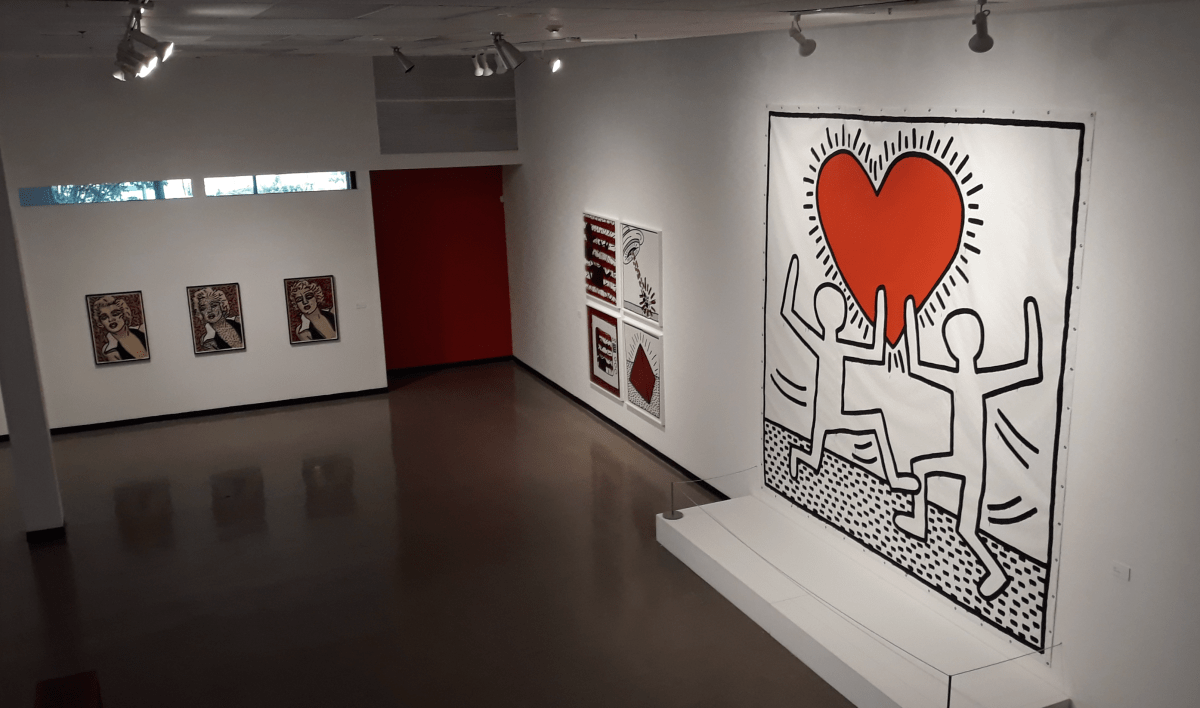
Cover: “Keith Haring: Against All Odds” at the Arlington Museum of Art (Texas), 2019