
Apple had its first earnings call since John Ternus took over as CEO, and it was—intentionally, I’m sure—just as boring as earnings calls were under Tim Cook. It followed Apple’s usual script, with the addition of Apple COO Sabih Khan joining the call and answering a couple of operations-related questions. Presumably, that wasn’t necessary before, given Tim Cook’s background as COO. Khan’s input didn’t make the call any more interesting.
Once again, a few things jumped out at me during the call.
Thinking Between Ternus’s Lines
Remember that earnings calls are essentially Apple marketing to analysts, so it’s always interesting to compare Apple’s superlatives with how its technologies feel to the rest of us. Here are a few things John Ternus said that made me think.
We’re also incredibly excited about iPhone 18 Pro and 18 Pro Max, which take massive leaps forward on camera, battery life, and performance, features that our users care deeply about.
Well, yes, we users do care about those features, but I’m not on board with the iPhone 18 Pro and 18 Pro Max taking “massive leaps forward” in those categories. Better, sure. Massively better? Not in my experience of using the iPhone 18 Pro since it arrived.
Siri AI marks a new chapter in AI at Apple. It is a completely reimagined assistant that is powerful, personal, private, and deeply relevant to our users’ daily lives. Siri AI is the future. [Siri AI] picks up what’s relevant to our users, understands what’s on their screen and holds a natural conversation, all to help them with the things they do every day. It’s the Siri we’ve always wanted. We are very pleased with the reviews and feedback we’ve received, and we’re so excited that more and more users are getting to experience it.
There is no question that Siri AI is vastly more capable than classic Siri. It’s much more than the “less stupid Siri” we’ve all wanted for years. However, it is also very much early days for Siri AI, which can be infuriatingly slow, often doesn’t work at all, frequently gets confused about which app to use, and feels like a flashback to 2023 in the way it constantly informs you that it’s an AI, not a doctor, dammit. I jest. Siri AI has shown no sense of humor, let alone a Dr. McCoy impression, but I’m sick of it disclaiming everything it says. Siri, we know you’re an AI and might get things wrong. It’s not like you were getting everything right before.
iPhone remains at the center of our opportunity as the intelligent personal hub. It’s always with you and understands your personal context, from your messages to your photos, notes, and apps to deliver powerful intelligence right when you need it.
Ternus’s positioning of the iPhone as an “intelligent personal hub” is both correct and intentional marketing. With OpenAI—and undoubtedly many others—developing AI-focused hardware, Apple wants to emphasize the essential role of the iPhone in whatever AI-powered future we end up in. But the fact remains: the iPhone is the center of our digital lives.
Then there’s Mac, which is having an AI moment all its own. Mac is what brought me to Apple, and through the years, has opened a world of possibilities. More than 40 years after the first Mac, the category is having its biggest moment yet, with every Mac in our latest lineup a powerful platform for AI. Mac mini and Mac Studio in particular are pushing the boundaries of local, private AI, giving users the ability to do things once considered impossible. From Mac to iPhone to iPad, we are proud that our products are the best platforms in the industry for AI for both first-party and third-party applications, and we’re excited about the opportunities that creates.
“AI” came up 44 times in my transcript, created by Audio Hijack and its AI-powered Transcribe block, with both Apple and analysts ignoring the US federal government’s widely mocked directive to change all mentions of “artificial intelligence” to “super intelligence.”
I’m conflicted here. Apple is making excellent hardware, and Siri AI is finally a reality, but for me, the magical aspects of AI come from Anthropic and OpenAI. Their tools helped me build apps like my macOS settings tracker SetShot and camera-based race timer FreezeFrame, analyze health data from my cycling crash, and finish tedious research in minutes that would have taken hours. Local, on-device AI will eventually be good enough for many tasks, but by then, cloud-based frontier models will have bounded ahead again. Perhaps frontier models will be needed only by scientists, serious developers, and the sort of people who used big iron back in the day, but we’re not yet at a point where on-device AI matches what people want to do.
Apple is happy to offload more intensive tasks to Private Cloud Compute, its privacy-focused cloud AI servers, and it may start charging for them. Ternus said there will be usage limits on features that rely on server-side models, including Siri AI and intelligent photo editing, and that people who need more will be able to purchase expanded access in the future. In other words, AI may start bolstering Services revenue.
Apple’s Actual Financial Results
Apple’s revenue for Q4 2026 was $114.5 billion, up 12% from the year-ago quarter. For perspective, Apple’s $30.7 billion in net income—that’s profit, after paying for everything—could cover NASA’s entire $24.4 billion budget for fiscal 2026 and still have $6.3 billion left over, roughly what NOAA gets to keep an eye on the weather.
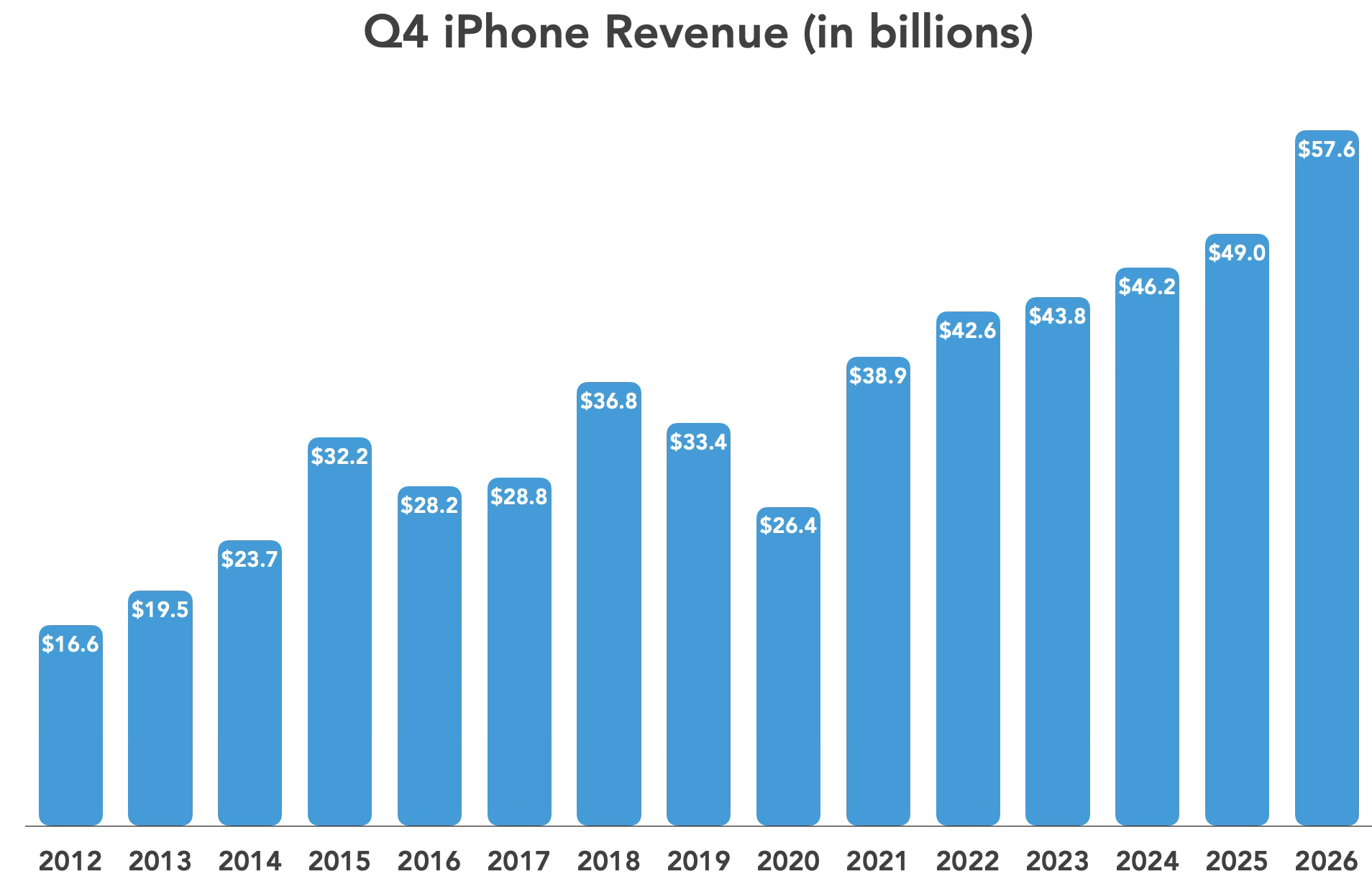
As always, Ternus and Parekh made sure to call out every September quarter and fiscal year record. Even a bullet list would run too long, so here they are in one breathless paragraph. Apple set September quarter records in revenue ($114.5 billion), net income ($30.7 billion), diluted earnings per share ($2.10), iPhone revenue ($57.6 billion), Services ($31.6 billion), Services revenue in the rest of Asia-Pacific, cloud services revenue, iPhone upgraders (worldwide and in the US, China mainland, and India), customers new to the Mac, Mac revenue in emerging markets, music, weekly App Store visitors, paid App Store subscriptions, every geographic segment other than Japan, and both developed and emerging markets. It also set all-time records for Services revenue ($31.6 billion), Services revenue in the majority of the markets Apple tracks, video, cloud services, payment services, advertising, India, and Mac sales in India and Southeast Asia. The company also set fiscal year records for revenue ($478.8 billion) and earnings per share ($8.98), as well as for iPhone and Services.
The big winners were the iPhone (up 17% from last year’s September quarter), the Mac (up 24%), and Services (up 10%). However, dark spots came from the Wearables category, which slipped 8% compared to the year-ago quarter, and the beleaguered iPad, which fell 10%. Here are the associated pretty pictures:
- iPhone ($57.6 billion): Needless to say, Ternus wouldn’t reveal how well the iPhone Duo is actually selling, although Apple is of course “thrilled with the early response from reviewers and customers, and we are working hard to get iPhone Duo into customers’ hands as quickly as we can.” Which I suspect means, “We’d like to build a lot more than we can.” It is notable that Apple set its quarterly iPhone revenue record despite supply constraints and without the plain iPhone 18 on sale. My understanding is that the non-Pro model is the best-selling one in each lineup, but delaying it until next year may have caused more people to buy the higher-margin Pro models.

- Mac ($10.8 billion): After a 29% year-over-year gain last quarter, the Mac grew another 24%. That’s thoroughly impressive, although one might wonder how much of it comes from Apple raising Mac prices across the board a few months ago (see “Apple Raises Prices for Many Products,” 26 June 2026). Ternus noted that Apple has never sold more Macs in a fiscal year, and Parekh attributed the quarterly results to the strength of the MacBook Neo and MacBook Pro—perhaps Apple is delaying the release of the M6 MacBook Air purely to spread out some of the revenue love. Ternus also bragged about Apple’s biggest-ever Mac education deal: the Philippines Department of Education plans to deploy over 170,000 MacBook Neos to teachers and staff. Someone got a nice bonus for negotiating that $117 million sale.

- iPad ($6.2 billion): Even though iPad revenue dropped 10% from last year, Apple still made billions and billions from iPad sales. Parekh blamed supply constraints and the usual “difficult compare” against last year’s release of the A16 iPad. That feels like a stretch—the A16 iPad hasn’t exactly set the world on fire—but I do think the new iPad mini will juice iPad revenue next quarter. It’s an awfully nice device (see “iPad mini Gets Larger OLED Display, A20 Pro, and Landscape-Edge Camera,” 27 October 2026).

- Wearables, Home, and Accessories ($8.3 billion): As with the iPad, the Wearables category dropped compared to the year-ago quarter, and once again, Parekh blamed a “difficult compare” due to the release of the Apple Watch SE 3 and the AirPods Pro 3 last year. It’s hard to see either of those as being that much more popular than this year’s Apple Watch Series 12, Apple Watch Ultra 4, and AirPods 5, but if it helps Apple sleep at night…

- Services ($31.6 billion): It’s time for the fake-looking graph that just goes up smoothly every year. The most interesting Services news was an announcement I missed in the days after my cycling crash. It turns out that, in over 100 countries, Apple’s iCloud+ subscriptions now include Apple TV and Apple Arcade at no additional cost, according to country-specific press releases. The bundle, which replaces Apple One for new subscribers, covers markets like India, Saudi Arabia, Singapore, and Türkiye, but not the US, Canada, the UK, most of western and northern Europe, or Australia. Curious!

RAMaggedon and FX Headwinds Continue
Throughout the call, Apple kept emphasizing that memory costs, which Ternus called “unprecedented,” would continue to increase, and that it would have done even better without the evocative “FX headwinds,” the analyst-speak term for unfavorable foreign exchange rates. I wrote more about these issues last time, and that discussion still seems relevant (see “Apple’s Q3 2026 Earnings—Record Revenue and Marketing to the Street,” 31 July 2026).
Sadly, I ended that article with this bit of unrealistic expectation:
See you all next quarter, when we’ll see how incoming CEO John Ternus handles the analysts while announcing that Apple has removed ads from Apple Maps because they degrade the user experience. No, I don’t really expect that either.
Ternus did not, of course, announce that Apple would remove ads from Apple Maps, though he seems to think Services is about “improving the lives of users around the world.” Instead, Parekh said:
…ads in Apple Maps, now live in the US and Canada, which will give local businesses a new way to reach customers while respecting our users’ privacy.
I will say it bluntly. Ads in Maps may make Apple money, and they may or may not benefit advertisers, but they do not improve users’ lives.
See you next quarter, when Apple announces expanded Siri AI access for just $4.99 per month—ads included at no extra charge.