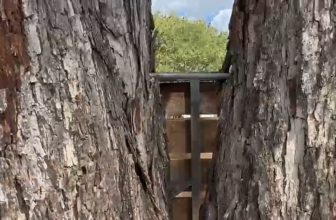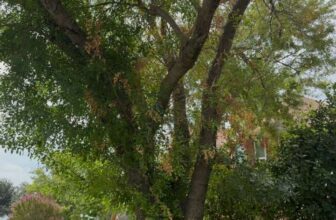
Today we’re here in Euless, Texas, inspecting several mature Savannah Post Oaks (Quercus stellata) that are exhibiting significant physiological stress during the middle of summer. As I walked the property, it became immediately apparent these trees are struggling to maintain normal vascular function. The canopy is beginning to thin, large amounts of foliage are already covering the ground beneath the trees, and throughout the canopy we’re seeing widespread necrotic tissue developing on the remaining leaves.
When a Savannah Post Oak begins dropping leaves during the middle of summer, it should immediately get your attention.
Unlike normal seasonal leaf replacement that occurs during the fall, premature leaf cast during periods of 95 to 100-degree temperatures indicates the tree is under significant physiological stress. Trees do not voluntarily lose healthy leaves unless they are attempting to reduce water demand or they are no longer capable of supporting the canopy.
One of the encouraging aspects of this inspection is that these trees are still alive. The vascular system appears to be functioning, but it is clearly under tremendous pressure. The challenge now is determining why the trees have reached this point and correcting those environmental conditions before permanent damage occurs.
As I continued evaluating the landscape, multiple contributing factors became obvious. None of them by themselves would necessarily explain the decline. However, when combined, they create a cascading series of environmental stresses that continue weakening the tree throughout the growing season.
This is exactly why plant healthcare begins with diagnosis.
If we only treat what we see above ground, we miss the conditions below ground that created the problem.
⸻
Why Savannah Post Oaks Are So Sensitive to Environmental Change
Savannah Post Oaks are among the most beautiful native oak species found throughout North Texas. They evolved on well-drained upland sites where soil oxygen remains available to the root system throughout most of the year.
Because of that adaptation, they perform exceptionally well in soils that drain properly.
However, they do not tolerate dramatic fluctuations between prolonged saturation and prolonged drought.
Their root systems perform best when moisture remains balanced.
When soils remain saturated too long, oxygen levels begin declining.
When those same soils suddenly become extremely dry during periods of intense summer heat, the root system experiences another completely different stress.
This repeated cycle of oversaturation followed by drought creates tremendous physiological pressure on the tree.
That is exactly what we appear to be seeing on this property.
⸻
What I Found During My Inspection
As I evaluated the root zones of these Savannah Post Oaks, several landscape issues immediately became apparent.
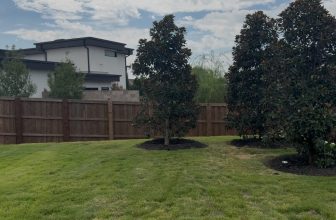
Each tree had been surrounded with black plastic landscape fabric extending across much of the root zone.
Large decorative rock had then been placed directly over the plastic.
While these landscape materials are often installed with good intentions, they can significantly alter the environment surrounding the root system.
The black landscape fabric restricts normal gas exchange between the soil and the atmosphere.
Large rock absorbs tremendous amounts of solar radiation throughout the day.
As temperatures climb into the upper nineties, those rocks become extremely hot.
That heat is transferred directly into the upper soil profile where many feeder roots are actively growing.
Instead of insulating the soil, the rock can actually increase soil temperatures during prolonged summer heat.
The result is additional stress placed on an already compromised root system.
⸻
The Effects of a Wet Spring Followed by Extreme Heat
One of the biggest contributors to this decline appears to be the weather pattern we experienced this year.
North Texas received an unusually wet spring.
Repeated rainfall kept soils saturated for extended periods.
When soils remain saturated, water fills the pore spaces normally occupied by oxygen.
This creates a condition known as root-zone hypoxia.
Roots require oxygen every hour of every day.
Without adequate oxygen, root respiration begins slowing dramatically.
Once the spring rains subsided, temperatures quickly climbed into the mid to upper nineties with occasional days approaching one hundred degrees.
Now the trees faced an entirely different challenge.
Instead of prolonged saturation, they suddenly encountered intense heat and increasing water demand.
This repeated transition from excessive moisture to drought conditions places enormous stress on mature Savannah Post Oaks.
Healthy trees can tolerate occasional environmental changes.
Repeated cycles become much more difficult.
⸻
Root Suffocation and Vascular Shutdown
One of the phrases homeowners often hear me use is vascular shutdown.
What does that actually mean?
The vascular system consists primarily of the xylem and phloem.
The xylem transports water upward from the roots.
The phloem transports carbohydrates produced by the leaves throughout the rest of the tree.
When roots become oxygen deprived during prolonged saturation, their ability to absorb water and nutrients begins declining.
Once drought and extreme heat arrive, the damaged root system cannot adequately support the demands of the canopy.
Water movement slows.
Nutrient uptake declines.
Photosynthesis becomes less efficient.
The tree begins making survival decisions.
One of those decisions is sacrificing foliage.
⸻
Why the Tree Begins Dropping Leaves
Many homeowners become alarmed when they see large quantities of leaves beneath their oak trees during summer.
The tree is not dropping leaves randomly.
It is attempting to survive.
Every leaf requires:
- Water
- Nutrients
- Carbohydrates
- Vascular support
When the root system can no longer support the entire canopy, the tree begins shedding leaves to reduce demand.
By carrying fewer leaves, the tree loses less water through transpiration.
This is an emergency survival response.
Unfortunately, it also creates another problem.
Leaves produce carbohydrates.
Carbohydrates are the tree’s stored energy reserves.
As leaves disappear, carbohydrate production declines.
Now the tree begins consuming stored reserves faster than it can replace them.
If this process continues long enough, those reserves become exhausted.
That is when recovery becomes much more difficult.
⸻
Why Savannah Post Oaks Can Decline So Quickly
Savannah Post Oaks are remarkably resilient under stable environmental conditions.
However, once significant canopy loss begins, recovery becomes increasingly challenging.
Unlike some faster-growing species that readily replace foliage, Savannah Post Oaks often recover much more slowly.
Every leaf lost represents a reduction in photosynthetic capacity.
Every reduction in photosynthesis means fewer carbohydrates are available to maintain:
- Root systems
- Vascular tissues
- Defense mechanisms
- Future growth
This is why early intervention is so important.
The goal is preserving as much healthy canopy as possible before carbohydrate reserves become critically depleted.
Why Seaweed Kelp, Humic Acids, and Carbohydrates Can Help
Once I determined these trees were suffering primarily from environmental stress rather than a primary disease, the treatment plan became focused on supporting the tree’s natural recovery process.
One of the first components of our Plant Healthcare Program is the application of seaweed kelp.
Seaweed extracts contain naturally occurring plant compounds that help improve stress tolerance while encouraging healthier root activity. Rather than forcing excessive growth, seaweed helps the tree respond more efficiently to environmental challenges.
The second component is humic acids.
Humic substances improve soil structure while increasing the soil’s ability to retain nutrients and moisture in a balanced manner. They also stimulate microbial activity within the soil, creating a healthier environment for feeder root development.
Healthy soil produces healthy roots.
Healthy roots support healthy canopies.
The third component is carbohydrate supplementation.
When trees lose large amounts of foliage, they lose part of their food-producing factory.
Photosynthesis slows.
Carbohydrate production declines.
Supplementing carbohydrates helps provide additional energy while the remaining healthy foliage works to rebuild the tree’s natural reserves.
The objective is giving the tree every possible advantage while it recovers from environmental stress.
⸻
Water Management Is Critical
One of the biggest lessons homeowners should take away from this inspection is that irrigation should never remain on the same schedule regardless of weather conditions.
Trees require different management depending upon the season.
Following prolonged drought, irrigation becomes extremely important.
However, if another rainy period develops during the summer, irrigation may need to be reduced or temporarily suspended.
Too much water can be just as damaging as too little.
The goal is maintaining consistent soil moisture without allowing the root system to remain saturated for extended periods.
Proper irrigation management requires observation rather than relying solely on an automatic timer.
Understanding what the weather has already provided is just as important as knowing when additional water is needed.
⸻
Why Heat and Rain Together Can Be So Damaging
Many homeowners assume drought alone is the greatest threat to trees.
Sometimes the combination of rainfall followed by intense heat can be even more stressful.
Following a wet spring, many root systems remain oxygen deficient.
When temperatures suddenly rise into the upper nineties, the canopy begins demanding tremendous amounts of water.
Unfortunately, roots that have already suffered oxygen deprivation cannot always keep pace with those demands.
Now the tree faces two challenges simultaneously.
The roots remain compromised.
The canopy continues demanding water.
That imbalance often results in premature leaf cast, canopy thinning, and vascular decline.
This weather pattern has been especially difficult on Savannah Post Oaks throughout North Texas.
⸻
When Trees Become Postmortem
One of the unfortunate realities of severe environmental stress is that some trees never recover.
As canopy loss continues, carbohydrate reserves eventually become exhausted.
Without carbohydrates, the tree can no longer support:
- Root respiration
- New leaf production
- Defense against pathogens
- Compartmentalization
- Normal vascular function
At that point, the tree enters irreversible decline.
Eventually it becomes postmortem.
Once the tree dies, an entirely different stage begins.
⸻
Hypoxylon Canker — An End-Stage Disease
One of the most misunderstood fungal diseases affecting mature oaks is Hypoxylon canker, caused primarily by Biscogniauxia atropunctata.
Many homeowners believe this fungus killed the tree.
Most of the time, that is not what happened.
Hypoxylon is generally considered an opportunistic pathogen.
It attacks trees that have already become severely weakened.
The drought…
The oversaturation…
The root dysfunction…
The carbohydrate depletion…
Those conditions came first.
The fungus followed.
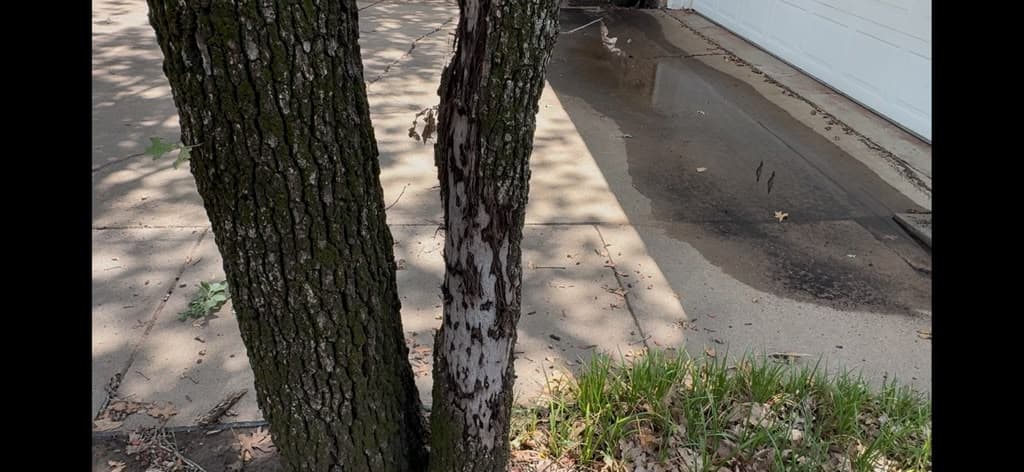
Once the tree becomes postmortem or enters advanced physiological decline, Hypoxylon begins colonizing the sapwood beneath the bark.
Eventually the bark begins separating.
Gray, silver, brown, or black fungal mats become visible.
By the time those fungal mats appear, the tree has usually experienced extensive internal decline.
The fungus is not the beginning of the problem.
It is often the final stage of it.
⸻
Our Plant Healthcare Program
The treatment program for these Savannah Post Oaks focuses on reducing environmental stress while improving the tree’s ability to recover naturally.
Our recommendations include:
- Seaweed kelp applications
- Humic acid soil conditioning
- Carbohydrate supplementation
- Micronutrient applications
- Proper irrigation management
- Seasonal monitoring
- Removing landscape fabric where appropriate
- Reducing excessive rock heat around the root flare
The objective is rebuilding root health while restoring healthy photosynthesis and carbohydrate production.
Plant healthcare is not about one product.
It is about improving the entire environment surrounding the tree.
⸻
Final Thoughts
These Savannah Post Oaks in Euless, Texas are showing exactly how multiple environmental stressors can combine to create significant physiological decline.
The unusually wet spring likely reduced oxygen availability throughout the root system.
That was followed by prolonged summer temperatures approaching one hundred degrees.
Black landscape fabric restricted normal soil gas exchange while decorative rock increased soil temperatures around the root zone.
The trees responded exactly as biology would predict.
They began shutting down portions of the vascular system, shedding leaves, reducing water demand, and consuming stored carbohydrate reserves in an effort to survive.
The encouraging news is these trees are still alive.
With proper irrigation management, improved soil conditions, seaweed kelp, humic acids, carbohydrate supplementation, and continued Plant Healthcare, they still have an opportunity to recover.
At Arborist USA, our goal is not simply treating symptoms.
Our goal is identifying the environmental cause of decline, restoring proper tree physiology, and preserving mature Savannah Post Oaks before stress progresses into irreversible decline and end-stage diseases such as Hypoxylon canker.
For general tree-care best practices, homeowners can also reference guidance from the Texas A&M Forest Service, https://tfsweb.tamu.edu/trees/, a trusted authority on Texas tree health.
Schedule a professional inspection. Early detection and scientific intervention are the difference between preservation and loss. If you’d like to speak to an arborist, please call us at 817-880-6130 or visit https://www.arboristusa.com/
Hello Community, I’m Henry Friar, Arborist with Arborist USA. Today we’re in Euless, Texas inspecting several mature Savannah Post Oaks (Quercus stellata) that are exhibiting significant environmental stress during the middle of summer. At first glance, many homeowners would simply say these trees are “dropping leaves.” But when you slow down and begin evaluating the canopy, the root system, and the surrounding landscape, a much larger story begins to unfold. During this inspection we observed: • Premature leaf cast • Necrotic leaf tissue • Progressive canopy thinning • Evidence of vascular decline • Trees beginning to consume their stored carbohydrate reserves One of the biggest contributing factors appears to be the weather pattern we’ve experienced across North Texas.