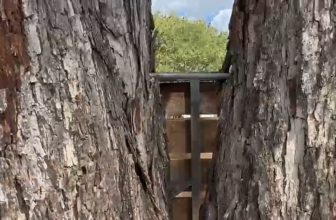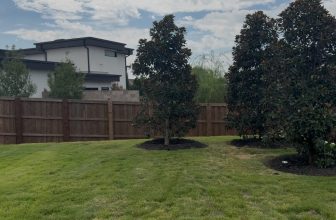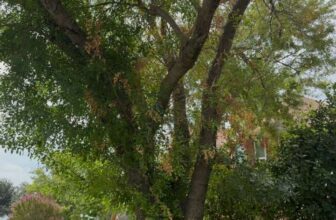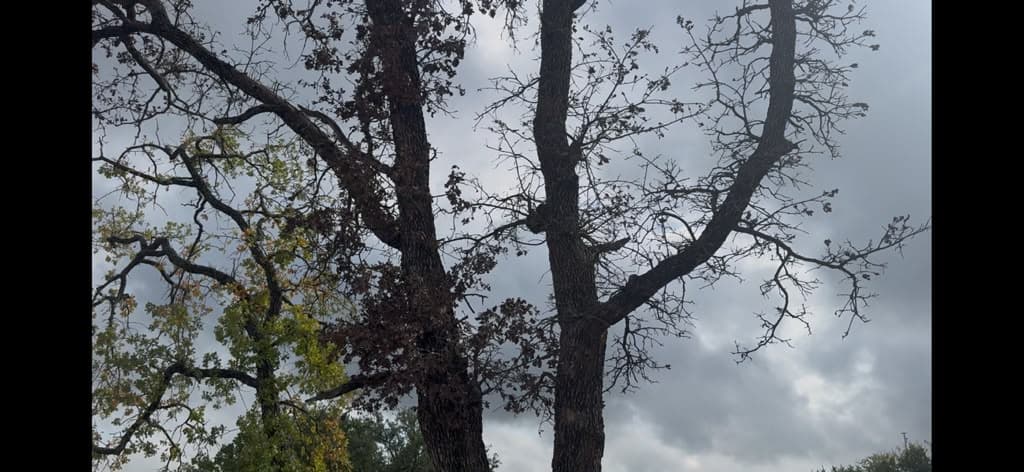
Today we’re here in Weatherford, Texas, inspecting several mature Savannah Post Oaks (Quercus stellata) that are exhibiting significant environmental stress following the construction of a new home. At first glance, many homeowners might assume these trees are simply reacting to the summer heat. However, after a thorough inspection of the property, it became obvious that the decline we’re seeing today is not the result of one single event.
Instead, these trees are experiencing what arborists refer to as a cascade of stress events.
Each individual stressor may not have been enough to seriously injure the trees by itself. But when multiple stress factors occur simultaneously, they begin compounding one another until the tree’s natural defense systems can no longer keep up.
That is exactly what we found on this property.
The Savannah Post Oaks are showing premature leaf drop, thinning canopies, necrotic foliage, and declining vigor during the hottest portion of the Texas summer. Temperatures have been ranging from the mid-90s to well above 100 degrees, placing tremendous water demand on the canopy while the root system is simultaneously struggling beneath the soil.
When I begin diagnosing declining Post Oaks, I rarely look for only one problem.
I look for every stress factor that may be contributing to the decline.
On this property, we identified several.
New home construction.
Soil compaction.
Herbicide exposure.
Over-fertilization of the surrounding lawn.
Excessive nitrogen applications.
High summer temperatures.
Each one of these factors has contributed to weakening the tree’s overall health.
Our goal now is stopping the cascade before the tree reaches a point where recovery becomes extremely difficult.
⸻
Savannah Post Oaks Are Built for Stable Environments
Savannah Post Oaks are native trees that evolved under very different conditions than what many suburban landscapes provide today.
They naturally thrive in well-drained soils with excellent oxygen exchange and relatively low fertility.
Unlike many ornamental landscape trees, Post Oaks do not require heavy fertilization to remain healthy.
In fact, excessive fertilization can sometimes create additional stress rather than improving tree health.
These trees evolved slowly.
They are conservative growers.
Their biology favors long-term stability over rapid growth.
When we dramatically change their environment through construction, irrigation changes, herbicides, and lawn fertilization, the tree must suddenly adapt to conditions it was never designed to tolerate.
⸻
Construction Changes Everything Beneath the Soil
One of the first things I noticed during this inspection was evidence of recent construction activity throughout the property.
Whenever a new home is built, much of the unseen damage occurs below ground.
Heavy equipment repeatedly travels across the root zone.
Building materials are staged beneath trees.
Construction traffic compresses soil.
Grade elevations change.
Drainage patterns change.
None of those changes are immediately visible within the canopy.
Instead, the injury begins beneath the surface.
Healthy soil contains thousands of interconnected pore spaces that allow oxygen, water, and beneficial microorganisms to move freely around the roots.
Construction traffic compresses those pore spaces.
Once that occurs, oxygen movement slows dramatically.
Root growth becomes restricted.
Water infiltration changes.
The tree begins operating under chronic stress long before homeowners notice the first leaf beginning to turn brown.
⸻
Soil Compaction and Root Suffocation
One of the greatest long-term consequences of construction is soil compaction.
Roots require oxygen every hour of every day.
Without oxygen, they cannot perform cellular respiration.
Respiration provides the energy necessary for:
- Water absorption
- Nutrient uptake
- Root elongation
- Cell division
- Defense against stress
When compacted soils restrict oxygen movement, roots begin losing their ability to function normally.
This condition is known as root-zone hypoxia.
Although the tree may continue appearing relatively healthy for months or even years, the decline has already begun beneath the soil.
As temperatures rise during summer, the compromised root system struggles to keep pace with the increasing demands of the canopy.
⸻
High Summer Temperatures Magnify Every Other Problem
One of the reasons these trees are declining so rapidly is because every environmental stress becomes magnified during prolonged periods of extreme heat.
When temperatures climb above 95 to 100 degrees, transpiration increases dramatically.
Leaves begin losing tremendous amounts of moisture.
Healthy roots normally replace that moisture continuously.
However, roots already weakened by construction, compaction, and environmental stress cannot always meet that demand.
The tree begins entering survival mode.
One of the first visible responses is premature leaf cast.
Rather than attempting to support the entire canopy, the tree begins shedding foliage in order to reduce water demand.
Although this response helps the tree survive temporarily, it creates another significant problem.
Every leaf that falls reduces the tree’s ability to perform photosynthesis.
Photosynthesis produces carbohydrates.
Carbohydrates fuel every biological process inside the tree.
Without carbohydrates, recovery becomes increasingly difficult.
⸻
Herbicide Injury Adds Another Layer of Stress
During my inspection, another possible contributing factor became apparent.
The surrounding turf has been maintained aggressively, and herbicide applications appear to have been part of the overall lawn management program.
When herbicides are improperly applied around mature trees, they can create unintended stress.
Some products may be absorbed through roots growing beneath treated turf.
Others may contact exposed feeder roots or drift onto low foliage.
Even when exposure is not severe enough to kill the tree outright, repeated herbicide stress forces the tree to redirect energy toward detoxification and recovery rather than producing healthy new growth.
This becomes especially significant when the tree is already attempting to recover from construction injury and extreme heat.
Instead of dealing with one stress factor…
The tree is now attempting to respond to several simultaneously.
Why Excessive Lawn Fertilization Can Stress Native Oaks
Another major contributor we identified on this property is excessive lawn fertilization.
Modern turfgrass programs often rely on relatively high nitrogen applications to maintain a dark green lawn throughout the growing season.
While that may benefit turfgrass, Savannah Post Oaks evolved in soils that are naturally much lower in fertility.
Applying excessive nitrogen throughout the root zone changes the entire soil environment.
Instead of supporting the tree, excessive nitrogen may stimulate lush turf growth that competes directly with the tree for:
- Water
- Oxygen
- Nutrients
- Rooting space
The grass becomes more aggressive while the tree continues declining.
This creates another imbalance within the landscape.
The objective should never be maximizing lawn growth at the expense of mature native trees.
Healthy trees and healthy turf require different management strategies.
⸻
Why Turfgrass Creates Additional Competition
One of the biggest mistakes we continue seeing throughout North Texas is allowing turfgrass to grow directly against the root flare.
Grass is one of the strongest competitors a mature tree has.
It continuously competes for:
- Moisture
- Mineral nutrients
- Oxygen
- Biological activity
At the same time, maintaining dense turf requires frequent irrigation.
Savannah Post Oaks generally perform best under a completely different moisture cycle than the surrounding lawn.
As irrigation frequency increases to satisfy the turf, the root flare often remains wetter than nature intended.
This places additional stress on an already compromised root system.
For these trees, I recommended creating a large mulch ring extending several feet beyond the trunk wherever practical.
Approximately three inches of hardwood mulch helps:
- Moderate soil temperature
- Improve soil biology
- Reduce evaporation
- Increase oxygen exchange
- Eliminate grass competition
Healthy root systems begin with healthy soil.
⸻
How the Cascade of Stress Continues
One of the concepts I often explain to homeowners is the cascade effect.
Tree decline rarely occurs because of one isolated problem.
Instead, several stress factors begin working together.
On this property the sequence appears to have developed like this:
- Construction disturbed the root zone.
- Heavy equipment compacted the soil.
- Oxygen availability declined.
- Irrigation increased to establish new landscaping.
- Turfgrass began competing with the trees.
- Herbicide applications introduced additional physiological stress.
- High nitrogen fertilizer promoted aggressive turf growth.
- Summer temperatures climbed above 100°F.
- Root systems could no longer support the canopy.
Each event made the next problem even worse.
Eventually the tree reached a point where the vascular system could no longer efficiently move water throughout the canopy.
Premature leaf cast followed.
Necrotic tissue developed.
Carbohydrate production declined.
This is exactly why diagnosing only one problem rarely solves the entire issue.
⸻
Why Carbohydrates Become So Important
As foliage begins disappearing, the tree immediately loses photosynthetic capacity.
Leaves manufacture carbohydrates.
Carbohydrates become the energy source that powers every living cell inside the tree.
The tree depends upon those reserves for:
- Root regeneration
- New foliage production
- Defense against disease
- Wound compartmentalization
- Environmental stress recovery
As leaves continue falling, stored carbohydrate reserves begin replacing the energy no longer produced through photosynthesis.
If stress continues long enough, those reserves eventually become exhausted.
Once carbohydrate depletion reaches a critical point, recovery becomes dramatically more difficult.
That is why our treatment program includes carbohydrate supplementation along with correcting the environmental conditions that created the stress.
⸻
Our Plant Healthcare Program
Following my inspection, I recommended a comprehensive Plant Healthcare Program designed to reduce stress while rebuilding tree vigor.
Our recommendations include:
- Seaweed kelp applications
- Humic acid soil conditioning
- Carbohydrate supplementation
- Comprehensive micronutrient applications
- Integrated Pest Management (IPM)
- Root-zone monitoring
- Irrigation adjustments
- Removing turf from around the root flare
- Installing a broad hardwood mulch ring
- Long-term monitoring throughout the growing season
The objective is restoring healthy root function while allowing the tree to gradually rebuild canopy density and carbohydrate reserves.
Plant healthcare is not about forcing rapid growth.
It is about restoring balance.
⸻
Hypoxylon Canker — An End-Stage Indicator
If these environmental problems remain uncorrected long enough, Savannah Post Oaks often enter a final stage of decline where opportunistic fungi begin colonizing weakened wood.
One of the most common is Hypoxylon canker, primarily associated with Biscogniauxia atropunctata.
Many homeowners believe Hypoxylon killed the tree.
Most of the time, that is not what happened.
The sequence usually looks like this:
- Construction stress
- Soil compaction
- Root-zone hypoxia
- Herbicide stress
- Excessive fertilization
- Heat stress
- Carbohydrate depletion
- Vascular decline
- Tree mortality
- Hypoxylon colonization
The fungus is generally not the original problem.
It is often the final indication that the tree’s natural defense system has completely failed.
By the time fungal mats appear beneath sloughing bark, the tree has usually suffered extensive internal decline.
That is why early intervention is absolutely critical.
⸻
Final Thoughts
These Savannah Post Oaks in Weatherford, Texas demonstrate how modern landscape practices can unintentionally place tremendous stress on mature native trees.
Construction altered the root environment.
Compacted soil reduced oxygen.
Herbicide exposure added physiological stress.
High-nitrogen lawn fertilization changed the soil ecosystem.
Frequent irrigation increased root-zone saturation.
Extreme summer temperatures intensified every one of those problems.
Together, they created a cascade of environmental events that reduced canopy density, slowed vascular function, depleted carbohydrate reserves, and placed these beautiful native oaks at significant risk.
At Arborist USA, our focus is identifying those stress factors before they become irreversible.
By improving soil conditions, reducing competition from turfgrass, managing irrigation properly, restoring healthy soil biology, and implementing science-based Plant Healthcare Programs, many mature Savannah Post Oaks can recover and continue thriving for decades.
Healthy roots produce healthy canopies.
Healthy canopies produce healthy carbohydrates.
Healthy carbohydrates build healthy trees.
For general tree-care best practices, homeowners can also reference guidance from the Texas A&M Forest Service, https://tfsweb.tamu.edu/trees/, a trusted authority on Texas tree health.
Schedule a professional inspection. Early detection and scientific intervention are the difference between preservation and loss. If you’d like to speak to an arborist, please call us at 817-880-6130 or visit https://www.arboristusa.com/
Today we’re in Weatherford, Texas inspecting mature Savannah Post Oaks (Quercus stellata) that are experiencing severe environmental stress following new home construction. Many homeowners believe one issue causes tree decline. In reality, it’s often a cascade of environmental events that slowly overwhelms the tree. On this property we identified several major stress factors: • Construction-related soil compaction • Herbicide exposure around the landscape • Excessive lawn fertilization with high nitrogen • Turfgrass growing against the root flare • Chronic oversaturation followed by extreme summer heat exceeding 100°F Together, these conditions have created root-zone hypoxia, reducing oxygen availability and causing the roots to slowly lose their ability to absorb water and nutrients.