

Micco homeowners should expect an annual premium around $4,558 for a standard HO-3 policy in 2026, with about 35% of homes sitting in significant flood zones. Coastal coverage works best when you treat it as two layers, wind and hurricane risk under the homeowners form, and flood under a separate policy.
That’s the reality on the ground for anyone living near the water in Micco. You are not shopping for one neat, all-in policy. You are balancing how the carrier prices the house against storm wind, storm surge, and flood exposure, then making sure the contract pays the right claim after a named storm.
Table of Contents
Why Coastal Home Insurance in Micco Is a Two-Layer Problem
Micco homeowners face a two-layer insurance structure that separates wind and flood coverage. A hurricane can rip shingles off, break windows, and push water into the house in the same night, but the policy does not treat every part of that loss the same way. Wind belongs under the homeowners policy. Flood belongs under a separate flood policy.
What that means when the storm hits
A coastal policy is priced around where the house sits, what it faces, and how much loss the carrier expects to pay. In Micco, the market summary points to an average annual homeowners premium of $4,558 for a standard HO-3, with quotes ranging from $2,968 to $7,950 depending on dwelling value, deductible, and risk factors, and a cost index of 1.06, which means prices run about 6% above the national benchmark. That same summary says about 35% of homes are in significant flood zones Micco market summary.
That is why I tell homeowners to stop asking, “What does my policy cost?” and start asking, “Which policy pays for which part of the loss?” If wind opens the roof, that claim follows one track. If storm surge pushes water into the home, that loss follows another. The homeowners carrier and the flood insurer are separate contracts, and one will not fix the other’s language problem.
Practical rule: If you cannot explain which policy pays wind and which policy pays water, you do not know what you bought.
Why the premium feels high before you even file a claim
Micco sits inside a coastal property-insurance market that has been tightening for years. A 2024 policy analysis found property insurance prices rose by an average of 21% since 2015, with increases of more than 50% in Florida Environmental and Energy Study Institute analysis. That broader coastal pressure matters because carriers are pricing repeated weather losses against a concentrated group of homes exposed to the same storm patterns.
If your renewal looks steep, do not assume the carrier picked your address at random. Coastal underwriting separates houses that are easier to defend from houses that are harder to protect. In Micco, that separation starts with wind and flood, then tightens once the carrier reviews the roof, the elevation, and the distance to water.
The Risk Factors That Price a Micco Coastal Policy
A Micco quote is not built from square footage alone. The carrier stacks risk factor after risk factor, then prices the home based on how those risks work together. If you want to understand your premium, you need to look at the actual drivers, not the polished language on the declarations page.
The four factors that drive the number
The first factor is hurricane wind exposure. Homes close to open water get a harder underwriting look because the wind load is stronger and the odds of a roof or opening-loss claim go up. The second is storm-surge proximity, because the closer a home sits to vulnerable water pathways, the more the carrier expects a combined wind-and-water event.
The third is flood-zone designation. Micco’s flood exposure is not theoretical. The Micco market summary says about 35% of homes sit in significant flood zones. The fourth is roof and structure age, because older roofs, weaker connections, and worn openings make the claim picture worse after a storm.
A home two miles inland in Sebastian can quote differently from one near the Indian River Lagoon because the carrier is not pricing geography as a label. It is pricing how the structure is likely to perform in a storm. That is the part many homeowners miss. The premium is a forecast of loss, not a reward for liking the neighborhood.
The market pressure behind the quote
The wider coastal-insurance market has been under strain for years. According to the Insurance Information Institute coastal insurance data, coastal homes along the Gulf and Atlantic face repeated storm-surge and wind exposure, and the concentration of property value in those areas keeps pressure on pricing Insurance Information Institute coastal insurance data.
That is the underwriting backdrop. Insurers know the losses show up often, and they know the value at risk along the coast is enormous. So Micco homeowners should expect quotes to reflect both the local coastline and the broader Florida market. The useful move is not to argue with the pricing formula. It is to shape the profile the carrier sees.
Strong recommendation: If your roof is older, your flood exposure is real, or your opening protection is weak, assume the first quote will be conservative and work backward from there.
If you are serious about lowering the wind side of the quote, start with storm protection from Breaking Glass Co. and any other mitigation that strengthens the structure before you shop carriers.

What a Florida Homeowners Policy Actually Covers in Micco
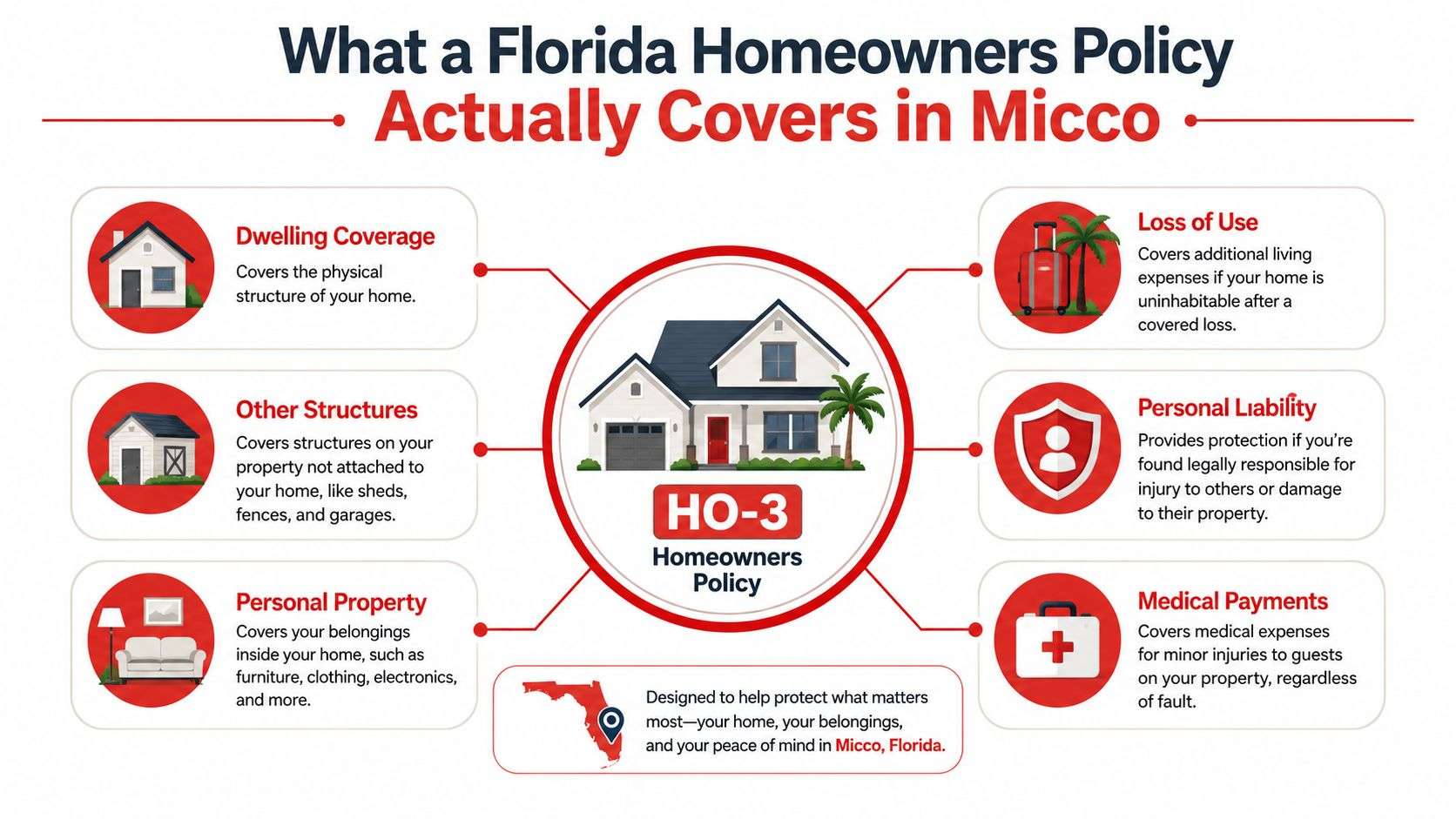
The HO-3 is the core homeowners form most Micco owners start with, but too many people only look at the premium and ignore the parts that matter after a loss. The policy is built around coverage pieces, and each one behaves differently when a storm tears through coastal Florida.
The parts that matter most
Dwelling coverage pays for the physical structure of the home. That limit has to reflect what it would cost to rebuild, not what the home would sell for on a good day. If the limit is low, the carrier can pay exactly what the contract allows and still leave you short.
Other structures covers detached items like a separate garage, fence, or shed, if the policy includes them. Personal property protects furniture, clothes, appliances, and other contents. The valuation method matters here. Replacement cost is what you want on belongings whenever the policy allows it, because actual cash value can leave you eating the depreciation.
The coverage people forget until they need it
Loss of use matters when the home is unlivable and the family has to relocate. In a coastal claim, that can last longer than people expect because drying, repair sequencing, and material delays stretch the timeline. Personal liability protects you if someone is injured and claims you’re responsible. Medical payments can handle smaller injury claims without forcing a liability fight.
Schneider and Associates’ Micco-area guidance for manufactured-home coverage puts the review points plainly, and they’re the same ones I want every Florida coastal homeowner to check, whether the home is manufactured or site-built. You need to ask whether the dwelling limit is realistic, whether belongings are on replacement cost or actual cash value, whether the liability limit fits your assets, and whether loss-of-use is enough for a long displacement Florida coastal coverage review points.
If you only read one page of your policy, read the declarations page and the form language around valuation. That’s where the important details are hiding.
What to ask before renewal
- Dwelling limit: Does it match rebuild cost, or did it just follow market value up and down?
- Contents valuation: Are your belongings protected on replacement cost, or is depreciation baked in?
- Liability limit: Would this make sense if a guest injury or property dispute turned serious?
- Loss of use: Could you stay somewhere else long enough if the home needs major work?
For homeowners who want a plain-language refresher on structural protection and glazing choices, the resource on storm protection from Breaking Glass Co. is a useful starting point for understanding how openings and barrier protection fit into the bigger risk picture.

Windstorm Coverage and Flood Insurance Side by Side
Most homeowners get tripped up here. They think a hurricane is one event, so one policy should handle it. That’s not how the claim file gets built. Wind and water are handled separately, and after a named storm the adjuster’s job is to sort out which part of the damage came from each cause.
| Coverage Layer | Wind / Hurricane | Flood / Storm Surge |
|---|---|---|
| Trigger | Wind-driven damage to the home, like roof loss, broken openings, or siding damage | Rising water, surge, or inundation from outside the structure |
| Policy Type | Homeowners form | Separate flood policy |
| Claim Question | What did wind damage first, and how far did that damage extend? | What damage came from water intrusion and inundation? |
| Deductible Style | Often percentage-based on the dwelling limit | Typically a flat policy deductible |
| Common Dispute | Whether the damage started with wind or water | Whether the loss is excluded because it’s actually wind-related |
The technical split matters because a hurricane claim can involve both wind damage to the structure and flood damage to the same home. Those are different losses, handled under different forms, with different deductibles and different causation arguments. Florida-focused guidance for Micco specifically says homeowners should review the dwelling limit, the hurricane-deductible wording, any written wind waiver, and whether the flood policy is in force before a storm Micco windstorm and hurricane coverage guidance.
How the claim is split in practice
If wind opens the roof and water later enters through that opening, the insurer and the flood carrier may both care about timing and sequence. If storm surge moves into the house from outside, that’s a flood issue. If the same storm also tears a window out, the wind claim sits in a separate lane. The homeowner’s job is to document the damage early and keep the sequence straight.
Bottom line: The cheapest premium is not the smartest buy if the wind-versus-water language is fuzzy. Clarity pays after a combined event.
This is why I don’t like vague coverage summaries. They let people think they’ve solved the problem when they’ve only bought a label. In Micco, you need the policy that tells you, in plain terms, what happens when wind and water show up together.
Deductibles, Mitigation, and Discounts That Change Your Quote
A coastal policy gets expensive fast when the deductible and the home’s mitigation profile are weak. That’s why I look at the structure before I look at the premium. A lower quote with bad deductible language is a trap, not a deal.
How the deductible really works
A hurricane deductible is usually a percentage of the dwelling limit, not a flat number. That means a 2%, 5%, or 10% deductible lands very differently depending on how much the home is insured for. If you raise it, the premium usually drops, but you also raise the amount you’ll pay out of pocket after a storm.
The rule is simple. You can buy down annual cost by accepting more claim pain later. That can be smart on a strong, well-mitigated house. It can be reckless on an older coastal property that already has a long repair list. The right answer depends on the home’s condition, not on what sounds cheaper at renewal.
What helps a Micco quote
Mitigation matters because carriers reward structures that can survive a storm better. In Florida, the features that usually matter most are hip roof design, impact-resistant openings, secondary water barrier protection, reinforced garage doors, and proper roof-to-wall connections. Those features help because they reduce the chance of major wind loss and make the structure easier to underwrite.
Documentation matters just as much. Before renewal, get the paperwork in order. A wind mitigation inspection, an elevation certificate, and a four-point inspection can all affect how the carrier views the risk, especially on older or coastal-risk homes.
Micco homeowners who need a practical checklist for premium control can also use how to lower homeowners insurance premiums as a planning resource, but the savings come from the condition of the home and the way the policy is written.
Where carrier appetite comes into play
Not every carrier wants the same coastal profile. Some will like a newer roof and strong mitigation. Others will not. If a property starts getting harder to place, Florida’s insurer-of-last-resort structure becomes part of the conversation, which is why coverage access is as important as price. The smartest move is to prepare the file before renewal, not after a non-renewal lands in the mailbox.

Steps to Evaluate and Bind the Right Micco Coastal Policy
Start with the home, not the quote. If you’re missing the facts the carrier needs, you’re going to compare bad numbers against worse numbers. I want the file built before the agent starts shopping, because that’s how you get apples-to-apples quotes instead of a mess of half-assumed pricing.
Build the file before you shop
Pull the elevation certificate if you have one. If you don’t, get clarity on where the home sits relative to flood exposure. Gather roof-age details and current construction photos, including openings, garage doors, and any mitigation features. If the home has been updated, photograph those updates clearly so the underwriter sees the condition, not just the year built.
Then ask for quotes with the same dwelling limit, the same deductible structure, and the same valuation method. If one quote uses a cheaper deductible or weaker contents coverage, it’s not cheaper. It’s just thinner.
Read the declarations page like a claim file
The declarations page should tell you the limits, the deductible, and the basic structure of the policy. The form language tells you more. That’s where you find the wording that matters when wind and water both show up. If the policy language is vague, don’t assume the claims team will be generous later.
For a plain-language guide to reading policy language, the article on decoding insurance coverages for restoration is a useful outside reference for understanding how coverage terms get translated into real-world handling.
Keep a hurricane-ready checklist on hand
- Photo inventory: Keep current interior and exterior photos off-site.
- Document storage: Save policy pages, inspection reports, and receipts in a cloud folder and a paper file.
- Claims contact: Know the carrier hotline before the storm, not after.
- Evacuation plan: Decide where you go if the home can’t be occupied.
- Pre-storm walkthrough: Check openings, yard items, and shutoff points about 72 hours before landfall.
If you wait until the first storm watch, you’re already behind. Bind the policy when the file is complete, not when the forecast gets ugly.
Why a Florida-Only Independent Agent Changes the Outcome
Micco is not a market where a one-size-fits-all sales script works. Carrier appetite changes, roof age gets scrutinized, and some homes are harder to place than others. That’s exactly where a Florida-only independent agency earns its keep, because it can shop multiple admitted carriers and specialty options instead of forcing you into a single channel.
Why access matters more than a slick quote page
A direct or call-center quote can look simple and still miss the core issue, which is whether the carrier wants the risk. An independent agent can compare options across multiple Florida-admitted carriers and match the structure of the policy to the house, not just the address. That matters in coastal Micco, where flood exposure, wind exposure, and roof condition can push the file in different directions.
If you’re trying to understand how an independent agency works in a market like this, the overview at what is an independent insurance agency is worth reading before you make a final decision.
What changes after the bind date
The value shows up after a storm. A Florida-only independent agency can help you keep the paperwork organized, track the policy form, and get the claim started with the right documents in hand. That’s not a luxury in coastal Florida. It’s the difference between clean file handling and a long, frustrating back-and-forth.
Schneider and Associates Insurance Agencies is a Florida family-owned independent agency, and it’s one option for homeowners who want local placement help with coastal coverage, flood, and claim support in the same state they live in. That kind of Florida-only setup fits Micco because it keeps the conversation grounded in coastal risk instead of generic national assumptions.
The carrier doesn’t care how much you liked the quote email. It cares about the structure, the paperwork, and the exposure. An independent agency helps line those up.
Micco Coastal Home Insurance FAQ and Final Checklist
Do you need flood insurance if you’re outside an official flood zone? Yes, if you live on the coast and can’t afford to self-insure a surge loss. Flood and homeowners coverage are separate, and that separation matters even more in Micco.
How often should you revisit the dwelling limit? At every renewal if you’ve renovated, had a roof change, or seen construction costs move against you. A stale dwelling limit is one of the fastest ways to end up underinsured.
What should you do if you get a non-renewal? Start shopping immediately, gather your inspections, and document mitigation. Don’t wait for the last week before the effective date.
How fast should you contact your agent after a loss? Right away. Early notice helps get the claim file started, preserve documentation, and avoid preventable delays.
Your final checklist is simple. Confirm the home is insured for the right rebuild amount, make sure wind and flood are both addressed, keep mitigation records ready, and know exactly which policy pays for which part of the storm. That’s the Micco model.


