Post 4861
Attorney Argument Without Evidence at Sentencing is Ineffective
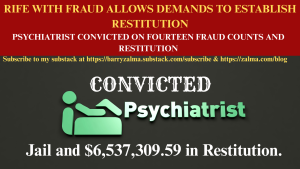
 In United States v. Gustavo Kinrys, Nos. 24-1592, 24-1716, United States Court of Appeals, First Circuit (September 21, 2026) Gustavo Kinrys, a Massachusetts psychiatrist, submitted fraudulent claims to private and public health insurers between 2015 and 2018, including claims for sessions that could not have occurred because he or the purported patient was abroad.
When insurers sought supporting records, he delayed, invoked a fictitious office manager, and created false documentation. A jury convicted him on fourteen of fifteen counts. The district court imposed a ninety-nine-month sentence, calculated intended loss at slightly more than $19 million using the face value of the bills, and ordered $6,537,309.59 in restitution.
LAW
Under U.S.S.G. § 2B1.1, loss is the greater of actual or intended loss, and intended loss turns on the pecuniary harm the defendant purposely sought to inflict.
When a scheme is rife with fraud, the billed amount may serve as prima facie evidence of intended loss; the defendant may rebut that figure with evidence of a lower subjective intent, although the government retains the ultimate burden of proof.
Under the Mandatory Victims Restitution Act, restitution compensates victims for actual losses caused by fraud, makes them whole, and may not provide a windfall. The government bears the burden to prove that a sentencing enhancement applies by a preponderance of the evidence.
In cases like this one, where the defendant’s scheme was “rife with fraud,” courts may calculate intended loss using a burden-shifting. That approach permits a sentencing court to use the billed amount as prima facie evidence of intended loss. The burden then shifts to the defendant, who may “rebut” the face value of the bills by proffering evidence establishing that he intended to reap some lesser amount.
Once both parties have put forth their competing loss amounts and the record is fully formed, the district court must make a “reasonable estimate of the loss,” bearing in mind that the government retains the ultimate burden of proving the applicability of the enhancement. The court determines reasonable loss based on the defendant’s subjective intent, that is, the “pecuniary harm that the defendant purposely sought to inflict
DISCUSSION
Kinrys argued that intended loss should have been limited to approximately $8.3 million — the reimbursement he expected under in-network contracts — rather than the amount billed, which would have reduced the sentencing enhancement. He also argued that restitution should be offset by separate, allegedly legitimate claims that insurers had not paid. The government relied on the fraudulent bills, Kinrys’s later civil suits seeking billed charges, and evidence that he kept payments exceeding contract rates.
ANALYSIS
The First Circuit found no clear error in using the billed amount.
Although Kinrys’s in-network status supported a plausible inference that he expected only contract rates, other evidence supported the district court’s finding that he intended to obtain as much as possible: he sued insurers for billed charges, sought damages exceeding those charges, and retained full billed payments when received.
He offered attorney argument rather than contrary evidence at sentencing. The restitution challenge also failed because the order included only fraudulent claims, while the proposed offsets involved distinct, contested reimbursement claims.
CONCLUSION
The First Circuit affirmed both the intended-loss calculation and the restitution order.
Billing the government for psychiatric care to the poor or elderly when Kinrys was on holiday in other countries where he claimed to give care was criminal and evil. He then tried to reduce his sentence and restitution by claiming his bills were never paid as presented but were reduced by the insurer. He will serve the full sentence and pay the full amount of restitution.

(c) 2026 Barry Zalma & ClaimSchool, Inc.
Please tell your friends and colleagues about this blog and the videos and let them subscribe to the blog and the videos.
Subscribe to my substack at https://barryzalma.substack.com/subscribe
Go to X @bzalma; Go to Barry Zalma videos at Rumble.com at https://rumble.com/account/content?type=all; Go to Barry Zalma on YouTube- https://www.youtube.com/channel/UCysiZklEtxZsSF9DfC0Expg; Go to the Insurance Claims Library – https://lnkd.in/gwEYk.