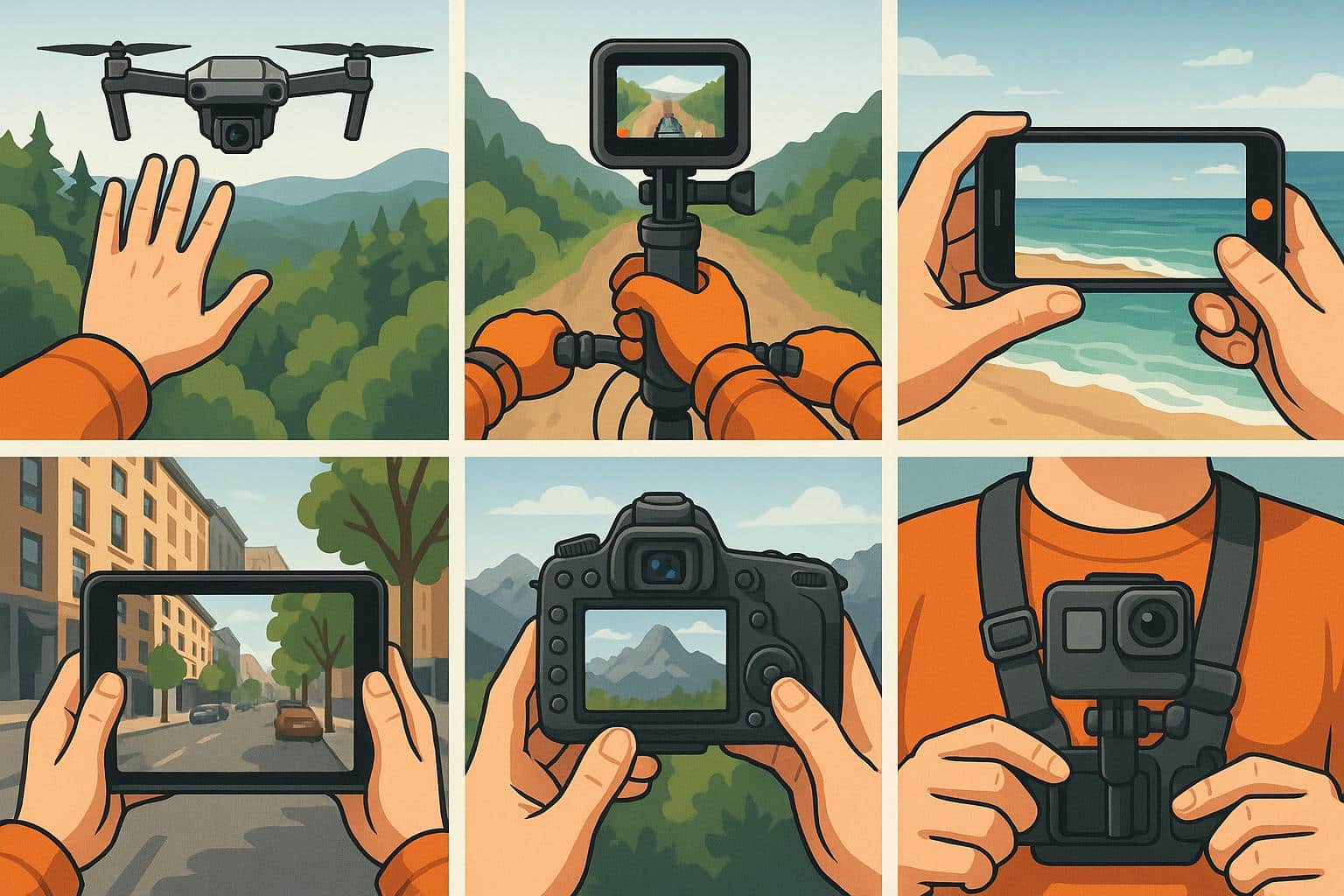
First-person content is no longer a niche type of video. You see it everywhere now, from TikTok and Instagram to YouTube. The POV hashtag alone has passed 732 billion views on TikTok. Data from 2025 also showed a 42% increase in audience retention for first-person videos compared with more traditional formats.
There is a good reason for that. When you see something from the creator’s point of view, it can feel like you are there with them. The footage feels less staged and often more personal. But getting that kind of footage is not always easy. Nobody wants to stop every few minutes to move a camera or check whether the shot looks right. Luckily, creators now have quite a few ways to record from their own perspective.
Smart Glasses With a Built-In Camera
Glasses with a built-in camera are one of the simplest ways to get a first-person shot without holding a camera. You wear them like regular glasses, and the camera records from around eye level. So when you turn your head or look at something, that is what the camera sees too.
It makes a bigger difference than you might expect. Phone footage often means stopping, holding the phone up, and thinking about the shot. With glasses, that extra step is gone.
Some creators discover this almost by accident. They might wear Meta glasses with recording features during a day out and later look through the footage. What they get is often quite different from something they would have filmed on purpose. Small moments are there. Conversations, surroundings, and little details that might otherwise have been missed.
That is also part of what makes first-person content interesting. It does not always look perfect, but it can feel much closer to the actual experience. Research from the Pew Research Center on personal media and documentation habits also highlights how people use personal media to document and share parts of their everyday lives.
Chest-Mounted Action Cameras
Chest mounts have been around for a long time, and there is a reason creators still use them. They are simple. Strap the camera on, start recording, and get on with whatever you are doing.
They work especially well for outdoor creators and sports content. A chest-mounted camera can record for a long time without needing much attention. It also gives you a wider view of what is happening around you.
The perspective is different from glasses, though. The camera sits lower, so you see more of the person’s surroundings and less of exactly what they are looking at. That can actually work well for hiking, cycling, or other outdoor videos.
Comfort is the main thing to watch. A good chest harness is easy to forget after a while. A badly adjusted one can become annoying pretty quickly. It is worth spending a few minutes getting it right before starting a long recording session.
Head-Mounted Action Cameras
Head-mounted and helmet cameras give you a view that is much closer to the creator’s actual line of sight. They have become especially common in sports such as skiing, surfing, mountain biking, motocross, and climbing.
For these activities, the setup makes sense. The camera stays with you, even when things get fast or unpredictable. It can also handle conditions that would be difficult for a phone or other camera.
The downside becomes more noticeable outside of sports. A camera attached to a helmet or head strap looks like recording equipment. People around you can see it, and the footage can feel more deliberately filmed as a result.
That is not necessarily a problem. For sports content, it may be exactly what the creator wants. For travel or everyday videos, though, a less noticeable setup can feel more natural.
Phone Mounts and Rigs for Static First-Person Shots
Not every first-person video needs a camera that moves with you. Sometimes the creator is sitting at a desk, cooking in the kitchen, or working on a project. In those cases, a phone mount can do the job perfectly well.
Small tripods and clamps are particularly useful here. They can be attached to a desk, shelf, or kitchen counter and positioned at roughly face level. Once the phone is in place, the creator can focus on the activity instead of the camera.
There is one obvious limitation. The phone stays where you put it. If you walk into another room, it cannot follow you.
For tutorials, cooking videos, demonstrations, and similar content, that is usually not an issue. A fixed camera can actually make these videos easier to shoot because the setup stays the same from beginning to end.
Wrist and Forearm Cameras
Wrist and forearm cameras offer a slightly different take on first-person filming. Instead of showing what the creator is looking at, they show what the creator is doing with their hands.
That makes them useful for things like cooking, crafting, repairing equipment, or working with tools. The viewer gets to see the action up close, rather than watching it from across the room.
This can make the footage feel surprisingly personal. You see the hands move, pick things up, make adjustments, and work through a task.
The small size of these cameras is useful, but it can also mean shorter battery life. For a longer recording session, it helps to plan when you will need to recharge rather than finding out halfway through that the battery is nearly empty.
Screen Recording as First-Person Content
Screen recording is easy to forget when people talk about first-person content. But for creators who make gaming videos, tutorials, tech content, or productivity guides, it can be one of the easiest options.
The idea is simple. Record the screen while you work, play, or demonstrate something, then add your voice over it. The viewer sees exactly what you are seeing.
That can be much more useful than a polished video when the goal is to teach someone how to do something. They can follow each click and step instead of trying to work out what happened after the fact.
According to the Creator Economy Report 2026 published by the Influencer Marketing Factory, short-form video continues to perform strongly across platforms such as YouTube Shorts, Instagram Reels, and TikTok. The report found that Reels volume increased by 3.8% year over year, while static content declined by 6.41%.
For screen-based creators, though, simply making a short video is not enough. The recording still needs to be clear, and the explanation needs to make sense. A good screen recording with straightforward narration can be far more useful than something packed with effects.
Conclusion
The best first-person setup depends on what you are actually filming. There is no need to use the same camera for everything.
Smart glasses can work well when you want to capture a day as it happens. Chest and head mounts make more sense for sports and outdoor activities. A phone mount is often enough for a cooking video or tutorial. Wrist cameras are useful when the hands are the main focus, while screen recording is a natural choice for digital content.
The important part is choosing something that does not get in the way. If the camera makes you stop and think about filming every few minutes, it can take you out of the moment. The right setup should let you concentrate on what you are doing and leave the recording to take care of itself.