One of the significant mistakes in business, which can be pretty expensive, is confusing strategy with tactics or, even worse, conflating grand strategy with strategy.
As I’ve highlighted in grand strategy, there’s a core difference as we move from grand strategy to tactics.
-
Grand Strategy = Territory (Structural/Contextual)
-
Strategy = Map (Navigational/Directional)
-
Tactic = Routes (Operational/Executional/Optional)
Now, back to the strategic part of it, assuming you understand the underlying territory well, you will know that at a strategic level, there will be a time to act and a time to wait.
Indeed, patience is as much a strategic move as action when the underlying context requires you to wait vs. act.
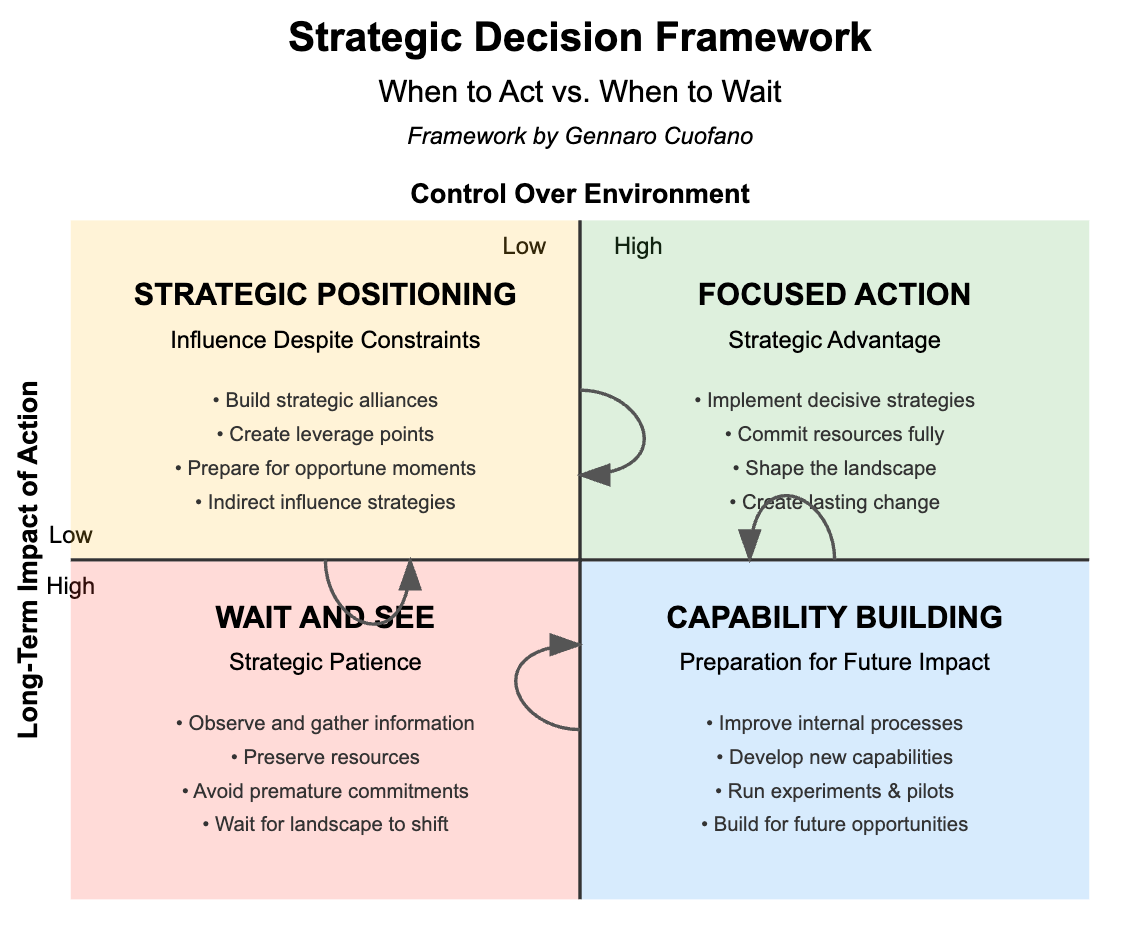
The Strategic Decision Framework is designed to help you determine the optimal timing for action based on two key factors: Control over the Environment and the Long-Term Impact of the Action.
This framework provides a structured approach to decision-making by categorizing situations into four strategic zones.
Each zone offers strategies tailored to your control level and potential impact in a given scenario.

This factor assesses how much you can influence or direct the elements affecting your situation.
High control suggests that you can shape outcomes directly, whereas low control indicates that external factors significantly influence the situation.
This factor assesses the potential for your actions to bring about lasting change in the strategic landscape.
Actions with high long-term impact can have a profoundly transformative effect on the environment, whereas those with low impact have a more limited impact.
When you possess significant control, and your actions can create a substantial long-term impact, it is the optimal time for decisive action.
In this quadrant, the objective is to gain a strategic advantage.
-
Implement comprehensive strategies: Develop and execute plans that address all critical aspects of the situation.
-
Commit resources fully: Allocate the resources needed to ensure the success of your strategies.
-
Actively shape the landscape: Use your influence to mold the environment to your advantage.
-
Create lasting change: Aim for transformative outcomes that sustainably impact over time.
When you have limited control but the potential for high impact, the focus should be on positioning and influence.
The objective here is to influence despite constraints.
-
Build strategic alliances: Form partnerships that can amplify your influence and leverage.
-
Create leverage points: Identify and develop opportunities that can be exploited for future action.
-
Prepare for opportune moments: Be ready to act when conditions are favorable.
-
Use indirect influence strategies: Employ tactics that allow you to exert influence without direct control.
When both control and potential impact are low, it is prudent to exercise strategic patience.
The objective in this quadrant is to observe and gather information while preserving resources.
-
Observe and gather information: Monitor the situation closely to understand developments and trends.
-
Preserve resources: Avoid committing resources prematurely.
-
Avoid premature commitments: Wait for more favorable conditions before taking action.
-
Wait for the landscape to shift: Be patient and allow the environment to evolve in a way that may present better opportunities.
When you have control but limited immediate impact, the focus should be on preparation for future impact.
The objective is to improve internal processes and develop new capabilities.
-
Improve internal processes: Enhance operational efficiency and effectiveness.
-
Develop new capabilities: Invest in skills and technologies that will be valuable in the future.
-
Run experiments and pilots: Test new ideas and approaches to gather data and refine strategies.
-
Build foundations for future opportunities: Lay the groundwork for future actions that can have a more significant impact.
By understanding and applying this framework, you can make more informed decisions about when to act and when to wait, ensuring that your strategies are aligned with your level of control and potential impact in any given situation.
-
A major business mistake is confusing strategy with tactics, or worse, with grand strategy.
-
Grand Strategy = Territory
(Structural, contextual understanding of the landscape) -
Strategy = Map
(Direction and choices within that territory) -
Tactics = Routes
(Concrete actions taken to navigate the map)
The framework helps determine when to act or wait, based on:
-
Control Over Environment: Can you shape outcomes?
-
Long-Term Impact of Action: Will your actions lead to lasting change?
→ Take decisive action
-
Implement comprehensive strategies
-
Commit resources fully
-
Actively shape the environment
-
Aim for long-term transformation
→ Influence indirectly
-
Build strategic alliances
-
Create leverage points
-
Wait for opportune moments
-
Use influence without direct power
→ Preserve and observe
→ Prepare and invest
-
Improve internal operations
-
Develop future-ready skills and technologies
-
Run pilots and small experiments
-
Build the foundation for future action
-
Strategic clarity comes from aligning your actions (or inaction) with your level of control and potential impact.
-
This framework helps avoid wasted effort, premature action, or missed opportunities by situating decision-making in the right context.
A smart strategy means knowing when to push, when to position, when to pause, and when to prepare.