While outcome-based pricing for agentic AI represents a compelling evolution in software monetization, the reality of implementation reveals significant challenges, risks, and potential pitfalls that vendors and customers must carefully navigate.
The seductive appeal of “pay only for results” can obscure complex underlying issues that, if not adequately addressed, can lead to failed implementations, damaged relationships, and financial losses for all parties involved.
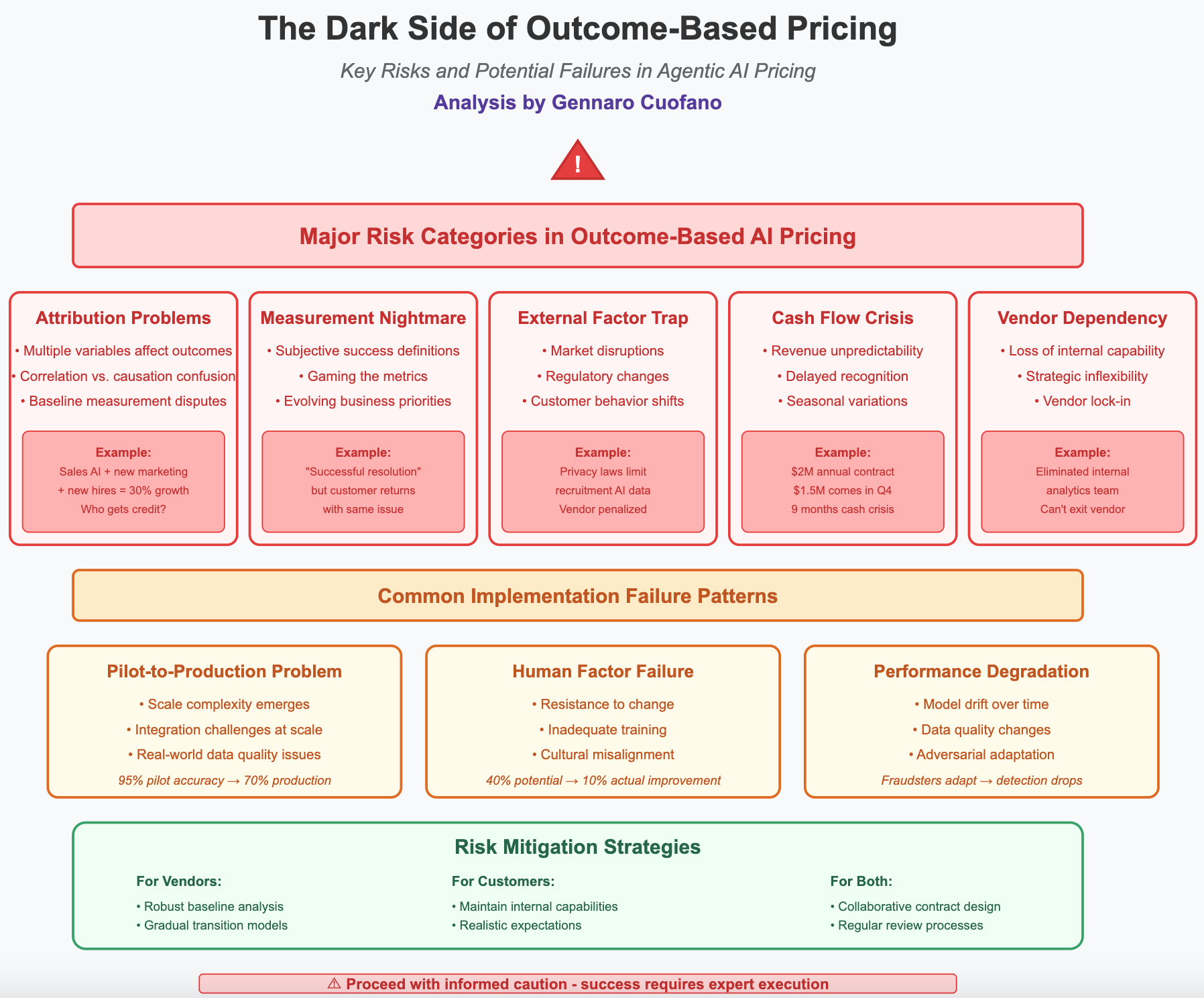

The Challenge: In complex business environments, attributing specific outcomes to AI systems becomes extraordinarily difficult.
What Goes Wrong:
-
Multiple Variables: Business outcomes are influenced by countless factors, including market conditions, human decisions, seasonal variations, competitive actions, and other technology systems. Isolating AI’s contribution can be nearly impossible.
-
Correlation vs. Causation: Just because an outcome improves after AI implementation doesn’t mean the AI caused the improvement.
-
Baseline Disputes: Establishing accurate baseline measurements becomes contentious when significant money depends on proving improvement.
Real-World Example: A sales AI system is implemented when the company also launches a new marketing campaign, hires experienced sales staff, and introduces a new product line. When sales increase by 30%, determining how much credit the AI deserves becomes a source of ongoing dispute.
Financial Impact: Legal costs, relationship deterioration, and potential contract termination can far exceed the value of the disputed outcomes.
The Challenge: Creating clear, unambiguous definitions of successful outcomes that both parties agree upon.
What Goes Wrong:
-
Subjective Interpretations: Different stakeholders can interpret terms like “customer satisfaction,” “successful resolution,” or “quality improvement” differently.
-
Gaming the System: When specific metrics are targeted, AI systems and human operators may optimize for the metric rather than the underlying business goal.
-
Metric Evolution: Business priorities change, but outcome-based contracts may lock parties into outdated success criteria.
Real-World Example: An AI customer service system is measured on “successful resolutions,” but the definition doesn’t account for customers who claim satisfaction initially but return with the same issue days later. The vendor counts these as successes, while the customer considers them failures.
Financial Impact: Continuous disputes over metric definitions can consume management attention and lead to expensive contract renegotiations.
The Challenge: Outcome-based contracts often fail to account for external factors beyond either party’s control.
What Goes Wrong:
-
Market Disruptions: Economic downturns, industry disruptions, or competitor actions can impact AI effectiveness regardless of system quality.
-
Regulatory Changes: New regulations can alter how success is measured or make specific outcomes impossible to achieve.
-
Customer Behavior Changes: The AI may perform perfectly, but changing customer expectations or behaviors can impact measured outcomes.
Real-World Example: A recruitment AI system performs well until new privacy regulations drastically limit available candidate data, making previous performance levels impossible to maintain. The vendor is penalized for factors completely outside its control.
Financial Impact: Vendors may face significant revenue loss due to circumstances beyond their control, while customers may lose access to valuable AI capabilities.
The Challenge: Outcome-based pricing creates highly unpredictable revenue streams that can destabilize vendor operations.
What Goes Wrong:
-
Delayed Recognition: Revenue may not be recognized until outcomes are measured and verified, creating significant cash flow delays.
-
Seasonal Variations: Vendor revenue becomes similarly volatile if customer outcomes vary seasonally.
-
Customer Concentration Risk: Heavy dependence on outcome-based contracts with few large customers creates existential business risk.
Real-World Example: An AI vendor signs a major outcome-based contract expecting $2M in annual revenue, but customer business seasonality means $1.5M comes in Q4, creating nine months of cash flow challenges that nearly bankrupt the company.
Financial Impact: When revenue predictability is low, working capital requirements increase dramatically, and access to traditional financing becomes difficult.
The Challenge: AI systems can experience performance degradation over time due to data drift, model decay, or changing conditions.
What Goes Wrong:
-
Model Drift: AI performance naturally degrades as real-world conditions diverge from training data.
-
Data Quality Issues: Customer data quality changes can impact AI performance without vendor control.
-
Feedback Loops: Poor outcomes can create negative feedback loops that further degrade performance.
Real-World Example: A fraud detection AI performs excellently initially but gradually becomes less effective as fraudsters adapt their techniques. Despite maintaining the same system, the vendor’s revenue drops steadily as detection rates decline.
Financial Impact: Vendors face declining revenue while maintaining system operation costs, potentially creating unsustainable unit economics.
The Challenge: Outcome-based contracts often underestimate the ongoing support and optimization required to maintain performance.
What Goes Wrong:
-
Continuous Tuning: Maintaining outcome performance requires constant system optimization and adjustment.
-
Customer Training: Ensuring customer teams use AI systems optimally becomes an ongoing vendor responsibility.
-
Integration Complexity: Deeper integration requirements emerge as outcome dependencies become clear.
Real-World Example: An AI scheduling system requires constant fine-tuning to maintain optimization outcomes, leading to support costs that are 300% higher than initially projected, turning a profitable contract into a loss-maker.
Financial Impact: Support costs can easily exceed contract value, especially for complex enterprise implementations requiring continuous optimization.
The Challenge: Outcome-based contracts can create unhealthy dependencies that limit customer flexibility and control.
What Goes Wrong:
-
Vendor Lock-in: Switching becomes prohibitively expensive when outcomes depend heavily on specific vendor systems.
-
Loss of Internal Capability: Organizations may reduce internal expertise, becoming overly dependent on vendor performance.
-
Strategic Inflexibility: Long-term outcome-based contracts can prevent organizations from adapting to changing strategic priorities.
Real-World Example: A company becomes so dependent on an AI vendor’s outcome guarantees that it eliminates its internal analytics team. When the vendor relationship sours, the company lacks the internal capability to maintain operations.
Financial Impact: Organizations may pay premium costs to maintain vendor relationships they cannot afford to exit, reducing negotiating power significantly.
The Challenge: Successful outcome-based implementations can create unrealistic expectations for future performance improvements.
What Goes Wrong:
-
Moving the goalposts: Success in one area leads to demands for improvements in adjacent areas not covered by original contracts.
-
Performance Plateaus: AI systems often reach performance plateaus, but customer expectations continue rising.
-
Scope Creep: Success leads to requests for expanded scope without proportional increases in vendor compensation.
Real-World Example: An AI system successfully reduces customer service costs by 30%, leading management to expect similar improvements in sales, marketing, and operations—areas the system was never designed to address.
Financial Impact: Unrealistic expectations can lead to contract terminations and deterioration of vendor relationships, requiring expensive replacements or internal development.
The Challenge: Focus on specific, measurable outcomes can lead to the optimization of metrics rather than overall business value.
What Goes Wrong:
-
Metric Fixation: Organizations become obsessed with contracted metrics while ignoring broader business impact.
-
Unintended Consequences: AI optimization for specific outcomes may negatively impact unmeasured but important areas.
-
Short-term Thinking: Pressure for immediate outcome achievement can undermine long-term strategic goals.
Real-World Example: An AI system optimizes for customer service resolution speed, achieving contracted targets but significantly reducing customer satisfaction as issues are resolved quickly but superficially.
Financial Impact: Achieving contracted outcomes while damaging overall business performance can be far more expensive than the original problem the AI was meant to solve.
The Challenge: Market competition in outcome-based pricing can lead to unsustainable vendor promises and customer expectations.
What Goes Wrong:
-
Vendor Desperation: Competitive pressure makes vendors accept unfavorable outcome-based terms to win deals.
-
Customer Unrealistic Expectations: Success stories create market expectations that are impossible to replicate across all implementations.
-
Market Consolidation: Only the largest vendors can sustain outcome-based models, reducing competition and innovation.
Real-World Example: Smaller AI vendors accept outcome-based contracts with minimal base fees to compete with larger players, leading to bankruptcies when performance targets prove unachievable.
Financial Impact: Market consolidation reduces customer choice and can lead to higher long-term costs as competition decreases.
The Challenge: Outcome-based pricing models may face regulatory scrutiny or legal challenges as they become more prevalent.
What Goes Wrong:
-
Consumer Protection Issues: Regulators may view some outcome-based models as unfair to customers, especially when vendor incentives misalign with customer interests.
-
Antitrust Concerns: Outcome-based models might create market behaviors that attract regulatory attention.
-
Liability Questions: When AI systems are responsible for outcomes, liability and insurance questions become complex.
Real-World Example: Healthcare AI vendors using outcome-based pricing face regulatory investigation when cost-cutting incentives appear to compromise patient care quality.
Financial Impact: Regulatory compliance costs and potential legal liabilities can make outcome-based models economically unviable in regulated industries.
The Challenge: Successful pilot implementations often fail to translate into successful production deployments under outcome-based contracts.
What Goes Wrong:
-
Scale Complexity: Factors that don’t matter in pilots become critical at scale.
-
Integration Challenges: Production environments reveal integration complexities not apparent in controlled pilots.
-
Performance Degradation: AI systems working well with curated pilot data may struggle with variety and quality of real-world data.
Real-World Example: An AI system achieves 95% accuracy in a controlled pilot with 1,000 transactions but drops to 70% accuracy when processing 100,000 diverse real-world transactions daily.
Financial Impact: Vendors may invest heavily in scaled deployments that fail to meet outcome targets, while customers face disruption from underperforming systems.
The Challenge: Outcome-based success often depends critically on human behavior changes that are difficult to predict and control.
What Goes Wrong:
-
Resistance to Change: Employees may resist using AI systems effectively, undermining outcome achievement.
-
Training Inadequacy: Insufficient training on AI system optimization prevents outcome realization.
-
Cultural Misalignment: Organizational culture may not support the behavioral changes necessary for AI success.
Real-World Example: A sales AI system can technically improve conversion rates by 40%, but sales teams resist using AI recommendations, achieving only 10% improvement and missing contracted outcome targets.
Financial Impact: When technically sound AI systems fail due to human factors, both vendors and customers lose, often leading to expensive contract disputes and relationship deterioration.
While the risks of outcome-based pricing are significant, they are not insurmountable. Successful implementations require:
-
Robust Baseline Analysis: Invest heavily in understanding customer environments before committing to outcomes
-
Gradual Transition Models: Start with hybrid pricing and evolve toward outcome-based as confidence builds
-
Force Majeure Protections: Include comprehensive external factor protections in contracts
-
Performance Monitoring: Implement real-time monitoring to detect and address performance degradation quickly
-
Realistic Expectation Setting: Understand that AI systems have limitations and performance variability
-
Internal Capability Maintenance: Retain sufficient internal expertise to avoid complete vendor dependency
-
Comprehensive Success Metrics: Define success broadly to avoid metric optimization at the expense of business value
-
Change Management Investment: Invest heavily in organizational change management to support AI adoption
-
Collaborative Contract Design: Work together to create fair, realistic, and mutually beneficial agreement terms
-
Regular Review Processes: Build in regular contract review and adjustment mechanisms
-
Shared Risk Models: Design models where both parties have skin in the game for success
-
Exit Strategy Planning: Plan for contract termination scenarios from the beginning
Outcome-based pricing for agentic AI represents a significant evolution in software monetization that powerfully aligns vendor and customer interests.
However, the complexity of implementation and the potential for significant adverse consequences require careful consideration and expert execution.
The most successful outcome-based implementations will acknowledge these risks upfront, design comprehensive mitigation strategies, and maintain realistic expectations about what AI systems can and cannot achieve.
Organizations that rush into outcome-based contracts without adequate preparation and protection may be worse off than traditional pricing models.
The future of AI pricing will likely include outcome-based elements, but the path forward requires learning from early failures, developing industry best practices, and creating legal and regulatory frameworks that protect all parties while enabling innovation.
As the market matures, we expect to see more sophisticated approaches that balance the benefits of outcome alignment with the practical realities of AI system limitations and business complexity.
The winners will be those who can navigate these challenges thoughtfully and systematically rather than those who simply chase the latest pricing trend without understanding its implications.
-
While “pay only for results” aligns incentives, it introduces deep operational and contractual complexities.
-
Poorly designed implementations can lead to financial losses, disputes, and failed partnerships.
-
Attribution is difficult: Outcomes are often influenced by many variables, not just AI.
-
Defining success is subjective: Misaligned metrics can lead to disputes or gaming.
-
External shocks (e.g., regulations, market shifts) can derail performance through no fault of the vendor.
-
Revenue unpredictability: Tied to outcome timing and seasonality; can stress cash flow.
-
Performance degradation: Model drift and data issues reduce accuracy over time.
-
Rising support costs: Continuous tuning and integration often exceed budget.
-
Vendor lock-in: Deep dependency can reduce flexibility and negotiating power.
-
Escalating expectations: Initial success may lead to unrealistic future demands.
-
Outcome myopia: Narrow optimization can hurt broader business performance.
-
Race to the bottom: Competitive pressure forces unsustainable pricing promises.
-
Regulatory concerns: Issues with liability, fairness, and consumer protection.
-
Pilot-to-production failures: Success at small scale may not generalize to full rollout.
-
Human factor failures: Adoption often hinges on behavior change that is hard to predict.
For Vendors:
-
Conduct deep baseline analysis before contracting.
-
Start with hybrid models, evolve gradually.
-
Add force majeure clauses and performance monitoring systems.
For Customers:
-
Set realistic expectations about AI limits.
-
Maintain internal expertise and flexibility.
-
Invest in organizational change management.
For Both Parties:
-
Define broad, fair success metrics.
-
Create clear, collaborative contract structures.
-
Regularly review and adjust terms.
-
Plan upfront for exit strategies and failure scenarios.
Outcome-based pricing is a powerful evolution in enterprise AI monetization, but only when implemented with careful design, risk-sharing, and trust.
Sustainable success requires navigating complexity with aligned incentives, measurable outcomes, and a shared commitment to long-term value, not just short-term results.
With massive ♥️ Gennaro Cuofano, The Business Engineer