Not all choices deserve equal deliberation in business.
In fact, as I’ve explained in impact vs. reversibility, once you do understand where you stand, you can unlock rapid iteration, which in business might be defined as the “state of flow” or where you might be able to do your best job, on a daily basis.
A key premise before we dive deep into it, while rapid iteration is a desired state for daily flow, and smooth scaling.
There will be along the way decisions that are not in tune with rapid decision making, as these will make or break the business, and where there is no way to smooth risk out, and you just got to embrace, as part of your “instict circle.”
I’ll touch on it, in one of the upcmoming issues.
In the meantime, rapid Iteration decisions, characterized by low impact and high reversibility, represent the experimental playground where businesses can build momentum without risking significant resources or reputation.
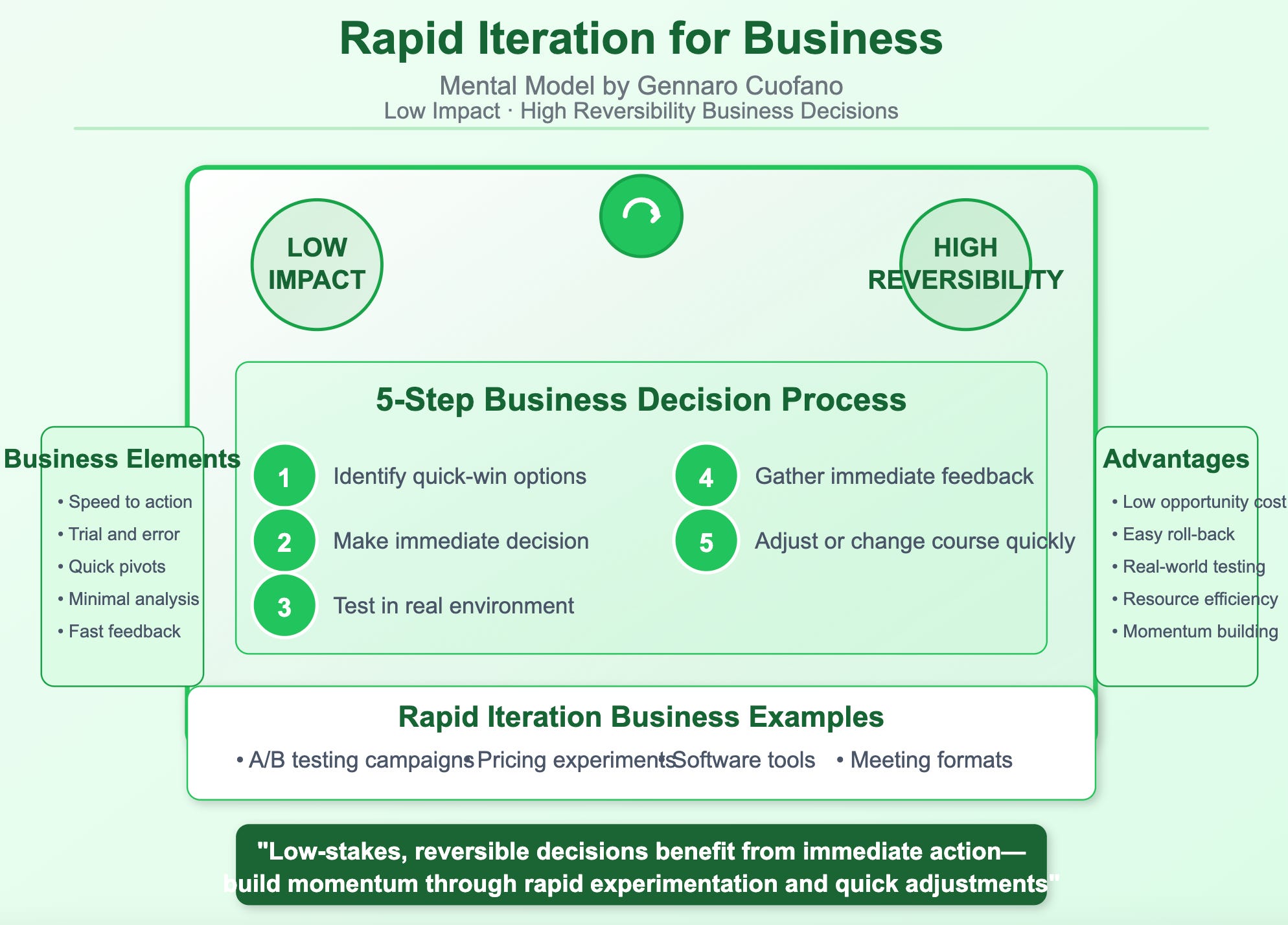
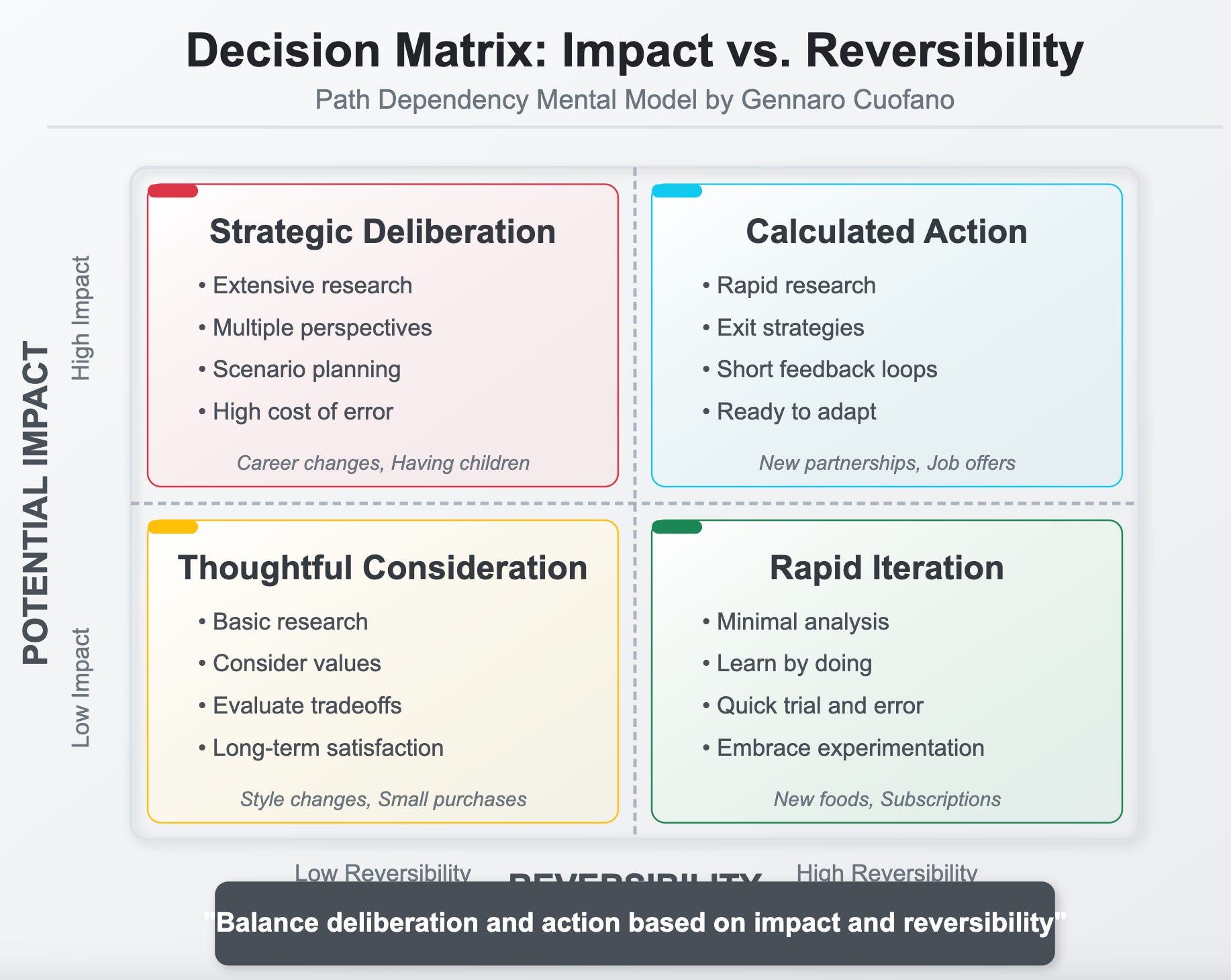
This is part of the impact-reversibility series, from which you can identify what I call the “rapid iteration sweet spot.”
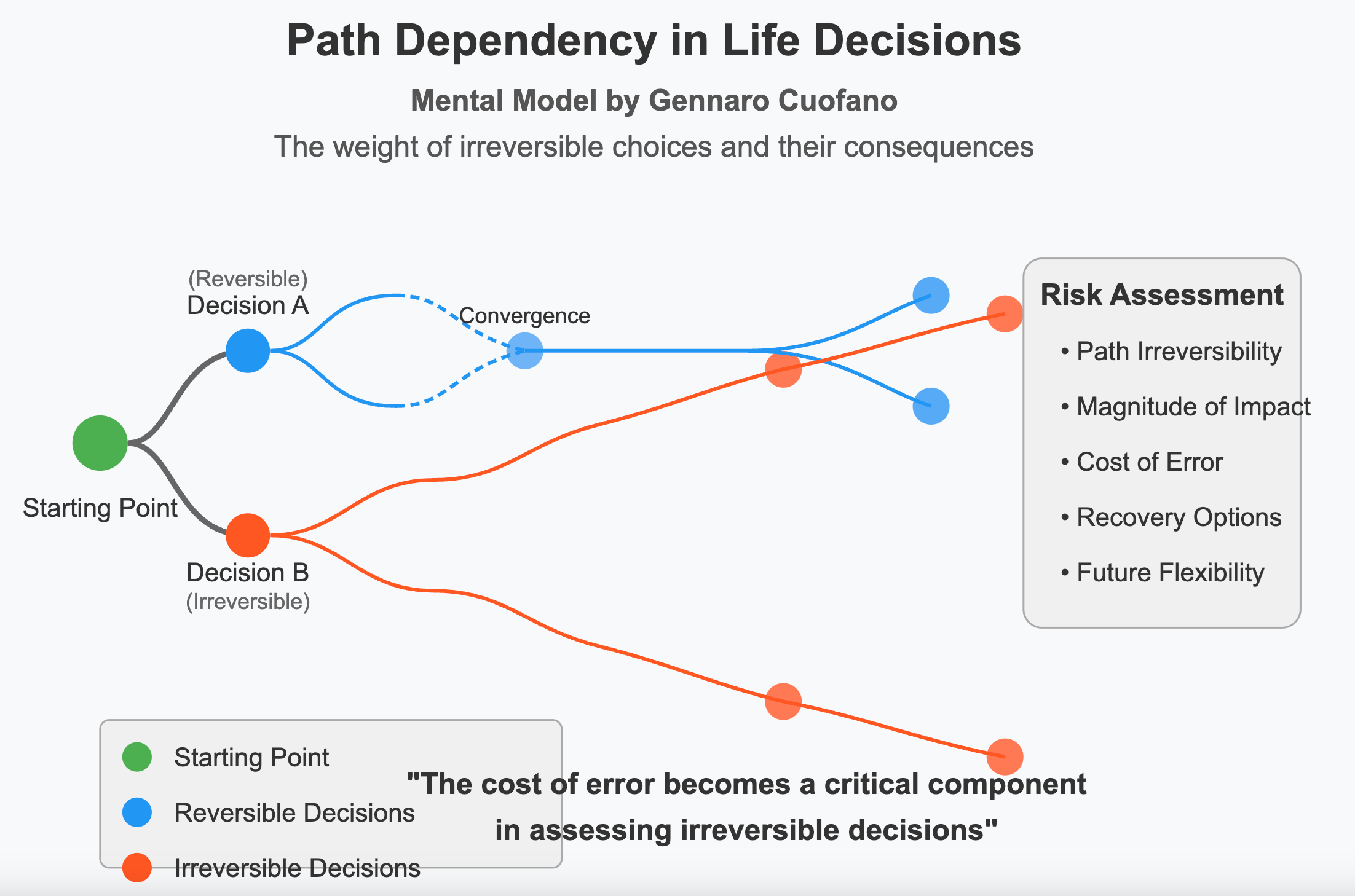
That’s because in the real world, making choices is a path-dependent process, where irreversible choices might carry much higher consequences unless you balance them out to de-risk some of these into a non-linear plan of action.

Rapid Iteration decisions won’t make or break your business. Their defining characteristic is the limited scope of potential positive and negative consequences.
This doesn’t mean they’re unimportant, rather, they’re safe spaces for experimentation.
Common characteristics include:
-
Limited financial exposure
-
Minimal brand risk
-
Confined operational effects
-
Short-term commitments
-
Easily contained outcomes
The true power of Rapid Iteration decisions lies in their reversibility. Unlike strategic pivots or infrastructure investments, these choices can be unwound with minimal friction or cost.
Reversibility manifests as:
Speed creates its own value in business. While Strategic Deliberation decisions require careful analysis, Rapid Iteration choices benefit from the opposite approach—quick action that generates momentum.
Benefits of momentum:
-
Teams stay engaged and energized
-
Learning cycles accelerate
-
Market feedback arrives faster
-
Innovation becomes habitual
-
Decision fatigue diminishes
In low-impact, reversible decisions, the cost of analysis often exceeds the cost of error. Real-world testing provides superior data compared to prolonged planning sessions.
Testing advantages:
-
Actual customer behavior vs. predicted behavior
-
Unexpected insights emerge
-
Hidden assumptions surface
-
Market conditions are current, not projected
-
Teams learn by doing, not discussing
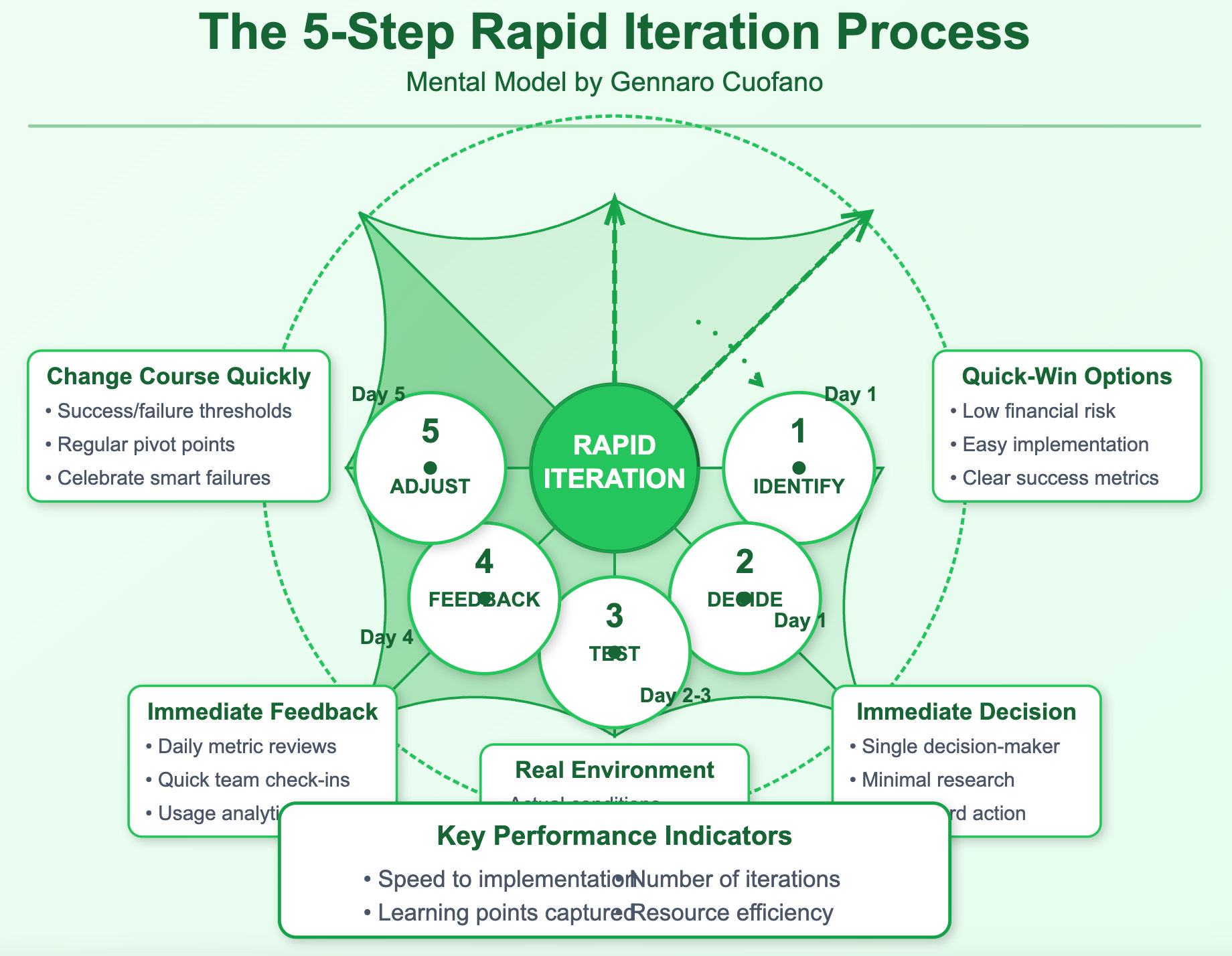
Start by recognizing decisions that fit the Rapid Iteration profile. Look for choices where the cost of delay exceeds the cost of potential mistakes.
Key indicators:
Once identified, move to action without committees, lengthy proposals, or exhaustive research. The goal is to start the learning process, not to guarantee perfection.
Decision shortcuts:
-
Single decision-maker empowerment
-
Pre-approved budget thresholds
-
Standard evaluation criteria
-
Template-based documentation
-
Bias toward “yes” for qualifying decisions
Deploy solutions in actual business conditions rather than controlled environments. This provides authentic feedback and reveals unforeseen interactions.
Testing principles:
-
Start with small user groups
-
Use existing systems when possible
-
Monitor basic metrics only
-
Accept imperfection as learning
-
Document observations, not just outcomes
Create tight feedback loops that provide quick insights. The goal is rapid learning, not comprehensive analysis.
Feedback mechanisms:
-
Daily metric reviews
-
Quick team check-ins
-
Simple customer surveys
-
Usage analytics
-
Informal observations
Be prepared to pivot, scale, or abandon based on feedback. The reversibility of these decisions makes course corrections painless.
Adjustment strategies:
-
Pre-defined success/failure thresholds
-
Regular pivot points
-
Clear escalation paths
-
Resource reallocation plans
-
Celebration of smart failures
-
Software subscriptions
-
Productivity apps
-
Automation trials
-
Integration testing
-
Feature toggles
-
Promotional offers
-
Bundle experiments
-
Pricing tier adjustments
-
Limited-time discounts
-
Service add-ons
Treating Rapid Iteration decisions like Strategic Deliberation choices wastes resources and kills momentum. Over-analysis of low-impact decisions creates several problems:
-
Opportunity costs mount
-
Team energy dissipates
-
Market windows close
-
Competitors move faster
-
Innovation stalls
Small decisions compound over time. While each individual choice may seem insignificant, the cumulative effect of rapid iteration creates substantial competitive advantage.
Compounding benefits:
-
Continuous improvement culture
-
Faster organizational learning
-
Enhanced adaptability
-
Reduced decision bottlenecks
-
Increased innovation capacity
Create systems that enable rapid iteration by default. This requires both cultural and structural changes.
Key elements:
-
Distributed decision authority
-
Clear decision boundaries
-
Pre-approved experimentation budgets
-
Safe-to-fail environments
-
Celebration of intelligent failures
Focus on learning metrics rather than success metrics for Rapid Iteration decisions.
Appropriate metrics:
Unlike high-impact, low-reversibility decisions, Rapid Iteration choices:
-
Don’t require board approval
-
Need minimal research
-
Benefit from individual decision-making
-
Favor speed over precision
-
Accept higher error rates
While both involve action, Rapid Iteration differs from high-impact, high-reversibility decisions by:
Though both are low-impact, Rapid Iteration differs from low-reversibility decisions by:
-
Prioritizing experimentation
-
Accepting temporary solutions
-
Focusing on external rather than internal effects
-
Valuing speed over permanence
-
Embracing change rather than stability
Major innovations often emerge from the accumulation of small experiments. Google’s 20% time, Amazon’s two-pizza teams, and 3M’s innovation hours all leverage rapid iteration principles.
Innovation patterns:
-
Big ideas start small
-
Failed experiments inform breakthroughs
-
Cross-pollination occurs naturally
-
Risk tolerance increases gradually
-
Success compounds incrementally
Rapid Iteration decisions generate valuable market intelligence at low cost. Each experiment provides data about customer preferences, operational efficiency, and competitive positioning.
Intelligence benefits:
-
Real customer behavior data
-
Operational stress testing
-
Competitive response monitoring
-
Team capability assessment
-
Market trend identification
In a business environment that increasingly rewards agility, the ability to identify and execute Rapid Iteration decisions becomes a crucial competitive advantage.
The framework reminds us that not every decision deserves deep deliberation. By recognizing low-impact, high-reversibility choices and approaching them with purposeful speed, organizations can:
-
Build momentum through action
-
Learn through real-world experimentation
-
Preserve resources for truly strategic decisions
-
Create cultures of innovation and adaptability
-
Gain competitive advantage through accumulated small wins
The anatomy of Rapid Iteration reveals a simple truth: in business, sometimes the best decision is the quick decision that can be easily changed.
-
Low impact, high reversibility decisions ideal for quick testing and learning.
-
Serve as safe zones for experimentation without risking major resources or reputation.
-
Low Impact: Minimal financial, brand, or operational risk.
-
High Reversibility: Easy to cancel, roll back, or adjust with minimal friction.
-
Enable momentum and keep teams energized.
-
Reduce decision fatigue and accelerate learning cycles.
-
Avoid costly delays by favoring real-world testing over over-analysis.
-
Identify quick-win options (trial-ready, low-risk decisions).
-
Make fast decisions without committee delays.
-
Test in real environments for actionable feedback.
-
Gather rapid feedback using lightweight tools.
-
Adjust quickly based on results—pivot, scale, or stop.
-
Marketing: A/B tests, content formats, channels.
-
Operations: Workflow tweaks, meeting formats, tool trials.
-
Tech & Tools: Software trials, automation, feature toggles.
-
Pricing: Promotions, bundling, tier experiments.
-
Wastes resources on small decisions.
-
Slows innovation and organizational learning.
-
Enables faster-moving competitors to pull ahead.
-
Small, fast decisions compound over time to build lasting competitive advantage.
-
Creates a culture of innovation, continuous improvement, and resilience.
-
Empower individuals to decide within boundaries.
-
Track learning metrics (speed, iterations, lessons), not just outcomes.
-
Celebrate intelligent failures.
-
Strategic Deliberation: High-impact, low-reversibility.
-
Calculated Action: High-impact, high-reversibility.
-
Thoughtful Consideration: Low-impact, low-reversibility.
-
Recognizing Rapid Iteration decisions allows businesses to move fast without breaking things.
-
In fast-changing markets, deciding quickly and adjusting often is a critical competitive edge.
With massive ♥️ Gennaro Cuofano, The Business Engineer