Most founders get this backward. They obsess over features, growth metrics, and investor updates while ignoring the fundamental mechanism that determines whether their company will survive: the quality and precision of their feedback systems.
Here’s the counterintuitive reality: not all feedback loops are created equal, and in the ambiguous world of early-stage companies, tighter loops aren’t just better, they’re essential for survival.
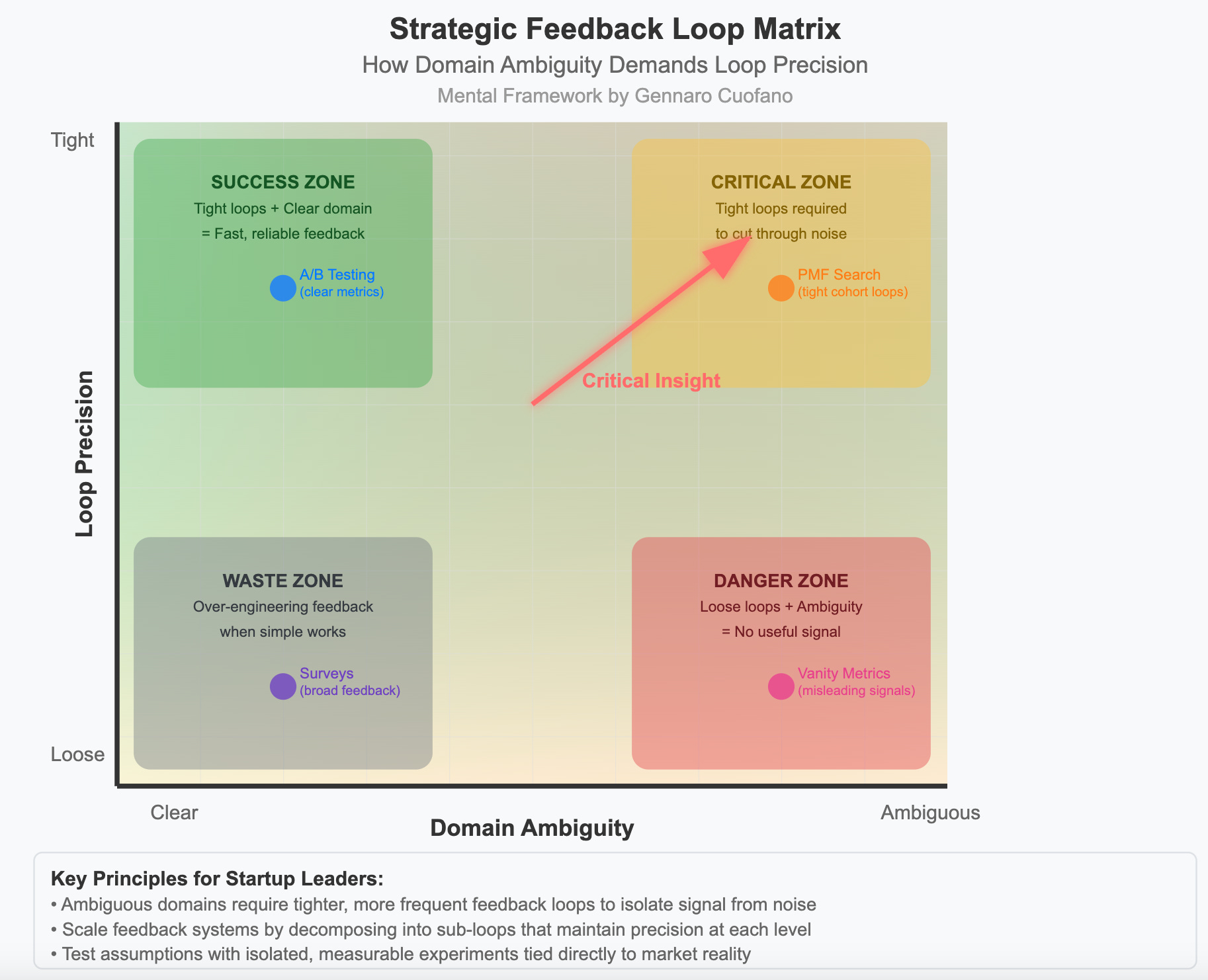
The relationship between market clarity and feedback precision follows a simple yet powerful rule: the more ambiguous your domain, the tighter your feedback loops must be.
This isn’t obvious because our intuition tells us that when things are unclear, we should cast a wider net.
But in startup reality, loose feedback loops in ambiguous markets produce nothing but noise.
You end up drowning in data that tells you nothing about whether you’re building something people want.
Consider two scenarios:
-
Clear Domain, Tight Loops (Success Zone): You’re optimizing conversion rates on an established e-commerce platform. The market dynamics are well-understood, customer behavior is predictable, and A/B testing gives you clean signals. Here, tight feedback loops compound into reliable growth.
-
Ambiguous Domain, Loose Loops (Danger Zone): You’re building “AI-powered productivity software for knowledge workers.” The market is undefined, customer needs are unclear, and you’re measuring vanity metrics like signups and session time. Loose feedback here is worse than no feedback, it creates false confidence while you drift toward irrelevance.
The magic happens in the Critical Zone, where ambiguous domains with tight loops exist. This is where most successful startups operate, even if they are not aware of it.

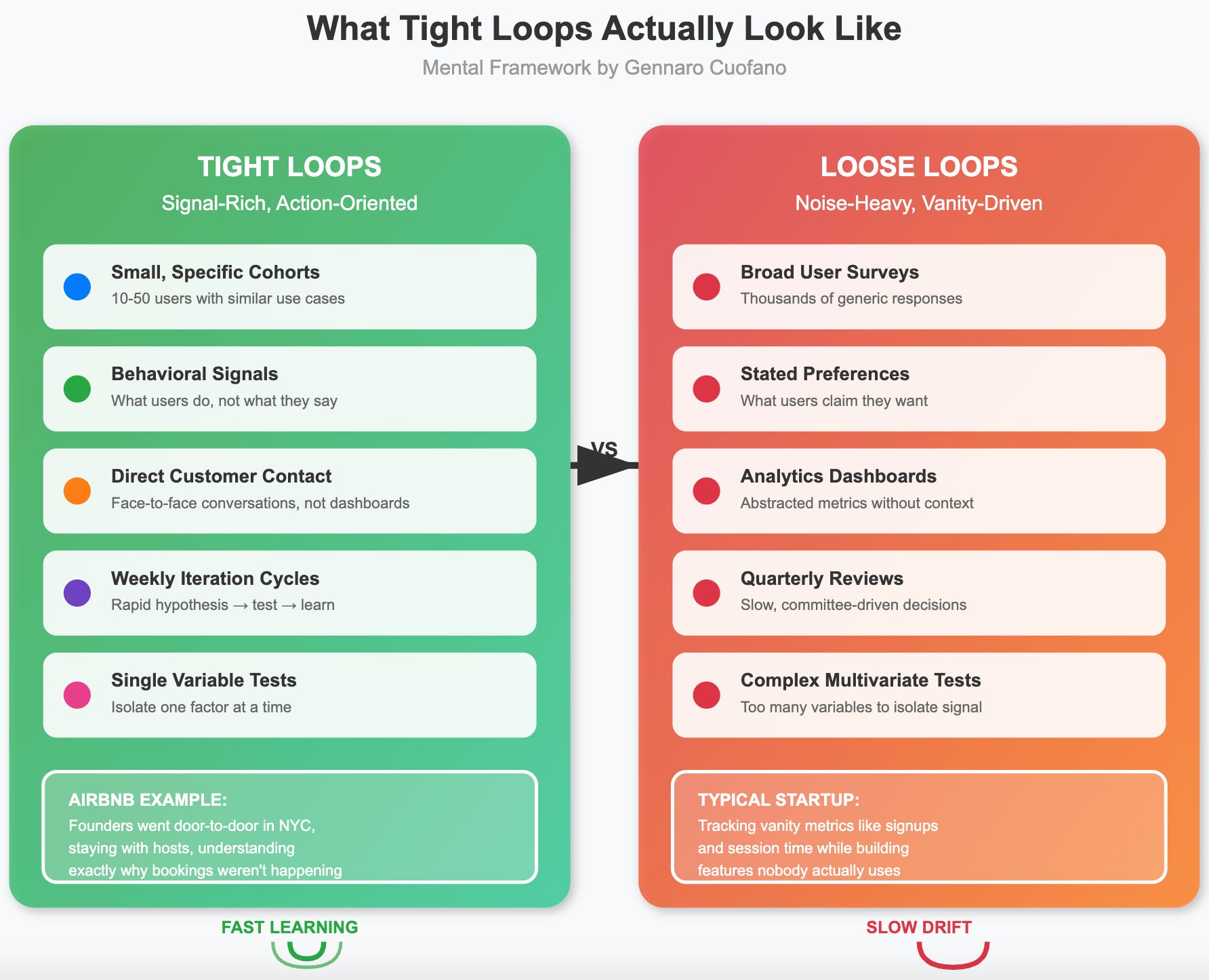
When Airbnb was struggling to find product-market fit, they didn’t run broad surveys or track generic engagement metrics.
They went door-to-door in New York, staying with hosts, and gained a deep understanding of why bookings weren’t happening, iterating based on hyper-specific insights from real users.
This is what tight feedback loops look like in practice:
-
Small, specific cohorts rather than broad user bases
-
Behavioral signals rather than stated preferences
-
Direct customer contact rather than analytics dashboards
-
Weekly iteration cycles rather than quarterly reviews
-
Single variable tests rather than complex multivariate experiments
The tighter your loop, the faster you can isolate real signals from market noise.
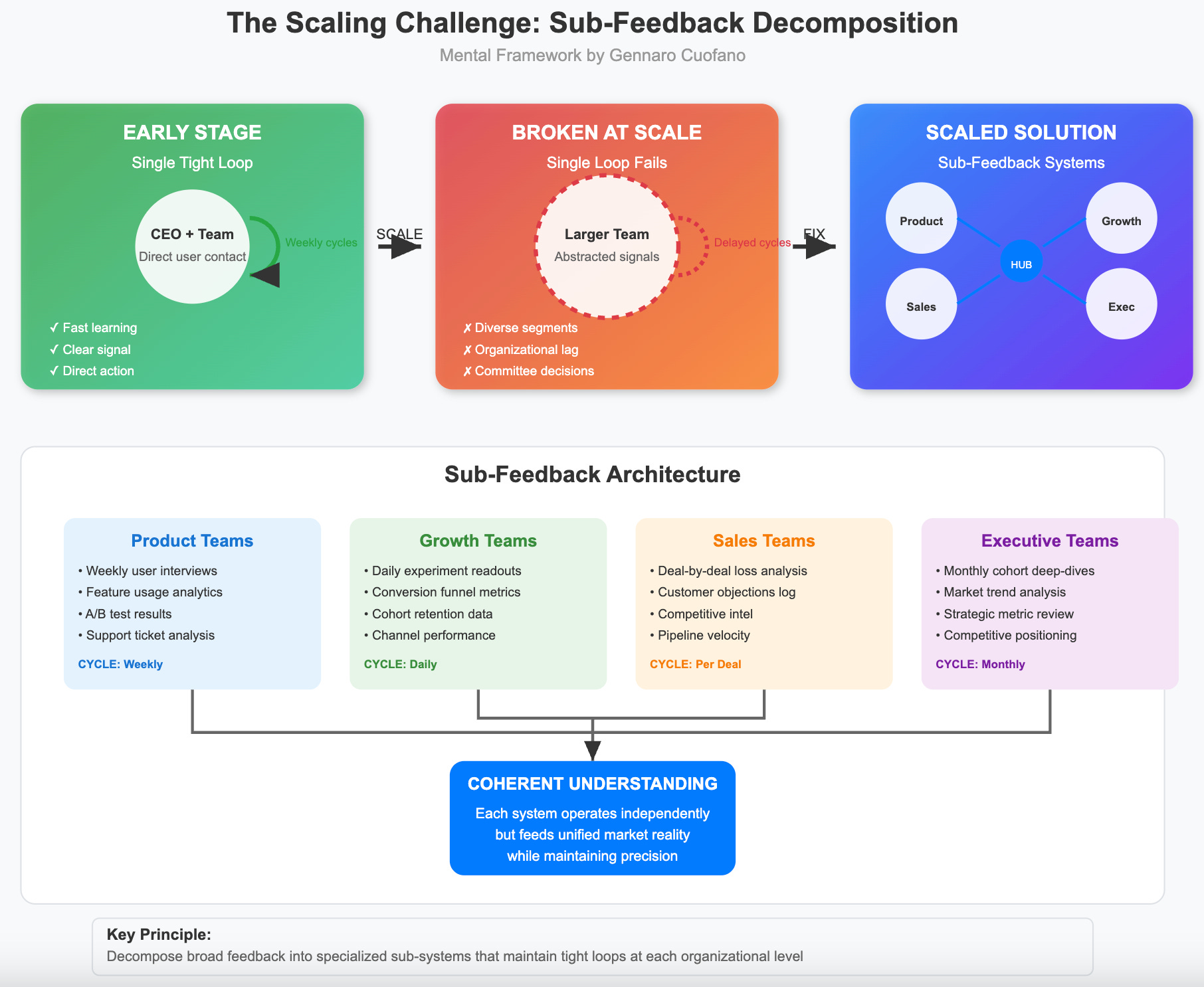
Here’s where most companies that achieve initial product-market fit start to lose their edge: they assume the feedback loops that got them there will continue working as they scale.
But scaling breaks feedback loops in predictable ways:
-
Customer segments become too diverse for unified insights
-
Organizational layers create a lag between signal and action
-
Success metrics become abstracted from user behavior
-
Decision-making becomes committee-driven rather than data-driven
The solution isn’t to abandon tight loops—it’s to decompose them into sub-feedback systems that maintain precision at each level of scale.
A scaled feedback architecture might look like this:
-
Product teams with weekly user interview cycles
-
Growth teams with daily experiment readouts
-
Sales teams with deal-by-deal loss analysis
-
Executive teams with monthly cohort deep-dives
Each subsystem operates independently but contributes to a coherent understanding of market reality.
The core insight that separates successful founders from everyone else is this: every feedback loop must be tied to a testable assumption about market reality.
Weak founders collect feedback that makes them feel good. Strong founders design feedback systems that prove them wrong as quickly as possible.
This means:
-
Isolating variables so you know what’s actually driving results
-
Defining failure conditions before running experiments
-
Measuring leading indicators rather than lagging outcomes
-
Creating binary decisions rather than gradual adjustments
The goal isn’t to confirm what you already believe—it’s to discover what you don’t know about how your market actually works.
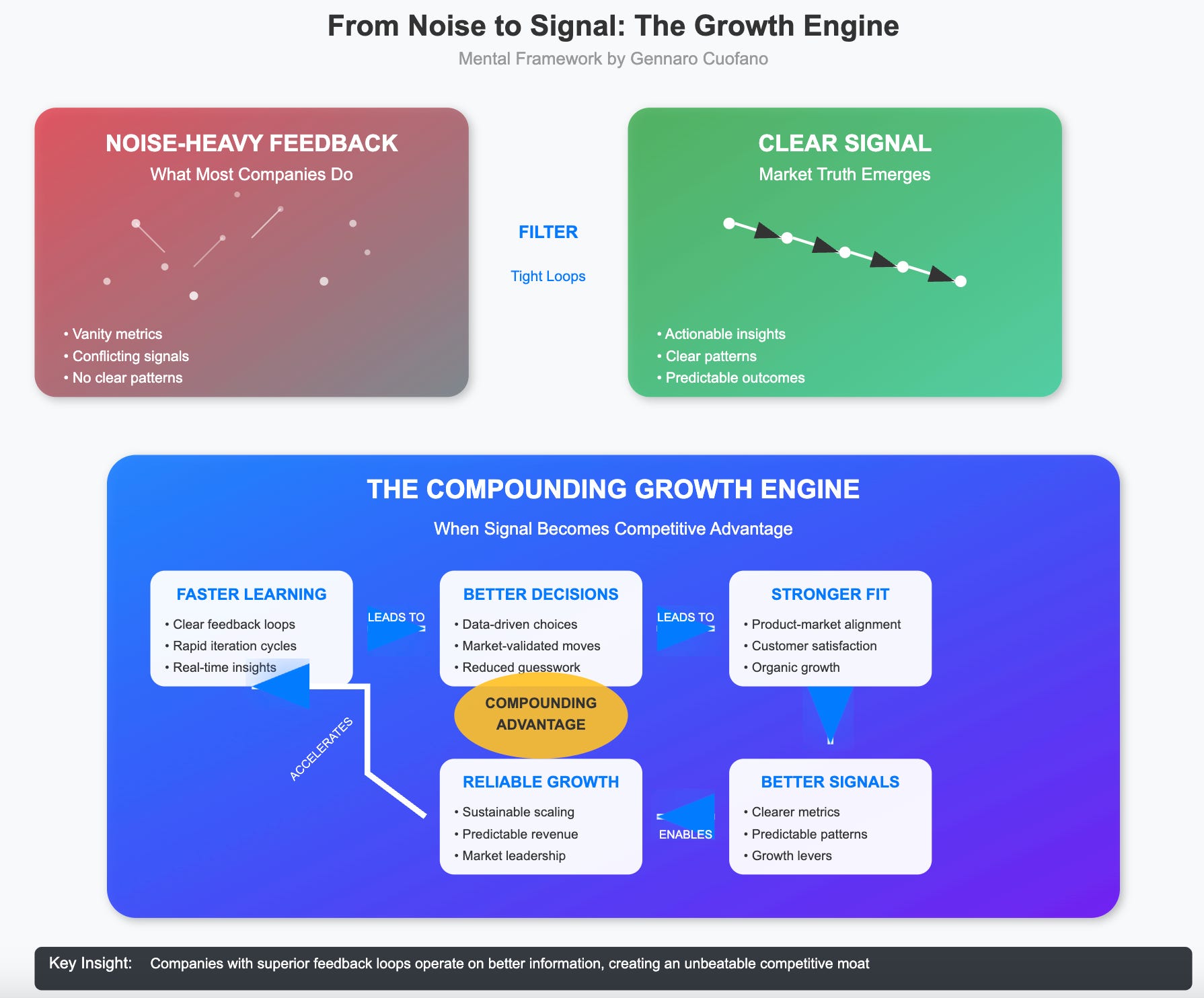
When you get this right, something remarkable happens: your feedback loops become your competitive advantage. While competitors are still debating strategy in conference rooms, you’re iterating based on real market signals.
This creates a compounding effect:
-
Faster learning leads to better product decisions
-
Better decisions lead to stronger market fit
-
Stronger fit leads to more reliable growth signals
-
Better signals enable even faster learning
Companies that master this feedback-to-growth engine become nearly impossible to compete with because they’re operating on fundamentally better information than everyone else in their market.
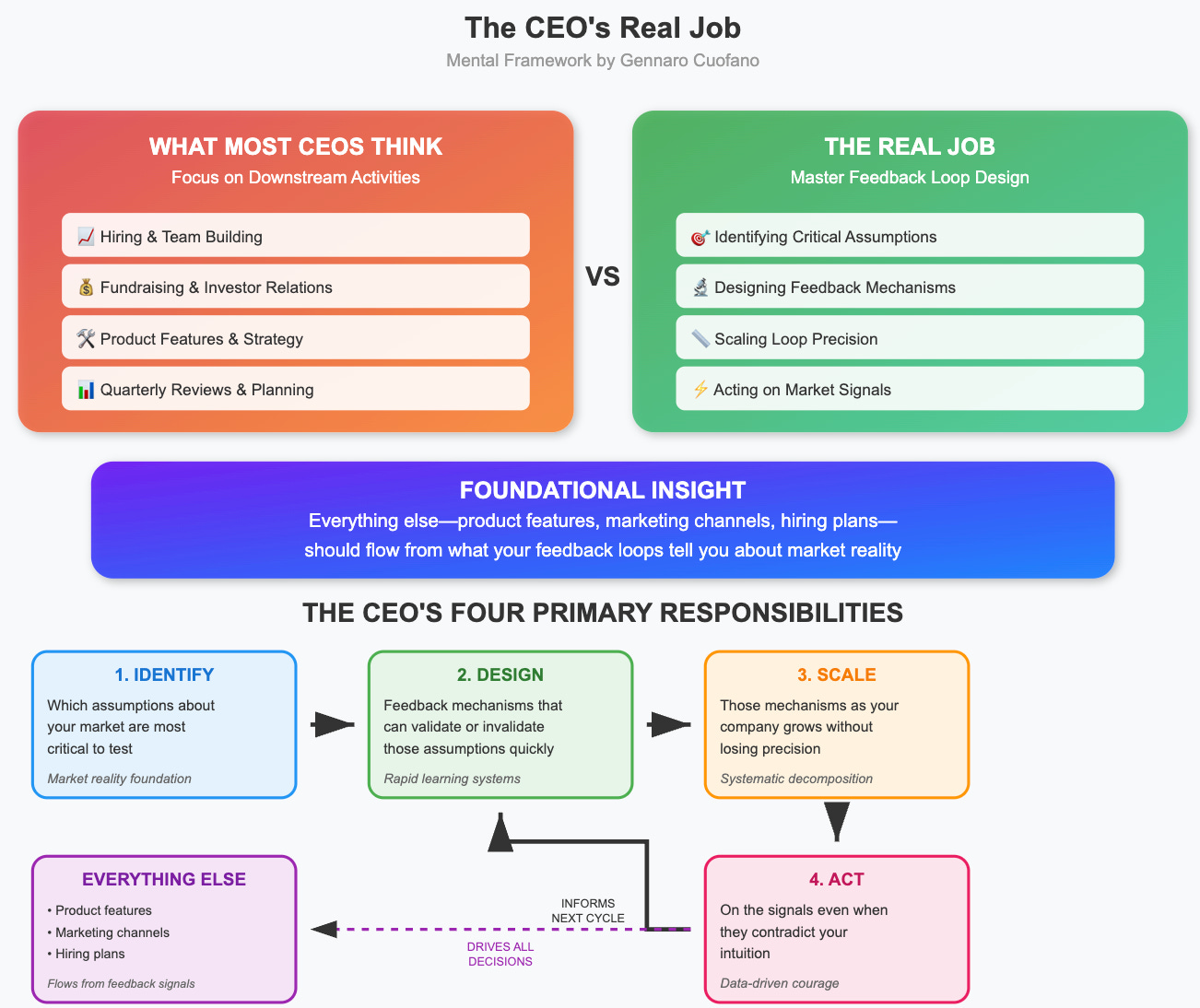
Most startup advice focuses on hiring, fundraising, or product strategy. But these are all downstream of the foundational capability that determines everything else: your ability to design and maintain feedback loops that reveal market truth.
As a startup CEO, your primary responsibilities are:
-
Identifying which assumptions about your market are most critical to test
-
Designing feedback mechanisms that can validate or invalidate those assumptions quickly
-
Scaling those mechanisms as your company grows without losing precision
-
Acting on the signals even when they contradict your intuition
Everything else—product features, marketing channels, hiring plans—should flow from what your feedback loops are telling you about market reality.
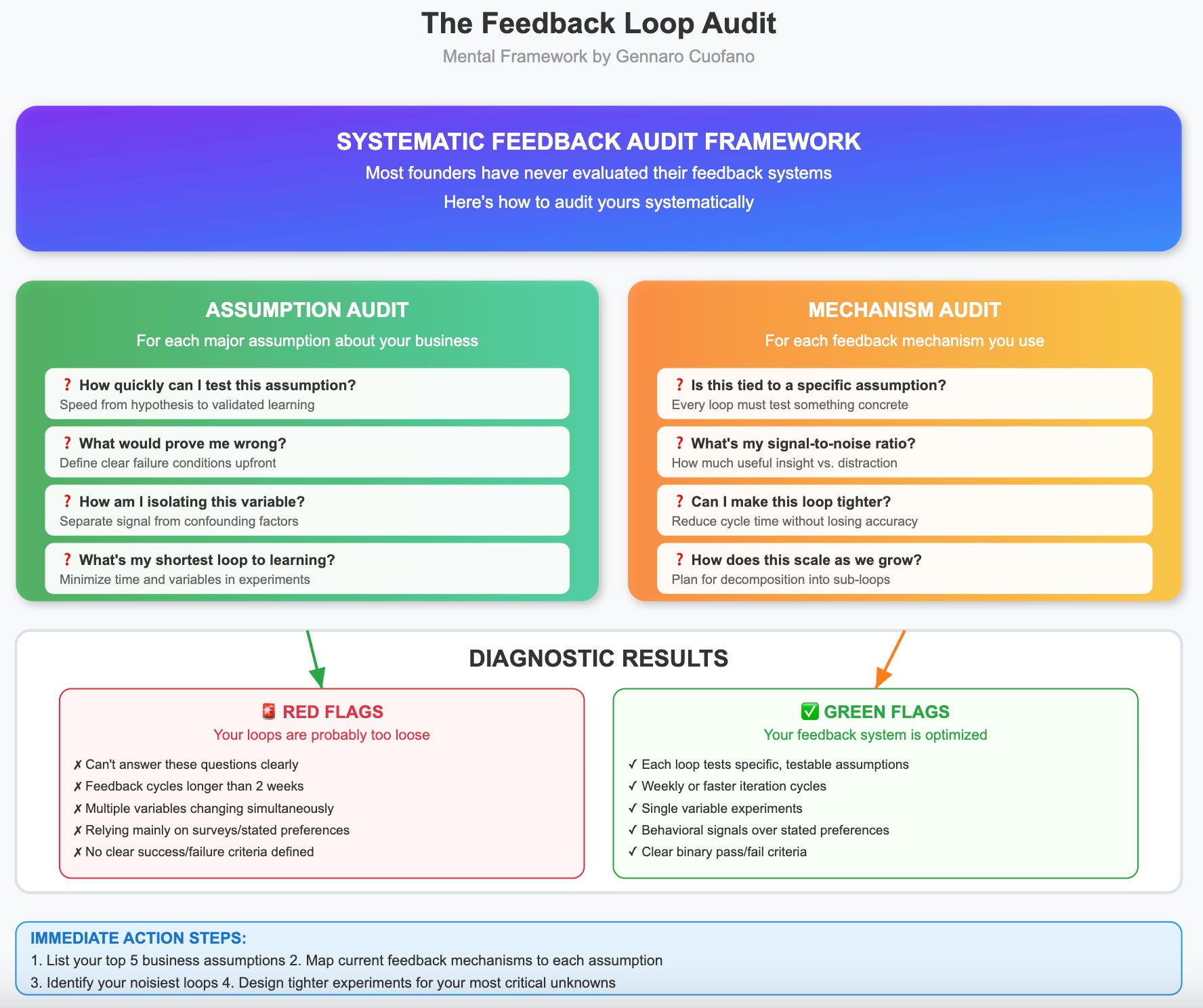
Most founders have never systematically evaluated their feedback systems. Here’s how to audit yours:
For each major assumption about your business, ask:
-
How quickly can I test this assumption?
-
What would prove me wrong?
-
How am I isolating this variable from other factors?
-
What’s the shortest loop from hypothesis to validated learning?
For each feedback mechanism you currently use, ask:
-
Is this tied to a specific, testable assumption?
-
How much noise am I getting relative to signal?
-
Can I make this loop tighter without losing accuracy?
-
How does this scale as we grow?
If you can’t answer these questions clearly, you’re probably operating with feedback loops that are too loose for the level of market ambiguity you’re dealing with.
The feedback loop paradox isn’t a paradox at all; it’s a fundamental principle of operating in uncertain environments. When you don’t know how your market works, your only competitive advantage is learning faster than everyone else.
Tight feedback loops in ambiguous domains aren’t just a nice-to-have capability. They’re the difference between companies that stumble toward product-market fit through luck and companies that engineer their way there through systematic learning.
In a world where most startups fail not because they build bad products but because they build good products that nobody wants, the ability to quickly and precisely understand market reality isn’t just important; it’s everything.
The companies that master this don’t just survive the uncertainty of early-stage markets; they thrive. They thrive in it, using their superior feedback systems to find opportunities that their competitors can’t even see.
The question isn’t whether you have feedback loops; it’s whether you have effective ones. The question is whether your feedback loops are precise enough to cut through the noise and reveal the truth about what your market wants.
Get this right, and everything else becomes significantly easier. Get it wrong, and nothing else matters.
-
The primary job of a startup CEO is not building products, but designing feedback loops that reveal market truth.
-
Most founders prioritize growth, features, and investor optics over precision feedback systems—which is a strategic error.
-
Not all feedback loops are created equal—tight loops are essential in ambiguous markets.
-
The more uncertain your market, the tighter your feedback systems must be to generate signal over noise.
-
Success Zone: Clear domain + tight feedback = reliable growth (e.g., optimizing conversion on mature platforms).
-
Danger Zone: Ambiguous domain + loose feedback = false confidence and misdirection.
-
Critical Zone: Ambiguous domain + tight feedback = where most breakout startups succeed.
-
Small, specific user cohorts
-
Behavioral data over opinions
-
Direct customer conversations
-
Weekly iterations
-
Single-variable testing
-
As companies scale, the original tight loops break down due to complexity and distance from users.
-
Solution: Build modular sub-feedback systems across teams:
-
Product: user interviews weekly
-
Growth: daily experiments
-
Sales: loss analysis per deal
-
Exec: monthly deep-dive cohorts
-
-
Identify critical market assumptions.
-
Design fast, targeted feedback mechanisms to test them.
-
Scale feedback loops without sacrificing signal precision.
-
Make decisions based on validated signals, even when they challenge your intuition.
Ask for each assumption:
-
Can I test this quickly?
-
What would prove me wrong?
-
Is this variable isolated?
-
What’s the shortest loop to learning?
Ask for each feedback mechanism:
-
In uncertain environments, tight feedback loops are your only edge.
-
Startups don’t fail because they build bad products—they fail because they build things people don’t actually want.
-
Tight, assumption-tested loops are the only reliable way to discover what people truly need.
With massive ♥️ Gennaro Cuofano, The Business Engineer