The holidays are coming up, which means two things (among others): One, the movie theatres are full of high-quality movies so that the production company can submit them for consideration for various awards. Two, many of you will be going to see one of these movies because it is cold outside, and it is just a great time to catch a movie. But if you do go to the movies this weekend, please let me know so I can sell my stocks.
Apparently, if movies make more money, it is a sign of poor investor sentiment and lower future stock market returns. Guy Kaplanski used Box Office Mojo gross earnings data from the US and compared it with other sentiment indicators like the Baker and Wurgler sentiment index. The chart below shows the monthly box office earnings together with the rolling 12-month average and the sentiment index from Baker and Wurgler. Even if you ignore the massive spike during the pandemic, you can sense that movie earnings rise faster when sentiment deteriorates and decline or slow down when sentiment improves.
Box office real gross earnings and market sentiment
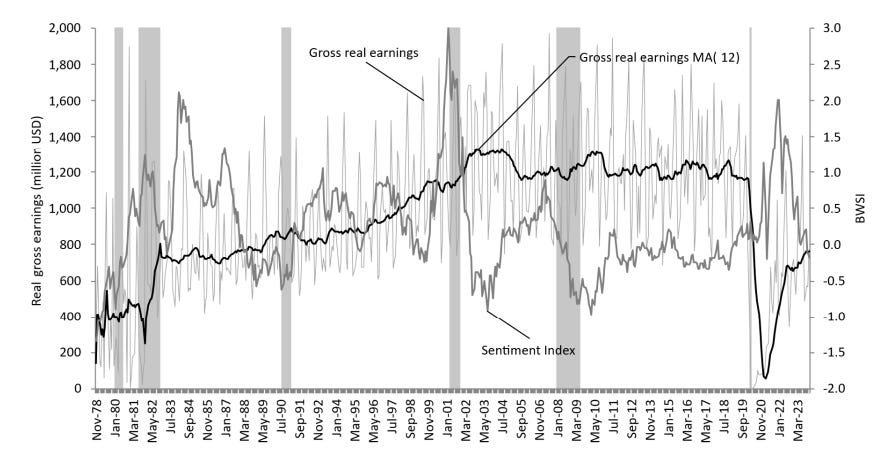
Source: Kaplanski (2025)
Indeed, Kaplanski shows that box office gross earnings are a leading indicator for investor sentiment. And since investor sentiment is a leading indicator for stock market returns, you can use box office earnings as an early warning sign for poor future stock market returns.
I am not sure if that works all that well, or if it’s just spurious correlation. Still, Kaplanski claims that box office earnings increase when people have less money (which would be a result of lower wage growth or increased unemployment, which is a lagging, not a leading indicator) and switch to cheaper leisure activities like movies.
He also claims that when people are feeling gloomy about the economy or the world, they seek some form of escapism, which movies provide. I will let you be the judge if that convinces you, but the one question Kaplinski definitely does not address in his study is how this relationship changes with the rise of streaming. So, even if this indicator has worked in the past (emphasis on the word ‘if’), it is unclear whether it is going to work in the future.