I have never hidden the fact that I live with bipolar disorder. What I have not talked about as openly is what the medication does to me, and what I have had to invent, physically and mentally, to keep painting anyway. This is the story of living with bipolar disorder and painting with the side effects of medication.
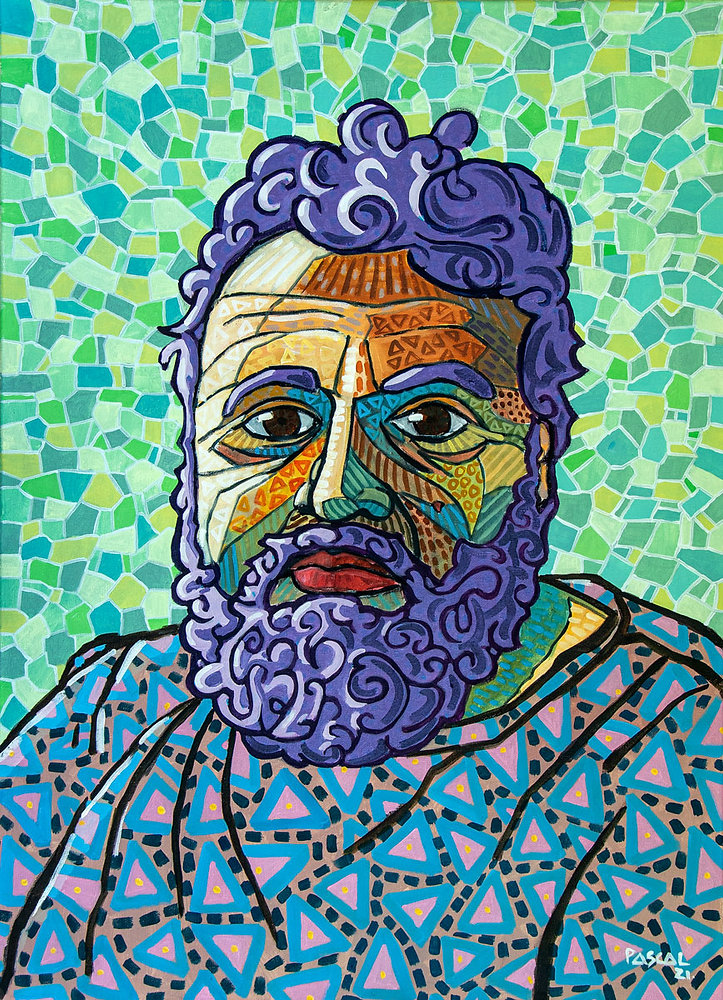
One of the side effects of my medication is tremor. I take three different medicines twice daily to control my moods. My hands shake, sometimes lightly and sometimes, when I am tired, making a straight line become a small challenge. For a painter whose whole style depends on precise motifs, on hundreds of tiny circles and triangles, this could have been the end of the Zafer style altogether.
I found a way around it, not through force but through support. I paint now, sitting in an armchair, with my elbow resting on the armrest. That single point of contact helps the shake become controllable. And when I need more precision than that gives me, I hold my right hand, the one that paints, with my left hand. Two hands instead of one.
It’s very difficult for me to paint standing anymore. The style I built over two decades, one that demands so much detail, has forced me to adapt the way I physically approach the canvas. What matters is not only that I found a workaround, but it is that the tremor did not get to decide whether I keep painting or not.
Many memories that are gone.
The second side effect is harder to describe and harder to live with. I have lost a significant part of my memory. Whole stretches of my past are blurry now, and some pieces are simply gone, as if they never happened at all. I sometimes look at a photo of myself, but cannot recall when or where it was taken, even when people try to remind me. It’s as if I was never there. The memories I have from my childhood are mainly of times when something disturbing happened. I have no recollection of any of my birthdays or very few memories of my time at school. I only have memories that my friends told me about through the years.
This is not a small thing to lose. Memory is where a person keeps the evidence of their own life. When it goes missing, you start to feel like a stranger walking through your own life using someone else’s stories.
Painting has become one of my ways back in. I lean on the stories my family tells me, the ones about my childhood, the houses we lived in, the places we visited, the small dramas and small joys that made up the years I can no longer access directly. I take those stories, and I try to rebuild them on canvas. It is a strange kind of archaeology. I am not painting memory. I am painting reconstruction, built from other people’s recollection of me. At times, I paint a happy moment on canvas so that in the future I remember that day. The painting below will always remind me of a fishing trip with my son Lucas, in case my mind erases it in the future.
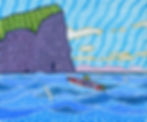
There is something oddly fitting about the loss of memory, given that so much of my work already deals with Mauritian history and half-remembered scenes, traditional houses, family events, dodos that no longer exist except in imagination and museum bones. I am using the same instinct to paint things I once witnessed and can no longer recall.
The moods that change without warning
The third side effect is the one that frightens me the most, because it comes with no warning at all. My moods swing, often for no identifiable reason, and it can happen in the space of a single moment. This is also the hardest thing to explain to someone who hasn’t lived with drastic mood swings. I have learned that music is one of my triggers. I no longer paint with music playing, because it so often pulls a mood swing out of me that I did not see coming. Silence, or listening to a podcast, has become part of my studio practice now, not as an aesthetic choice but as a safety measure.
What happens when the mood drops while I am mid-painting is very specific. One second, the work has purpose, and I can feel the benefit it gives me, and the next second, that purpose is simply gone. The painting in front of me suddenly looks pointless, and I can no longer feel any of the calm or satisfaction it was giving me a moment earlier. It happens too fast to reason with.
I know now, from enough repetitions of this pattern, exactly what I have to do. I have to stop. If I keep painting through a sudden low, I will start reaching for colours that come from that low mood rather than from the painting itself, and those colours can pull the whole piece in a direction I never intended. So I put the brush down and changed activities. I wait. The mood will rise again, usually, and when it does, I can go back to the canvas as the person who started it, not the person the low mood tried to make me into.
I am not the first painter to deal with this
When I started paying closer attention to my own patterns, I went looking for other painters who had described something similar, and I found more than I expected.
Vincent van Gogh is the obvious place to start, because he wrote about almost everything he felt, in letter after letter to his brother Theo. Across more than two thousand of these letters, Van Gogh described a lifetime of sharp mood swings, moving between periods of intense creative energy and mania, and periods of anxiety and depression. Psychiatrists who have studied the letters since his death, without being able to examine him directly, have proposed bipolar disorder as one likely explanation for what he lived through, though this remains a historical guess rather than a confirmed diagnosis.
What strikes me most is not the general pattern but a specific line from one of his letters, written during a depressive stretch, where he described the feeling of being bound hand and foot at the bottom of a deep, dark well, utterly helpless. I recognise that feeling. Not the well itself, but the suddenness of being dropped into it, and the helplessness of not being able to climb back out on command.
Van Gogh was not alone among painters in this. Edvard Munch, the man behind The Scream, is also widely believed to have struggled with serious mood disturbances, and some researchers have linked his most famous image directly to a psychotic episode he experienced. Jackson Pollock, generations later, is thought to have lived with bipolar disorder as well, and there is research suggesting his most productive and celebrated period, the drip paintings between 1948 and 1950, coincided with a period of mood stabilising treatment. None of these diagnoses was made during the artists’ lifetimes. They are reconstructions, built from letters, behaviour, and the paintings themselves.
I find some comfort in this, not because I want to romanticise mental illness through art, which I think could become a dangerous habit, but because it tells me the struggle to keep creating through an unreliable mind is not new. Van Gogh kept painting through it. Munch turned a hallucination into one of the most recognised images in the world. Pollock’s most stable creative period happened while he was actually being treated, not despite it.
None of this makes the tremor easier to feel or the missing years of my life less strange to think about, or the sudden mood drops less frightening when they happen. But it does give me a framework. The armchair and the two hands solve the tremor. The family stories and the canvas work together to rebuild what medication has taken from my memory. And the discipline of stopping immediately the moment a low mood arrives protects both my mental health and the integrity of the work itself. And Netflix is there to change my mind while I wait!
I did not choose any of these side effects, and other people have worse ones. But I have chosen, every time, to keep finding a way back to the canvas. That choice is really what the Zafer style has always been about. Not the search for perfection, but just the decision to keep painting joy into a life that is not always stable.