What colours can you put inside an airbrush? In this article, we will explore the different types of airbrush paints, inks, and mediums you can use, the key differences between specially formulated airbrush colours and standard paints, and how different airbrushing colours compare. Along the way, we’ll gain a deeper understanding of airbrushing and the materials needed to get started.

What is an Airbrush?
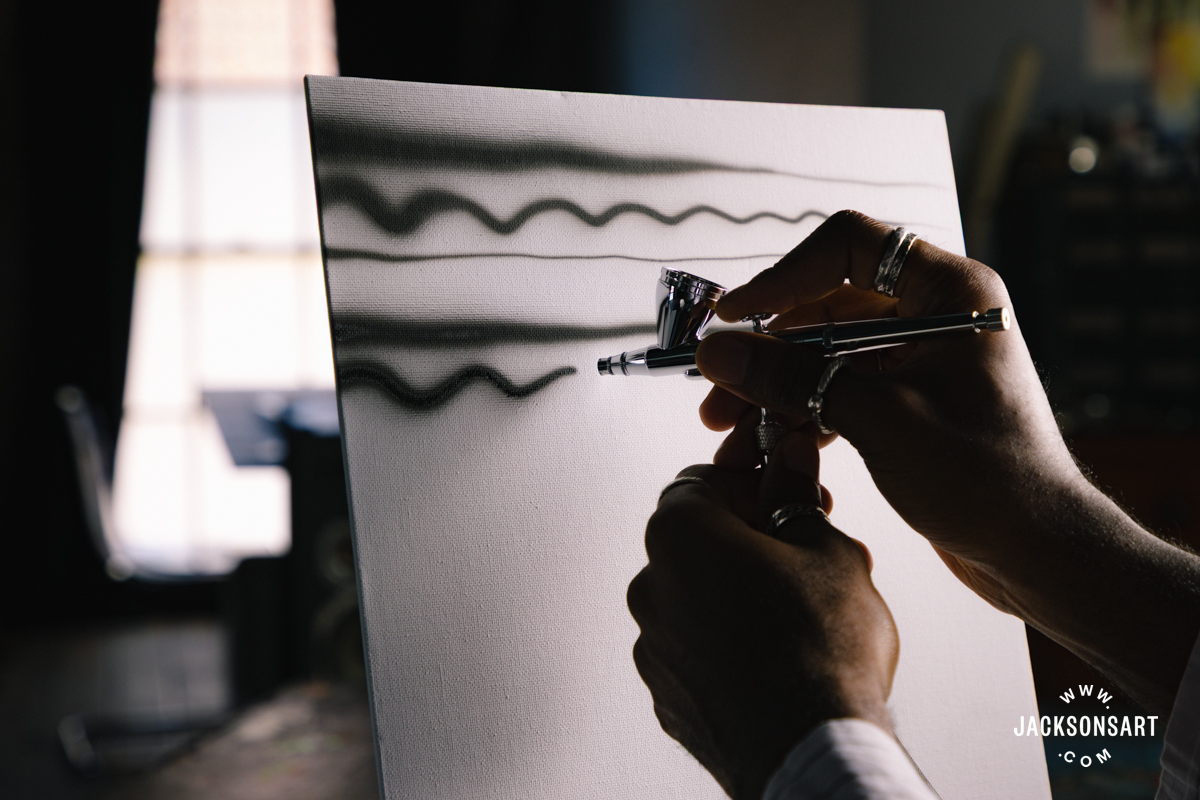
The airbrush is a versatile tool used to spray paint, inks, primers, and dyes onto various surfaces. It is often designed as a pistol-shaped device fitted with a nozzle and needle inside, with a paint cup and trigger positioned on the top or on the side of the airbrush gun. Although the airbrush is considered a modern medium, its history dates back over a century.

The first airbrush, ‘the Stanley Air Brush,’ or ‘atomiser’, was patented in 1882 by Francis Edgar Stanley, a photographer from Newton, Massachusetts. It was originally designed to assist with retouching photographs. The term photo airbrushing is derived from this same practice – a technique of removing imperfections, smoothing textures, and enhancing the quality of the image.
This innovative tool used hand-pumped bellows to push air through a small nozzle, producing a flow of fine sprayed liquid. In modern versions, the airbrush gun is commonly designed with a gravity feed cup with a dual-action trigger. This grants superior spray control and precision by allowing the paint to naturally flow into the air chambers of the airbrush gun through gravity, while air passes through it, powered by an air compressor.

By the late 19th century, Airbrushing had cemented itself in the photography industry. It would later have a significant impact on the automotive industry, as mechanics quickly realised its effectiveness for painting cars and motorcycles.
Airbrushing gained recognition in the film industry with Ridley Scott’s 1979 movie Alien. Before its release, airbrushing had primarily been used as a retouching tool for visual effects. However, this changed thanks to the work of the film’s conceptual designer and visual effects artist, H.R. Giger. The Swiss surrealist painter was known for his biomechanical illustrations, which intertwined bodily anatomy with mechanical forms. His paintings heavily involved airbrushing – helping transform the tool into a fine art medium. His distinctive iconography had an enormous influence over the Alien film franchise and earned him an Academy Award for Visual Effects.
What Makes Airbrushing Unique?
Airbrushing is a painting technique that carries its own unique features and advantages that make it suitable for a range of different applications. One of the distinctive characteristics of an airbrush is the ability to achieve soft, ultra-smooth blending due to the fine, airy layers of paint. This allows the artist to attain photorealistic effects often associated with oil painting. Artists often use an airbrush for techniques like adding shadows, transparent glazing, or highlights, as it’s well-suited to create subtle contrasts. Another advantage of airbrushing is to cover large surface areas efficiently, making it great for spraying on cars, walls, and interiors. In contrast, the needle inside the airbrush can also offer sharp, precise mark-making, suitable for small touch-ups and micro detailing. Overall, the versatility that the airbrush offers is one of its greatest strengths as a medium.

What is the difference between Airbrush Colours and Standard Acrylics?
Airbrush paints and inks have special properties that make them ideal for use in an airbrush. Airbrush paints such as Golden High Flow Acrylic Paint, Jacquard Air Brush Colour and Vallejo Premium Airbrush Paint include additives designed to improve the fluidity and are specially formulated to allow them to be sprayed through an airbrush. Standard acrylics are more heavy-bodied and do not have the right consistency to flow through an airbrush. This can cause the tool to clog if used straight from the tube or pot, risking damage. The low viscosity and high pigmentation of airbrush colours are the key difference between them and standard acrylic paint.
Similarly, some acrylic inks such as Schmincke Aero Color Fluid Ink, Liquitex Professional Acrylic Ink, and Jackson’s Acrylic Ink may appear as regular acrylic inks on the shelves, but they also all have the right consistency to work in an airbrush without needing to thin them.

In general, most airbrush inks come in a bottle with a dropper inside the cap. This allows them to be easily added into the airbrush gun. Most airbrush inks are pre-thinned to be low in viscosity. This is because when the inks travel through the airbrush gun, the fast-moving compressed air passes over the ink and atomises the particles – turning liquid into a fine mist of pigment. Another key difference is transparency. Most acrylic inks contain ultra-fine ground pigments in a resin-like binder and water, creating highly concentrated and transparent colours that resemble watercolour in its layering and staining capabilities. However, airbrush inks juggle an equal ratio of coverage and saturation, resulting in most airbrush colours being semi-transparent and more pigmented than standard acrylic inks.

The difference between airbrush paint and airbrush inks is the consistency; airbrush inks have a watery consistency, whereas airbrush paint has a fluid body like milk. Both are designed to spray through an airbrush without issue.
Below are examples of spray tests demonstrating the flow and how sprayable each airbrush colour is without any medium or water added using Sparmax Dual Action Airbrushes in the models SP-20X and Max 4 and Every brand of airbrush colour, from Golden High Flow to Jackson’s Acrylic Ink, worked through the airbrush without issues, but notable differences could still be felt between each product.

Golden High Flow Acrylic Paint
Golden High Flow Acrylics are professional-grade airbrush paints that come in 86 colours, all of which are lightfast. They are slightly thicker in body compared to other airbrush colours; however, they are still thin enough to pass through the airbrush without any thinning medium added. The slightly higher viscosity demands a higher air pressure, but the high flow offers consistent coverage, requiring less paint needed to cover a surface.
Schmincke Aero Color
Schmincke Aero Color is a professional range of airbrush inks that come in a total of 69 lightfast colours. They have a low viscosity and can flow in the airbrush without further thinning. Although they are thinner than the Golden High Flow, they are highly pigmented, providing excellent coverage and can run at a lower air pressure.
Liquitex Professional Acrylic Ink
Liquitex comes in 55 lightfast colours. The range has a water-like consistency with colours that retain their potent saturation when used in an airbrush. Their thin consistency allows them to be used in an airbrush operating with low air pressure.

Jacquard Air Brush Colours
Jacquard comes in 43 lightfast colours. A noticeable difference with this paint range is that they have a thicker consistency in comparison to the other airbrush colours. The heavier body and opaque colour ranges mean that Jacquard offers excellent coverage. In addition, the paints are washfast, meaning they are durable on clothes, shoes, and other fabrics. Jacquard airbrush paint requires a higher air pressure to operate, while some opaque colours may need thinning to improve the fluidity.

Vallejo Premium Airbrush paint
Vallejo comes in 53 lightfast colours. Like Jacquard, Vallejo airbrush paints are slightly thicker in body, which means they offer great coverage but require higher air pressure or a thinner to improve the flow of paint. Vallejo Premium Airbrush Colours are acrylic polyurethane paints. The polyurethane is a chemical hardener that makes the paint more durable. Artists interested in painting outdoors or on non-porous surfaces would choose Vallejo Premium for its durability and adhesion qualities.

Schmincke Aqua Drops Liquid Watercolour

Aqua Drops come in 25 lightfast colours. These are watersoluble concentrated watercolour inks. Their water-like consistency and concentrated pigment make them ideal for the airbrush. All colours except for white are transparent and only adhere to paper or surfaces primed with a watercolour ground. Another key characteristic is that they re-activate with water; however, most colours are highly staining, which means they won’t lift off entirely with moisture.


Jackson’s Acrylic Ink
Jackson’s Acrylic Ink comes in 41 lightfast colours; these inks have a water-like consistency similar to Liquitex Acrylic Inks. Each colour is highly pigmented. Due to their low viscosity, the inks can operate at low air pressure.

Alternative Paints and Inks for the Airbrush
Not all paints and inks are labelled with the airbrush symbol, but that does not necessarily exclude them from working in an airbrush. Before using these alternatives, it’s important to read the packaging carefully or check the manufacturer’s advice online to see if it’s advised to use the product in an airbrush. Some products may damage the airbrush or present safety risks when atomised. Key features to look out for is if these alternative colours are low-viscosity and water-based. If the product is thin enough and water-based, then it should be sprayable. Watercolour inks and Indian inks are great examples of alternatives that can be used through the airbrush even though it may not be specified on the label. Any oil-based inks or oil-based mediums should not be sprayed through an airbrush, as they can damage the tool and potentially release toxic fumes.
Special Effects Airbrush Inks
There are some inks that carry special effects or have unique properties that can change the depth and contrast of what you’re spraying; these products are often referred to as ‘special effect’ inks.
Schmincke Aero Color Special Effects Inks

Aero Shine Silver and Gold produce a shiny pearlescent effect. Colours shimmer when applied on light surfaces and give off a metallic look when applied on dark surfaces.
Aero Vision Colours are iridescent colours whose colours shift depending on the angle of light, background colour, and the thickness of the layer. The result is a unique shifting spectrum of colours. They are available in Silver-Violet, Gold-Red , and Space.
Aero Metallic is offered in seven shades of colour that produce a metallic effect, with colours appearing brighter on darker backgrounds and more subtle on lighter backgrounds. These effect inks are available in Brilliant Silver, Brilliant Gold, Brilliant Bronze, Bright Maroon, Red, Blue, and Green.
Aero Total Cover is a highly opaque paint range designed to have excellent covering qualities. Each Total Cover colour has a mattifying effect, a byproduct of its highly opaque nature. The 12 Total Cover colours are: Brilliant Yellow, Naphtol Orange, Cadmium Red Hue, Ruby Red, Dioxazine Violet, Phthalo Blue, Phthalo Turquoise, Phthalo Green Yellow Shade , Chromium Oxide Green, English Red, and Vandyke Brown.


Schmincke Aero Candy colours are 9 highly transparent and saturated colours. They are all lightfast and have a special silky gloss finish. The Candy colours are very concentrated transparent dye-based inks. Their transparency gives them infinite layering capabilities, and they best display their luminosity and depth on light coloured surfaces. The colours are: Sunflower Yellow, Sunbeam Yellow, Yellow Gold, Poppy Red, Flame Red, Wine Red, Sky Blue, Teak Brown, and Smoke Black.

Airbrush Mediums, Additives, and Solvents
Airbrush medium is a combination of resin/binder and additives. Mediums are often used to thin the paint whilst retaining saturation and adhesion, improving the flow of the paint through the airbrush.
Additives are chemical substances included inside mediums that change the properties of the paint that is mixed with. For example, some additives slow the drying time of the paint or increase the transparency and gloss.

Examples of Airbrush Mediums
Golden airbrush medium is a 100% acrylic medium designed to modify Golden acrylic paints to improve fluidity and make them more sprayable; it has a recommended mixing ratio of 1:1 for best spray results. Other variants include the Golden High Flow Airbrush Medium, which has similar properties designed to reduce drying time and minimise tip dry (a process where paint dries at the tip of the nozzle, causing clogging issues).
Schmincke Aero Retarder is a medium that slows down the drying time of Schmincke Aero Acrylic Inks. It is recommended to mix your ink at a 1:1 ratio. The medium will also reduce tip dry on your airbrush.
Schmincke Aero Textile Medium is a water-based acrylic medium that transforms the Aero acrylic inks to be more durable and washfast. Allowing your painting to be durable on fabrics and leather while sustaining light washing.

Solvents are liquid mediums engineered to dissolve the binder in paint, adjusting the viscosity of the paint and reducing internal friction, allowing for smoother, easily flowing application. An airbrush flow improver is a solvent designed to thin airbrush paints and inks while keeping the integrity of the paint.
Water is also considered a solvent, as it has the chemical properties to break down the bonds between binder and pigment in acrylics. Water is a cheaper and accessible alternative to thin your airbrush paints. Although water can thin your airbrush colours, it also reduces the adhesion, making the paints less stable on other surfaces. In contrast, other mediums such as Golden Airbrush Medium improve the flow of the paint while retaining adhesion properties. It is advised that if you are using water, you use it in controlled amounts and combine it with medium in order to keep the integrity of the paint.

For many years, the airbrush has been an elusive tool; however, it is evident that this modern medium carries a deep history. The airbrush is an extremely versatile tool offering a multitude of ways to apply it to any creative practice, whether it is in film, photography, fine art, interiors or exteriors. With the right paints, inks, and medium, the airbrush can adapt to the needs of the artist.
Further Reading
A Review of Jackson’s Acrylic Inks
A Modern Medium: A Brief History of Acrylic Paint
Schmincke Aero Color: Properties and Applications